Why AI-Heavy Faceless Channels Stall – and It Is Not the AI
There is an odd pattern in the current wave of AI-assisted channels: the operators using the tools most aggressively often fail fastest. Automated pipelines, daily uploads, generation at every stage – and views that never hold, retention that sits low, and recommendations that quietly cool off after a few months.
The obvious reading is that the platform dislikes AI. That is not what is happening. The tools are permitted and plenty of successful channels use them. The failure is more specific, and it starts at the research stage, long before anything gets generated.
Mistake one: copying the surface
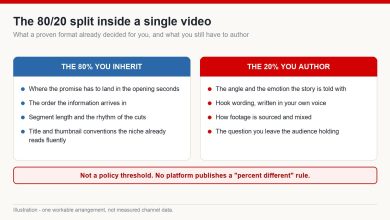
A beginner finds a video with a huge view count. They study the thumbnail, note the title format, register the pacing, and reproduce all three as closely as they can.
What they have copied is the packaging. What made the video work was the thing the packaging pointed at.
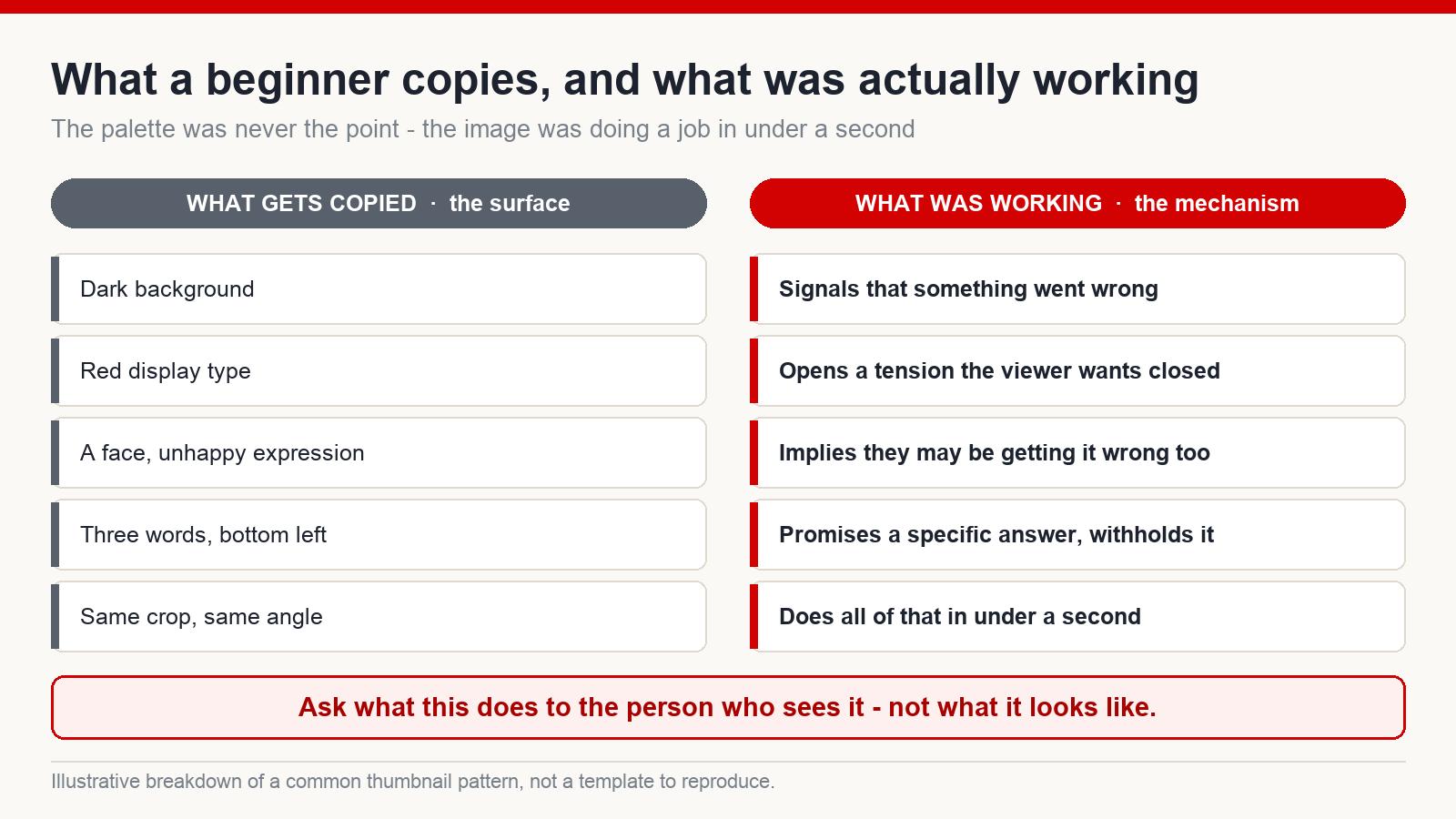
Take a thumbnail that performs well: dark background, red text, a face carrying an unhappy expression. The surface reading is a colour scheme and a layout. The functional reading is different. That image is doing several specific jobs – it signals that something went wrong, it creates an unresolved tension the viewer wants closed, it implies there is something they might be getting wrong themselves, and it does all of that in under a second.
Reproduce the colour scheme without the mechanism and you get an image that looks like a successful thumbnail and does none of its work. The palette was never the point.
The same applies to titles, formats and structures. The question worth asking about anything that performed well is not “what does this look like” but “what is this doing to the person who sees it, and does my video do the same thing”.
Learning from a video and cloning it are different activities
Both start with studying something that worked, which is why they get confused.
Learning means extracting a mechanism: how the opening earns the next thirty seconds, how tension gets built and released, where the payoff sits, why a particular audience cares. What you take away is transferable to subjects the original never covered.
Cloning means taking the artefacts: the title with words swapped, the thumbnail with a different photo, the script re-voiced. What you take away only works on that subject, and it works worse than the original because the audience has already seen it.
The important part is that viewers detect this without analysing anything. Someone who has watched three near-identical videos does not think “this is derivative” – they just stop clicking. The recommendation system reads that behaviour, not the similarity.
Mistake two: shipping the draft
The standard automated pipeline looks efficient on paper. Find a competitor’s video, feed it to a model, get a summary, generate narration, render over stock footage, upload, repeat.
The problem is that every step in that chain removes something and none of them add anything. What comes out is accurate, fluent, and completely without a point of view.
Generated scripts fail in recognisable ways. They state things without arguing for anything. They have no rhythm – every paragraph is the same length and carries the same weight. They contain no specific example, because a model that was not there cannot supply one. And they never take a position, because averaging the internet produces the middle of the distribution by design.
None of that is a reason to avoid the tools. It is a reason to treat their output as a first draft. A good draft, produced in a minute instead of an hour – and still a draft.
What the second pass has to add
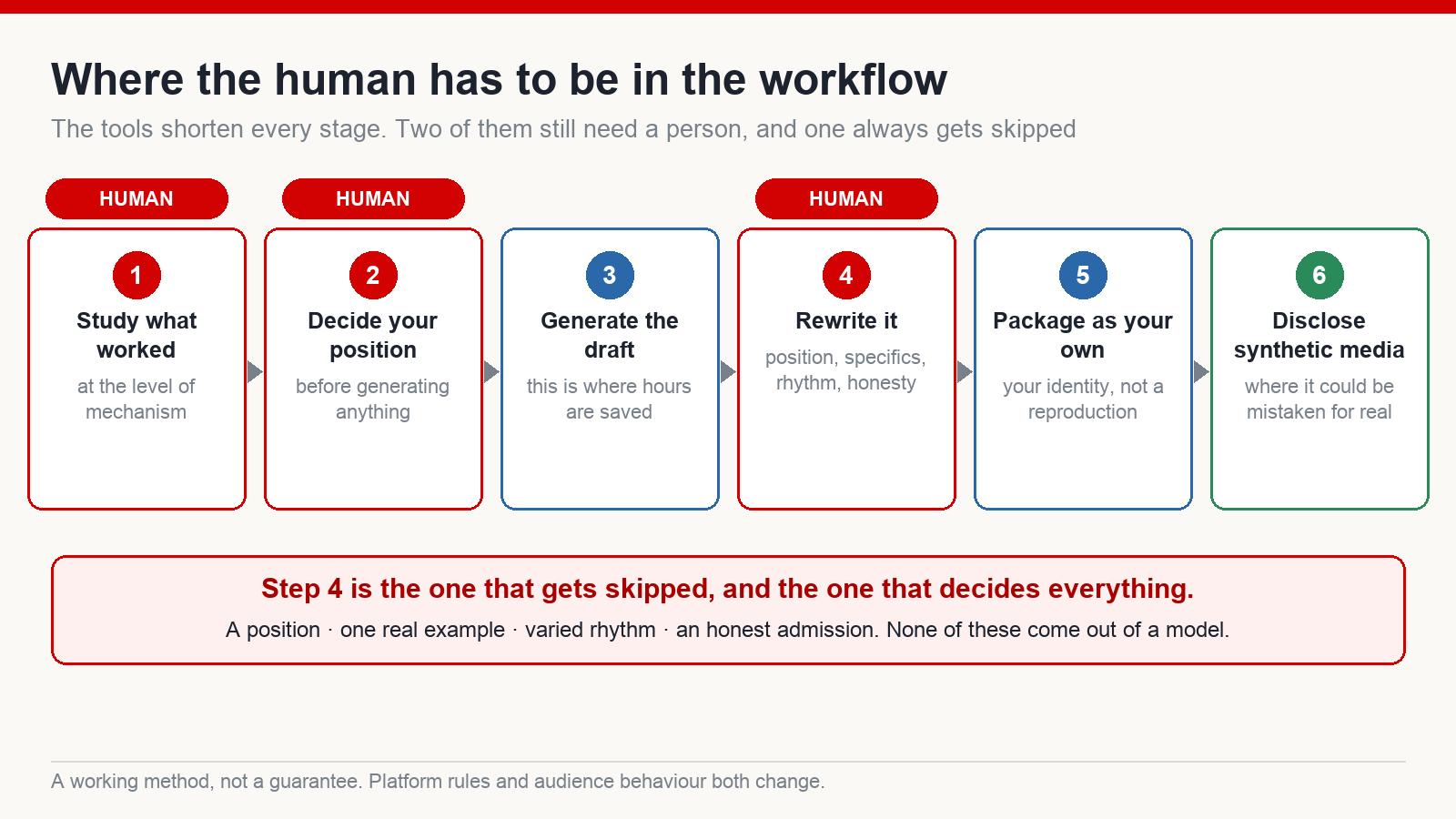
The rewrite is where the video becomes worth watching. Four things have to go in that a model cannot supply:
A position. The video should argue something, and ideally something not everyone agrees with. Neutral summaries are forgettable by construction.
Something specific. One real case, one thing you watched happen, one number you actually looked up. Specificity is the fastest signal that a human was involved.
Rhythm. Vary sentence length. Let a short line land. Slow down where the idea is difficult. Generated prose is uniformly paced and that uniformity is what makes it tiring.
An admission. What you got wrong, what you are unsure about, where the advice breaks. Nothing builds trust faster and nothing is less likely to come out of a model.
Why this matters more without a face on screen
A presenter carries a lot of weight. Expression, timing, personality and a sense of who is talking all arrive for free, and they hold attention even when the script underneath is ordinary.
Remove the face and all of that has to come from somewhere else: the writing, the pacing, the structure, the choice of what to include. A faceless video with a generated script and a generated voice has nothing left to hold anyone. There is no person in it at any layer.
This is the part people get backwards. Faceless does not mean less human input is needed. It means more, because the human has to arrive through the writing rather than through a presence on camera.
Mistake three: assuming volume substitutes for quality
The belief underneath most automated pipelines is that output is the variable that matters, so more of it is straightforwardly better.
But the systems deciding what to show people are optimising for whether viewers were satisfied – whether they stayed, came back, watched another. Fifty videos nobody finishes do not accumulate into anything. One video that genuinely answers a question people had can keep working for years.
There is a further problem with pure volume. YouTube’s monetisation policies name mass-produced and repetitive content directly, and a catalogue assembled by running one prompt fifty times is a reasonable description of that. The tools are not the issue; output with nothing added is.
Audiences have learned the patterns
Something changed over the last couple of years: viewers have now seen enough generated content to recognise it. The particular cadence of a synthetic read, the phrasing that appears in every model’s output, the stock clip that has nothing to do with the sentence over it.
Recognition is not the problem. Feeling talked at by nobody in particular is. Once a viewer has that feeling they leave, and enough of them leaving is the whole story of a channel that cooled off without any obvious cause.
A workflow that holds up
Nothing exotic. The tools stay; the order changes.
- Study what worked, at the level of mechanism. Not the thumbnail – what the thumbnail was doing.
- Decide what you think before generating anything. The position comes first; the draft supports it.
- Generate the draft. This is where the tools save real hours.
- Rewrite for position, specifics, rhythm and honesty. The step that gets skipped, and the step that decides everything.
- Package it as your own. Your visual identity, not a reproduction of somebody else’s.
- Disclose realistic synthetic media. Required by the platform, and viewers who feel misled do not come back.
Frequently asked questions
Is using AI on a faceless channel a problem in itself?
No. The tools are permitted and widely used. What causes trouble is publishing generated output unchanged, in volume, with nothing of your own added.
Why do so many AI-assisted videos retain badly?
Generic scripts, no position, no specific examples, and uniform pacing. Viewers disengage without being able to say why, and the retention curve shows it.
Should I copy a thumbnail that is clearly working?
Work out what it is doing psychologically and build your own version of that effect. Copying the layout produces something that looks like another channel’s video.
Will AI replace creators?
It has replaced a large share of the labour and none of the judgement. Deciding what is worth saying, and having something to say, remains the part that is not automated.
What matters most on a faceless channel?
That the viewer feels understood. Without a presenter, that has to be built in the writing – which is exactly why generated scripts shipped unedited perform so poorly.
The question worth changing
Most people using these tools are asking how much of the process can be handed over. It is the wrong question, and it produces channels that are efficient at making things nobody wants.
The better question is what the tools free you up to do that you could not do before – more research, more time on the argument, more attention to the thirty seconds that decide everything. Speed is a genuine advantage. It just does not decide how far anything goes.
If you want a structured way to build a faceless channel for an English-speaking audience without ending up with a catalogue nobody finishes, that is what we work on at mmoyoutube.com.