One Brand, Several Channels: Naming for a System You Have Not Built Yet
The awkward moment does not arrive on sign-up day. It arrives about eight months in, when the channel is working, you want to start a second one in an adjacent subject, and you realise the first name cannot carry a family. It was built as a one-off. Any sibling channel you launch beside it will look like a stranger.
I have been building YouTube channels since 2017, most of that on faceless channels aimed at English-speaking audiences, and this is the part of naming that almost nobody plans for. People choose a name. Very few people choose a YouTube channel branding convention — a repeatable structure that a second, third and fourth channel can inherit without any of them looking like an unrelated account.
That structure costs you nothing on day one. It saves you a rebrand later.
The Question Nobody Asks on Sign-Up Day
Most naming advice stops at one channel: is it memorable, is it short, is it taken. Those are real questions and they matter. But there is a fourth one that only shows up later.
If I were running four channels in this space, would they read as one operation?
Ask it out loud before you register anything. It is a two-minute question, and the answer changes what you type into the box. A name that only works alone quietly caps you at one channel — or forces every later channel to start its recognition from zero.
What a Naming Convention Actually Is
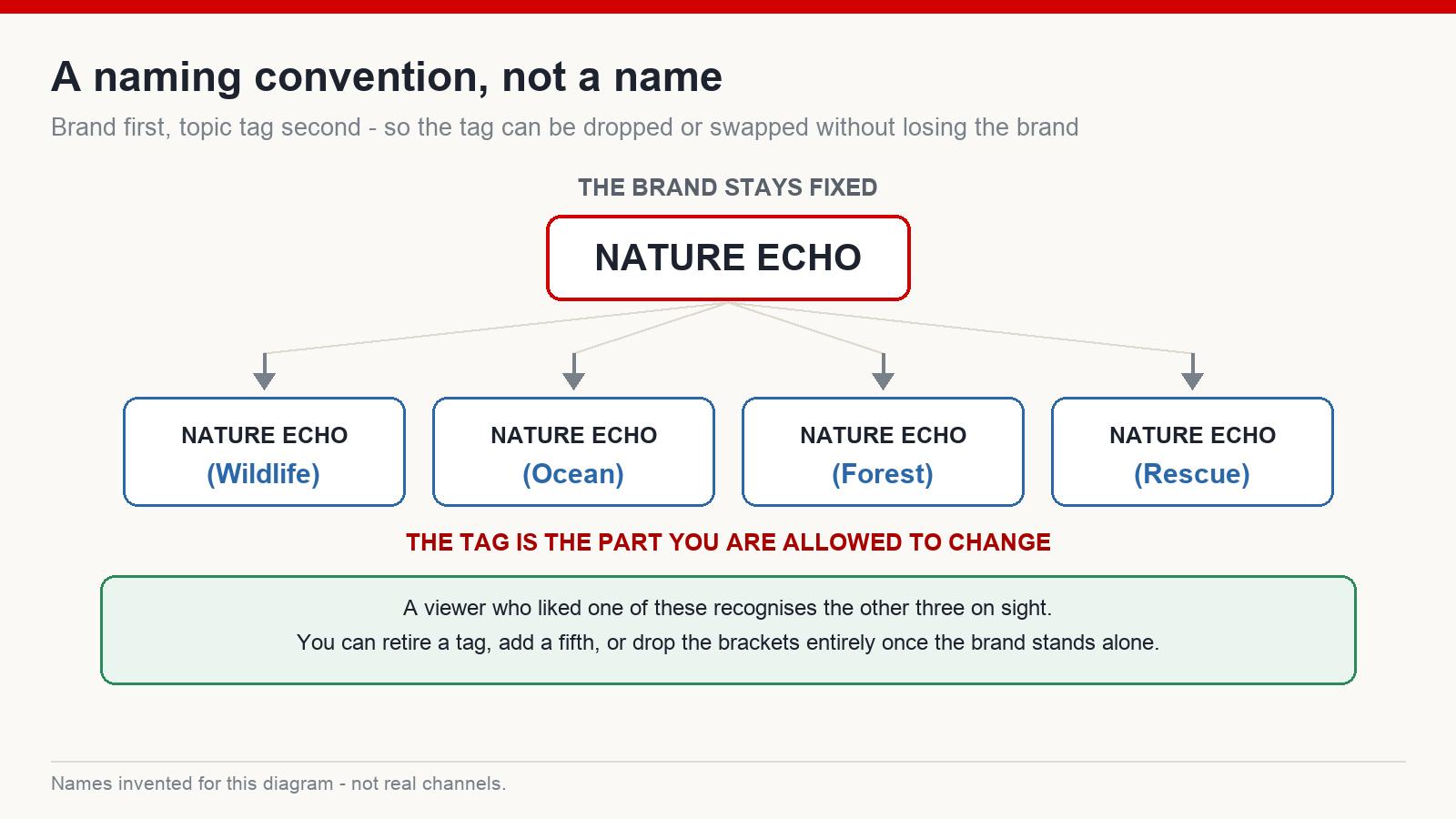
The version I keep coming back to is deliberately boring:
Brand + topic tag.
The brand is the fixed part. It carries no subject matter, so it never expires. The tag is the removable part, sitting in brackets or after a dash, and it says what this particular channel covers:
- Nature Echo (Wildlife)
- Nature Echo (Ocean)
- Nature Echo – Rescue Stories
- Wisdom Path (Retirement)
Both separators work. Brackets read slightly more like a label and slightly less like part of the name, which is exactly the effect you want, but a dash is fine. What matters is that you use the same separator every time. A family where one channel uses brackets, one uses a dash and one uses a colon is not a family. It is three channels that happen to share a word.
Why the Tag Sits Outside the Name
The whole point of the bracket is that it is detachable.
Names expire in a specific way: the subject part gets outgrown long before the brand part does. A creator who names a channel around one narrow topic and then widens the catalogue is stuck choosing between a name that no longer describes the content and a rename that costs recognition.
Put the expiring half inside brackets and that choice disappears. You drop the tag, swap it for a broader one, or remove it entirely once the brand can stand on its own. The part viewers actually memorise — the brand — never changes.
This is also why the tag should be a plain subject word rather than a clever one. Wildlife, Ocean, Retirement, Rescue Stories. If the tag needs explaining, it is doing the brand’s job, and it will be much harder to remove later.
What the Tag Does Not Do
I want to be blunt here, because this is where the advice usually gets oversold. Putting a subject word in your channel name is not a ranking technique. There is no documented mechanism by which the words in a channel name push your videos up search results, and I have never seen a channel where changing the name moved discovery on its own.
What the tag does is cheaper and more reliable: it makes the shelf legible once you are already being shown. When someone lands on a search page and four of your videos appear beside your channel and a playlist, the tag tells them in half a second that these belong together and what they are about. That is recognition work, not ranking work.
Treat any promise beyond that with suspicion. Discovery is decided by what the videos are about, how well they match what people actually search for, and whether viewers stay. The name is packaging around that, not a substitute for it.
Write the Brand the Same Way Every Time
This sounds like a detail and it is not. If the brand is written NATURE ECHO in the channel name, it should be NATURE ECHO in the banner, in the description, in the end screen, in the pinned comment and in every place you ever type it. Not Nature Echo in one spot and natureecho in another.
Inconsistent capitalisation reads as improvised. Consistent capitalisation reads as a media brand, which is the impression you want when a viewer from another country is deciding in a second whether this channel looks like a real operation or an abandoned experiment. Pick a casing on day one and write it down somewhere you will actually look.
Three Fields, Three Different Jobs
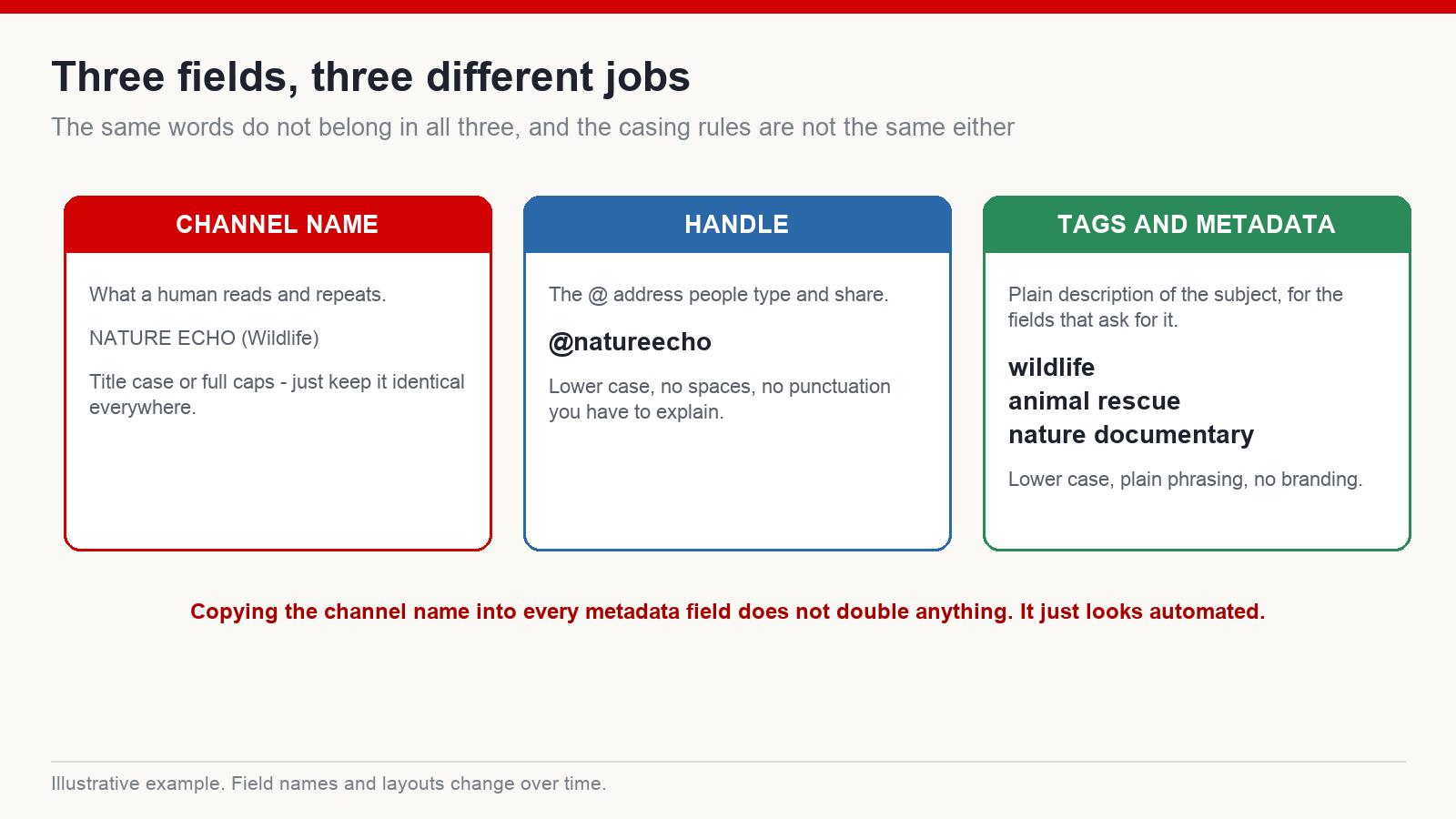
A mistake I see constantly: the same string of words pasted into every field on the account, on the theory that repetition helps. It does not. The fields are asking for different things.
- The channel name is what a human reads and repeats. Branded, cased consistently, tag optional.
- The handle is the address people type and share. Lower case, no spaces, nothing you would have to spell out over a phone call.
- Tags and other metadata are plain description. Lower case, ordinary phrasing, no branding at all — wildlife, animal rescue, nature documentary.
Writing your brand name into the tag field does not reinforce anything. It just fills a slot that could have described the video.
The Three-Channel Test
Before you commit to a name, run it through this. It takes five minutes and it is the closest thing I have to a reliable filter.
- Write your name with three different topic tags attached, for three subjects you could plausibly cover in two years.
- Read all three aloud. Do they sound like siblings, or does one sound absurd?
- Now delete the tags and read just the brand. Does it still work as a standalone name?
- Search the brand on YouTube. If an established channel already owns something close to it, stop here and pick a different direction — a near-duplicate name leaks your recognition to whoever got there first.
A name that passes all four is a name you can build a system on. A name that fails step three is a name that will always need its tag, which means you can never widen it.
Where the Convention Breaks
Brackets are not magic, and they can be used badly. The failure modes are consistent:
- The bracket becomes a keyword dump. “Nature Echo (Wildlife Animals Nature Documentary Relaxing)” is not a tag, it is a metadata field wearing a costume, and it reads as spam to a human before any system has an opinion.
- The tag is longer than the brand. If people quote the tag instead of the brand, the brand is too weak to carry a family.
- The whole thing stops fitting. Long names truncate in narrow layouts and on phones. Say it out loud, then look at it small.
- The convention is applied to one channel only. A convention that is never repeated is just a name with punctuation in it.
The Short Version
Name the brand, not the video subject. Put the subject in a bracket you are allowed to remove. Write the brand identically everywhere. Keep the name, the handle and the metadata doing three different jobs. And before you register anything, test whether the name could survive being repeated three times with three different tags attached.
None of that will get a video recommended. What it does is make every video you publish over the next few years accumulate into one recognisable thing instead of scattering across accounts that look unrelated. Results vary, platform layouts change, and a strong name will not rescue weak content — but a structural name costs the same as a careless one and is far cheaper than a rebrand.
If you want the whole system around this — niche selection, packaging, and the production workflow behind a multi-channel operation — that is what we work through at mmoyoutube.com.
FAQ
Brackets or a dash?
Either reads clearly. Brackets separate the tag slightly more strongly, which makes it easier to drop later. The only real rule is to use the same separator across every channel you launch.
Does a subject word in the channel name help me rank?
Not in any way I would rely on. It helps a viewer understand what the channel is once they are already looking at it. Discovery is decided by the videos themselves.
How long should the whole name be?
Two to three words in the brand, one short tag. Anything longer gets truncated in narrow layouts and is harder to repeat from memory.
Should the brand be in full capitals?
It is a style choice, not a technique. Full caps can read as more deliberate; title case can read as friendlier. What matters far more is that you write it the same way in every single place.