Who The Video Is For Beats What It Is About
Most people start a video by asking what to make. It feels like the responsible question. It is the wrong one, and it is the single most expensive mistake I see in the first year of a channel.
Ask it and you end up making content by mood. Artificial intelligence is getting attention this week, so you make something about that. Next week a short-form video does well somewhere, so you try short-form. A month later the channel has fifteen videos, no recognisable audience, and no explanation for why any of them did or did not work.
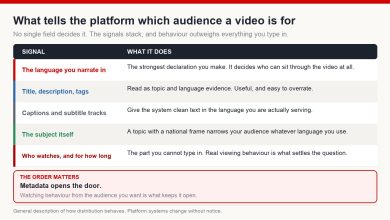
The platform is in the same position you are. It cannot work out who to show your videos to, because the videos do not agree with each other about who they are for.
The same subject, four different videos
Take one topic – using automated tools in video production – and notice that it is not one video. It is at least four.
For someone who has never published anything, it has to be slow, concrete and almost free of jargon. For someone already running a channel, it is about production throughput and what happens to retention when you scale. For someone evaluating whether this is worth their time at all, it is about the realistic effort involved and what usually goes wrong. For someone who has already tried and stalled, it is a diagnosis.
Same subject. Four scripts with almost nothing in common – different vocabulary, different length, different opening, different promise. You cannot write any of them until you have decided which one you are making.
Three questions before the script exists
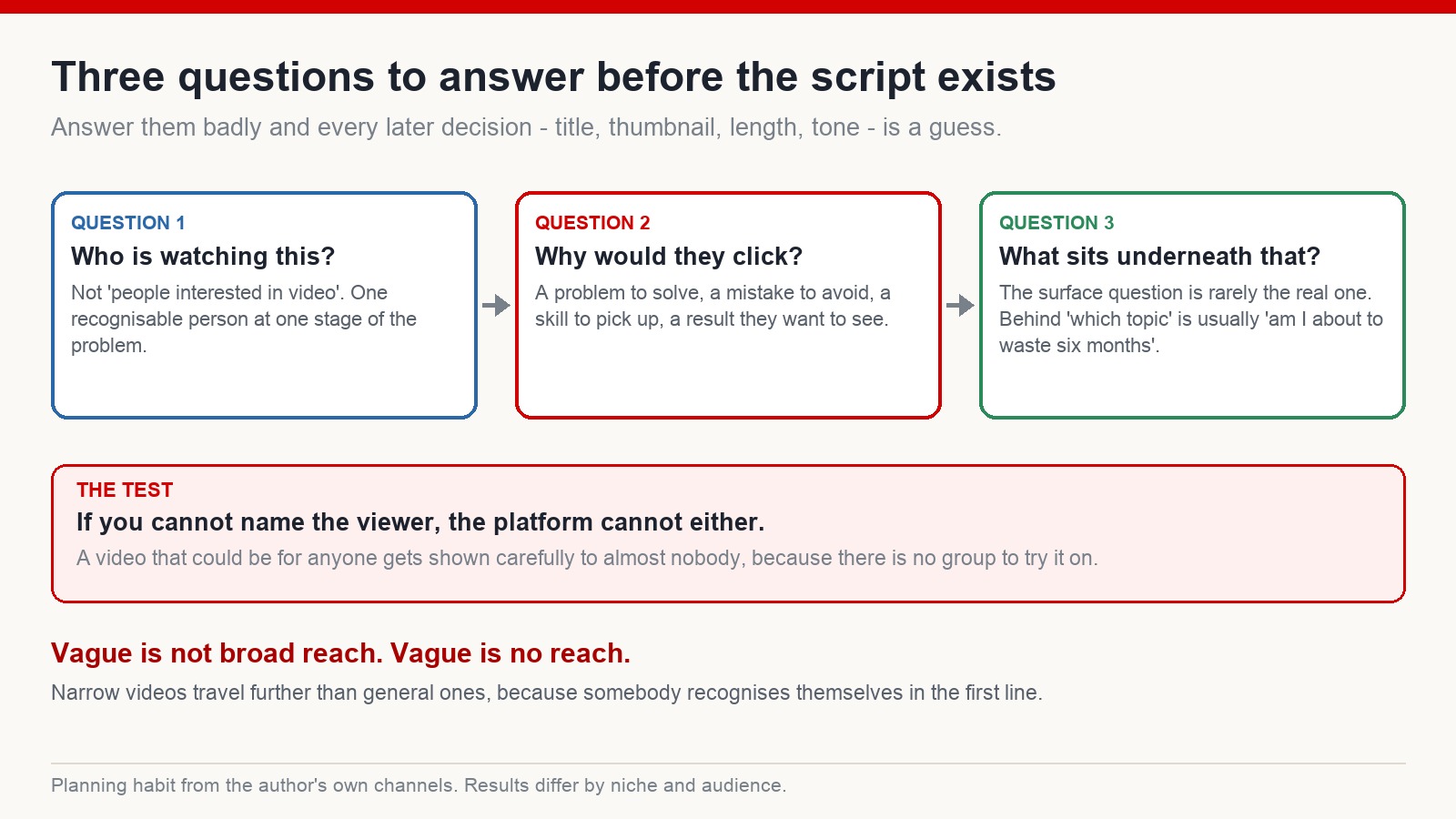
Who is watching this?
Not a demographic. One recognisable person at one identifiable stage of a problem. “Someone three months in with no traction” is a viewer. “People interested in video” is not – nobody wakes up as that person.
Why would they click?
Nobody clicks because you published. There is always a reason: a problem to solve, a mistake to avoid, a skill to acquire, a result they want to see somebody else get first. The title and thumbnail exist to make that reason obvious in about a second. If you cannot name the reason, no amount of packaging work will invent one.
What sits underneath that?
The surface question is rarely the real one. Somebody asking how to get views is usually asking whether they are wasting their time. Somebody asking which topic to pick is usually asking how to avoid burning six months on the wrong one. Answer only the surface question and the video is technically correct and completely forgettable. Answer the one underneath and people finish it.
Why vague videos go nowhere
A lot of videos with nothing wrong with them get no views. The content is accurate, the edit is competent, and nobody watches, because the message never made clear who it was for.
“How to grow on this platform” is true for everyone and aimed at no one. “What to check when a channel has been running three months with nothing moving” describes a person. The second one is narrower, and it will travel further – because someone reads it and recognises themselves, and because the platform now has an obvious group to try it on.
This is the part that feels wrong at first. Narrowing sounds like shrinking your audience. In practice, vague is not broad reach. Vague is no reach.
The one-sentence brief
I write one sentence before any script, and I do not start writing until it comes out cleanly.
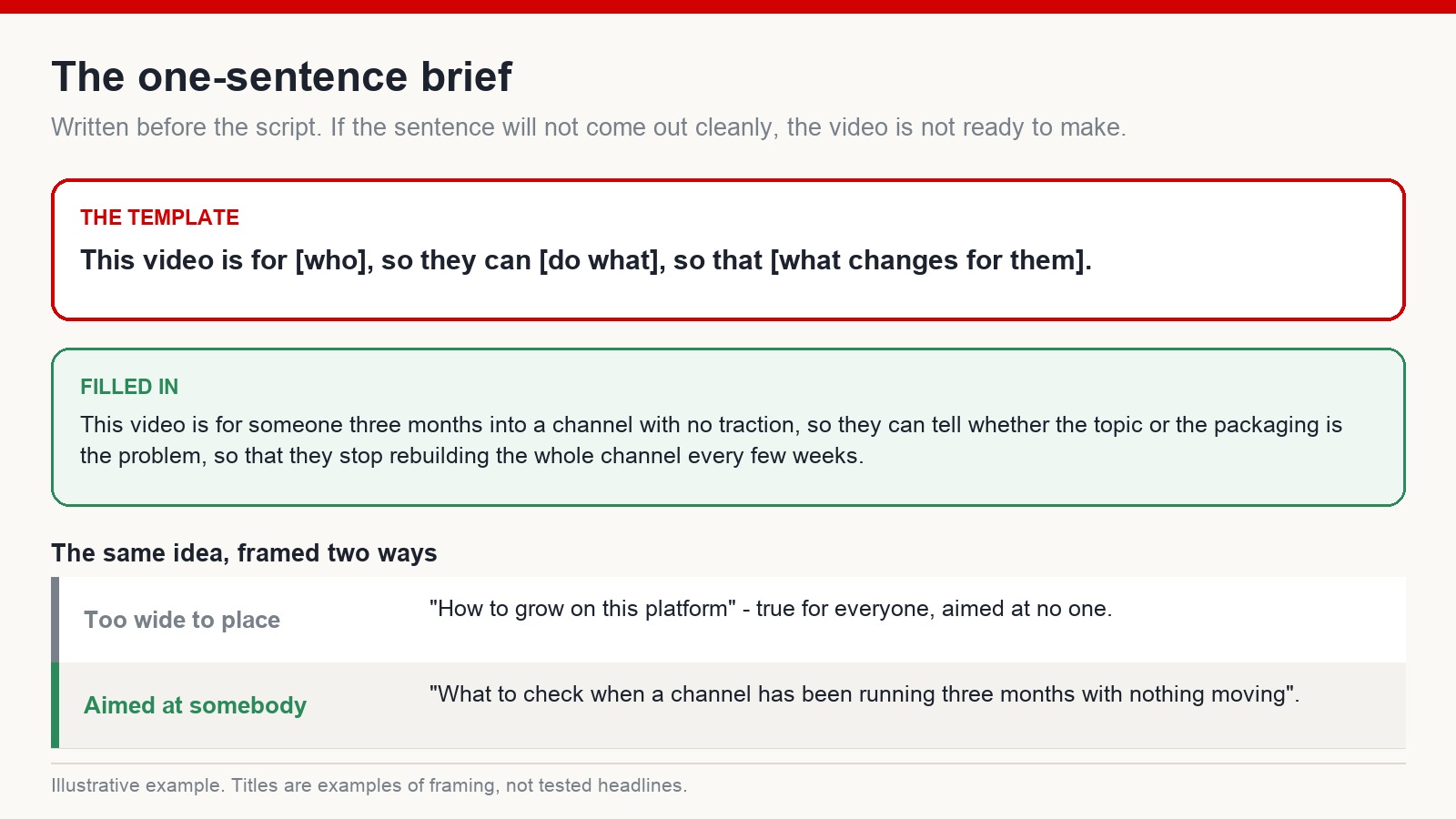
The shape is: this video is for a specific person, so they can do a specific thing, so that something specific changes for them. Filled in, it might read – this video is for someone three months into a channel with no traction, so they can tell whether the topic or the packaging is the problem, so that they stop rebuilding the whole channel every few weeks.
If the sentence will not resolve, the video is not ready to make. That has saved me more wasted production days than any other habit, and it takes about ninety seconds.
What gets easier once you can name the viewer
Almost every downstream decision stops being a matter of taste. Which words to use and which to explain. Which examples land. Whether the video should be six minutes or twenty. Which pain the thumbnail should point at. Where to send them next.
This is why small channels frequently outgrow much larger ones in a specific niche. Not more output – more precision. They are talking to somebody in particular, and that person can tell.
It matters more when the audience is abroad
Building for viewers in another country adds a layer. You are not only guessing at a person, you are guessing at a person whose context you do not share – different assumptions, different reference points, different phrasing for the same problem.
Vagueness that would merely underperform at home tends to fail completely across a border, because you have no instinct to fall back on. The correction is the same, just less optional: name the viewer, write the sentence, and check your assumptions against what that audience already watches rather than against what feels reasonable to you.
Before your next video
Take five minutes and write the sentence. Who it is for, what they will be able to do, what changes for them. If it comes out easily, the script will follow quickly. If it does not, you have just saved yourself a production day on a video that was never going to find anyone. If you want the longer version of this method applied to English-language faceless channels, that is what I teach at mmoyoutube.com.
Frequently asked questions
Should a beginner define their audience before publishing anything?
Yes, at least provisionally. Early definitions are often wrong, and that is fine – you correct them with data. What you cannot correct is a catalogue of videos with no consistent audience for the platform to learn from.
Is it a mistake to make videos about what interests me?
Only if nobody else wants them. Your interests should overlap with something an audience is actively looking for. Sustained output on a subject you dislike is difficult; sustained output on a subject nobody searches for is pointless.
Can one channel serve several audiences?
Eventually. Early on, one group is far easier to build for and far easier for the platform to interpret. Widen once you have consistent data about who watches and finishes.
How narrow is too narrow?
If you can list twenty video ideas the same person would watch, it is not too narrow. If you struggle past five, widen the problem slightly rather than the audience.