Copy the Structure, Not the Video: How to Learn From Channels That Already Work
A video you published two years ago can still be collecting views this morning while you sleep. That is the property that makes a channel different from almost any other kind of freelance work, and it is why I describe a channel as a library rather than a feed.
But libraries only compound if the books belong together. A hundred unrelated uploads is not a library; it is a pile. And the fastest way to end up with a pile is to learn from other channels in the wrong way – copying what a successful video looks like instead of understanding why it worked.
This is about how to do that properly: a learning model that stops you from either reinventing everything or plagiarising anything, and the narrowing process that turns a broad interest into a subject you can actually build on.
The wrong lesson people take from a channel that works
Someone finds a channel doing well in their space. They study it for an evening, and what they walk away with is the surface: this thumbnail style, that colour grade, this title formula, that voice.
Then they reproduce the surface, publish, and nothing happens. The natural conclusion is that the niche is saturated or the algorithm has stopped favouring newcomers. Usually neither is true. What actually happened is that the visible parts of a successful video are the least important parts, and they are the only parts a casual study picks up.
What made the video work sits underneath: the choice of subject, the promise being made, the order the information arrives in, the reason a viewer stays past the first thirty seconds. None of that is visible from a thumbnail.
Shu-Ha-Ri: a learning model borrowed from craft
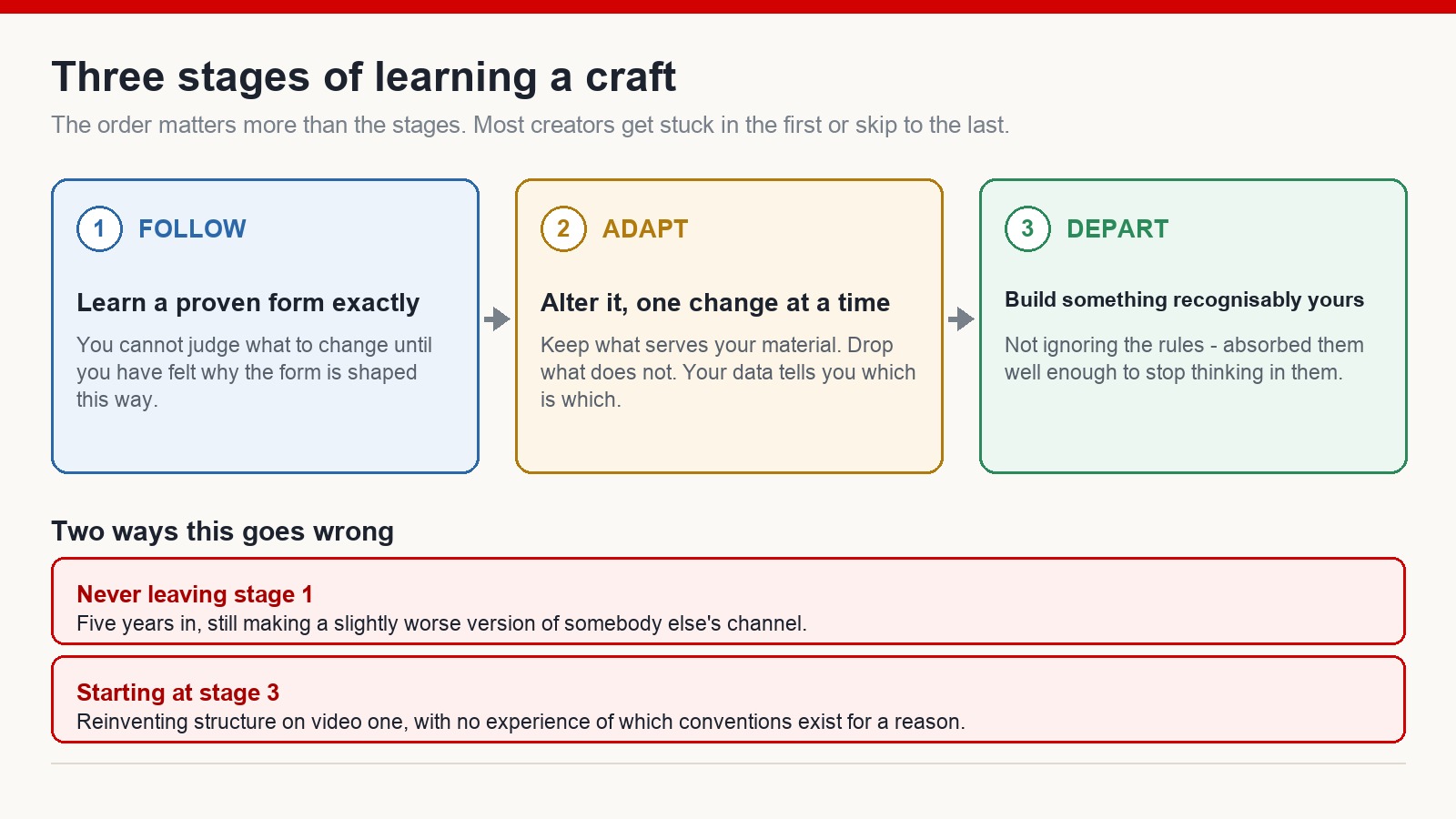
The most useful framework I have found for this comes from traditional Japanese craft and martial arts, and it describes three stages a student passes through.
Shu – follow. You learn a proven form exactly, without improvising. Not because originality is bad, but because you cannot judge what to change until you have felt why the form is shaped the way it is.
Ha – adapt. Once the form is reliable, you start altering it. You keep what serves your material and drop what does not, and you find out fairly quickly which of your instincts were worth trusting.
Ri – depart. Eventually the form is internalised and you build something that is recognisably yours. You are not ignoring the rules; you have absorbed them well enough that you no longer think in them.
Most creators fail at this in one of two ways. Some never leave Shu: five years in, still making a slightly worse version of someone else’s channel. Others try to start at Ri: reinventing structure on video one, without the experience to know which conventions exist for a reason. The order matters more than the stages.
What to actually extract during the Shu stage
Studying a competitor is only useful if you know what you are looking for. Here is the teardown I run, and it deliberately never asks “what did they say”.
- The subject choice. Which question is this video answering, and how would somebody phrase that question if they were typing it rather than watching?
- The promise. What does the title and thumbnail together commit to delivering? Does the video actually deliver it, and at what point?
- The opening. How many seconds before the viewer knows what they are getting? What is the first thing shown, and why that?
- The structure. Write down the sections in order. Most successful videos in a niche share a skeleton, and it is usually not the one you would have guessed.
- The pacing. How often does something change – the shot, the topic, the tone? Where does the video slow down deliberately?
- What keeps you watching. Open questions, a running thread, a promised payoff at the end. Name the specific device.
Do this on ten videos from different channels in the same space and the shared skeleton becomes obvious. That skeleton is what you are learning. The words, the footage and the specific examples are not, and taking those is a different activity with a different name.
Where studying ends and infringement begins
This distinction matters more than it used to, so let me be blunt about it. Understanding why a structure works and rebuilding it with your own material is learning. Downloading someone’s footage, adding a voice track over the top and publishing it is not, regardless of how many seconds you trimmed.
Compilation and commentary formats can be entirely legitimate, but the legitimacy comes from what you add – analysis, education, criticism, a genuinely new arrangement that serves a purpose the original did not – and from actually holding the rights to the material you use. “It was on a stock site” and “I only used a few seconds” are not rights. If you cannot point to the licence, you do not have one.
The narrowing problem: cut the slice, not the whole pizza
The second half of building a coherent library is choosing what it is about, and the most common beginner mistake is picking a subject that is far too large.
“Health” is not a niche. It is an industry. So is technology, education, or news. A channel aimed at a category that broad is competing with everybody and speaking to nobody in particular, which means every video has to win a new audience from scratch.
The fix is to keep slicing until you can describe one viewer in a sentence.
Health becomes health for older adults. Health for older adults becomes joint mobility for people over sixty. At that point something changes: you can picture the person watching, you know what they already tried, you know what worries them, and you know what they would type into a search box at eleven at night. Every video you make has a reason to exist for a specific human being.
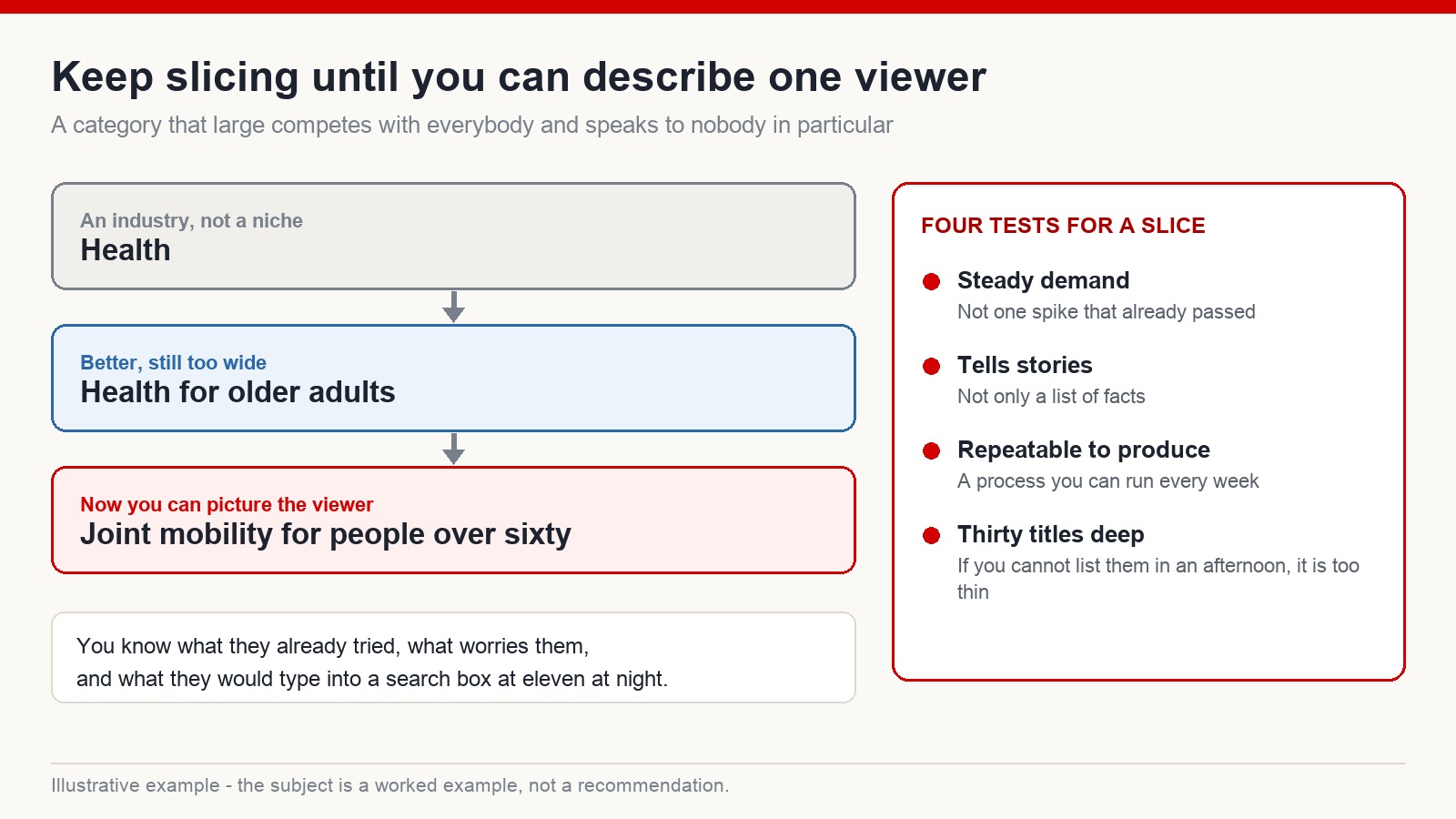
A slice worth committing to usually passes four tests. There is steady demand for it, rather than one spike that already passed. It can be told as stories rather than only as facts. It has enough repeatable structure that you can produce it consistently. And it holds enough distinct subjects to support a long run of videos – if you cannot list thirty titles in an afternoon, the slice is too thin.
That last test is the one people skip, and it is the one that ends channels around video fifteen.
Knowing when to leave the template
The Ha and Ri stages have a trigger, and it is not a feeling of readiness. It is data.
Once you have enough videos that a pattern exists on your own channel, your own analytics become a better teacher than any competitor. You will notice that a section you added on instinct is where people stop leaving, or that the format everyone in your niche uses is quietly costing you the first minute. That is the point to start deviating, one change at a time, so you can tell which change did what.
Before you have that data, deviation is just guessing with extra steps. After you have it, following the template is leaving information on the table.
What this does not promise
There is no timetable here. Some channels find an audience quickly because their subject happens to have unserved demand; others take many months of steady publishing and improvement. Meeting the requirements of the Partner Programme depends on the audience genuinely showing up, and nobody can tell you in advance how long that takes for your particular subject.
What I am confident about is the direction. Creators who study structure rather than surfaces, who narrow until they can name their viewer, and who let their own data tell them when to break the pattern, build something that keeps working. That is a better bet than any individual video.
Frequently asked questions
Is it acceptable to model my videos on a successful channel?
Studying structure, pacing and subject choice is normal practice in every craft. Reusing someone’s footage, script or voice is not, and the difference is not a matter of degree.
How narrow should a niche be?
Narrow enough that you can describe one viewer in a sentence, broad enough that you can list thirty video ideas without straining.
Do I need to appear on camera?
No. Faceless formats work when the content is genuinely useful and well made. Not showing your face is a production decision, not a limitation on quality.
When should I stop following the template?
When your own analytics have enough videos in them to show a pattern. Before that, you are changing things without a way to measure the result.
Can AI do the teardown for me?
It can summarise structure quickly, which is genuinely useful. It cannot tell you which structural choice mattered to a real viewer, and it does not know your audience.
If you want to work through this with a process rather than alone, that is what we do at mmoyoutube.com. Results differ between channels and platform behaviour changes – treat all of the above as method, not as a forecast.