One Video, Seven Days: The Two Constraints That Make a Repurposing Prompt Work
One video, seven days of content, without repeating yourself. That is what this prompt template promises, and the promise is reasonable – a twelve-minute video usually contains four or five ideas that each deserve their own post.
What makes it work is not the length of the prompt. It is two constraints near the bottom: do not simply shorten or copy sections of the video, and do not invent information that is not supported by the original video. One stops repetition, the other stops fabrication. Without them you get seven summaries or seven confident inventions.
What the prompt is actually doing
Read past the wording and there are five stages, in order.
| 1. Extract → | 2. Assign → | 3. Make it native → | 4. Check against the source → | 5. Rank |
|---|---|---|---|---|
| Pull the strongest ideas out first Insights, stories, examples, opinions, lessons |
One idea per day Seven days, seven different pieces |
Fit the platform, not the video A thread is not a caption is not a short |
Nothing the video did not say No invented statistics, no borrowed claims |
Name the three strongest And say why they would attract new viewers |
| Skip this and you get seven summaries | Skip this and day three repeats day one | Skip this and every post reads like a description | Skip this and you publish something you cannot defend | Skip this and you spend equal effort on all seven |
Stage one is the one people skip when they repurpose by hand. Cutting a video into seven clips is not repurposing; it is slicing. Extracting the ideas first is what allows day four to be an opinion and day six to be a question, from the same source.
Six brackets decide the whole week
The prompt asks for your title, transcript, audience, niche, platforms, tone and goal. Fill those with single words and you will get seven posts that could belong to anyone.
| Bracket | Weak fill | Strong fill |
|---|---|---|
| Video title | “My new video” | The exact title as published, so the angle is clear |
| Transcript or summary | A three-line description | The full transcript – this is the single biggest quality lever |
| Target audience | “Creators” | “People who have published fewer than ten videos and edit on a phone” |
| Niche | “AI” | “AI tools for faceless YouTube channels in English” |
| Platforms | “Social media” | The two or three you actually post on, named |
| Tone / voice | “Professional” | “Plain, direct, no hype, short sentences” |
| Main goal | “Grow” | “Send viewers to the full video” or “get replies in the comments” |
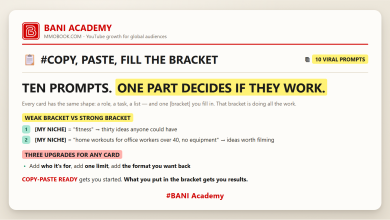
The transcript field does most of the work. A summary gives the model your conclusions; the transcript gives it your examples, your asides and the way you actually phrase things – which is what makes the output sound like you rather than like an article about you. That is the same principle as the bracket rule in the one part that decides whether a prompt works, and the slot structure in vague in, vague out.
The post this came from
Watch the reel
The full prompt template on one card, ready to copy. Posted on the BANI Academy page.
A worked week, so you can see the shape
This is roughly what a good answer looks like – useful as a sanity check when the model hands you seven things that all feel the same.
| Day | Format | Core idea | What makes it native | Call to action |
|---|---|---|---|---|
| Mon | Short video | The single most surprising point | A clip cut around one idea, not the intro | Watch the full video |
| Tue | Text post | The practical takeaway | Three lines, no link in the body | Ask a question |
| Wed | Carousel | The step-by-step part | One step per card | Save it |
| Thu | Short video | A story or example from the video | The moment something went wrong | Comment a word |
| Fri | Text post | An opinion you stand behind | Say the unpopular half out loud | Invite disagreement |
| Sat | Question post | The thing you are still unsure about | Genuine, not bait | Reply to everyone |
| Sun | Recap or carousel | The whole argument in five lines | The version for people who missed it | Point to the video |
Notice that no two days share a format or a purpose. If your output has three “key takeaway” posts in a row, the model ignored the no-repetition rule and you should push back rather than accept it – the second pass habit from most people use AI to draft.
A practical note on platforms: on Facebook in particular, a post with a link in the body usually travels worse than one without, which is why several days above end in a comment or a save rather than a link. Decide that per platform before you generate, not after.
When one video is not enough for a week
The template assumes the source video is rich enough to carry seven pieces. Plenty are not, and forcing it produces exactly the repetition the prompt was written to avoid.
A quick test before you run it: can you write down four things the video says that a viewer could act on, without rewatching it? If you can, the week is there. If you can only find two, you have a two-post video, and the honest move is to publish two good pieces rather than seven thin ones. Nobody has ever unfollowed a channel for posting less.
There is a better fix for thin sources than stretching them. Run the template across two or three related videos at once and let it find the throughline between them – a topic you have covered three times usually contains an argument you have never stated directly. That post tends to outperform anything cut from a single upload, because it is genuinely new writing built on material you have already tested with an audience.
Either way, the decision belongs before the prompt, not after it. A template cannot tell you whether the video had enough in it; only you can, and it takes about a minute to check.
Three checks before any of it goes out
Check it against the video. The prompt says not to invent, and models comply imperfectly. Read each piece next to the transcript and delete any number, claim or example you cannot point to. This is the fastest way to lose trust, and the easiest to avoid.
Check the voice. Repurposed posts often arrive slightly more enthusiastic than you are. Strip the superlatives; your audience recognises your register faster than your logo.
Check the promise. If a post promises something the video does not deliver, it is a bad post even when it performs well – the same trap as an overclaiming thumbnail in thumbnail ideas and the curiosity gap.
If you run this weekly, save it as a named shortcut so you are not pasting the template every time – the setup in save once, call in one word. And when the clipping half is what slows you down, one long-to-short tool covers it, as in faceless video: ten tools, and the two you need.
Frequently asked questions
Does this work in any assistant?
Yes – the card says ChatGPT, Claude and Gemini, and it is plain instructions rather than a product feature.
What if the seven pieces still feel repetitive?
Your video probably has two ideas, not seven. Ask for four pieces instead, or add a second video as source material.
Should I schedule all seven at once?
Generate all seven, then publish daily and adjust. The week is a plan, not a queue you stop reading.
Is repurposing worth it if my videos are small?
That is when it is worth most. A video with two hundred views can produce a post that reaches people who have never heard of the channel.
Run it on your last video
Take the video you published most recently. Paste the full transcript, fill the other brackets as sentences rather than words, and name only the platforms you actually post on. Then read the seven pieces against the transcript, delete anything unsupported, and publish the three the model ranked highest.
Repurposing is not repeating. Same message, different angle, native format – and nothing in it that the video did not earn.
Learning a lot does not make anyone good. Doing a lot does.
If you want the structure that turns that into a habit, that is what our free challenge is built for: no barrier to entry, a genuine commitment to action, and a refundable commitment fee you get back when you finish. You are not paying for the knowledge. You are betting on yourself finishing, and we hold the stake.
Which video would you run this on first? Tell us in the comments on the original reel.
For more on building channels for English-speaking audiences, that is what we work on at mmoyoutube.com.
One Comment