External Traffic To A New Video: What Helps, And What Quietly Hurts
Every creator eventually asks the same question about a new upload: is there anything I can do, right now, to help this thing along? The honest answer is yes, but it is a much smaller and much more boring set of actions than the ones being sold in creator forums.
I have been making YouTube content since 2017, and the channels I build and teach are faceless ones aimed at viewers in the US, the UK, Germany and Japan. Bringing people to a video from outside YouTube is a normal part of that work. It is also the single easiest way to damage a video that would otherwise have done fine, which is why it is worth being precise about.
What external traffic actually is
In your analytics, traffic sources are split into a handful of buckets: browse features, suggested videos, search, channel pages, notifications, and external. External means someone arrived from a link outside YouTube – a post, a message, a newsletter, a forum thread, another website.
It is worth understanding what that traffic does and does not do. It does not tell the recommendation system that your video is good. It brings people to the video, and then those people behave in a way that YouTube records. The behaviour is the signal. The link is just a door.
That single distinction explains almost everything that follows. If you bring people who want the video, the behaviour they produce is genuine and useful. If you bring people who do not, you have not added a signal – you have added noise to the one measurement that decides whether your video gets shown to anyone else.
Why the first day carries more weight than the rest
A new video is not pushed to everyone at once. It goes out to a small group who look, on paper, like they should want it, and YouTube watches what they do: whether they click, whether they stay past the opening, whether they finish, what they watch next. If that goes well, the group widens. If it does not, distribution quietly stops expanding.
Nothing dramatic happens to a video that fails that test. It is not penalised. It simply does not get a second one. That is why the first day matters out of proportion to the rest of a video’s life – not because of a magic window, but because the sample YouTube is judging you on is collected then.
Which means that whatever you send at a video in that window, you are sending straight into the evidence.
The version of this that backfires
Here is the pattern I see repeatedly, usually from people acting in good faith.
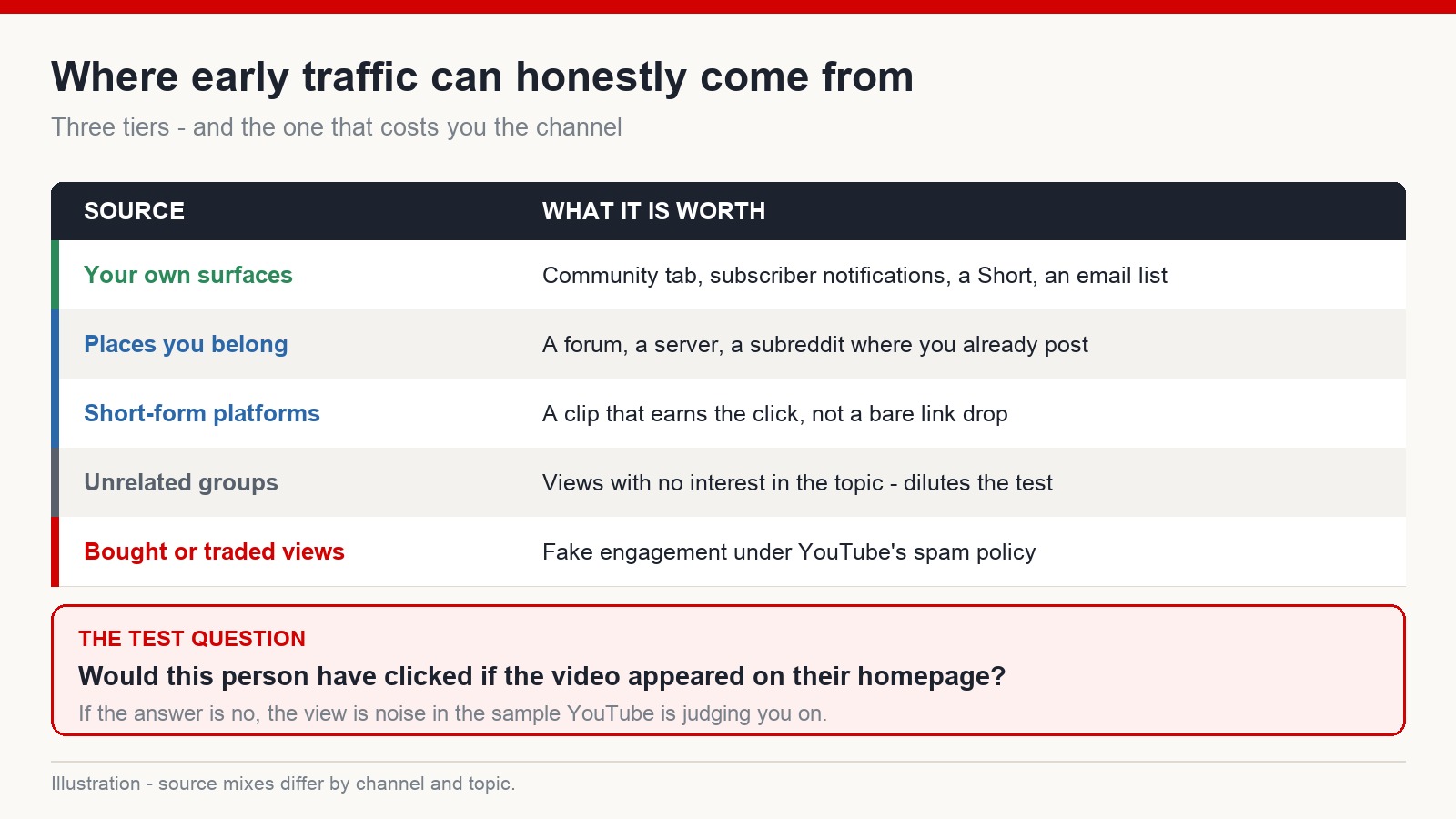
The video goes live and the link goes everywhere: general chat groups, unrelated communities, reply threads under other people’s posts, a dozen link-drop channels that exist purely for creators to swap clicks. Sometimes it goes further – a service that sells views, a traffic exchange where you watch strangers’ videos to earn credits for your own, or a group where twenty people agree to watch and comment on each other’s uploads.
The view counter moves. Then, within a few days, impressions collapse and nobody can explain why.
Two separate things are going wrong.
The first is policy. YouTube’s spam and deceptive practices rules define fake engagement as views, likes, comments or subscribers that do not come from real people with genuine interest. Bought views land there. Traffic exchanges land there, because a view you received in return for a credit is not a person who wanted your video. So do view-for-view and comment-for-comment arrangements, and so do accounts you own and operate yourself. The documented consequences run in stages: the affected metrics are stripped, individual videos can be removed, and repeat cases end the channel.
The second thing is arithmetic, and it applies even in the cases where nothing is ever detected.
The part that bites even if you get away with it
Assume, generously, that nothing you did is ever flagged. It is still a bad trade.
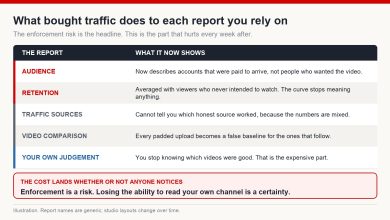
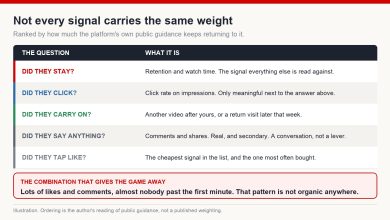
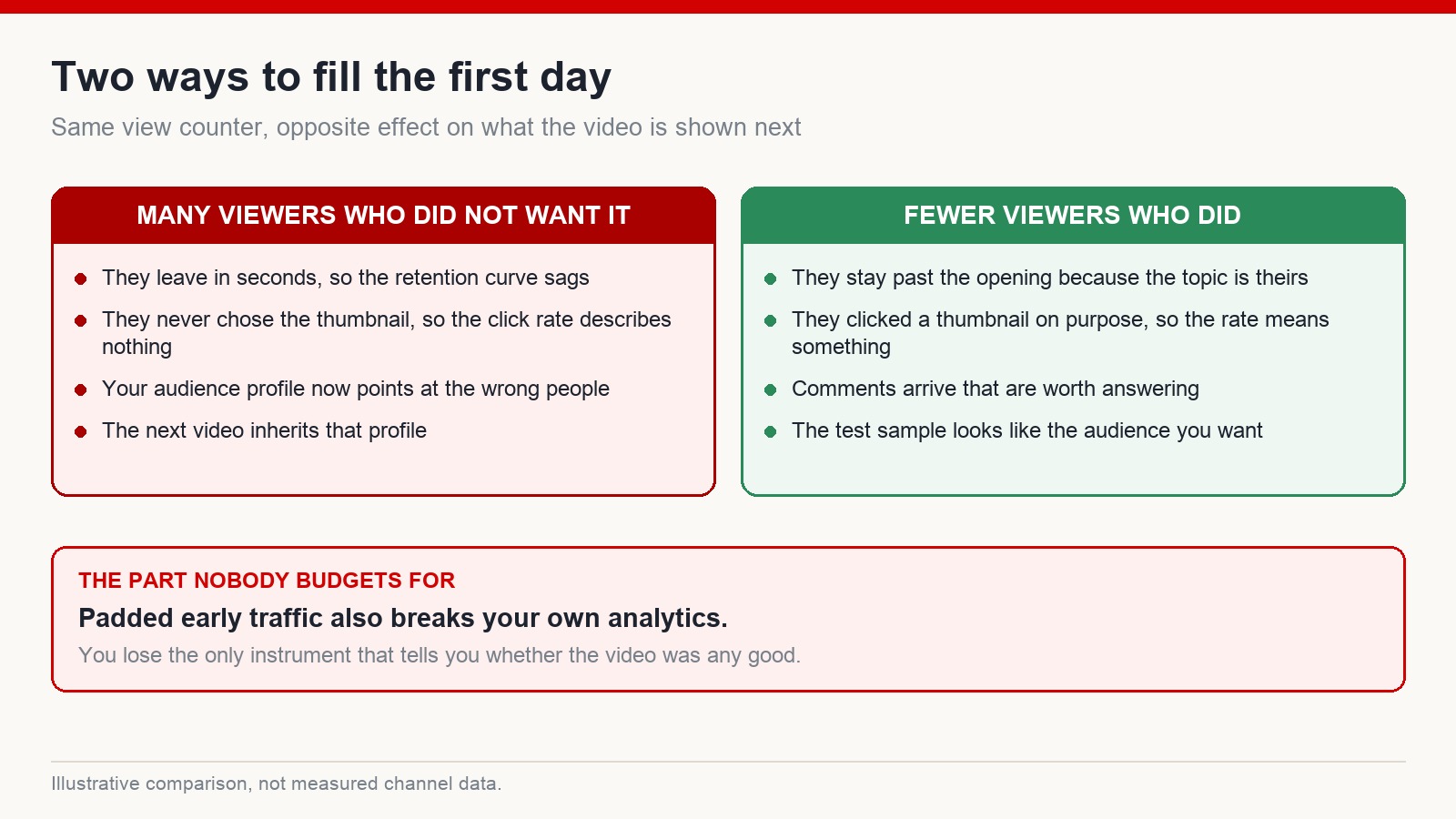
Every early viewer is a data point in the test. People who had no interest in the topic leave in seconds, so your retention curve sags. They never chose your thumbnail, so the click-through figure describes nothing real. Your audience profile now points at people who do not want your content, which shapes who the next video is shown to. You did not help the test. You failed it more convincingly, and taught the system to aim your channel at the wrong room.
And then there is the cost that keeps running: you can no longer trust a single chart in your own analytics. You have removed the only instrument that tells you whether the video was any good. Every decision you make after that – topic, thumbnail, length, opening – is now made on corrupted data.
A hundred viewers who wanted the video are worth more than a thousand who did not. On a faceless channel aimed at a specific English-speaking audience, that is not a nice sentiment. It is the whole business model.
Where honest external traffic comes from
None of this means publish and walk away. It means the people you bring have to be people who might genuinely want the video.
Surfaces you already own
The community tab is the most underused thing on YouTube. A post shortly before or after publishing reaches people who already chose to follow you. Subscriber notifications cost nothing and depend entirely on whether your last few videos were worth the click. If you run an email list, that is the warmest audience you will ever have and the one most likely to watch to the end.
A short clip that earns the click
Short-form platforms work for this, but only in one specific way: the clip has to be worth watching on its own, and the long video has to be the obvious next step. Tease the result in the clip and explain the method in the long form. A clip that is just a trailer with a link in the caption gets scrolled past, and the handful of people who do follow it arrive with no context and leave immediately – which, as above, is worse than nobody arriving at all.
Places where you are already a participant
A niche forum, a Discord server, a subreddit, a hobby group – these can send excellent traffic, on one condition. You have to be someone who posts there anyway. The test I use is blunt: if I would not post in that community without a video to promote, I do not post there with one. People can tell the difference instantly, and so can moderators.
Your own back catalogue
An older video that still gets steady views is a distribution channel you already own. A pinned comment or an end screen pointing at the new upload sends people who have already demonstrated interest in exactly this topic. It is slower than a link blast and it works far better.
Asking for a reply without buying one
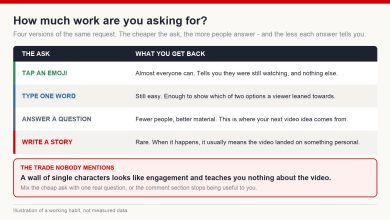
A short prompt in a pinned comment – a real question, asked once – does bring replies, and replies from people who watched are worth having. There is a line to keep an eye on, though. Asking a question is participation. Making engagement the price of something, so that people comment to be entered into a giveaway rather than because they have anything to say, drifts toward incentivised engagement, and platform rules on that change over time. If you offer to send someone a resource, treat it as a promise you keep rather than a mechanism for producing comment counts.
The test is the same as everywhere else in this article: would this interaction exist if nobody were counting?
Reading what happened, afterwards
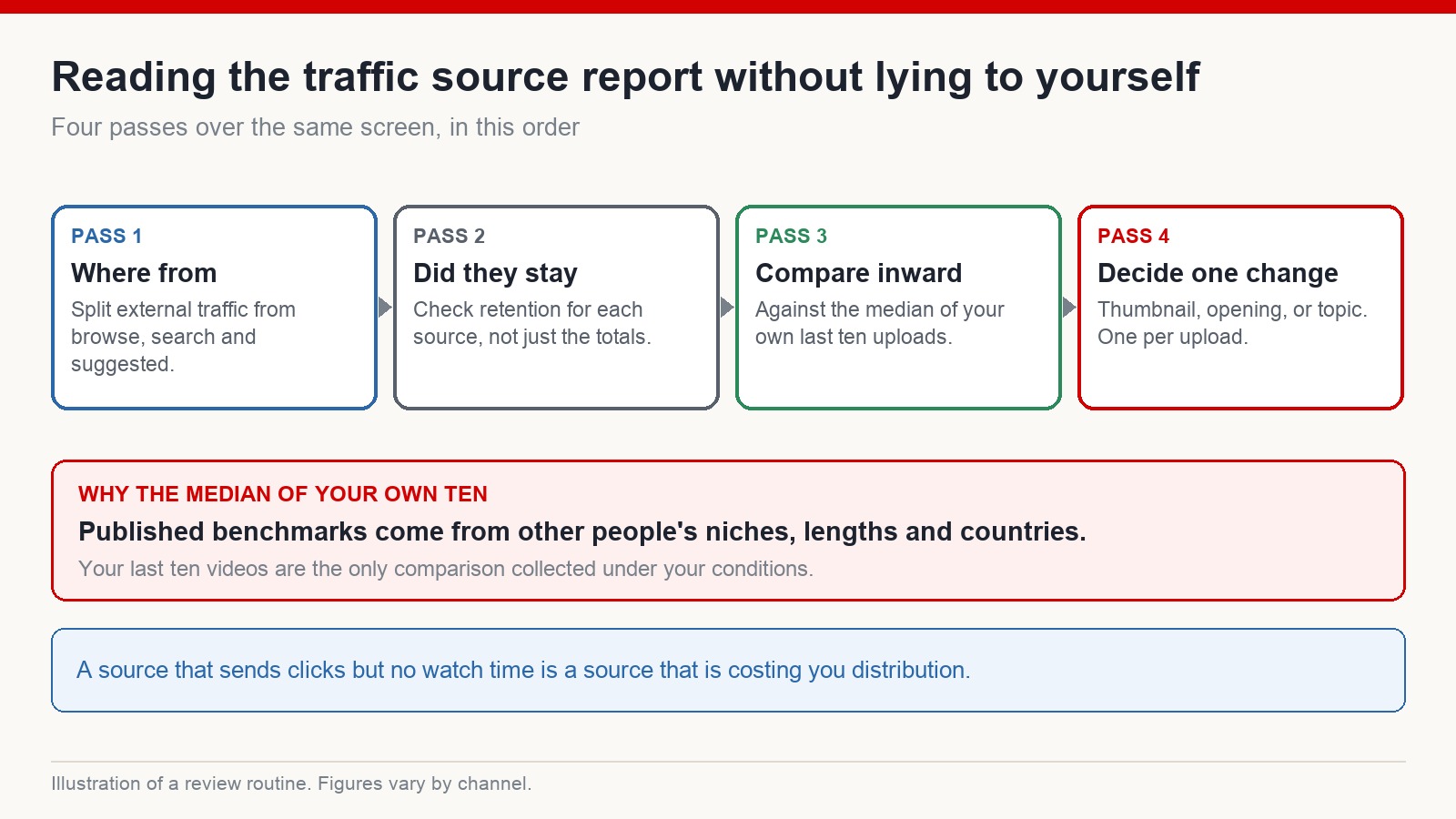
A day or two later, open the traffic source report and do four passes over it, in this order.
First, split external traffic from browse, search and suggested, so you know what came from where. Second, look at retention per source rather than the totals – a source that sends clicks but no watch time is actively costing you distribution, and the top-line view count hides that completely. Third, compare inward. Fourth, change one thing on the next upload, not five.
That third step deserves the most attention, because it is where most creators go wrong. Do not measure your click-through rate against a figure you read in a blog post. Those numbers come from other people’s niches, video lengths, countries and audience ages, usually with no date and no sample size attached. Line your last ten uploads up instead, note the click-through rate and average view duration for each, and take the middle value. That median is your bar. It was collected under your conditions, and it moves as you get better, which keeps it honest.
What publishing day looks like when you stop pushing
Mine is short. Publish. Write the pinned comment. Post to the community tab. If there is a clip worth cutting, it goes out the same day or the next morning. Then I answer comments properly for half an hour, and I leave the video alone.
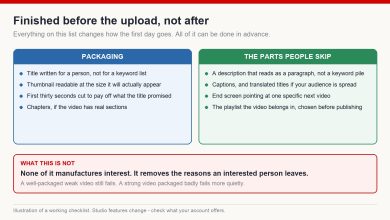
The temptation to keep poking a video that has not moved is strong, and I have never once seen it pay off. The lever that actually matters was pulled before you published: the topic, the packaging, and the first thirty seconds. External traffic can put a good video in front of a few more of the right people. It cannot rescue a video that the right people did not want.
Questions people ask
Does external traffic hurt a video?
Not in itself. Traffic from people interested in the topic is fine and normal. Traffic from people with no interest drags down retention and distorts your audience profile, which does hurt.
How many views should I try to bring in the first hour?
There is no number worth chasing, and anyone quoting one is guessing. Send the video to people who might want it, however many of those there are, and stop there.
Is sharing my video in creator groups a good idea?
Groups where creators watch each other’s videos to be watched back are engagement trading, which falls under fake engagement. Groups where people who share your topic happen to gather are a different thing entirely.
Should I delete a video that got bad early traffic?
Usually not. Deleting removes the watch history and the comments too. Stop the bad traffic, let the video settle, and judge the next upload on clean numbers.
How long before I know whether a video worked?
Long enough that panicking on day one is pointless. Look at the shape of the retention curve and how it compares to your own recent median, rather than the raw view count, and be prepared for videos that pick up weeks later.
The short version
Bring people who want the video. Bring them from places where you already have permission to speak. Then read what they did honestly, against your own history rather than someone else’s benchmark, and put what you learn into the next upload instead of into pushing this one.
If you want the rest of the process for building a faceless channel aimed at an English-speaking audience, that is what we work through at mmoyoutube.com.