Teaching Versus Apprenticeship: Why More YouTube Knowledge Never Fixed Anyone’s Channel
There was an evening, years ago now, when I sat down and worked out exactly how far behind I was. I had spent about five years on YouTube by then. I had read everything. I had watched every “how to grow a channel” video that existed in two languages. And I had nothing to show for it except a set of debts and a very well-informed opinion about why my videos were not working.
The strange part, looking back: I was not short of knowledge. I was short of one person standing next to me, pointing at the screen and saying that bit is wrong, do it again.
That evening is why I now draw a hard line between two things people treat as the same: teaching someone, and showing someone a trade.
The information problem was solved a long time ago
Search “how to grow a YouTube channel” and you get thousands of videos and tens of thousands of articles, most of them free and many of them genuinely good. If information were the constraint, this would be a solved field and everyone reading would be doing fine.
That is not what I see. Almost nobody fails from a missing fact. They fail from doing the work at half strength and quietly dismantling the process while they do it.
There is a specific failure mode I have come to expect. Call it the illusion of competence: you read the article, you watch the video, you feel the click of understanding, and your brain files the topic as done. Then you skip the keyword research because it is boring. You accept a thumbnail that is merely acceptable. You never look properly at what the channels beating you are doing, because studying competitors is tedious and you would rather be making things.
Every one of those is a step someone told you to take. Skipping them does not feel like disobedience. It feels like efficiency.
Teaching and apprenticeship are not the same job
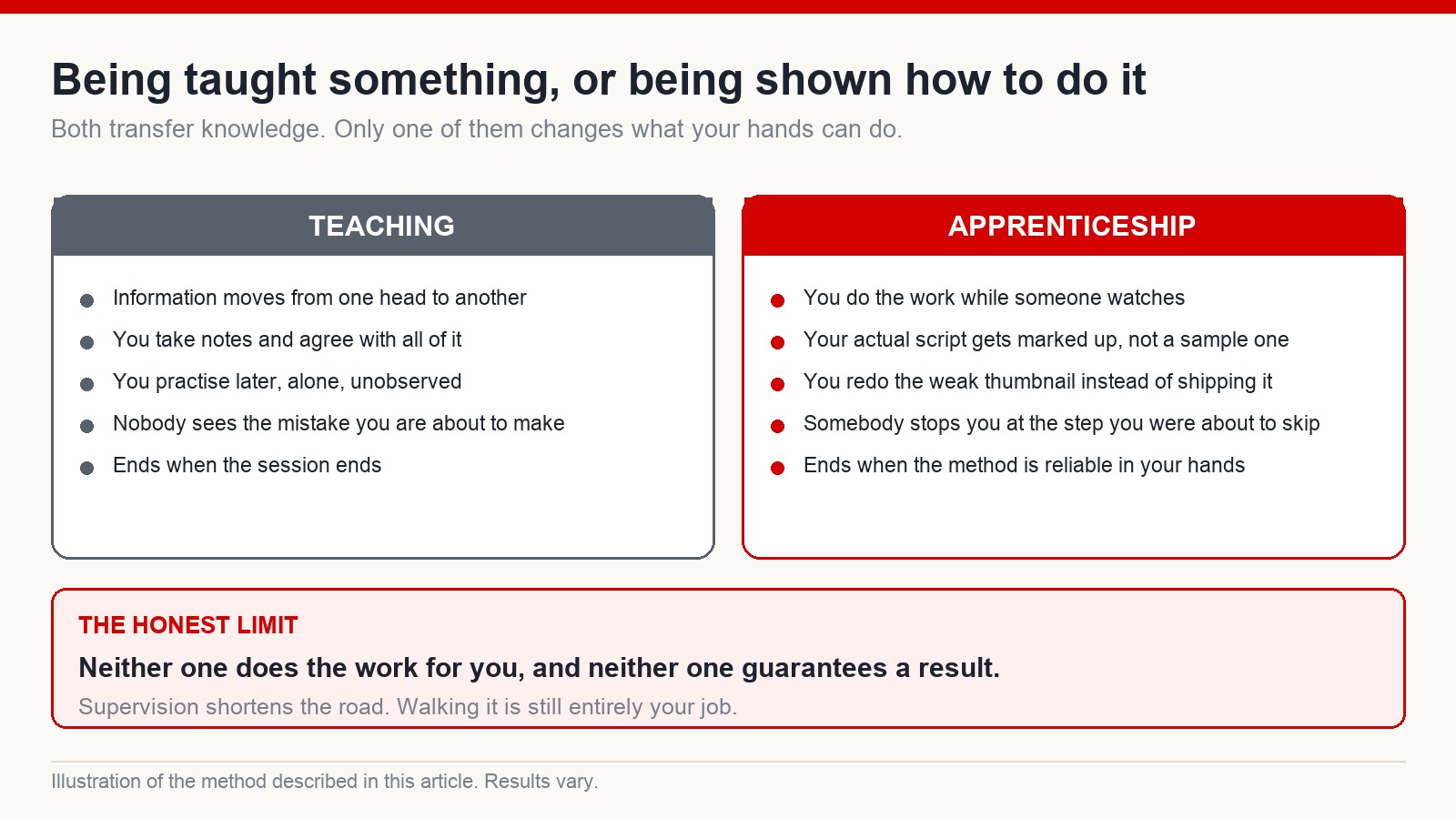
Teaching moves information. I stand at the front, I tell you what is true, you write it down and nod, you go home and try. The rest is your problem.
Apprenticeship is a different arrangement. It is close supervision, correction of the specific mistakes you personally make, and someone holding you to the process until it becomes reliable in your hands. A master carpenter does not read the apprentice a chapter on planing. He stands beside him, watches the grip, adjusts the stance, and makes him do it again until the cut runs straight.
I think content is a trade in exactly that sense. It rewards discipline and systematic thinking, and it punishes inspiration-led work. And trades are not learned by reading. Nobody learns to drive from a book about driving. Building a faceless channel for an English-speaking audience is not different in kind.
What supervision actually consists of
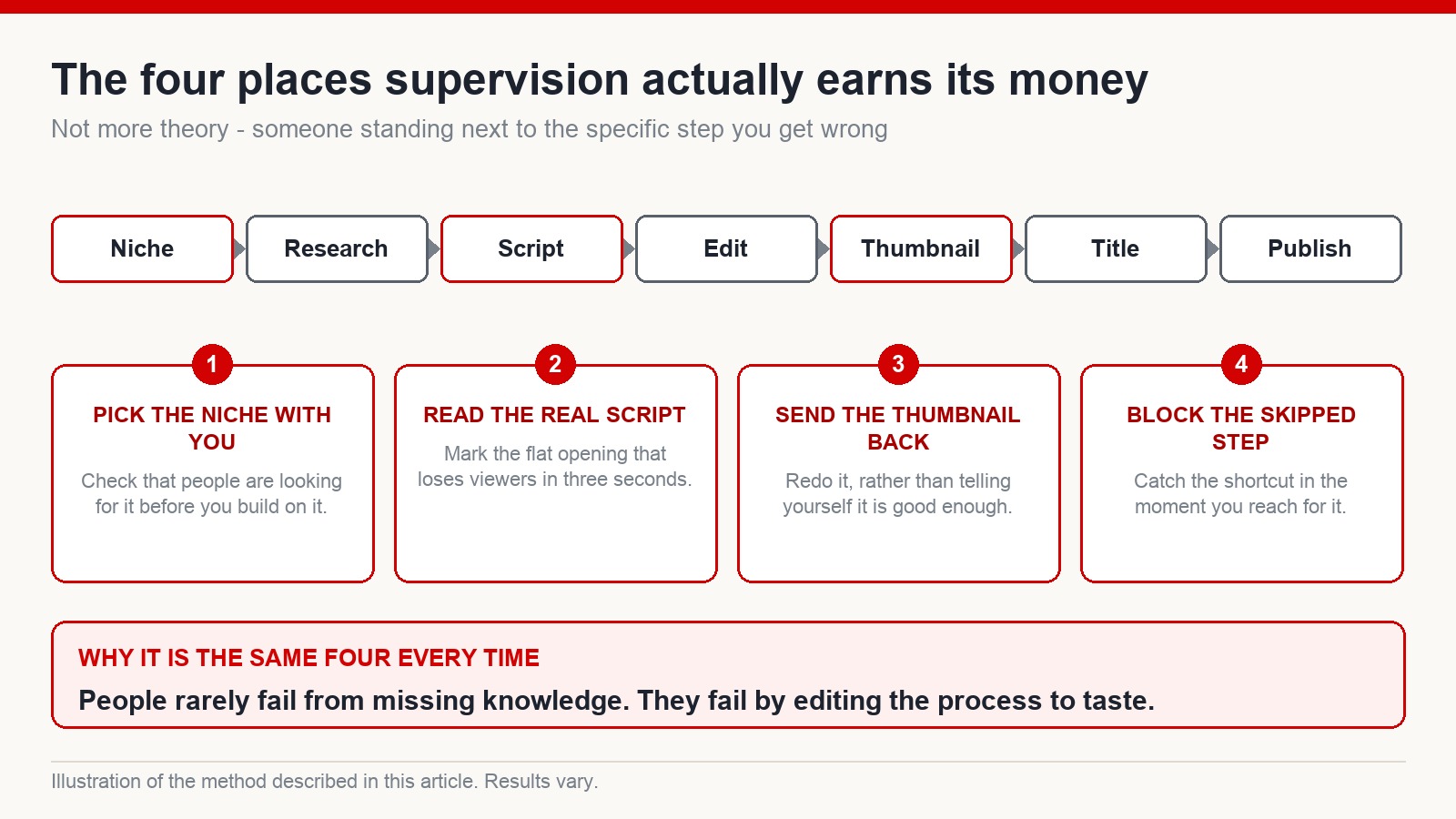
When I say supervision, I do not mean more explaining. Explaining is the cheap part. The valuable part is narrow and slightly uncomfortable:
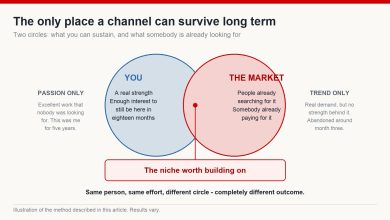
- Sitting with you while you choose the niche, and checking whether people are actually searching for it before you spend six months on it.
- Reading the script you really wrote – not a sample one – and marking the opening that is flat enough to lose a viewer in three seconds.
- Sending the thumbnail back when it is not strong enough, instead of letting you tell yourself it will do.
- Catching your hand at the moment you reach for a shortcut, because that is the move that ends most channels and it happens fast.
In one sentence: practice with correction. You do the work; the corrections are real, specific and about your own material.
Who this actually suits
Two groups, in my experience.
The first is the individual who wants to own a channel, or a small system of channels, and run it properly. Not as a hobby that might pay – as a trade they intend to be competent at.
The second is a business or an established channel owner who sends one person to be trained, so that person can come back and build the internal team. That case is unusually efficient: one properly supervised person can teach the rest of the department, instead of an entire company learning by collision.
What both have in common is that they accept being watched, corrected and held to a process. If someone looking over your shoulder and telling you to redo a thumbnail sounds unbearable, this is the wrong format for you, and I would rather say that up front.
The part I have to say plainly
I am not going to sell you a fantasy. This work takes time and discipline, and there is no button that produces money. I do not promise that everyone who is coached ends up with views or income, because that is not true, and I spent my own bad years resenting the people who implied otherwise.
Supervision does one thing, and only one: it shortens the road, because somebody who has already fallen into the hole can see you walking towards it. It does not do the work. You still sit down, produce, get it wrong, fix it, and go again. Results depend on your niche, your persistence and factors – platform policy, competition, timing – that neither of us controls.
I say this with some feeling because my first five years were spent entirely alone with no one correcting anything, and I paid for that in failure and debt. What I offer now is the thing I did not have.
If you are brand new, do not buy coaching yet
Honestly: someone starting from zero should not jump straight into close supervision. It is expensive and premature. Go and do the work first. Build something badly. Publish videos, run into real problems, and find out whether you actually want this trade or just like the idea of it.
A structured programme you can walk through step by step is a better first move – guided practice, real tasks, no promises about speed or income. Once you have been through that and still want to go further and get properly good, supervision starts to make sense. There is no rush and no reason to be pushed.
I started where you are: no money, no contacts, nobody to ask. I came back to point at the road because that is the only sensible way to pay for having found it. If you want the structured English-language version of this path, it is at mmoyoutube.com.
How is this different from buying a course?
A course delivers content, and the transaction ends there – what you do with it afterwards is unobserved. Supervision is the opposite arrangement: the work is yours, done in the open, and corrected specifically. The measure of a course is whether you finished it. The measure of supervision is whether the method is now reliable in your hands.
I already know the theory. Would coaching add anything?
Possibly more than for a beginner, and this is the awkward part. Experienced people carry an ego that arrives with the competence, so they skip steps they have decided are obvious. If you know the theory and the channel still is not working, the problem is almost never the missing fact – it is the step you quietly stopped doing.
Does an apprenticeship model guarantee results?
No, and be suspicious of anyone who says otherwise. It shortens the learning curve and stops you repeating known mistakes. Outcomes still depend on niche, execution, persistence and timing, plus platform rules that change without asking anyone.
Can a company send one employee instead of training everyone?
That is the case where this works best. One person taken through the full process properly can build and run the internal team afterwards, which is faster and cheaper than having a whole department learn simultaneously by trial and error. It does mean picking someone who will actually stay and teach the others.
Why do you compare content work to a trade rather than to art?
Because the results track discipline far more than they track inspiration. A trade has a sequence, standards, and a way of telling good work from bad. Treating content as inspiration is precisely what kept me poor for five years – I made what I felt like making and never checked whether anyone was looking for it.
Disclaimer: this article describes how I work and what I have observed. It is not a promise of income, views or any specific result. Outcomes vary widely, and platform policies change.