How to Write an Emotional YouTube Script That Actually Holds an Audience
Something I worked out later than I should have: viewers do not remember much of what you said. They remember how the video made them feel, and whether it made them need to know what happened next.
It explains a thing that used to annoy me. Videos with plain editing, an ordinary voice and no effects hold an audience all the way through, while videos with beautiful motion graphics lose most of the room inside the first half minute. The difference is not production value. It is whether the script is doing anything to the viewer.
This is how I write an emotional YouTube script for faceless channels — the structures, the prompts and the sample lines I actually use. I have been making YouTube videos since 2017, mostly for English-speaking audiences, and this is the part of the process I would not give up.
Why feeling outranks information
YouTube is not a classroom. Almost nobody opens an app at eleven at night in order to learn something. They open it because they are curious, or bored, or want to be unsettled, or want to feel understood, or want a reason to believe a thing can be done.
The signals the platform reads — how long people watch, whether they finish, whether they respond — are downstream of that. An accurate video that produces no feeling gets accurately ignored. This is a tendency, not a law: niches differ, audiences differ, and platform behaviour changes.
Write for the emotion your audience came for
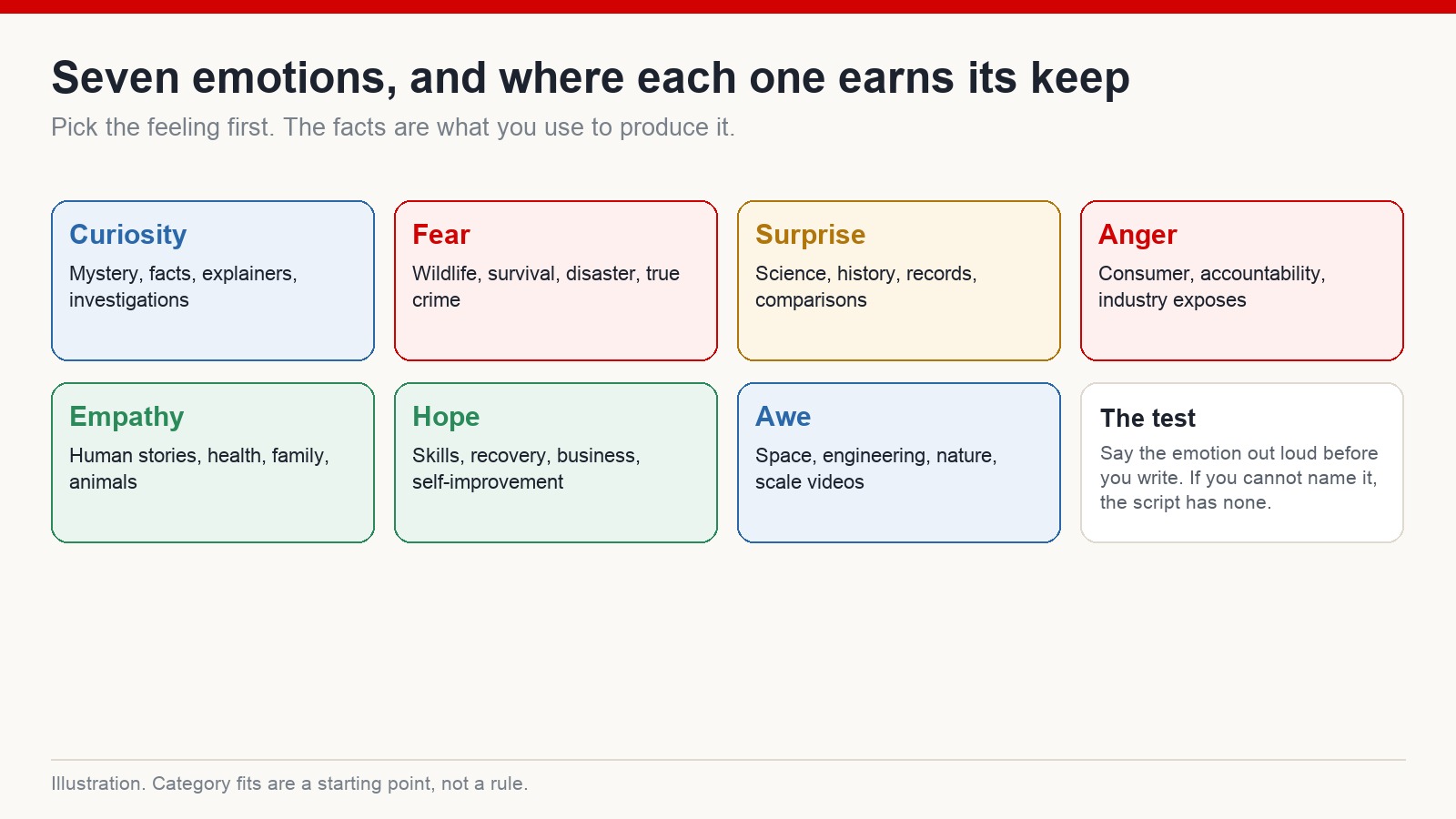
The most common beginner mistake is writing to your own feeling instead of the viewer’s. The question that fixes it is blunt: what do I want this person to feel, in this scene, right now? If you cannot name the emotion out loud, the script does not have one.
Same fact, two temperatures:
Flat: “This is one of the most venomous snakes in the world.”
Loaded: “One bite carries enough venom to kill a room full of people. It is currently sitting under somebody’s porch in Queensland.”
Identical information. Completely different thing happening in the viewer’s chest.
Two emotional structures that hold up
Instead of delivering information at a constant temperature, move the viewer through stages.
Curiosity to outrage to empathy
Strong for human stories, social subjects, true crime, reaction and review formats.
Curiosity: “Every morning for eleven years, she left a hot meal on the same bench for the same man.”
Outrage: “Then she found out what he had been doing with them the whole time.”
Empathy: “And when she finally understood why, she went back the next morning anyway.”
Nobody leaves in the middle of that, because the ending is the only thing that resolves it.
Pain to recognition to hope
Strong for skills, business, self-improvement, software and anything where the viewer wants to become better at something.
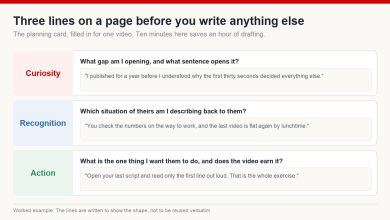
Pain: “I published nearly forty videos in a row and barely anyone watched a single one.”
Recognition: “It took me embarrassingly long to see the problem: I was making what I wanted to make, not what anyone was looking for.”
Hope: “The month I changed how I picked topics, the same channel started behaving completely differently.”
The recognition beat is the one people skip, and it is the one that earns the trust. It is where the viewer thinks: that is me.
The opening is where the feeling starts
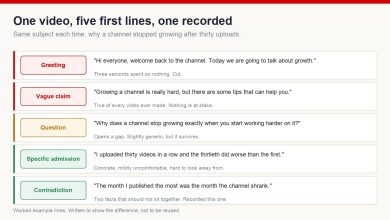
If the first few seconds are flat, nothing after them gets read. A good opening does one of three things: it makes the viewer curious, it makes them uneasy, or it surprises them.
- “There is a step almost everyone skips, and it is the reason their channel stalls.”
- “This tool is replacing a job I used to pay someone to do, and it happened in about six months.”
- “You think you are not scared of snakes. Give it forty seconds.”
Each one opens a gap in what the viewer knows. Human attention is very bad at leaving gaps alone. Keep it under fifteen seconds and get to the gap as early as you can — and note that the promise the opening makes has to be paid off later, or the video reads as bait and the audience remembers.
Prompt the model for feeling, not for subject
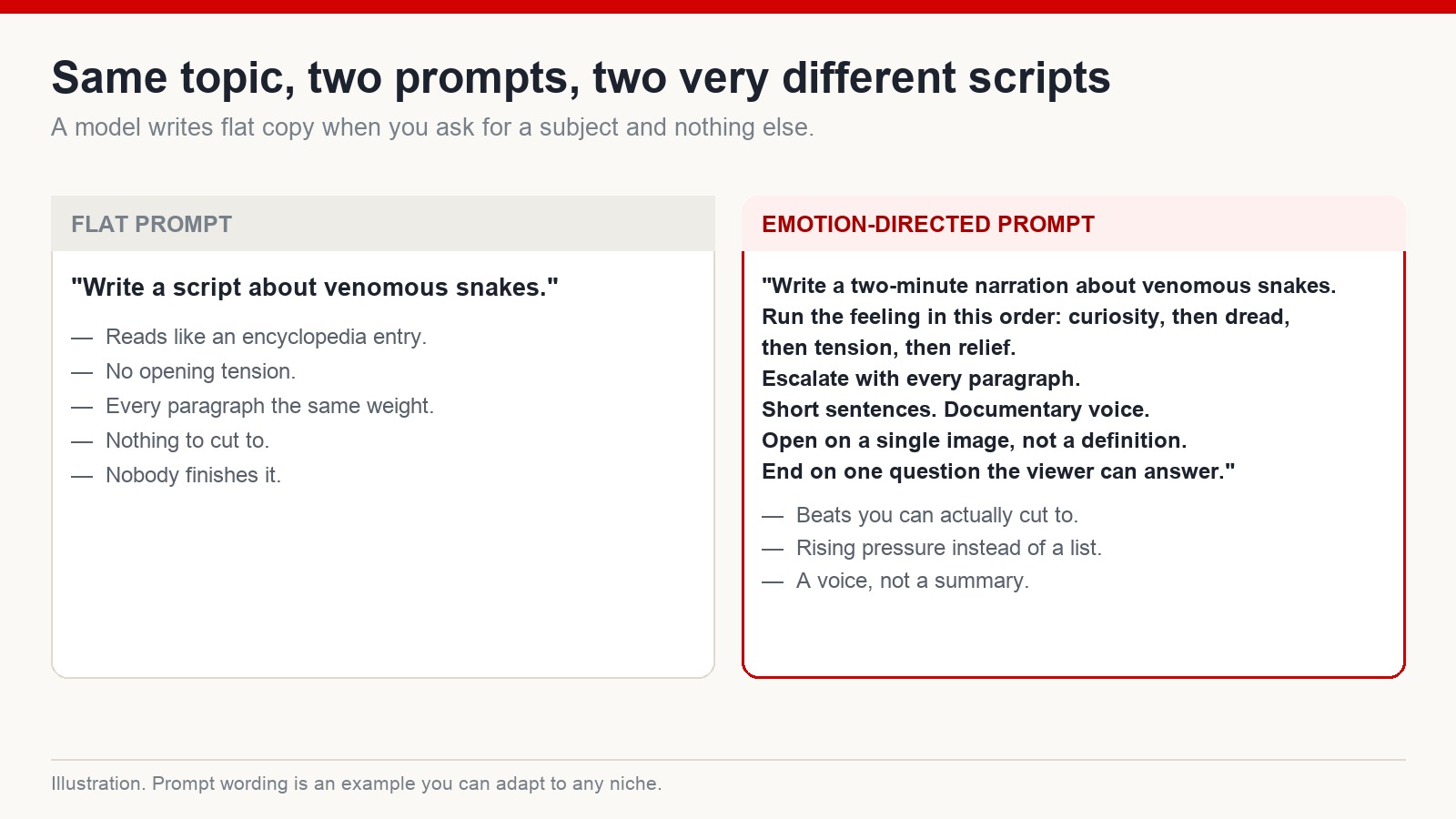
If you hand a model a topic, it hands you an encyclopedia entry. Every paragraph the same weight, no tension, nothing to cut to. That is not the model being bad at writing; it is you not asking for anything.
Weak prompt:
“Write a script about venomous snakes.”
Better prompt:
“Write a two-minute narration about venomous snakes. Run the feeling in this order: curiosity, then dread, then tension, then relief. Escalate with every paragraph — each one must raise the stakes on the last. Short sentences. Documentary voice, not encyclopedia. Open on a single image, not a definition. End on one question the viewer can answer.”
The second one produces beats you can actually cut to.
The same approach works for studying videos that already performed. Do not rewrite someone’s transcript — map its emotional rhythm. Where does the tension start, where does it break, what does it hold back and for how long? Then take your own subject, your own angle and your own evidence, and give it a rhythm that works as well. Structure is fair to study. Words, footage and voice are not yours to reuse, and reusing them breaks platform policy.
Say it, show it
This is where faceless videos leak feeling. The narration says one thing and the picture shows another, and the whole scene goes cold.
If the line is “it struck faster than the camera could follow” and the screen is showing generic forest footage, you have just told the viewer that nothing is really happening. When the words name a moment — the strike, the chase, the eyes, the silence — the visual has to be that moment. It is the cheapest immersion you can buy, and it costs nothing but attention while you write the visual field of each scene.
Turn the feeling into a response — carefully
A video that produces a strong feeling and then ends with nothing is a wasted opportunity. Ask for something while the feeling is still there.
But be careful what you ask for. “Comment the number one if you got this far” is engagement bait, it is explicitly discouraged by platform policy, and it teaches your audience that responding is meaningless. Ask a real question instead:
- “What would you have done in her position?”
- “Which of these three would you try first?”
- “If you have watched this happen to your own channel, I want to hear it.”
Same emotional moment, an answer worth reading, and no policy risk.
Three reasons a script comes out flat
It reads like a textbook. Definitions, long sentences, careful qualifications. All correct, all unwatchable. Write the way you would explain it to one person who is interested.
Too much information, not enough feeling. Dense videos often go unfinished. People retain a feeling far more reliably than a list, and the feeling is what carries the facts.
No climax. A script needs tension, escalation and payoff somewhere. If the video is the same temperature at nine minutes as it was at one, the audience quietly leaves in the middle and you will see it in the retention graph.
The simplest emotional flow to start with
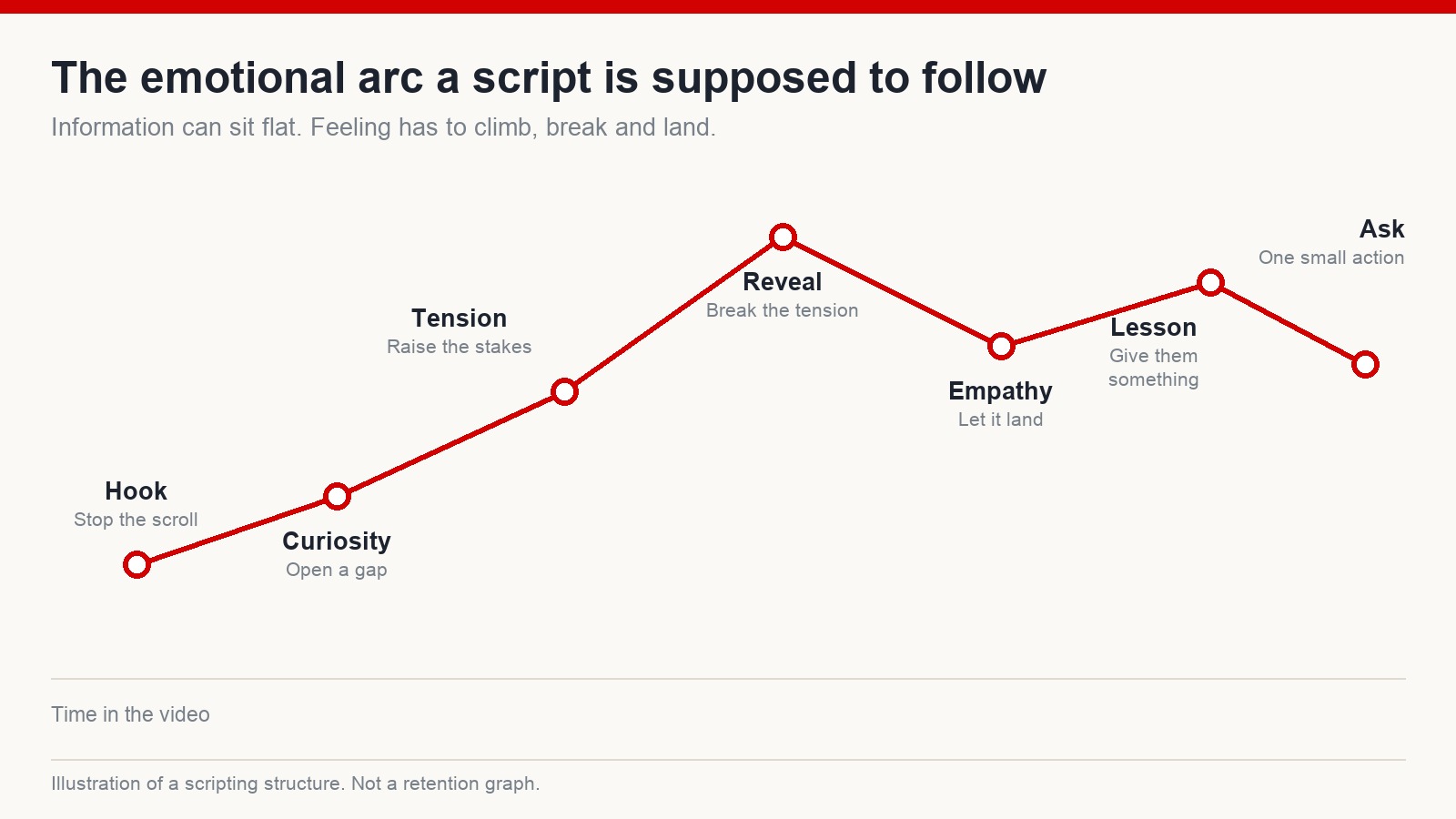
Hook → pain or curiosity → rising tension → reveal → empathy → lesson or solution → one honest ask.
That order works across documentary, faceless narration, story channels, self-improvement and review. It is not the only structure, but it is the one I would use for the first twenty videos before experimenting.
Where to start
If your videos are getting clicks and losing people early, the problem is usually not your editor. It is that the script is delivering information when it should be running a feeling.
Before your next video, write down the emotion for each scene — one word per scene — and read the column top to bottom. If it does not climb anywhere, the video will not either. That single pass has done more for my retention than any effect I have ever added in post.
Frequently asked questions
Why do my most informative videos get the fewest views?
Information alone does not hold attention. Viewers stay for storytelling and tension; the facts land because the feeling carried them.
How long should an opening be?
Under fifteen seconds, and preferably a lot less. Reach the unresolved thing as early as you can, and make sure the video eventually resolves it.
Can a model write an emotional script?
It can, if you specify the emotional order, the escalation and the voice. Given only a subject, it will write something flat every time.
Do faceless videos need this more than normal ones?
Yes. With no presenter on screen, the narration, the pacing and the picture are all you have to hold someone. The script is doing the work a face would otherwise do.
If you want the full process for building a faceless channel for English-speaking audiences, that is what I teach at mmoyoutube.com.