What Is a Faceless YouTube Channel, and Why Does It Suit Beginners?
I put off starting a channel for a long time, and none of the reasons were good ones.
I did not think I was any good on camera. I was not confident about how I would come across. I had no proper equipment. My English was not strong. Somewhere underneath all of that sat an assumption I had never examined: that YouTube was a place for people with a particular kind of talent, and I was not one of them.
Then I started noticing how many channels pass millions of views without their owner appearing for a single second.
The people earning from this platform are frequently not the people in front of the lens.
What a faceless channel actually is
A faceless channel is one where the creator never appears on camera. That is the whole definition – it is a production choice, not a genre, and it does not mean the channel is anonymous or that nobody is accountable for it.
The picture comes from somewhere else instead:
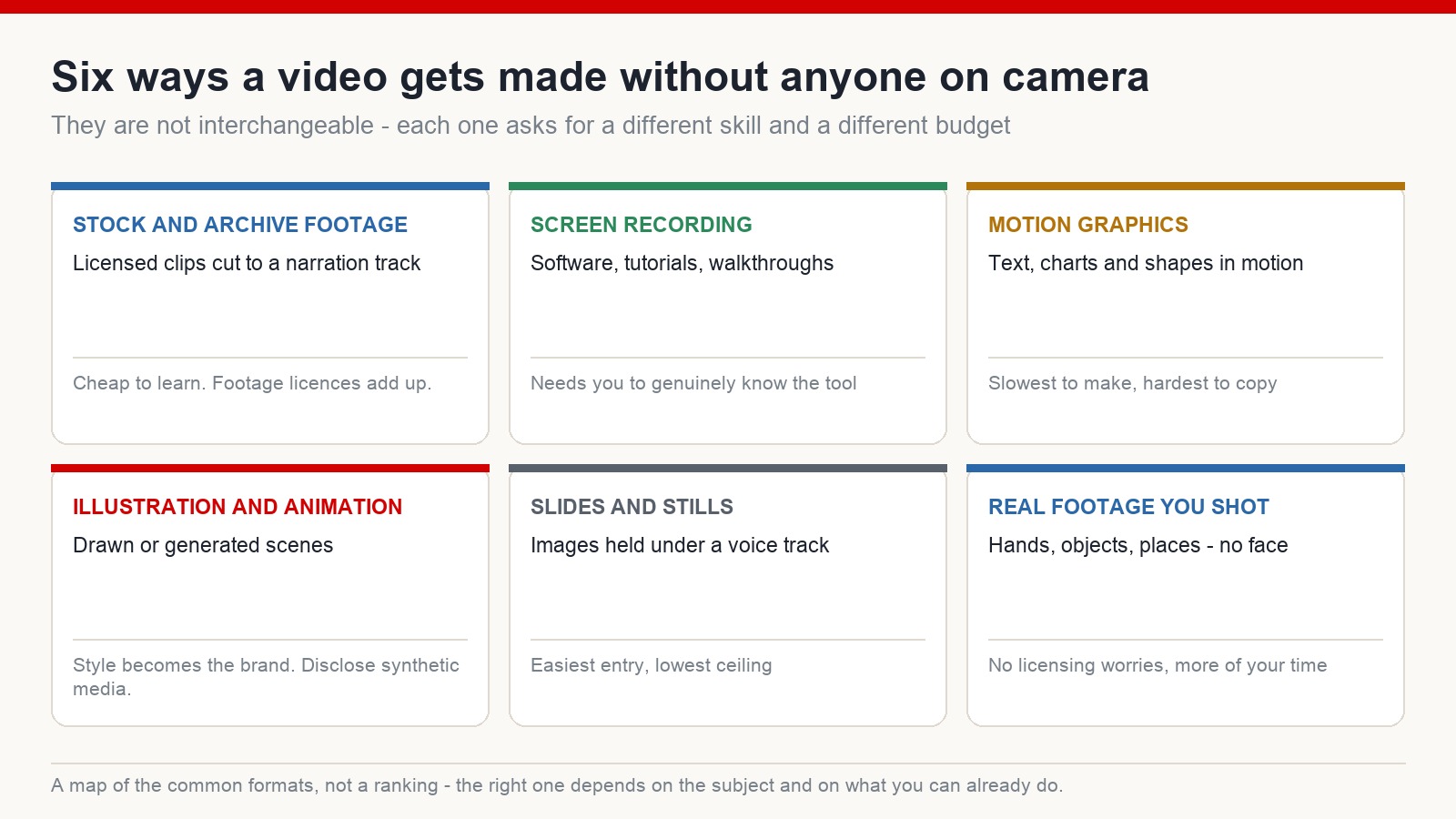
Those formats are not interchangeable. Stock footage is quick to learn but the licences accumulate. Screen recording is cheap but requires you to genuinely know the software you are demonstrating. Motion graphics take the longest and are the hardest for a competitor to copy. Animation makes your style the brand, and if you are generating it, expect to disclose that. Slides are the easiest way in and the fastest to hit a ceiling.
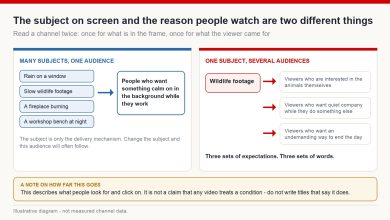
What they have in common is that the viewer’s attention is on the subject rather than the presenter, which is exactly why the model suits people starting out.
Why it fits a beginner
It removes the excuse most people are actually using
The questions that stop people – do I sound alright, do I look alright, what if someone I know sees this – all disappear at once. You are not performing. You are not learning to be comfortable on camera at the same time as learning everything else.
That matters more than it sounds, because it removes the reason to postpone, and postponing is what ends most channels before they exist.
You do not need technical skill or fluent English to begin
Publishing for an international audience used to mean hiring a scriptwriter, a narrator and an editor. Now a drafting tool, a voice tool and a basic editor cover the same ground for one person.
Two honest caveats. AI narration is good enough to publish with, but you should have a fluent speaker check pronunciation of names and terms before it goes out – and platforms increasingly expect synthetic voice and imagery to be disclosed, so build that in from the start. The scarce skill is no longer technical anyway. It is choosing a subject people want and understanding the audience for it.
The start-up cost is genuinely low
A computer, an internet connection and a few subscriptions. Compared with almost any other business you could start, the financial risk of trying is small, which means you can afford to be wrong a few times.
Low cost is not the same as low effort, and it says nothing about the odds. Plenty of channels never reach monetisation. What the low cost buys you is permission to experiment, not a likely outcome.
You do not have to be original yet
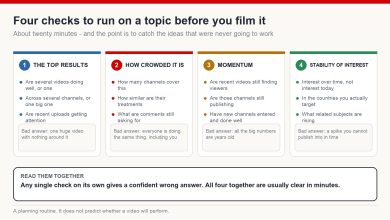
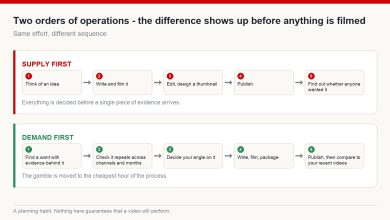
The common mistake is believing you need an idea nobody has had. In your first stretch, the more useful work is understanding how the market behaves: watch what performs in your subject, break down why, then build your own version with your own research and your own assets.
Learn the form first. Personal style shows up later, and it shows up faster in people who understood the form before they started bending it.
One person can run the whole thing
Research, script, voice, edit, upload, optimise – all of it fits inside one person’s week, at least at the start. If the channel grows, that is when delegation and automation start to make sense. Building a team before there is anything to run is a good way to spend money on a channel that has not proven anything yet.
What being faceless does not remove
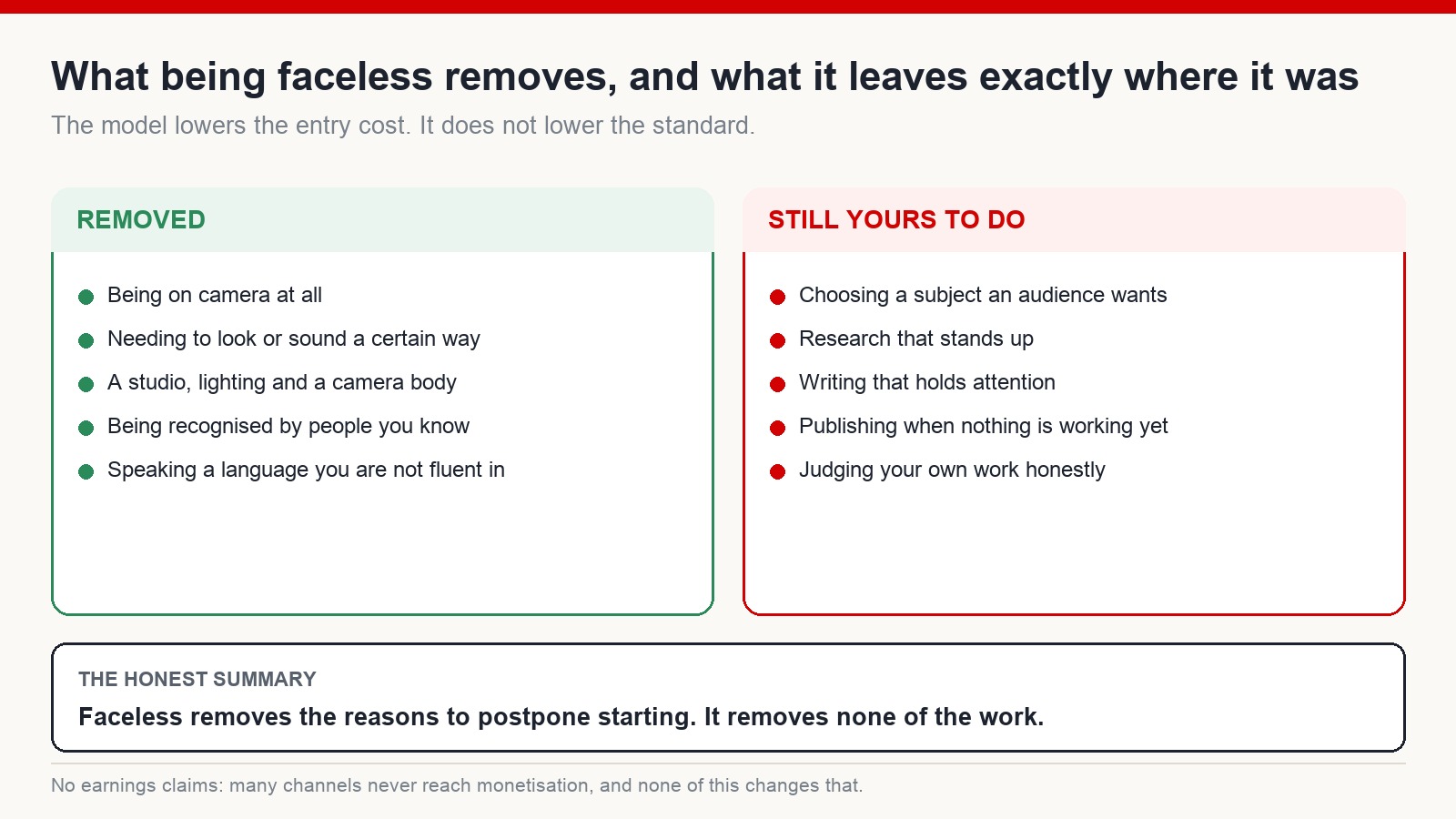
This is the part the model’s fans tend to skip.
Not appearing on camera removes the barriers to entry. It removes none of the actual work. You still have to choose a subject an audience wants, research it well enough to be worth watching, write something that holds attention, publish through the stretch where nothing is happening, and judge your own output honestly.
It is also worth saying that faceless does not have to mean permanently invisible. As a channel matures, a small amount of human presence – a consistent sign-off, a personal aside – often becomes the thing that distinguishes it from everything else being made the same way. Starting faceless does not lock you out of that.
Why the model keeps growing
Viewing habits have shifted. Audiences care much less about who is on screen than about whether a video answers something they wanted answered, and whether it holds them long enough to matter.
That is why faceless channels covering explanation, history, science, nature, technology and skills continue to reach very large audiences without anyone knowing what the creator looks like.
The mistakes that end most attempts
- Expecting money quickly. Most channels do not earn anything for a long time, and many never do. Any plan that requires early income is fragile.
- Choosing a subject that is far too broad. “Technology” is not a niche. It is a shelf in a library.
- Changing topics repeatedly. Every switch resets what the platform has learned about who to show you to.
- Spending on effects instead of substance. Nobody has ever stayed for a transition.
- Waiting for the first video to be good enough. It will not be. That is what the first video is for.
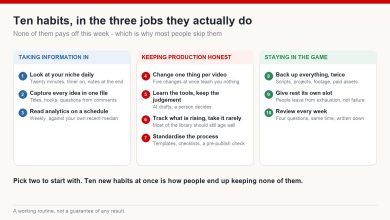
The thing that separates channels that get somewhere is dull and unglamorous: a publishing rhythm you can maintain, and small improvements you actually act on.
If you are waiting to be ready
You will be waiting a while. Start narrow, make one video, keep the process simple enough that you can repeat it next week, and let your own data tell you what to change.
What decides whether this works is not how often you appear on camera. It is whether the videos are useful to the people who find them.
Do I really never have to show my face?
Correct. Stock footage, screen recording, animation, motion graphics and self-shot footage that avoids your face all work, combined with narration you record or generate.
Is faceless a good model for a complete beginner?
It is a reasonable one: the entry cost is low, the process is learnable, and one person can run it. That makes starting easier. It does not make succeeding easier.
Can I make videos for a US or UK audience using AI?
Yes – drafting, translation and voice tools all support that, and it is a common approach. Get a fluent speaker to review before publishing, follow the platform’s rules on disclosing synthetic media, and remember that content quality still decides the outcome.
Which faceless format should I pick first?
Whichever one your subject naturally wants, weighted toward what you can already do. If you know a piece of software, screen recording is the shortest path. If your subject is visual, stock or self-shot footage will serve you better than slides.
How long before a faceless channel earns anything?
There is no dependable answer, and anyone who gives you one is guessing. It depends on the niche, your output, the quality and the audience you reach – and a large share of channels never reach monetisation at all. Plan on the assumption that it takes far longer than you would like.
If you want a structured way through the first stretch for an English-speaking audience, that is what I teach at mmoyoutube.com. Results vary between channels and platform policies change – nothing here is a guarantee of an outcome.