Do Calm Keywords Really Raise Your Earnings Per View?
The claim, stated plainly
You will run into a version of this advice in every faceless creator community: swap the dramatic words in your titles for calm ones — peaceful, relaxing, tranquil, serene — and your revenue per view goes up. Same footage, better rate, no extra production.
It is one of those claims that is neither true nor nonsense, which is the most awkward category. There is a real mechanism underneath it, and the way the claim is usually stated skips over three or four steps where things can go wrong. Since the advice keeps circulating with the steps missing, it is worth walking through what actually holds up.
What a keyword can and cannot reach
Revenue per thousand views is the last link in a chain, and the wording of your title sits at the front of it.
The words you choose influence who clicks. Who clicks influences where the audience is watching from and how they behave once the video starts. That behaviour — how long a session runs, what kind of content surrounds it, what category the video lands in — is part of the context advertisers are bidding into. Somewhere at the end of all that, a rate is produced.
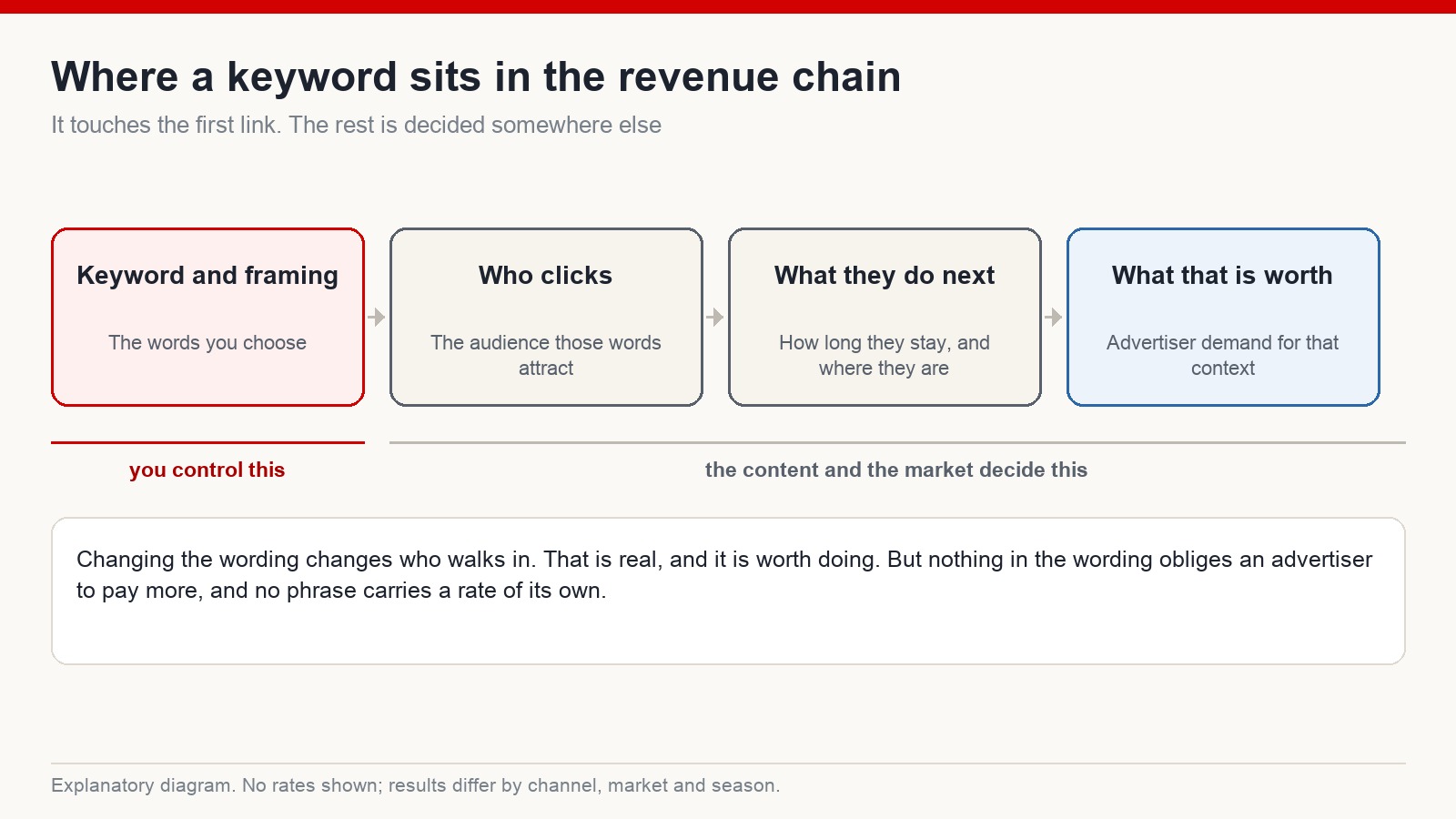
So a keyword touches the first link and nothing after it. That is not nothing — the first link decides who is in the room — but it is a long way from “these words pay more”. No phrase carries a rate of its own, and no wording obliges an advertiser to bid on anything.
The part of the claim that does hold up
Here is the mechanism that makes the advice work when it works.
People searching for calm content behave differently from people searching for spectacle. Someone who types relaxing forest sounds for sleep is usually starting something they intend to leave running. Often in the evening, often on a television or a speaker, often for an hour or more. Someone who types craziest animal attacks wants a couple of minutes of intensity and will be somewhere else afterwards.
Those two are not the same product. Long, ambient sessions and short spikes of attention produce different watch patterns, and the calm audience for this kind of content tends to be spread across markets where advertising is competitive. That combination is where the observed difference comes from, when there is one.
Notice what did the work in that paragraph. It was not the word peaceful. It was the shift in what kind of session the video became — which the wording caused only because the content genuinely supported it.
Where the claim quietly falls apart
The version of the advice that circulates skips exactly that condition, and it fails in the same predictable way every time.
If you attach calm vocabulary to a video that is not calm, you get clicks from people who wanted quiet, followed by immediate exits when they find something else. That is a worse position than not being clicked, because the exits are measured and the missed clicks are not. You have taught the system something unflattering about a video you were trying to promote.
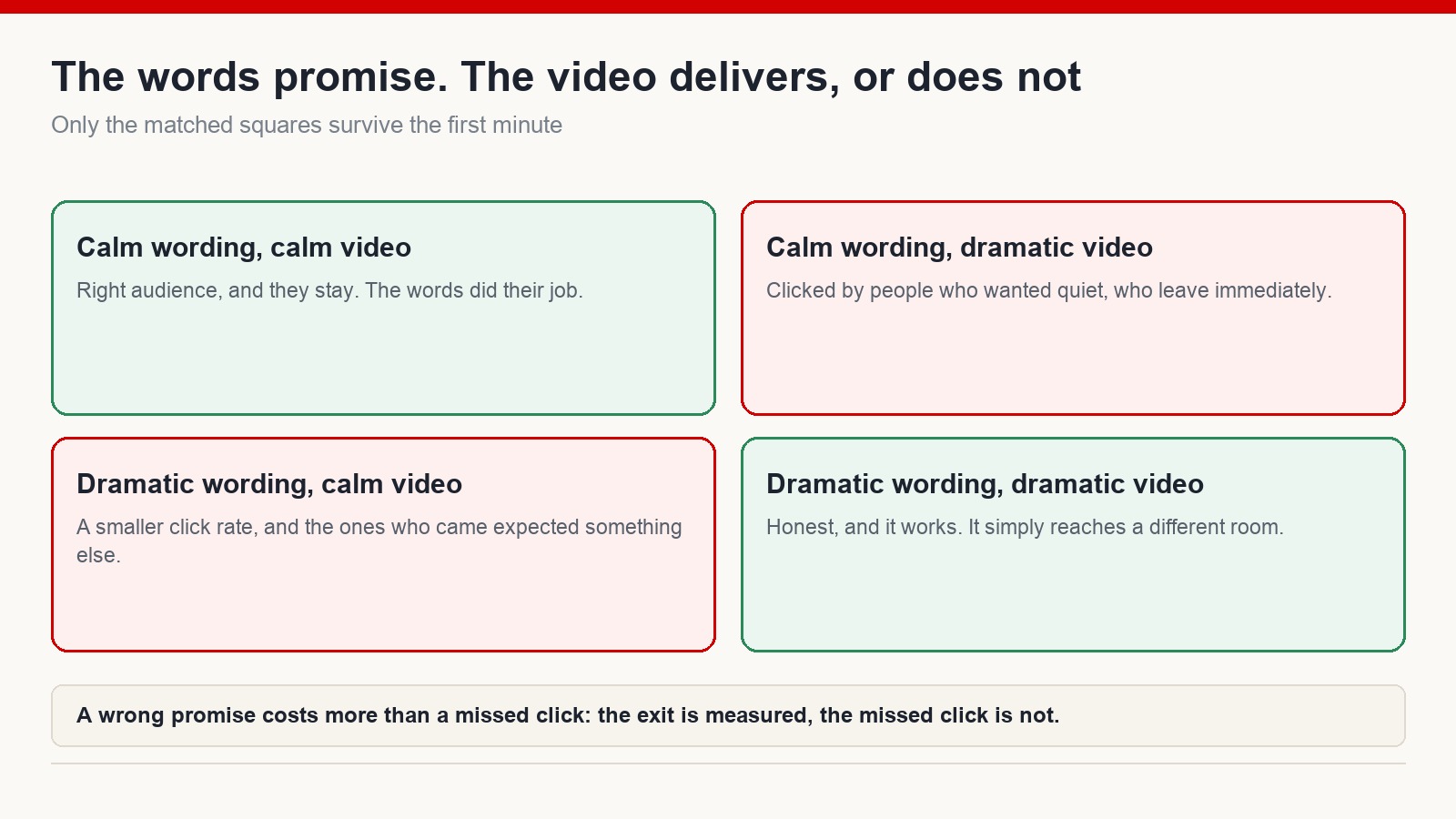
The second failure is subtler. Calm categories are not empty. Sleep and ambience audiences are served by very established channels with enormous back catalogues, and moving your titles into that space means competing with them rather than with whoever you were competing with before. Sometimes that trade is good. It is never automatic.
The third is seasonality and mix. Advertising demand moves through the year and differs by category. A change you make in one month can look brilliant or catastrophic in the next for reasons that have nothing to do with your titles at all.
Repositioning is real. Just not as a word swap
None of this means the underlying idea is worthless. Deciding which audience your content is offered to is one of the genuinely high-leverage decisions available to a creator, and it costs nothing to make.
But it is a positioning decision rather than a vocabulary trick. It means asking what experience your footage actually delivers, then finding the words that audience uses for that experience. If your nature footage really is slow, quiet and long-form, calm wording is accurate and the audience it brings will stay. If your footage is fast, loud and cut for impact, the same words are a lie, and the retention numbers will say so within a day.
Done properly, the change is not confined to the title. The thumbnail has to be calm too. The opening thirty seconds have to be calm. The length has to suit the use. Otherwise you have relabelled the box without changing what is in it, which viewers detect faster than any algorithm.
How to actually find out, on your own channel
Since nobody can tell you what this will do for your channel, the only sensible response is to measure it, and to measure it in a way that can produce a real answer.
Publish a group of videos positioned one way and a group positioned the other. Keep the production comparable. Give each group enough videos that a single unusual upload cannot dominate the result, and enough weeks that ordinary fluctuation averages out. Then compare across the groups: how many people clicked, how long they stayed, what the revenue reporting shows for each.
What you must not do is change the titles on one video, watch the numbers for three days, and conclude anything at all. Single-video, short-window comparisons on a platform this noisy will confirm whatever you already believed.
Optimising for the right thing
The useful reframing in all of this is not about calm words. It is that a view is not a unit. A hundred thousand views from people who watched four seconds and a hundred thousand from people who left something running for an hour are the same number describing two entirely different outcomes.
Once you accept that, the question changes from “how do I get more views” to “who is arriving, and does my content actually serve them”. Wording is one of the levers that answers the first half of that. The content answers the second, and there is no way to word your way around it.
Frequently asked questions
Do calm keywords increase revenue per view?
Not by themselves. They can bring a different audience with different watch behaviour, which is part of what sets the rate. If the content does not genuinely match the words, the effect is negative rather than neutral.
Should I use relaxing wording on every video?
No. Use it where the content really delivers that experience. On a tutorial, a news-style video or anything fast-cut, it is simply inaccurate, and inaccuracy costs retention.
Do I have to reshoot anything to reposition a video?
Often not, but you usually have to change more than the title. The thumbnail, the opening and the pacing all have to agree with the new positioning, or the promise breaks in the first minute.
How long should I test a repositioning before judging it?
Longer than feels comfortable. Several videos in each group, and enough weeks that one outlier cannot decide the outcome.
Is any of this guaranteed to work?
No. Advertising demand, competition and recommendation behaviour all change, and results differ enormously between channels and subjects. This is a way of improving your odds, not a mechanism with a fixed output.
The honest version of the advice
Choosing your words carefully changes who walks through the door. That is real, it is worth doing, and on some channels it makes a visible difference. What it is not is a lever with a rate attached.
If somebody tells you a specific list of words raises earnings, ask what happened to the content in between. If the answer is nothing, you are being sold a shortcut that the first minute of viewer behaviour will close.
The full system I teach for building faceless channels around English-speaking audiences is at mmoyoutube.com. Results vary by channel, subject and market.