How to Structure a YouTube Script So People Watch to the End
A video can be correct, well edited, well narrated and still lose most of its audience before the second minute. I spent an embarrassing amount of time blaming the edit for that. The edit was rarely the problem. The problem was the order I had put things in.
What follows is the YouTube script structure I use on faceless channels: how to sequence a video so that at every point there is still something ahead worth waiting for. I have been publishing on YouTube since 2017, mostly for English-speaking audiences, and this is the part of the process that changed my results the most.
Start with demand, not with what you feel like making
Before any structure question, there is a supply question. Most beginner scripts are answers to something nobody asked. The topic was chosen because the creator found it interesting, and then the script had to work uphill for the whole video.
If a subject already has search volume, a healthy stack of videos with real view counts, and comment sections full of follow-up questions, the demand is proven. Starting there is not unoriginal, it is just cheaper. Save the contrarian bets for when you have an audience that will follow you into them.
Information has an order. Feeling has an order too.
The instinct most people bring from school is to organise by logic: define the thing, explain the thing, list its properties, conclude. That order is fine for a document. It is terrible for a video, because logic has no forward pull. Nothing in paragraph three makes you need paragraph four.
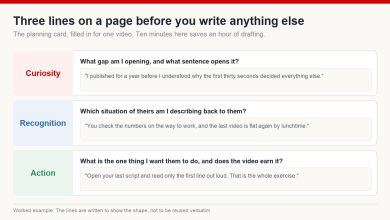
A script that holds an audience is sequenced by pressure instead. Something is opened, something is raised, something is resolved, and while it is being resolved something else is opened. The classic run for story-driven and documentary formats is curiosity, then indignation, then recognition, then payoff. Curiosity gets someone in. Indignation stops them putting the phone down. Recognition is where they see themselves in it. The payoff is the reason they come back to the channel.
Put your best material last
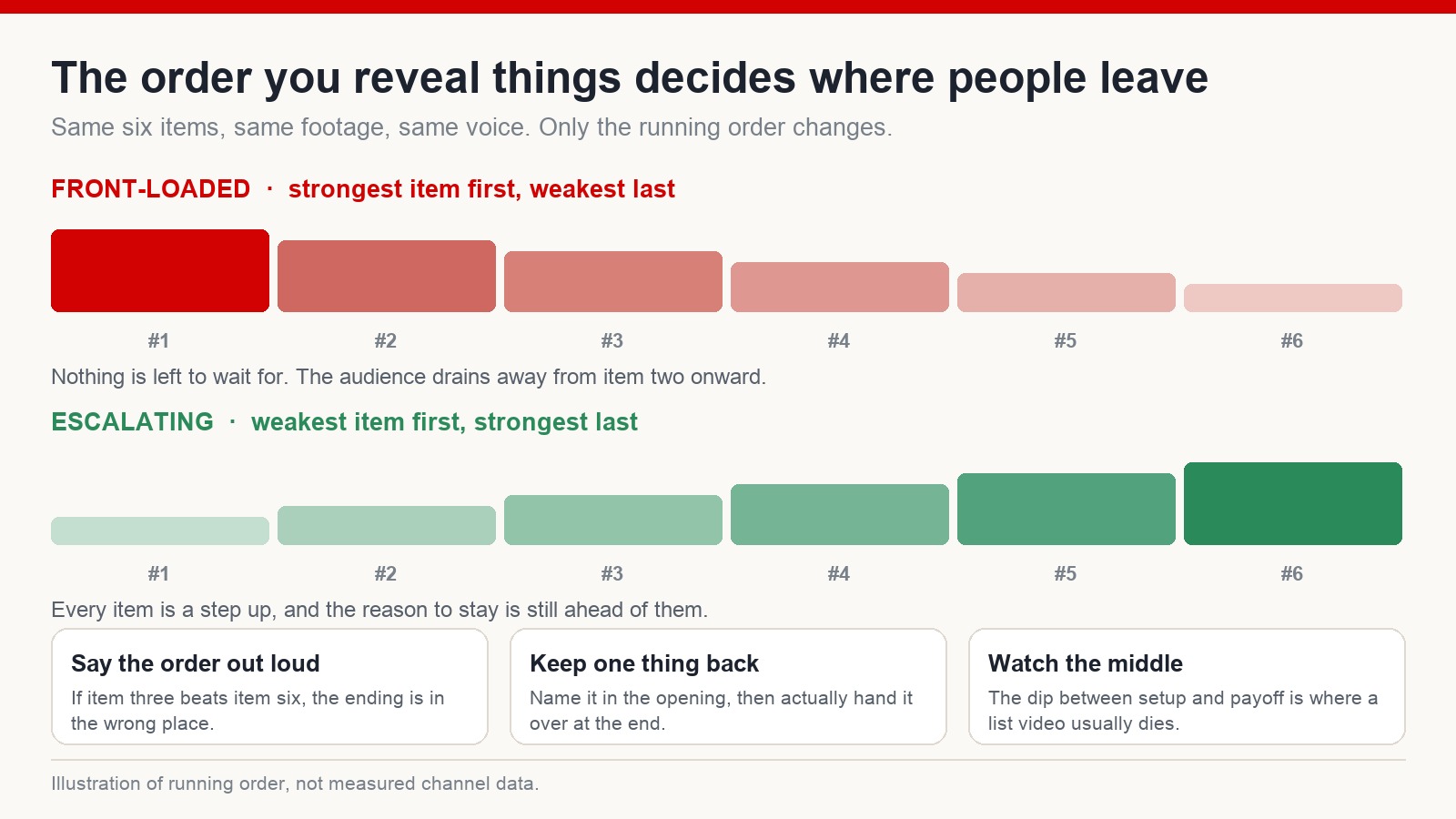
This is the change that costs nothing and helps most. The instinct is to lead with the strongest item, because it is the one you are proudest of. Do that in a list video and you have handed over the reason to keep watching in the first ninety seconds.
A countdown works for a reason. If the video promises the most dangerous animal on the list and the audience knows it is at the end, the whole middle inherits some of that pull. Rank your points honestly. If point three is better than point six, either move it or cut it, because on the way to a weak ending a viewer will leave and the graph will show you exactly where.
The same applies outside list formats. Decide early what the single best moment of the video is, name it in the opening, and then hold it back until you have earned it.
Write the opening last
Plenty of experienced creators do not write an intro at the start at all. They finish the video, watch it back, find the most alive thirty seconds in it, and build the opening out of that.
The logic is simple: at the start of the process you are guessing what the strongest moment will be. When the edit is done, you know. An opening assembled from material that already exists also has an obvious advantage over a written promise: it shows the viewer a piece of what they were promised instead of describing it.
Practically, that means writing the body first, marking two or three candidate moments while you draft, and choosing between them once the video is assembled.
Say it and show it in the same second
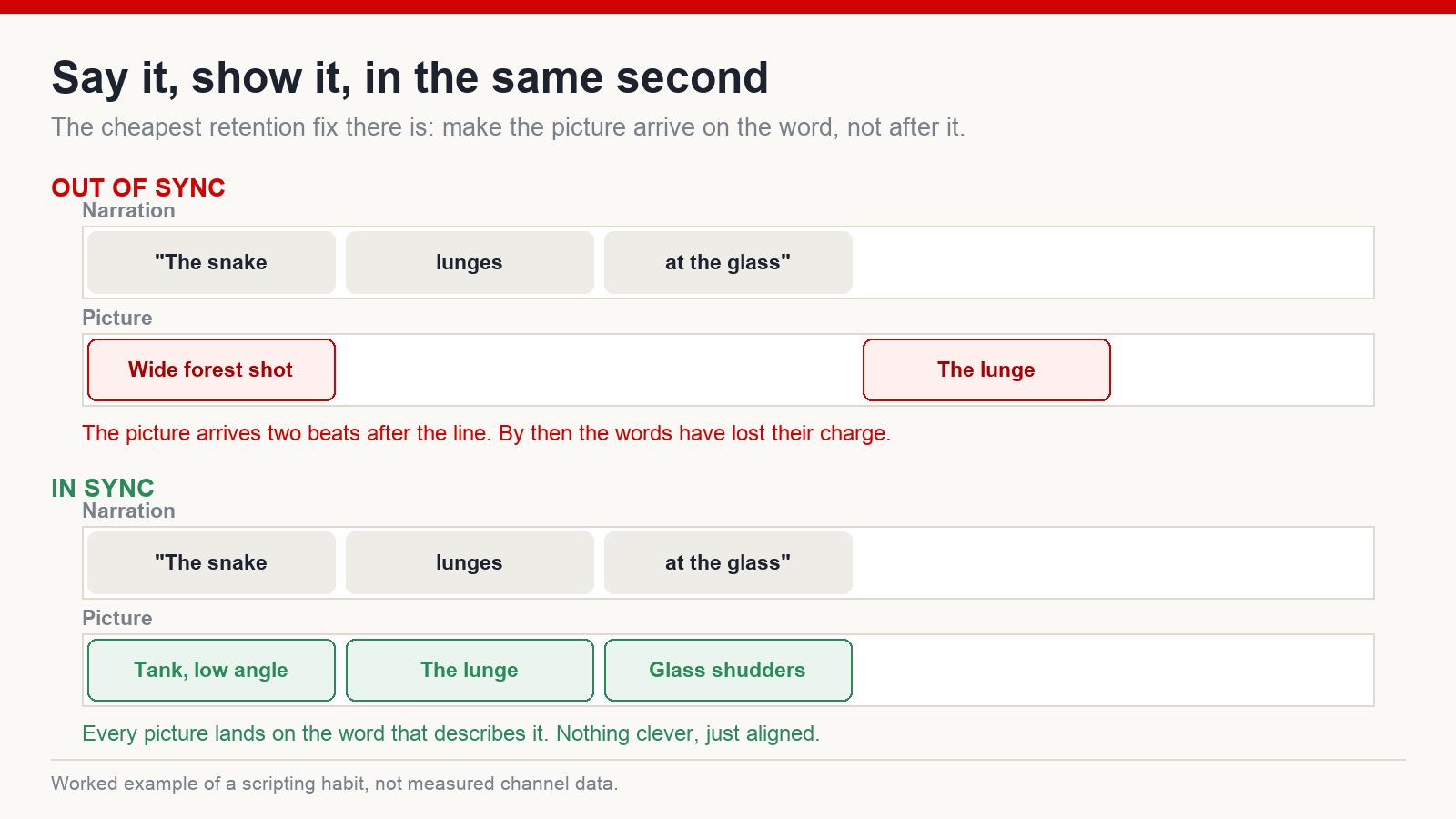
This is the smallest and most reliable retention habit I know. When the narration says the snake lunges, the lunge appears on that word. Not two seconds later, and not over a wide establishing shot that happens to be nearby in the timeline.
When sound and picture agree, the video feels immediate and the viewer stops noticing that they are watching something assembled. When they disagree, even by a beat, attention slackens. On a faceless channel this matters more than anywhere else, because narration and picture are the only two instruments you have.
Every segment needs a bridge into the next one
Look at where people leave a long video and it is usually at a seam: the moment one section finishes and the next has not started pulling yet. A bridge line is what closes that gap.
“That is the easy half. The other half is where most people quit.”
“Which brings up the question I get asked more than any other.”
“And this is the part I got completely wrong the first time.”
“Before the last one, there is something you need to know about the third.”
They cost about four seconds each and they are the cheapest structural repair available. The rule that keeps them honest: never open a loop you do not close inside the same video. Bait works once, and then people stop believing your openings.
Ask for one thing, and make it a real question
Long calls to action get ignored. Three requests in a row get ignored harder. One clear ask, placed where the video has just delivered something, does far better than a list of favours at the end.
One warning here, because it is a habit that spread widely and is genuinely risky. Asking viewers to “comment 1 if you watched to the end” or “comment 0 if this scared you” is engagement bait, and soliciting engagement that way is against YouTube’s policies. It can get comments or the video removed. Ask something people would actually want to answer instead: which of these have you already tried, or what would you have done differently. The answers are also worth reading, which the number comments never are.
Three mistakes that show up in the graph
The lecture. Accurate, complete and airless. Nobody opens the app to attend a seminar. Facts still need somewhere to sit.
The long approach. Twenty seconds of preamble before the subject arrives. Whatever the video is really about should be visible almost immediately, even if it is not explained yet.
The flat middle. A video that is the same temperature at eight minutes as it was at one. If nothing escalates, people leave quietly somewhere in the middle and you will not be able to point at a single line as the culprit.
Getting useful structure out of a model
Asking a model to “write a script about X” produces exactly what you would expect: an even, sourceless summary with no pressure in it. The fix is to hand over the structure and let the model fill it.
“Restructure this draft so the running order is curiosity, then tension, then recognition, then payoff. Move the strongest item to the end. Add a one-line bridge at every section break that closes the previous question and opens a new one. Short sentences. Keep every fact from my draft and do not invent new ones.”
That works because the judgement stayed with you. The model is arranging your material, not sourcing it.
Where to start
If you want one pass to run on your next script, run this one: write your sections as a numbered list, with no prose, and read it downward. Ask whether each line makes you want the next one. If it does not, reorder before you write a single sentence of narration. Structure is much cheaper to fix on a list than in a timeline.
Frequently asked questions
Does retention matter more than views?
They are connected rather than ranked. How long people stay is one of the signals that decides whether a video gets shown to more people, so retention tends to arrive first and views follow.
How long should an opening be?
The first few seconds carry most of the weight, and the whole opening should be well under fifteen. Get to the unresolved thing quickly and resolve it later.
Why hold the best part until the end?
Because it is the only thing keeping someone through the middle. Once it is spent, the rest of the video has to survive on goodwill.
Can AI write a script that holds attention?
It can write the sentences. The structure, the running order and the judgement about what matters still have to come from you, and results vary a great deal by niche.
If you want the full process for building a faceless channel aimed at English-speaking audiences, that is what I teach at mmoyoutube.com.