Localisation Is Not Translation: The Pass to Run on Every Script
Most people building a channel for a foreign audience think the language problem is solved once the grammar is correct. It is not. There is a wide gap between a script that is correct and a script that sounds like somebody from inside that audience wrote it, and viewers hear the difference long before they could explain it.
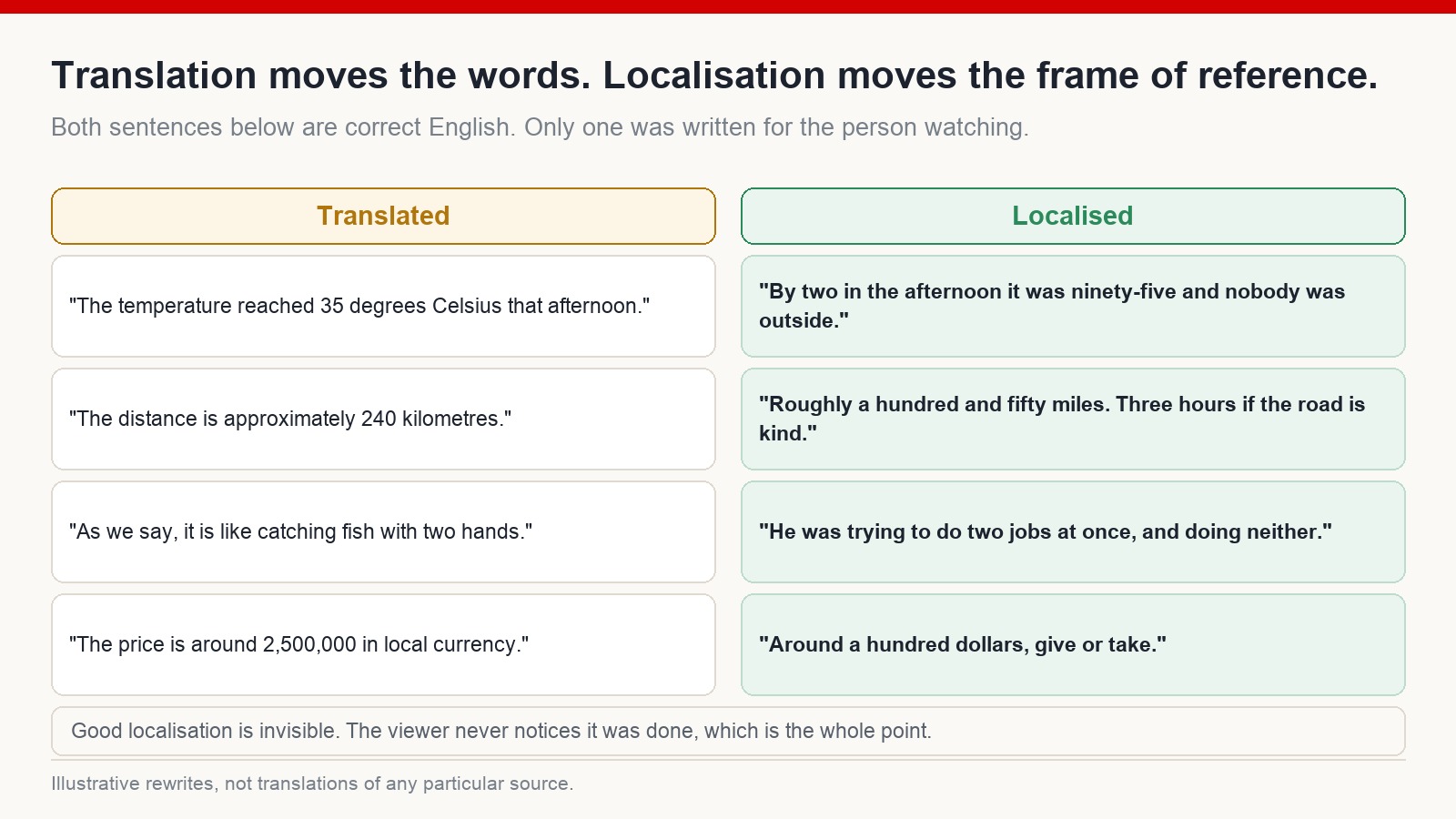
Closing that gap is localisation, and it is a different job from translation. Translation moves the words. Localisation moves the frame of reference: the units, the money, the dates, the examples, the sayings — everything a person who grew up somewhere simply assumes.
The difference, in one comparison
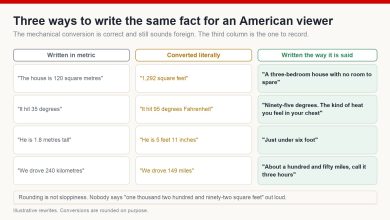
“The temperature reached 35 degrees Celsius that afternoon” is correct English. “By two in the afternoon it was ninety-five and nobody was outside” is the same fact written for the person watching. Both are accurate. Only one was written from inside the audience’s head.
The second version is not more polished. It is doing something the first one is not: it never asks the viewer to convert anything, and it gives them a picture instead of a measurement.
Good localisation is invisible
This is the part that makes it hard to sell as a task: when it works, nobody notices. A viewer does not think “well localised”. They simply never get the feeling that the video was made somewhere else and pointed at them.
That feeling is the thing you are managing. Viewers rarely put it into words, and they never leave a comment saying the content felt foreign. They just leave, and it shows up as a curve that drops early for no reason the analytics can explain.
Write from the other head
The mental move is simple and it takes practice. Before a sentence, ask: how would somebody in that audience say this? What would they picture? Which example would land without explanation?
Once you are genuinely asking those questions, most of the individual decisions stop needing rules. You do not have to remember that Americans use Fahrenheit if you are imagining an American saying the sentence. The checklist below is a safety net for the times when you are writing fast and forget to imagine anybody at all.
The seven-item pass
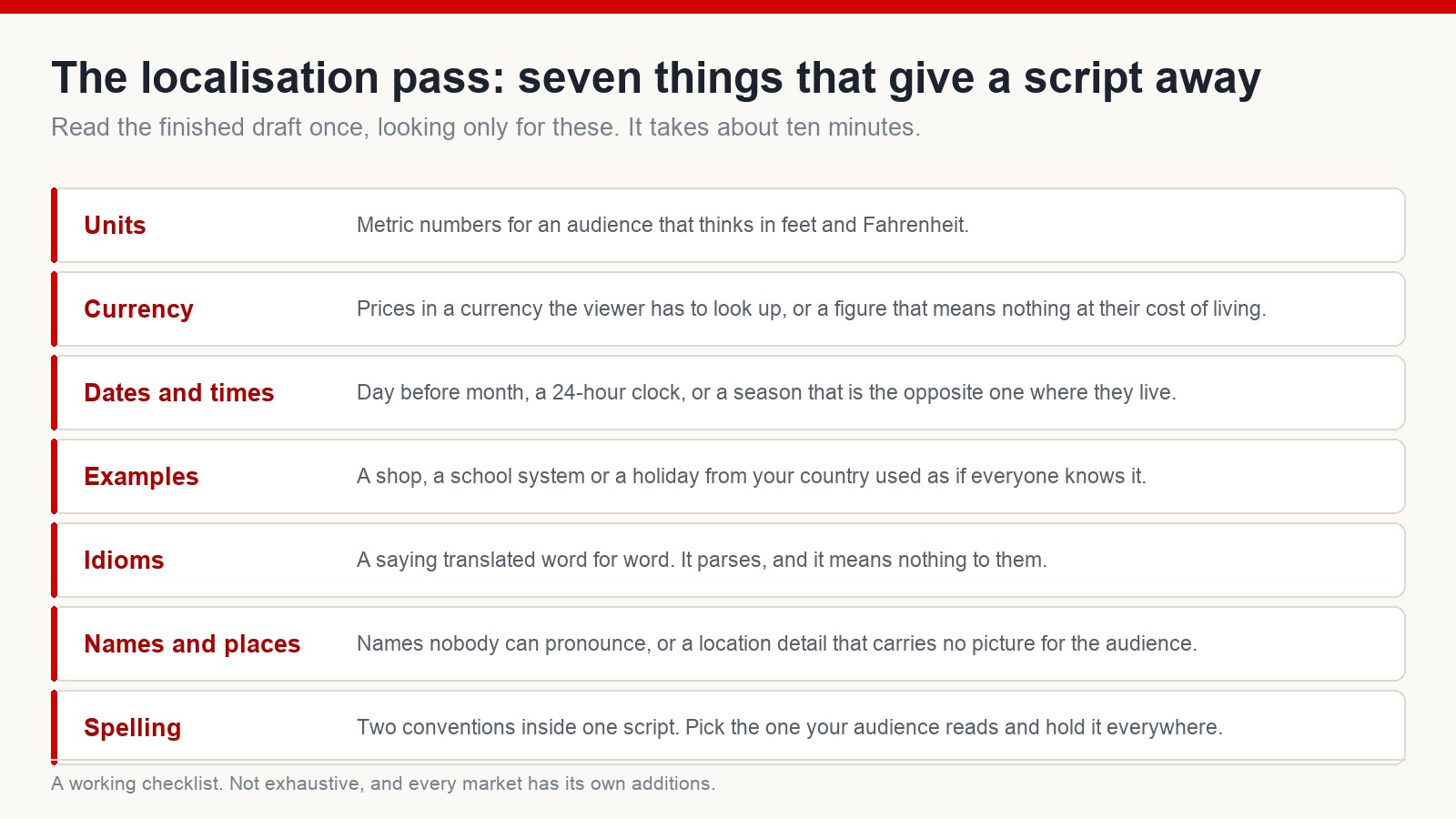
Read the finished draft once, looking only for these. Ten minutes on a normal script.
Units. The most visible one. Write in the system the audience thinks in, round to something a person would say out loud, and replace the figure with a description when the precision was never the point.
Currency. Quote prices in the currency of the market you are addressing. A figure in a currency they have to look up is a stall in the middle of your sentence — and even converted, a number only means something against the audience’s own cost of living, so a comparison often works better than the amount.
Dates and times. American audiences read the month before the day, and the twelve-hour clock is the default in speech. Seasons are worth a moment’s thought too, since “summer” points at opposite ends of the year depending on hemisphere.
Examples. This is the item people skip and it may be the most important. A shop, a school system, a public holiday or a piece of everyday bureaucracy from your own country lands as a blank for an audience that has never encountered it. Either pick a reference they share, or spend a clause explaining it — and if it needs more than a clause, pick a different example.
Idioms. Sayings almost never survive a word-for-word move. The translated version parses, means nothing, and marks the script as imported more clearly than any unit does. Find the equivalent expression the audience actually uses, or simply say the plain thing you meant.
Names and places. A name nobody can pronounce breaks the rhythm of the narration every time it appears. A location detail that carries a strong picture at home may carry none abroad; either give it a sentence of context or drop the detail and keep the point.
Spelling. Choose one convention and hold it. Two conventions inside one script — one word spelled the British way, the next the American — is a small thing that reads as carelessness, especially in on-screen text.
Make it a step, not a mood
Localisation done when you happen to remember is localisation done badly. Put it in the process: script written, then one dedicated read for these seven items, then record.
The reason to make it a separate pass rather than something you do while drafting is that they are different kinds of attention. Drafting is about what you are saying. This pass is about how it will land somewhere else, and trying to hold both at once means one of them gets done poorly.
Where localisation should stop
One boundary worth stating, because it is easy to overshoot. Localising is about removing friction, not about pretending to be someone you are not. Manufacturing a personal history in a country you have never lived in is a lie the audience will eventually catch, and it destroys far more than an awkward idiom ever would.
The honest version is straightforward: write in the audience’s frame of reference, drop the details that only make sense at home, and when your own perspective is genuinely from elsewhere, say so plainly. An outside view, admitted, is interesting. An outside view, disguised, is a problem waiting to happen.
Why the small details decide it
None of these seven items is individually large. What they have in common is that each one is a signal, and viewers read signals in aggregate. Enough of them agreeing produces a channel that feels like it belongs. A handful disagreeing produces the quiet verdict that this was made somewhere else — and that verdict is expensive, because it applies to everything you say afterwards.
Results vary and no amount of localisation rescues a video nobody wanted. But among the things you control, this one is unusually cheap: ten minutes a script, and it compounds across everything you publish.
Frequently asked questions
What is the difference between translation and localisation?
Translation converts the words. Localisation converts the frame of reference — units, currency, dates, examples, idioms and conventions — so the content reads as though it was written inside the audience’s world.
Do I have to hide that I am not from the audience’s country?
No, and you should not try. Remove the details that create friction, keep your own perspective, and be straightforward about where you are writing from if it comes up.
Which market should I localise for if my audience is split?
The largest group, and then stay consistent. Mixing conventions inside one video is worse than picking the less common one and holding it.
Can a language model localise a script for me?
It is genuinely useful for flagging idioms and converting figures, and unreliable at judging which examples an audience shares. Use it as a first pass and read the result yourself.
How long should the pass take?
About ten minutes on a normal script, less once the habit forms and you start writing in the audience’s conventions from the first draft.
If you want the full process for building a faceless channel aimed at English-speaking audiences, that is what I teach at mmoyoutube.com.