Working Smart on a Faceless Channel: Five Habits That Beat Publishing More
For a long stretch I was convinced that whoever published the most would win. I worked days, worked nights, uploaded as often as I could physically manage, and treated the number of videos as the whole strategy.
Then I noticed something that stopped me: people publishing a couple of videos a week whose channels grew steadily, next to people publishing daily whose view counts barely moved. The gap was not hours at the desk. It was how the work was being decided.
Nine years into building faceless channels for English-speaking audiences, these are the five habits I keep seeing in the people who are still doing this profitably years later. None of them are about working less. They are about spending the same effort in a way that compounds.
1. Run a process, not a mood
Creators with stable results rarely open the day by asking what they feel like making. They have a sequence, and the sequence does not care how inspired they are.
Mine looks roughly like this: research the subject, build the keyword set, read what competitors did with it, write the script, design the packaging, publish, watch the data, write down what the data changed.
The point of a documented sequence is not bureaucracy. It is that a good process produces a floor. Your best video will still come from a good day, but your worst video stops being a disaster, and on a channel the floor matters more than the ceiling because the floor is what the majority of your library is made of.
It also makes you replaceable to yourself. When you are ill, travelling or simply flat, a written process means the channel keeps moving without requiring you to feel a certain way about it.
2. Let data outrank the feeling
This is the clearest split between someone in their first year and someone in their fifth. A beginner says I think this video is good. Someone experienced asks a different set of questions.
- Did people click it when they saw it?
- How far in did they get before leaving?
- Did anyone come back for a second video?
- Does the subject keep working, or was it one lucky upload?
Feeling is what makes you creative. Data is what makes you correct. You need the first to produce anything worth watching, and the second to decide what to do next.
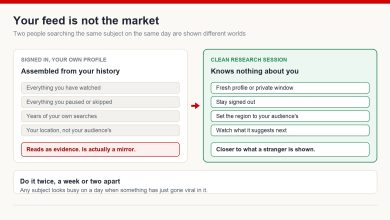
This matters twice as much when the audience lives somewhere you do not. If you are making videos for viewers on the other side of the world, your instinct about what is interesting was trained in a different market. The numbers are the only feedback you have that is not filtered through your own cultural defaults.
3. Watch the trend, not the spike
One video underperforming does not mean the idea was wrong. One video overperforming does not mean it will repeat. Individual results are noisy in both directions, and both kinds of noise are emotionally loud.
What is worth reading is the direction across many uploads: which subjects keep working, which title shapes keep getting a response, which formats hold attention to the end.
The failure mode here is common and expensive – a bad week triggers a total change of direction, and the change resets whatever pattern you were three videos away from being able to see. Do not let one day’s numbers rewrite a quarter’s plan.
4. Test constantly, but test one thing
Almost nobody gets it right on the first attempt. The people who get there are running structured experiments rather than hoping harder.
Things worth testing: the title, the thumbnail, the opening seconds, the structure of the middle, the length, the editing pace.
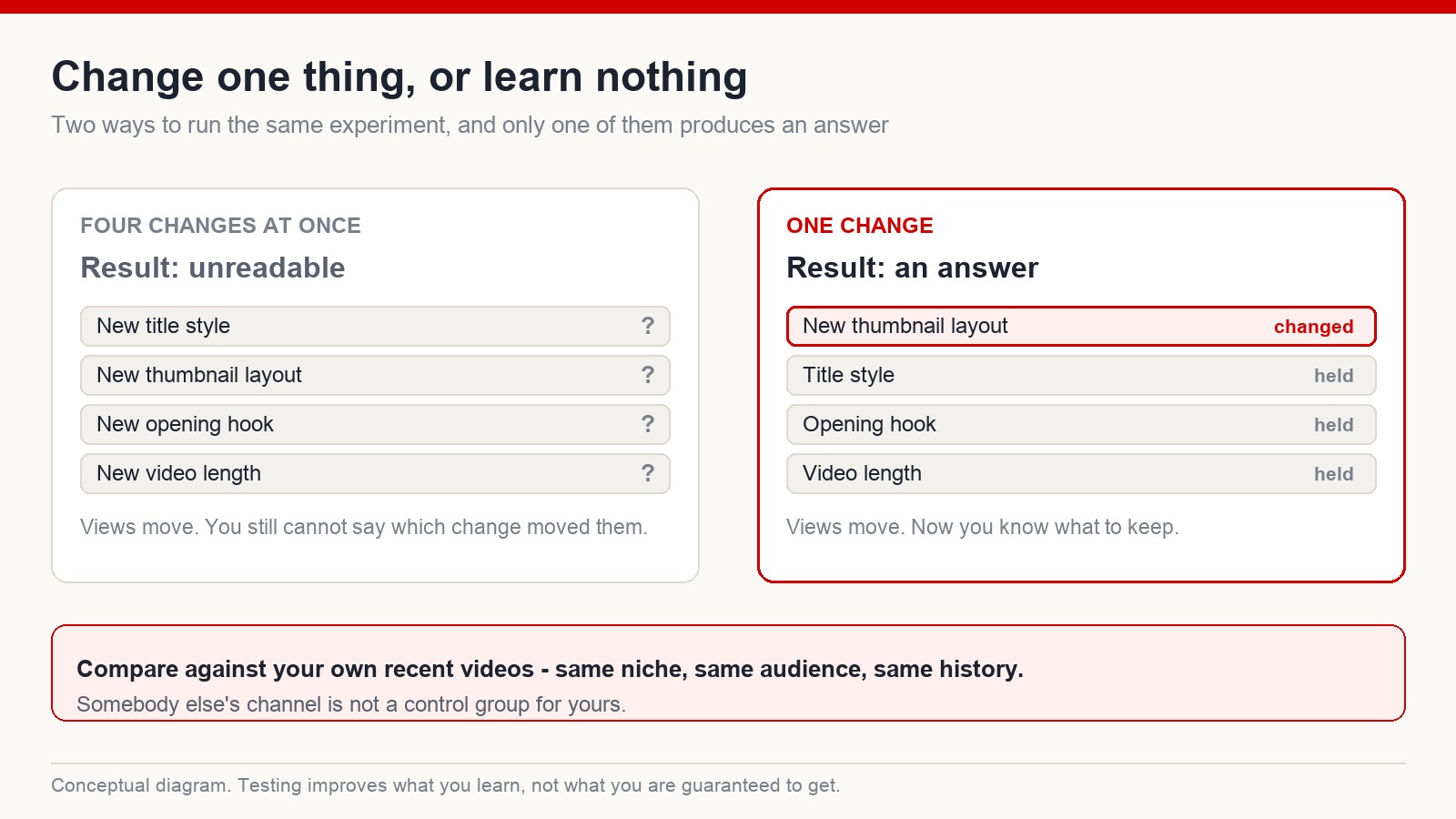
My rule is simple: change one element at a time, then compare. Change four and you will still see the views move, but you will have no idea which change moved them, so you have paid for the experiment and received nothing.
And compare against your own recent videos, not against a screenshot from someone else’s channel. Your last ten uploads share your niche, your audience and your history, which makes them the only fair control group available to you. Someone else’s channel is a different experiment entirely.
Testing is also not there to prove you were right. It is there to find out what this specific audience responds to, which is frequently not the thing you would have picked.
5. Retire the channel, keep the research
This is the habit I find most people resist, and the one that saves the most time over a few years.
If a project is not working after an honest attempt, you are allowed to stop. What you are not allowed to do is conclude that the market is dead, the subject is finished, or that you are not built for this – because none of those conclusions are supported by one project failing.
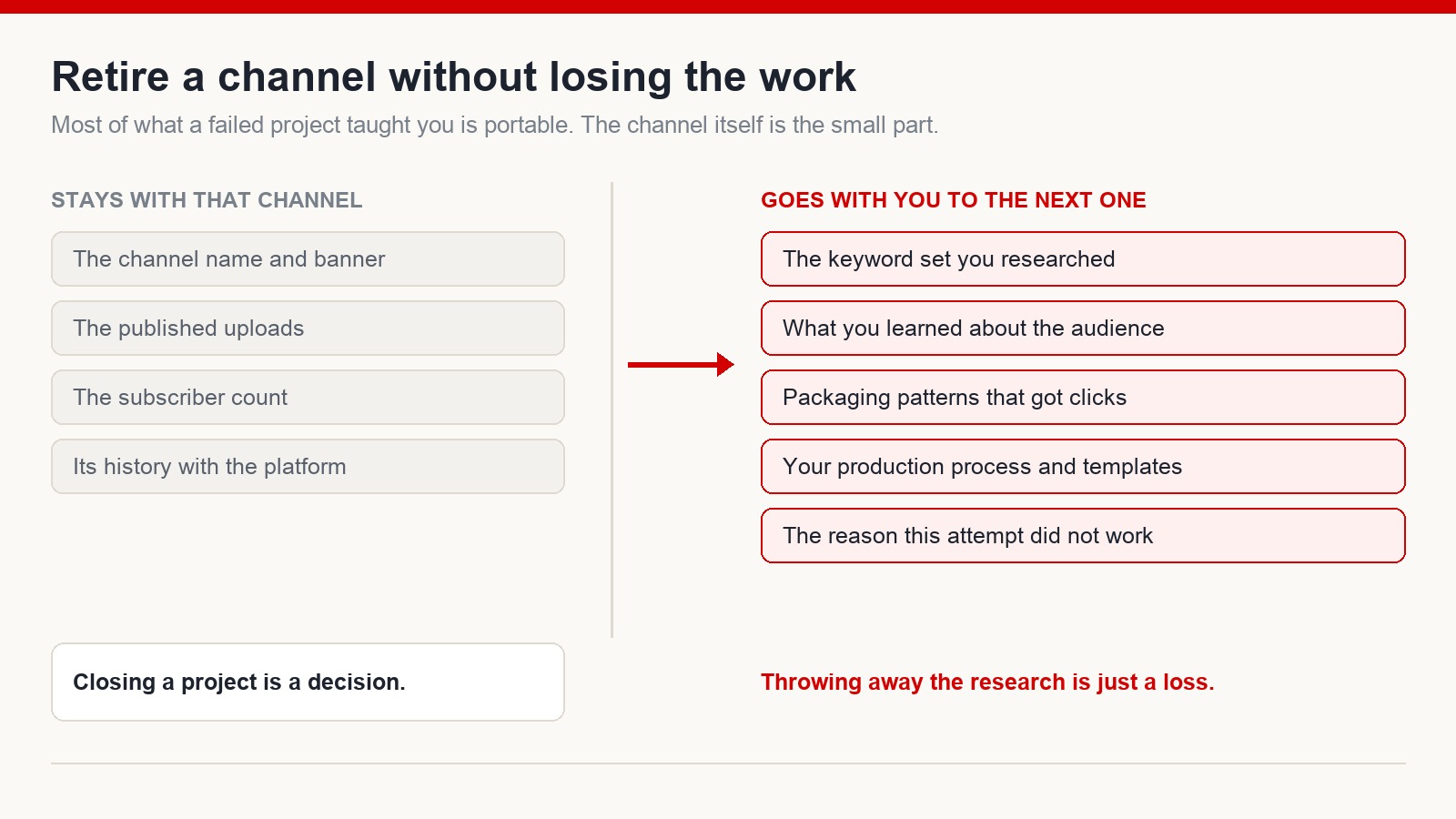
What stays behind is the channel name, the uploads and the subscriber count. What travels with you is everything that actually took the time: the keyword set you built, what you now know about the audience, the packaging patterns that got clicks, your production templates, and a clear reason why this attempt did not work.
Closing a project is a decision. Throwing away the research on the way out is just a loss. I have watched people abandon months of keyword work along with the channel, then start the next attempt from the same blank page they started the first one from.
The operator’s view
The through-line in all five habits is that the video is not the product. The system is.
People who last build a production process, a content library, a keyword set, an analytics routine and a way of improving each of those. Every upload makes those assets slightly better, which is what makes growth cumulative instead of dependent on getting lucky.
To be clear about what this does and does not promise: none of it guarantees an outcome. Niches saturate, platform behaviour changes, and plenty of well-run channels never find an audience. What a system gives you is legible results – after twenty videos built to a plan, you can say what worked. After twenty scattered ones you can only say whether you feel good about it.
The people I have seen go the distance were rarely the fastest starters. They were the ones who kept adjusting, kept the useful parts, and were still there after the fast starters had run out of energy.
Frequently asked questions
Should I shut down a channel that is performing badly?
Possibly, but diagnose it first. The problem is often positioning, packaging or the content itself rather than the whole market. And whatever you decide, keep the keyword research and the notes.
How much testing is enough?
There is no fixed number. Test deliberately, write down what you changed, and change one element at a time so the result can be attributed to something.
Does hard work still matter?
Yes, but it multiplies whatever direction you are pointed in. Effort with a process and data behind it compounds. Effort without them repeats the same mistake faster.
How long before a process shows results?
Longer than most people expect, and it varies with the niche and the audience. The realistic promise is not speed but clarity – you learn faster, which over time is what changes the outcome.
If you want to see how this way of working is applied to channels aimed at English-speaking audiences, that is what I do at mmoyoutube.com.