The Skill No Tool Replaces: Building a Network as a Creator
Every week there is a new tool. People learn to prompt, collect video generators, spend evenings testing applications, and end the year with a much better toolkit and roughly the same income.
Meanwhile someone with a worse toolkit gets the collaboration, the introduction, the deal – because a person who trusted them thought of them at the right moment.
I do not think this is a coincidence, and I do not think it is unfair. As the tools become universally available, the thing they cannot supply becomes the scarce one. What is scarce now is trust between people, and there is no subscription for it.
Some of what follows crystallised for me watching talks by Dan Martell, the Canadian entrepreneur and coach who writes about buying back your time. The observation that stuck was how deliberate he is about proximity to people ahead of him – he has described being willing to travel a long way for a conversation of under half an hour, and treating that as an investment rather than a cost. That is a very different relationship to time than most people have.
Your room sets your ceiling
You gradually become the average of the people you spend the most time around. Not because anyone is holding you back deliberately, but because a group shares assumptions about what is normal, what is risky and what is worth attempting.
If everyone around you thinks a modest steady thing is the sensible ceiling, you will find it very hard to seriously plan for anything larger. Not through lack of ambition – through lack of examples. Nobody in view has done it, so it stays theoretical.
The fix is not abandoning your friends. It is deliberately adding one or two rooms where the standard is higher, so that the version of normal you carry around gets updated. That can be a paid community, a small group of peers who are further along, or simply following the work of people who are visibly better and taking it seriously.
Someone has already solved this
There is a particular kind of pride that keeps people stuck: the belief that working it out alone is more honourable.
I lost a lot of time to that. Months spent reverse-engineering something a single conversation would have handed me, because asking felt like an admission. Meanwhile the person I could have asked had solved it years earlier and would probably have told me in ten minutes.
Learning directly from someone who has done the thing is not a shortcut in the pejorative sense. It is a decision about what your time is worth. The caveat is that this only works if it runs both ways – a relationship where one person only extracts is not a relationship, it is a slow-motion imposition, and people notice.
Stop chasing contacts, start publishing
The default advice on networking is to go to more events, send more requests and follow up harder. That works, in the sense that anything works if you do enough of it. It is also exhausting, and nothing accumulates between attempts.
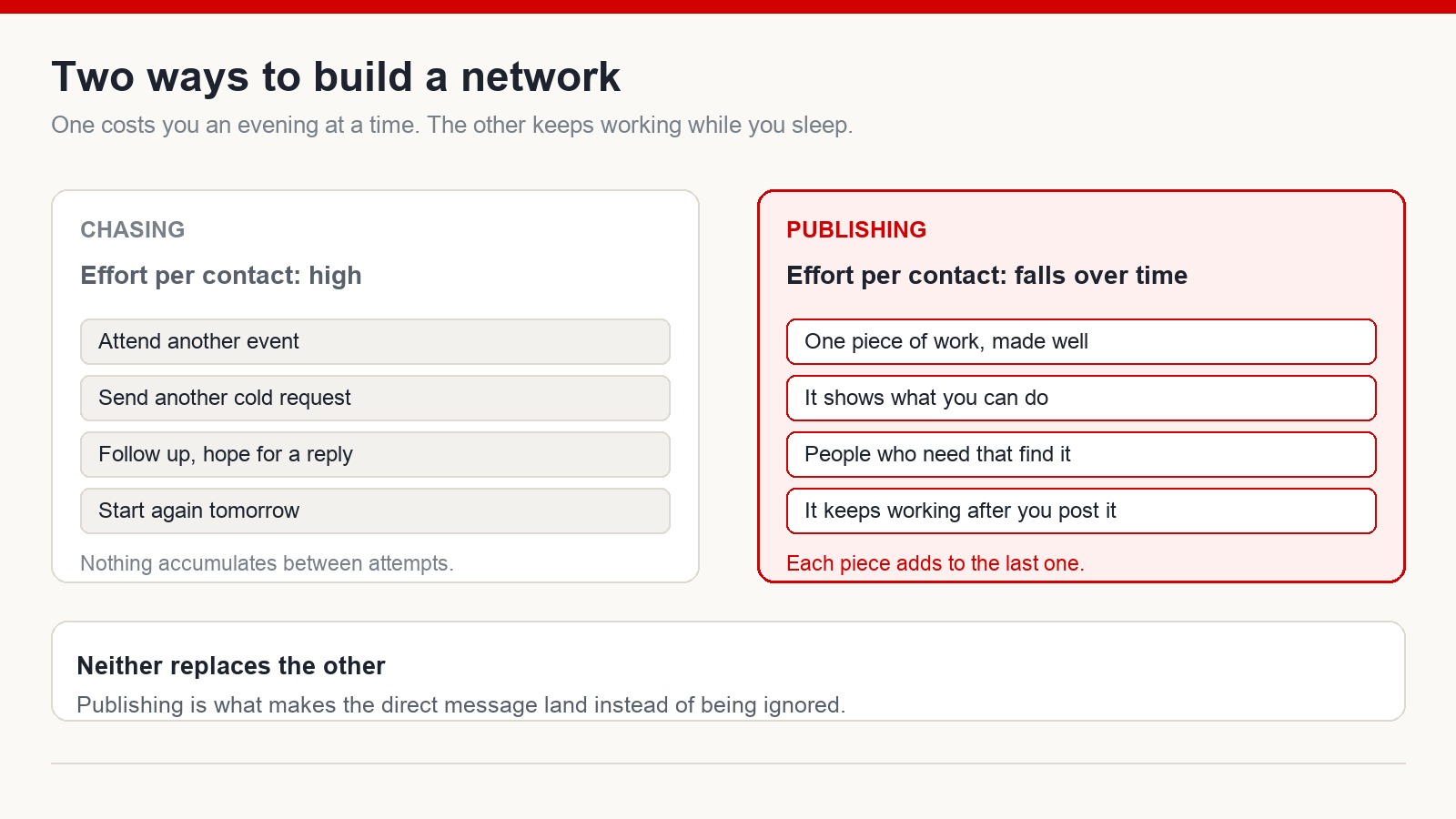
There is a version with better mechanics: publish work that demonstrates what you can do, consistently.
Every article, video or breakdown you put out is a calling card that keeps working after you have stopped thinking about it. It shows how you think, what you know and what it is like to work with you – which is precisely what someone needs to know before they will introduce you to anyone or hand you anything.
Do that for long enough and the direction of travel reverses. People with similar interests arrive on their own. Clients contact you rather than being pursued. Opportunities surface that you were not looking for and could not have engineered.
To be honest about the timeline: this is slow. It does not work in a month, and it will not work at all if the work is not genuinely useful. But it compounds, which chasing does not.
Asking is a skill, and it is learnable
An enormous number of opportunities die at the point of not sending the message. Fear of being a nuisance, of being ignored, of not being good enough yet.
The way through is to make the message easy to answer. What you ask for matters far less than how much of the other person’s effort you are quietly requesting.
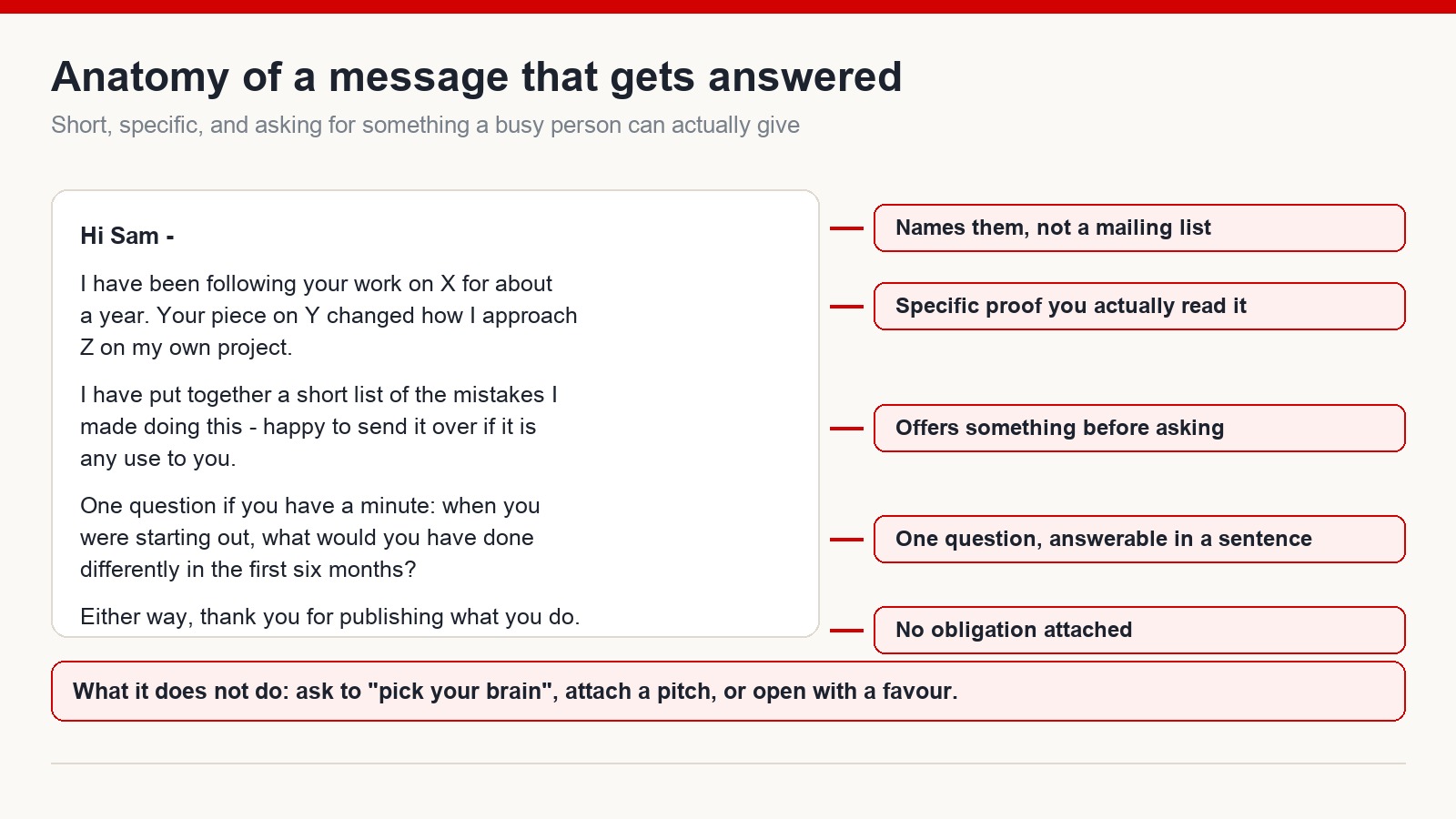
A message that works is short. It names something specific you engaged with, so it is obviously not a template. It offers something before it asks for anything. It contains exactly one question, answerable in a sentence. And it makes clear that no reply is also a fine outcome.
What it never does is ask to “pick your brain”, attach an unrequested pitch, or open by requesting a favour from someone who does not know you exist.
Three things worth doing this month
- Write the list. Twenty people in your field you would like to learn from or work with. Not a fantasy list – people whose attention is plausibly reachable.
- Give first, without an invoice attached. Share their work with a genuine comment on why it is good. Send a correction privately. Make an introduction that helps them. Do it with no expectation, because doing it with an expectation is a transaction wearing a costume and everyone can tell.
- Send the short message. Specific, brief, one question, no obligation. Then let it go.
None of these do anything visible this month. Over a couple of years they compound into something you could not have bought.
Why this is the durable advantage
Tools will keep improving and keep getting cheaper. Whatever you learned this year will be partly obsolete next year, and the specific skill of operating a particular application has a short shelf life by design.
A reputation does not depreciate on that schedule. Neither does the fact that thirty people know your work is honest and that you do what you said you would do.
Anyone can subscribe to the same tools you use. Nobody can subscribe to your relationships. So keep learning the tools – they matter, and falling behind on them is a real cost. But do not let the tooling absorb all the hours, because how far you get is not only a function of what you know. It is also a function of who is willing to vouch for you.
Frequently asked questions
Does AI make relationships less valuable?
The opposite, in my view. When capability becomes widely available, the differentiator moves to trust and judgement, neither of which is distributed by a subscription.
Can an introvert build a network?
Yes, and often better. You do not need volume. A handful of real relationships maintained honestly beats hundreds of contacts, and publishing work suits people who would rather write than mingle.
How does publishing lead to relationships?
It shows people how you think before they have to spend time finding out. That is what makes someone willing to reply, refer you or work with you.
Should I ignore the tools then?
No. Tools raise your output and falling behind is expensive. The argument is about proportion – if every hour goes to tooling and none to people, you are optimizing the part that everyone else has already optimized.
If you want to see how this thinking runs alongside the technical side of building channels for English-speaking audiences, that is what I work on at mmoyoutube.com.