How Much of a Channel Should Chase Trends?
For a stretch of about six months I made nothing but evergreen videos. Carefully researched, properly optimised, decent thumbnails, subjects that would still make sense in three years.
The views crawled.
Then, mostly out of frustration, I made one video on something that was happening that week. The video did well, which I half expected. What I did not expect was that several of the older evergreen videos started getting recommended more in the weeks afterwards.
That is one channel and one observation, not a study, and I would not build a strategy on a single anecdote. But it changed how I thought about the question, which until then I had been framing as a choice: are you an evergreen channel or a trend channel?
It is not a choice. They are two components of the same system, and channels that only run one of them tend to have a predictable problem.
What each one is actually for
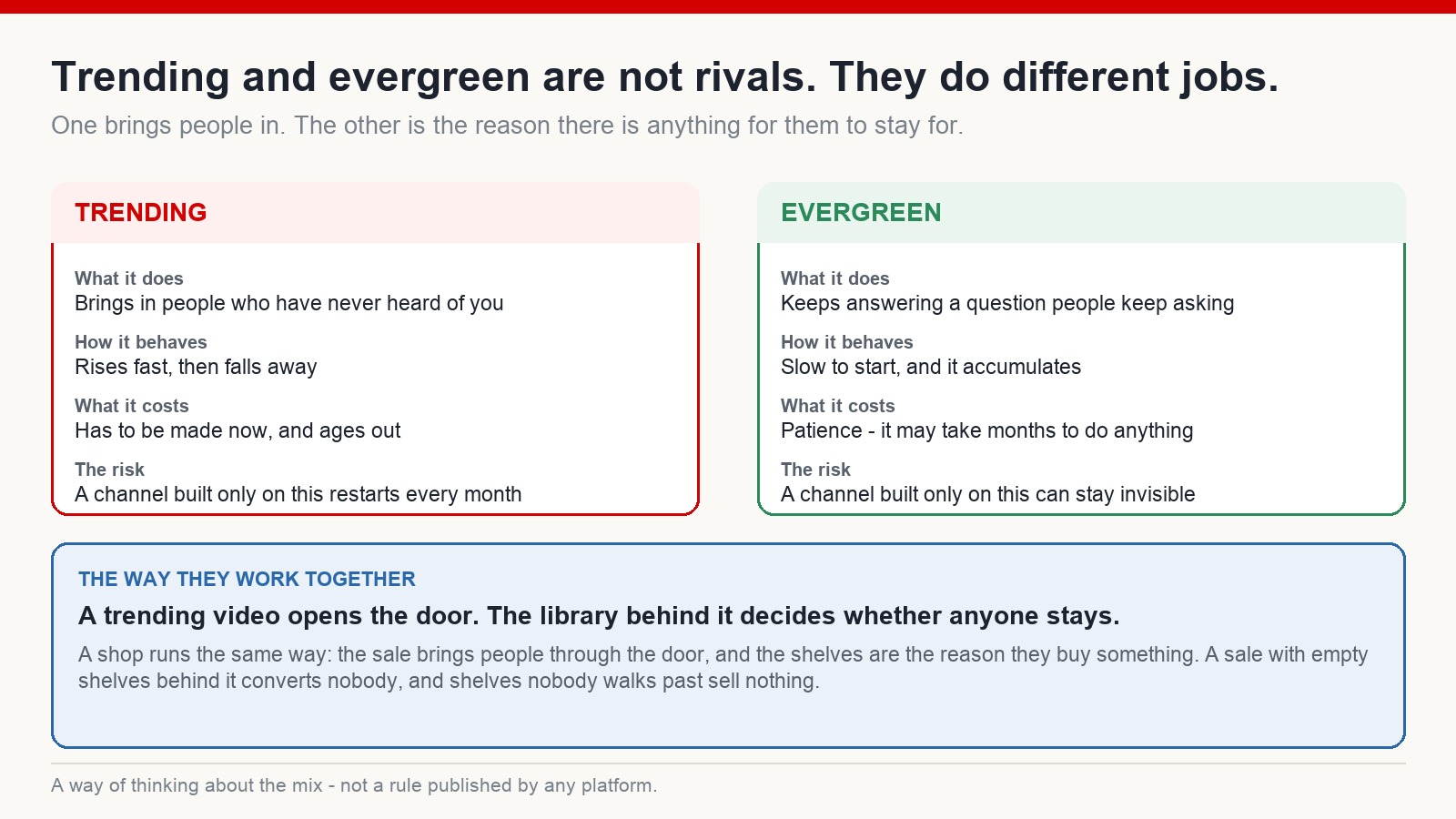
Trending content brings in people who have never heard of you. It rises quickly and falls away just as quickly, it has to be made now or not at all, and its shelf life is short by definition. The risk of relying on it is that the channel restarts from zero every month – each spike brings people who came for the moment, and the moment passes.
Evergreen content answers a question people keep asking. It starts slowly, sometimes discouragingly so, and it accumulates: a video published two years ago can still be bringing in viewers today. The cost is patience. The risk of relying on it alone is staying invisible – a library nobody has any reason to walk past.
The shop comparison is worn out but it is accurate. Evergreen videos are the shelves. A trending video is the sale that gets people through the door. A sale with empty shelves behind it converts nobody. Shelves nobody walks past sell nothing.
The ratios people actually use
You will see specific mixes quoted – four evergreen to one trending, five to one, three to one. I use something in that range myself, and it is worth being clear about what those numbers are: planning habits, not measured optima. Nothing on the platform enforces them and nobody has proved one is better than another.
What they are good for is preventing drift, which is the actual failure mode. Roughly:
- Around four or five evergreen to one trending suits a channel playing a long game – building a subject, a brand and a library that keeps working.
- Around three to one suits an early channel that needs discovery more than it needs depth, and can afford to spend more of its output on reach.
Expressed as proportions, that is somewhere in the region of eighty to ninety per cent evergreen. The exact figure matters far less than which side of the line the majority sits on.
The majority rule
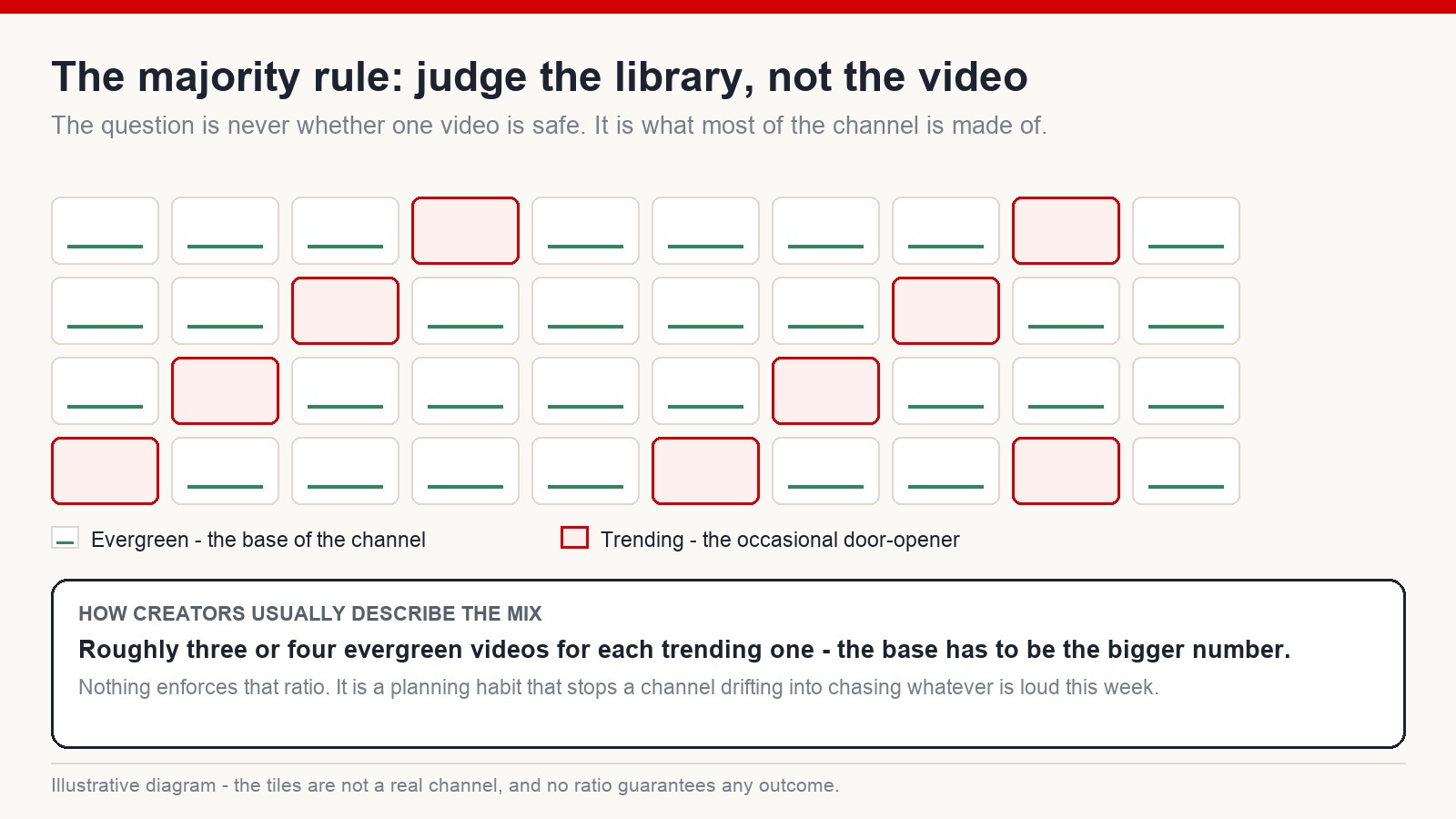
This is the idea underneath the ratios, and it is more useful than any of them.
When you are deciding whether a particular video is a good idea, you are asking the wrong question. One video almost never determines anything. What determines the shape of a channel is what most of it is made of.
So the question is never “is this video safe, or valuable, or on-brand”. It is: if a stranger scrolled the whole channel, what would they conclude it is about? If the honest answer is a coherent subject with a few opportunistic videos scattered through it, you are fine. If it is a pile of whatever was loud that month, no individual video will fix that.
This also applies to anything you are unsure about – a more sensational framing, a format experiment, a subject slightly outside your lane. One of those inside a solid library is an experiment. A channel made mostly of them is a different channel.
Why a trending video can lift the rest
The mechanism is not mysterious. A trending video brings people to a page they had no reason to visit. Some proportion of them look at what else is there. If what else is there is relevant and good, some of them watch it, subscribe, and come back.
Two conditions on that, though, and both get skipped.
First, there has to be a library. A trending video on a channel with four other videos converts almost nobody, because there is nothing to convert them to.
Second, the trending video has to be adjacent to the rest. A viral video on a subject unrelated to everything else brings an audience with no interest in your library, and you end up with a spike in views, a drop in overall retention, and a recommendation system now confused about who your channel is for. That combination is worse than not having made it.
How the trap works
It always goes the same way, and it is easy to sympathise with.
You make one trending video. It works. The numbers are better than anything else you have published, and they arrive quickly instead of over six months.
So you think: what if I did another one? That works too. Then the schedule is half trending, then most of it, and at some point there is no evergreen production happening at all. The channel now lives entirely on finding the next thing before everyone else does, which is a job, and an exhausting one.
The tell is when you stop asking what would still be worth watching in a year and only ask what is happening this week. Views can look good throughout – right up until the week you do not find anything, and there is nothing underneath to hold the channel up.
Choosing which trends to take
Three questions before making one:
Does it connect to the subject? If you would have to explain the connection, the audience it brings will not stay.
Would the video be worth anything in six months? Some trending subjects have an evergreen version underneath them – a piece of news that is really an example of a lasting principle. Those are the good ones, because they earn twice.
What audience does it bring? Not how many people, but which people. A spike from viewers who will never watch anything else you make is worth less than a smaller spike from the right ones.
How to hold the balance in practice
Plan the evergreen first. Write the list of core videos for the next month or two before you know what will be trending, so the base is committed rather than whatever is left over.
Then treat trending videos as additions to that plan rather than replacements for it. When something comes up, the question is whether it fits into the space you left, not whether it should displace what you already scheduled.
And when a trending video does well, resist the obvious conclusion. The instinct to do five more of them is the exact instinct that has hollowed out a lot of channels.
The short version
Trends create speed. Evergreen creates a floor. Trends bring new people to the channel; the library is the reason any of them stay.
Get the majority right and you have something that can both grow and survive a quiet month. Get it wrong in either direction and you have either a channel nobody finds, or a channel nobody has any reason to return to.
What ratio of trending to evergreen should I use?
Something in the region of three to five evergreen videos for each trending one is a common planning habit, not a rule. What matters is that the evergreen side is clearly the majority – the specific number is yours to adjust based on how your own videos perform.
Can a channel be built entirely on evergreen content?
Yes, and many are. It tends to be slower, because nothing is bringing new viewers in quickly. If you have the patience for it, the compounding is real – but expect the first months to look like nothing is happening.
Is chasing trends bad for a channel?
Not in itself. It becomes a problem when it takes over the schedule, when the trends have nothing to do with the channel’s subject, or when there is no library for the new viewers to discover. Occasional and adjacent is fine.
How do I tell whether something is evergreen?
Ask whether somebody will search for it in two years. If the answer depends on a specific event, a date or a version number, it is trending content – which is fine, as long as you know that is what you are making.
If you want the fuller version of how to plan a content mix for an English-speaking audience, that is what I teach at mmoyoutube.com.