Shuhari for YouTube: Why Your First Videos Should Not Be Original
Almost everyone starts a channel with the same instinct: make something nobody has made before. Invent the format, invent the style, follow whatever feels inspired that week. It sounds like ambition, and it is the reason a lot of first channels quietly die.
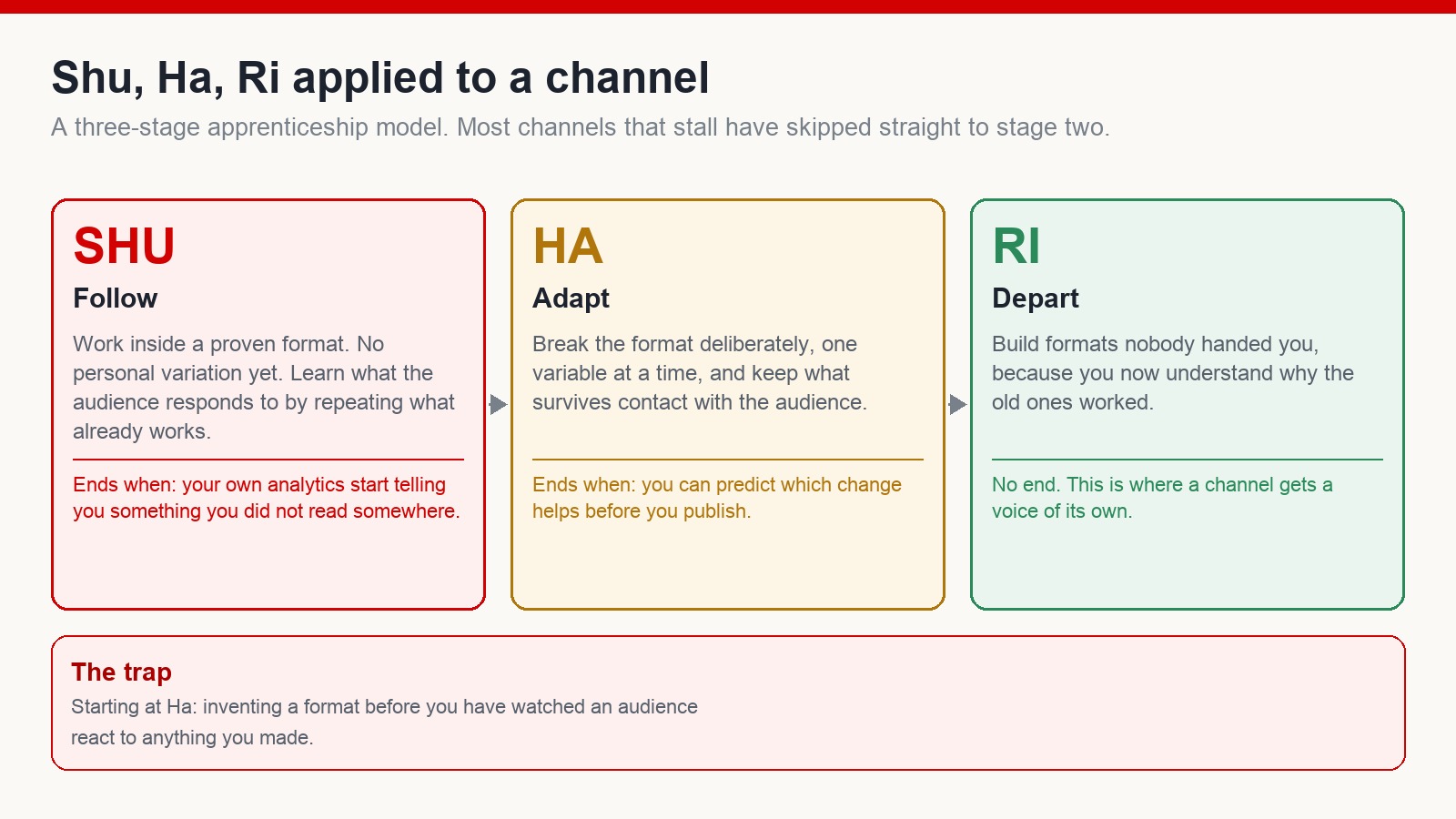
The Japanese martial-arts idea of shuhari describes how skill is actually acquired: shu, follow the form; ha, break the form; ri, leave the form behind. Applied to a channel, it explains something uncomfortable. Your first stretch of videos should not be original, and trying to make them original is what keeps most people stuck.
What “shu” actually means
Shu is the stage where you work inside a form somebody else proved. You put your taste aside on purpose, not because your taste is bad, but because you have no evidence yet about which parts of it an audience responds to.
The goal is not to become a copy. The goal is to learn the rules of the game while the cost of learning is low: how the platform distributes video, what makes people click, what makes them stay, why a particular video worked when a nearly identical one did not.
Why originality this early usually backfires
Think about what a brand-new creator is actually deciding when they invent a format. They have never had a video hold an audience. They have not seen their own retention graph fall off a cliff and worked out why. They have never watched a thumbnail win against five others in the same feed. And from that position, they choose to do something nobody has done.
What comes out is a video that satisfies its maker. That is a different thing from a video an audience wants. The platform is indifferent to effort; it responds to whether people watch, keep watching, and come back. In the beginning, learning what already works teaches you far faster than inventing does.
Studying a format is not copying a video
This is the distinction that decides whether the whole approach is legitimate or worthless, so it is worth being precise about.
What you study and reuse: the shape. How long before the first change of scene. The order the points arrive in. How the opening sets up a question. Where the tension sits. What the title promises. How the thumbnail reads at small size. Structure is not owned by anyone.
What is never yours to take: the footage, the narration, the wording, the specific research, the edit. Re-uploading someone’s video, or rewriting their script sentence by sentence, is theft and it breaks platform rules besides. That path ends in strikes or a channel with nothing behind it.
Reading a public transcript to map how a video was built is fine. Copying that transcript into a tool and asking for a paraphrase is not, and the result usually reads exactly like what it is.
How to run the shu stage properly
1. Audit twelve videos, not one
One video tells you nothing; it might have got lucky. Ten or twenty tell you what the audience in that niche reliably rewards.
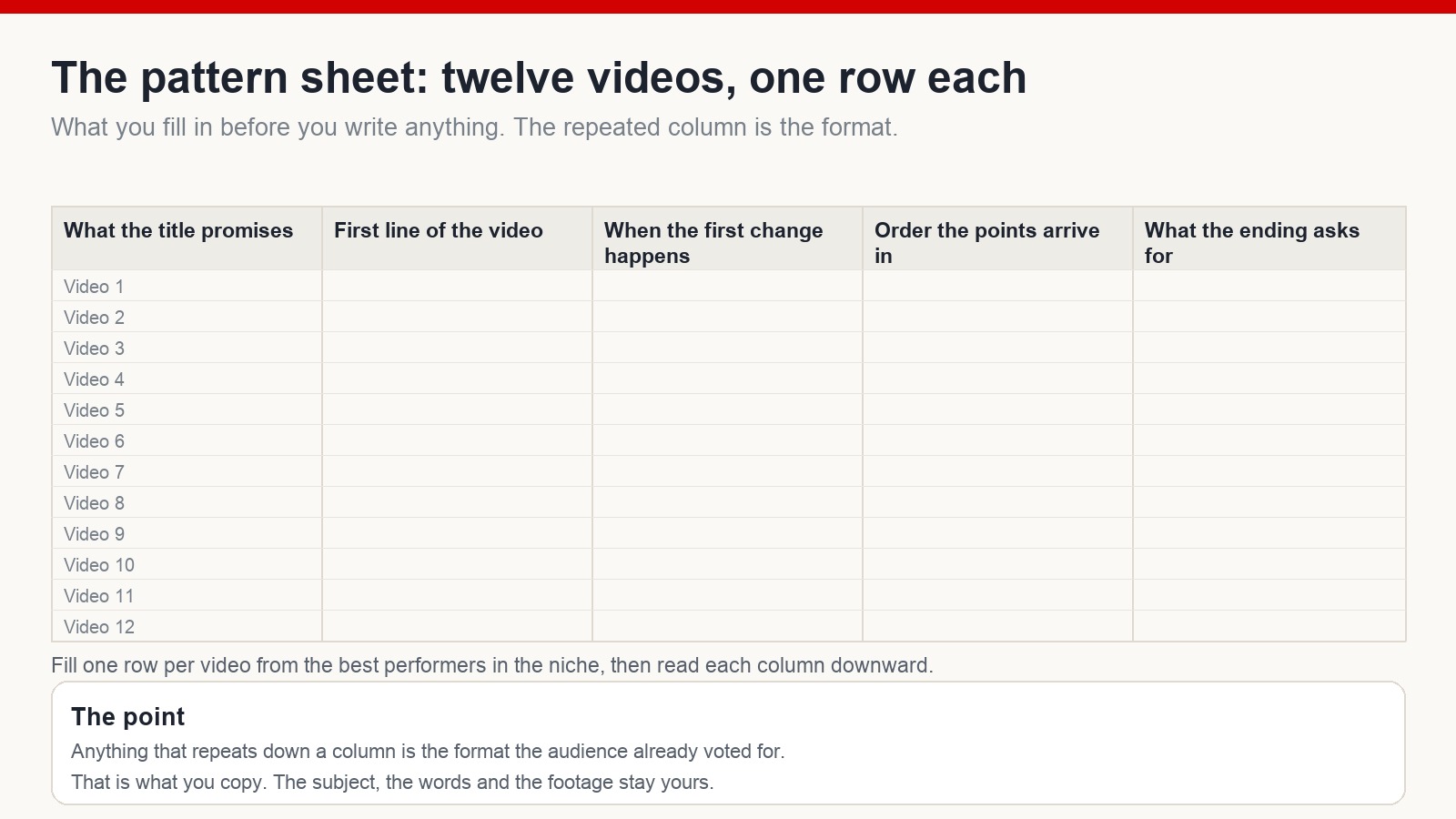
Make a sheet with one row per video and columns for what the title promises, the first line of the video, when the first change of scene happens, the order the points arrive in, and what the ending asks for. Fill it in, then read each column downward instead of across. Anything that repeats is the format.
2. Learn structure from public transcripts
Transcripts that a channel has made publicly available are a good way to see pacing on the page: how quickly they get to the point, how often they change subject, how they bridge between segments.
Use them the way an architecture student uses a floor plan. You are looking at how the space is arranged, not stealing the furniture. Take the beat pattern and write your own material into it.
3. Watch how they hold attention, not what they say
New creators watch competitors for ideas. It is more useful to watch them for mechanics. How many seconds pass before something changes on screen. Where the music enters and where it drops out. Which moment is deliberately withheld. When a question is asked and how long it stays open.
Those are the parts you can learn and apply immediately, in any subject.
4. Publish enough to see a pattern in your own data
Repetition is the point. If every video is a different experiment, nothing is comparable and you learn nothing from any of it. Keep the format steady and change one thing at a time, so that when something moves you know what moved it.
A myth worth deleting
Somewhere along the way, a rule spread that using clips under a certain length, five seconds being the usual figure, makes third-party footage safe. It does not. There is no clip-length threshold that turns someone else’s material into yours.
What actually matters is whether you have the right to use the footage, and whether your video adds substantial original value rather than repackaging someone else’s work. A short clip used without permission is still used without permission. Licence your footage, film your own, or use material that is genuinely cleared for the purpose.
When shu is over
You are ready to leave the follow stage when your own analytics start telling you things you did not read anywhere. When you can look at a retention graph and name the line in your script that caused the drop. When you can predict, before publishing, which of two thumbnails will do better and be right more often than not.
That is when it makes sense to deliberately break the format, one variable at a time. Leaving too early is the common failure: the channel drifts away from what its audience showed up for, retention falls, and the creator concludes the niche is finished when in fact they wandered out of it.
What this stage is really for
Copying is not the opposite of creativity. Nearly everyone who is good at a craft went through a period of deliberate imitation first: editors, writers, filmmakers, musicians. The difference between useful imitation and the useless kind is awareness. You should be able to say what you are borrowing and why it works.
The creators who fail early are rarely the ones who lacked ideas. They are the ones who started inventing before they understood what they were inventing against. Results vary enormously between niches and nothing here guarantees an outcome, but the sequence is the part I would keep: learn the form, then earn the right to break it.
Frequently asked questions
What is the shu stage in shuhari?
The first stage, where you follow a proven form exactly, without personal variation, in order to learn why it works before changing it.
Why should early videos follow a template?
Because consistency makes your results readable. If every video differs, you cannot tell which change helped, and you learn nothing from the ones that failed.
Does studying other channels break the rules?
Studying structure does not. Reuploading, or reproducing someone’s script or footage without rights, does. The line is between the shape of a video and its content.
When should I start doing my own thing?
Once you can read your own analytics and explain your results without guessing, then change one element at a time rather than everything at once.
If you want the full process for building a faceless channel aimed at English-speaking audiences, that is what I teach at mmoyoutube.com.