Curiosity, Recognition, Action: Three Lines to Write Before You Draft
Nobody remembers the information in a video. Ask someone about something they watched last week and you will get a feeling, a moment, maybe one line — almost never the list of points you spent an afternoon organising.
That is not a failure of the audience. It is how attention works, and it has a practical consequence for anyone writing scripts: a video that only delivers information is competing on the one axis where it is weakest. The channels that hold people are running an emotional sequence underneath the information, and the sequence is short enough to plan on a single page. Three beats: curiosity, recognition, action.
Three lines before the first paragraph
The habit I would give a new writer is not a structure to fill in. It is three questions to answer before writing anything else.
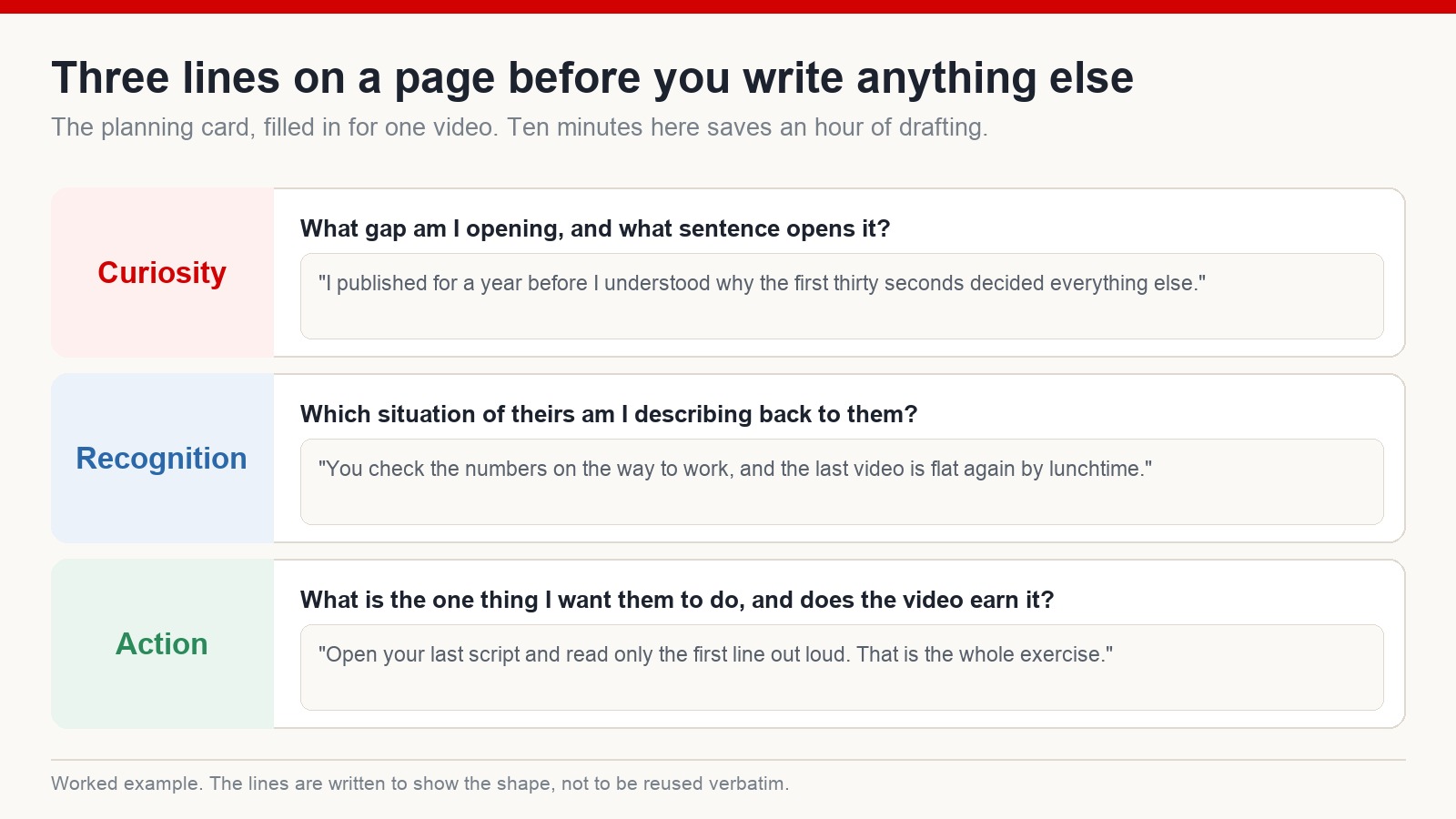
What gap am I opening, and what sentence opens it? Which situation of theirs am I describing back to them? What is the one thing I want them to do, and does the video earn it?
Ten minutes with those three, and the draft has a spine. Skip them and you get what most scripts are: a competent list of points arriving in whatever order they occurred to you, with no reason for anyone to still be there at minute six.
Beat one: curiosity, and what it actually is
Curiosity is not excitement and it is not a promise of value. It is an incomplete thought. You put something in front of a viewer that does not resolve, and their attention stays until it does.
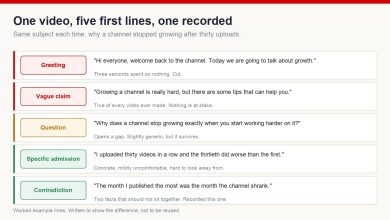
“How to make better content” resolves instantly — nothing is missing, so nothing pulls. “The month I published the most was the month the channel shrank” does not resolve. Two facts that should not sit together, and no explanation offered. That gap is the mechanism.
The discipline here is restraint. The instinct is to answer your own opening in the next sentence because withholding feels rude. It is not rude; it is the job. State the gap, then move into the body without closing it.
Beat two: recognition, which is where most scripts thin out
Once you have attention, you have to convert it into something more durable. That happens when a viewer sees their own situation described more precisely than they would have described it themselves.
The failure mode is abstraction. “Many creators struggle with motivation” describes nobody. “You check the numbers on the way to work, and by lunchtime the new video is flat again” describes a specific afternoon, and the person who has had that afternoon feels seen rather than addressed.
Concrete beats general every time, and it is not a stylistic preference. A general statement lets the viewer stay outside the video as an observer. A specific one puts them inside it.
Two things to be careful about. First, this beat is where writing tips over into manipulation if you push it — describing a real difficulty is honest, manufacturing a crisis is not. Second, you can only write this beat well for an audience you actually know something about. If the recognition line comes out generic, it usually means the research is thin, not the writing.
Beat three: action, or the feeling has nowhere to go
A video that opens a gap, closes it, and then stops has wasted the two beats that came before it. Attention that has been raised needs somewhere to land.
What that looks like is smaller than most people think. One request, stated once, in a plain voice, and proportionate to what the video actually delivered. “Open your last script and read only the first line out loud” is an action. “Like, subscribe, comment, and check the links” is four requests, which is the same as none.
And a thing worth saying plainly: asking people to type a number in the comments — reply 1 if you agree, 0 if you do not — is engagement bait, and platforms treat it as spam. It also teaches your audience that your requests are decorative. If you want responses, ask a question you would actually like the answer to, and be prepared to reply to the ones you get.
The vocabulary is the raw material
The three beats are the frame. The words are what actually does the work, and hunting for them mid-draft is where writing stalls.
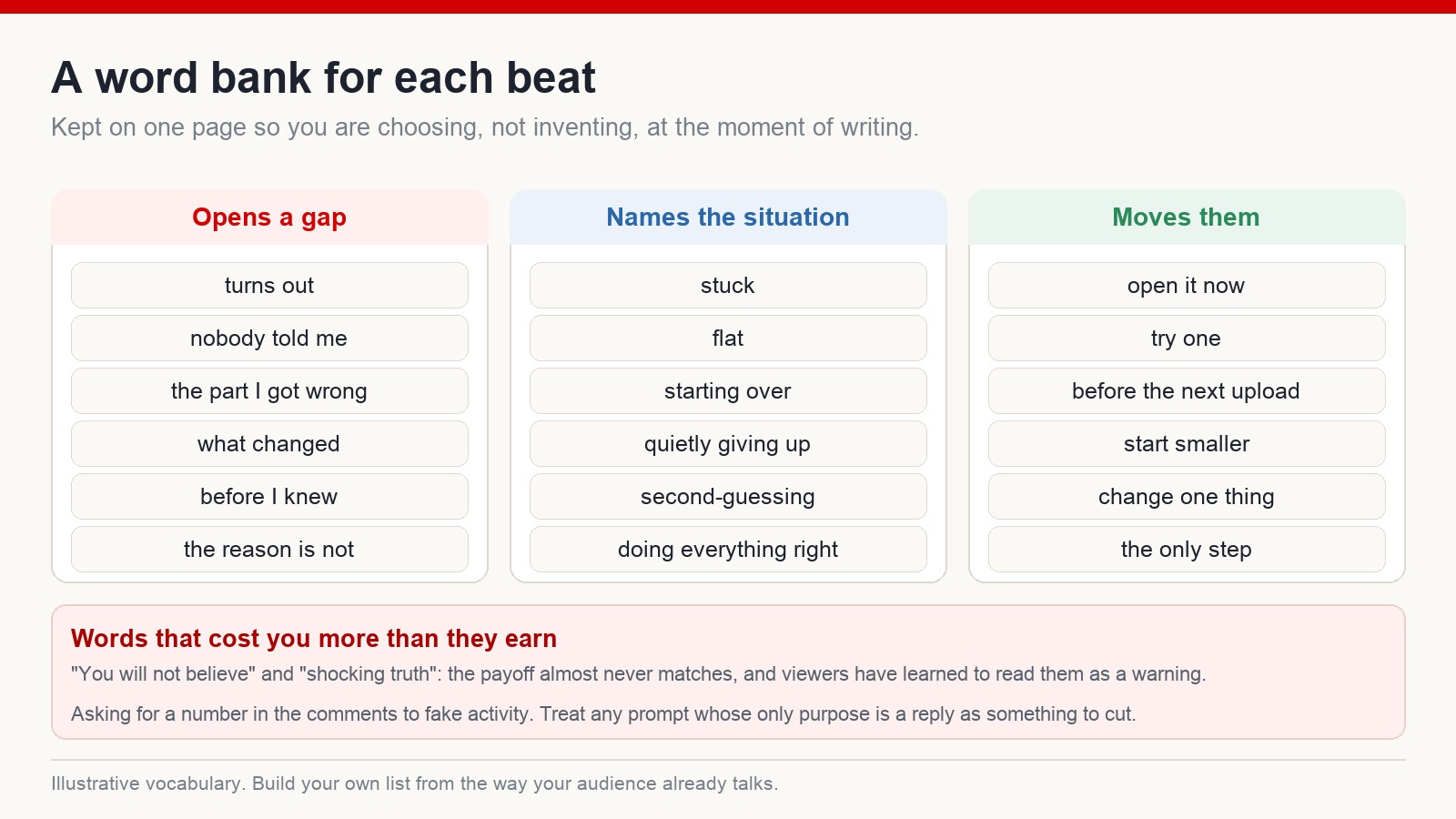
Keep a page with three columns. Phrases that open a gap: turns out, the part I got wrong, nobody told me, what changed. Phrases that name a situation: stuck, flat, starting over, second-guessing, doing everything right. Phrases that move someone: try one, before the next upload, change one thing, start smaller.
Build the list from your own niche rather than copying somebody else’s. The words that land are the ones your audience already uses about their own situation, and you find those by reading comments, not by brainstorming.
Three ways the sequence backfires
The gap does not match the payoff. You promised a contradiction and delivered a list of tips. The viewer feels tricked, leaves early, and the video carries that signal with it. This is the expensive one.
The feeling is manufactured. A small inconvenience narrated as a catastrophe reads as theatre. Audiences are unusually good at detecting effort in the wrong place, and once they hear it they discount the rest.
Everything is spent in the first minute. The opening is intense, then the middle flattens into explanation. Curiosity is not a starting condition; something has to remain unresolved all the way through, and the last thing you close should be close to the end.
Checking the beats survived the edit
The sequence often dies in the edit rather than the draft, so it is worth one pass afterwards. Watch your own video and ask three questions. At what second is the first unresolved thing introduced? Is there a moment where a specific situation is described rather than a general one? Is there exactly one request at the end, and does the video earn it?
If any answer is no, you can usually fix it with a sentence rather than a rebuild. Move the gap earlier. Replace one abstract line with one concrete one. Cut three requests down to one.
Where to start
Before your next script, write the three lines on a blank page and nothing else. If any of them is hard to write, that is information: an unwritable curiosity line usually means the topic has no tension, and an unwritable recognition line usually means you do not yet know who you are talking to.
And keep the honest boundary in view. Use these beats to make a true thing land harder, not to make a thin thing feel substantial. Emotional technique in front of nothing is the reason a certain kind of channel gets a burst of attention and then loses the audience permanently.
Frequently asked questions
Does this work for tutorials and other dry subjects?
Yes, and it matters more there. The gap can be small — an unexpected step, a mistake most people make — and the recognition beat is simply describing the moment where the process goes wrong.
How long should each beat be?
Curiosity is a sentence or two at the top. Recognition is a short passage early, not a section of its own. Action is one line at the end. The body of the video sits between them.
Is this the same as clickbait?
The opposite, if you use it properly. Clickbait opens a gap it never closes. This sequence only works when the payoff matches the promise.
Can a model write these lines for me?
It can produce candidates, and they usually come out generic because the specifics are the part it does not have. Give it your own recognition detail and ask it for variations rather than asking it to invent the feeling.
If you want the full process for building a faceless channel aimed at English-speaking audiences, that is what I teach at mmoyoutube.com.