You Are Not Hitting the Limit Because You Work Too Much. You Are Paying for Retries.
Most people do not hit a usage limit because they worked too much. They hit it because every answer needed three follow-ups to repair a request that was vague to begin with.
That is a cheerful diagnosis, because it means the fix is free. You are not being asked to work less. You are being asked to stop paying for the same answer four times.
The rules below sort into four families, and the families matter more than the individual tips – each one attacks a different way retries happen.
Four families, one habit
| 1. Structure the prompt | 2. Manage the context | 3. Control the output | 4. Fix, do not restart | What changes |
|---|---|---|---|---|
| Be specific. One task per message. Exact word counts. Set the rules once instead of repeating them.
Stops the retry before it happens. |
A new chat per task. Cut old context. Upload the file rather than pasting it in.
Stops you carrying yesterday’s conversation into today’s question. |
Ask for a summary first. Give one or two samples. Ask for a critique before the rewrite.
Catches the wrong direction while it is still cheap. |
Rephrase the request. Do not press regenerate and hope.
Turns a coin flip into a correction. |
Fewer attempts per finished piece of work
Small changes in how you ask. Large change in how much you burn. |
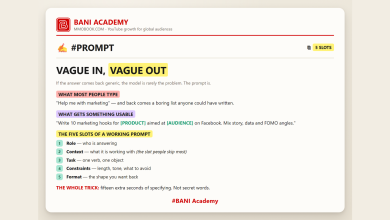
Family one is the same argument as the five slots we set out in vague in, vague out. Everything here is downstream of that: a request that names the task, the constraints and the format does not need repairing afterwards.
The rules, and what each one prevents
Every rule here exists to stop a specific retry. That is the useful way to read the list – not as etiquette, but as a set of things that each remove one wasted attempt.
| Rule | The retry it prevents |
|---|---|
| Be specific | The generic answer you were always going to reject. |
| One task per message | The answer that does two jobs badly, then two follow-ups to separate them. |
| Give exact word counts | “Shorter.” “Shorter than that.” “Now too short.” |
| Set the rules once, not every time | Re-typing your tone and constraints in every single message. |
| New chat per task | Answers contaminated by a different job from an hour ago. |
| Cut old context | A long thread where the model is still weighing decisions you abandoned. |
| Upload the file, do not paste it | Sending the same document again with every follow-up message. |
| Ask for a summary first | A full draft built on a misunderstanding you could have caught in two lines. |
| Give one or two samples | Three rounds of “not quite my style” with no example to aim at. |
| Ask for a critique before the rewrite | A rewrite that changes the wrong things. |
| Rephrase instead of regenerating | The same answer again, because nothing about the question changed. |
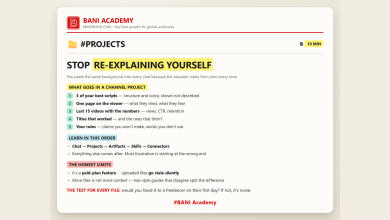
Two of these are worth more than the rest combined. Ask for a summary first costs two lines and catches the expensive misunderstanding before a thousand words get built on it. And set the rules once is not a prompting trick at all – it is the ten-minute setup we described in stop re-explaining yourself, which removes the repetition permanently rather than per conversation.
Watch the reel
All the rules on one card, grouped by family. Posted on the BANI Academy page.
The mechanism nobody explains
Why does a new chat per task actually help? Because of how a conversation works underneath.
Each time you send a message, the assistant is given the earlier turns along with it – that is how it remembers what you were discussing. Useful, and not free: the fortieth message in a long thread arrives with thirty-nine messages attached to it, while the same question in a fresh conversation arrives on its own.
Three consequences follow, and they explain most of the context rules at once. A long thread gets more expensive as it goes, whether or not the old material is still relevant. A document pasted into four messages has been sent four times. And a conversation carrying an abandoned direction will keep weighing it, which produces answers you then spend more attempts correcting.
None of that is a reason to be precious about starting new chats. It is a reason to start them often.
The retry loop and the fix loop
These two loops look identical from the outside. One of them ends.
| The retry loop | The fix loop | |
|---|---|---|
| What you do | Press regenerate, or type “no, try again” | Work out which part of the request was missing, and add it |
| What changed | Nothing. The question is the same | The question is now answerable |
| Typical result | A different flavour of the same miss | Closer, and closer again |
| What you learn | Nothing that transfers | Which slot you habitually leave empty |
| Where it ends | When you give up or hit the limit | Usually on the second or third attempt |
The fourth row is the compounding one. Every fix teaches you something about your own defaults – that you never state the audience, or never say how long, or always forget the format. After a few weeks of noticing, the first attempt starts landing, and the whole problem this article is about quietly disappears.
There is a shortcut for people who would rather not work that out alone: ask the assistant to improve your prompt before running it, or tell it to ask you questions before answering. Both were on the hundred-prompt sheet we went through in the hundred-prompt audit, and they are the two that pay for themselves fastest here.
What this looks like in a video week
Concretely, for a channel. One conversation for research, closed when the research is done. A separate one for the script, opened with the audience and the rules already stated. A separate one for titles, because titles contaminated by script context come out describing the script rather than selling it.
Upload the transcript rather than pasting it, ask for a two-line summary of what it thinks you want before it writes anything, and when something comes back wrong, say what was wrong instead of asking again.
And if you are hitting limits often, the other half of the answer is which tool you are using for which job – a search-based assistant for anything factual, a writing one for drafts. That split is in five assistants, five jobs, and it removes a surprising number of retries on its own.
Frequently asked questions
Does a longer prompt cost more than a short one?
Slightly, and it is almost always cheaper than the three follow-ups a short vague one produces. Length is not the enemy; vagueness is.
Is regenerating ever the right move?
Occasionally, when the request was fine and the answer was simply poor. If you are on the third regenerate, the request is the problem.
Why start a new chat instead of just scrolling up?
Because the old turns travel with every new message. A fresh conversation is the cheapest way to drop context you no longer need.
Do these rules work on other assistants?
Yes. They are about specifying a job and managing a conversation, not about one product’s quirks.
One change for your next session
Pick the single rule you break most often – for most people it is asking for two things in one message – and hold to it for a week. Count your attempts per finished piece of work before and after.
That number is the only measure that matters here, and it moves faster than people expect.
Learning a lot does not make anyone good. Doing a lot does.
If you want the structure that turns a rule into a habit, that is what our free challenge is built for: no barrier to entry, a genuine commitment to action, and a refundable commitment fee you get back when you finish. You are not paying for the knowledge. You are betting on yourself finishing, and we hold the stake.
Which rule do you break most? Tell us in the comments on the original reel and we will tell you which retry it is costing you.
For more on building channels for English-speaking audiences, that is what we work on at mmoyoutube.com.
2 Comments