Ad Payment On Hold? The Checklist to Work Through Before You Panic
It is a specific kind of dread. The channel is monetised, the views are steady, the earnings line keeps climbing, and then the payments page says the payment is on hold. The first assumption is always the worst one: something is wrong with the account, the money is gone, the channel is in trouble.
Almost always, it is none of those things. A held payment is usually the system telling you that one required step on the account has not been completed yet. It is a checklist problem, not a penalty. Here is how to work through it calmly, in the order that resolves the most cases.
One caveat before anything else: I am a video creator, not an accountant or a lawyer, requirements differ by country, and they change. Treat this as a map of where to look, and follow the official help pages and your own tax advice for anything that touches money or tax.
Why payments get held at all
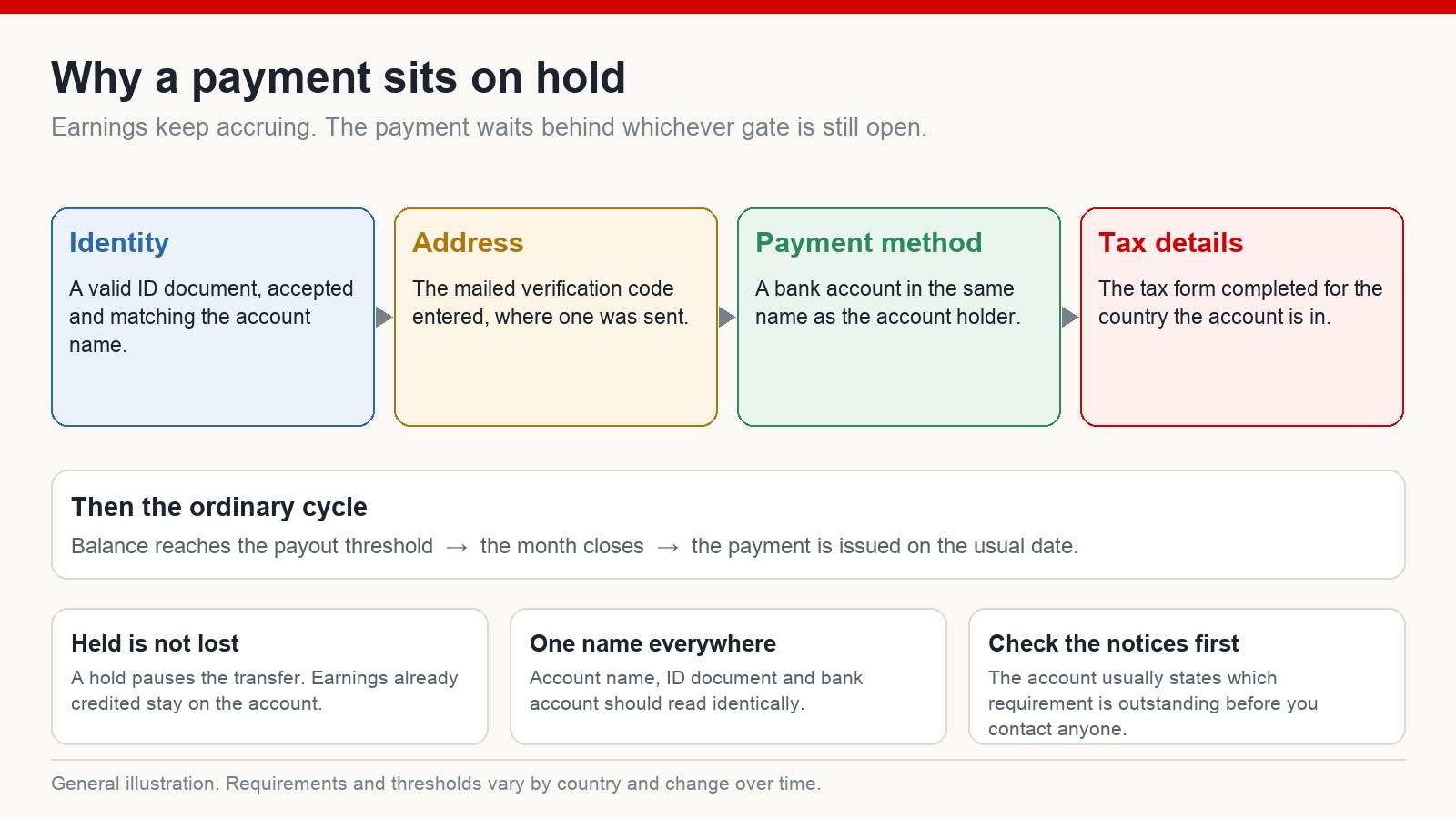
A payment is only released when the account satisfies every verification requirement attached to it. Identity, address, payee details and tax information all have to be in place. Miss one and the transfer waits, even though the earnings themselves keep being credited normally.
That distinction matters, so it is worth saying plainly: a hold pauses a transfer, it does not delete earnings. Revenue already credited stays credited while the outstanding item is sorted out.
1. Identity verification
This is the most common cause by a wide margin. At some point the account may ask you to verify who you are with an official document.
Where people get stuck is not the requirement, it is the upload. Before you submit, check that the name on the document matches the name on the account exactly, that the photograph is sharp and evenly lit, that no corner or edge is cropped out of frame, and that the document has not expired. A blurred or cropped image is rejected, and every rejection adds days.
2. The address verification code
Once earnings pass an initial threshold, a verification code may be posted to the address on the account in many countries. Until that code is entered, payments can stay on hold.
Three things to check: that the address on file is genuinely one where you receive post, that the code has actually been entered rather than sitting in a drawer, and whether you are still inside the window in which it can be entered before a new one has to be requested. If you moved house since you set the account up, fix the address before you request anything.
3. The name on the payment method
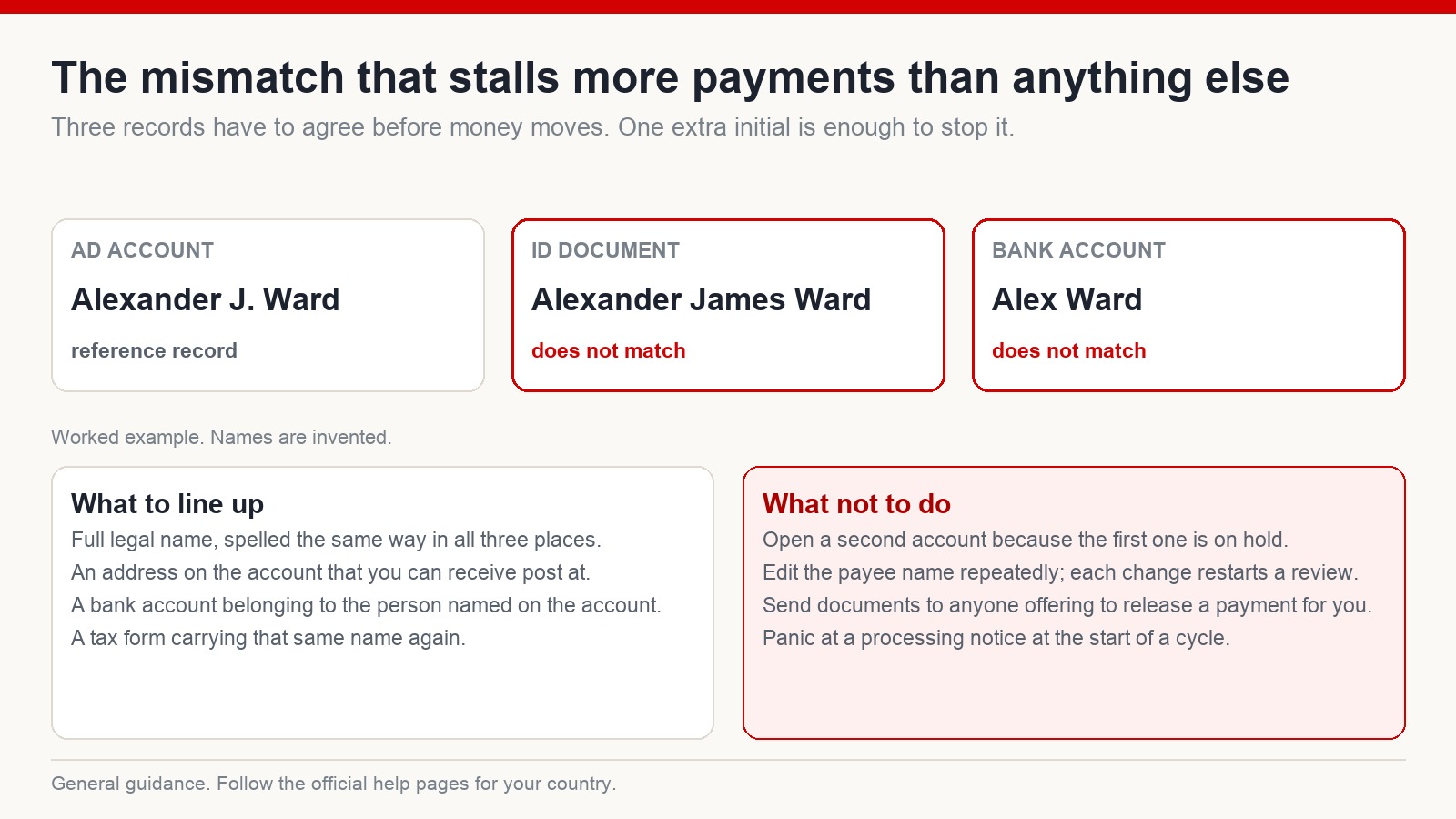
A quiet one that stalls a lot of first payments. The payee name on the account, the name on your identity document and the name on the receiving bank account all need to agree.
Middle names, initials, a shortened first name, a married name on one record and not the others, a family member’s account being used because it was more convenient. Each of those is enough to stop a transfer. Line all three up before you submit anything.
4. Tax information
If any of your revenue comes from viewers in a country whose tax rules apply to the platform, you will be asked to complete a tax form inside the account. Creators outside the United States who earn from United States viewers routinely have to do this.
Check that the form was actually submitted rather than saved as a draft, that the personal details on it are correct, and that the name matches the account. Errors here are one of the slowest categories to unstick, because the form usually has to be corrected and reviewed again.
5. “Processing” is not always a problem
At the start of each payment cycle, earnings are reconciled and finalised before anything is sent. During that window the account can show statuses like processing, finalising earnings or payment in progress.
If there is no policy notice and nothing is being requested from you, that is the ordinary cycle doing its job. Waiting is the correct action. Changing settings during this window because the status looks alarming is how people accidentally trigger a real review.
6. When it is worth contacting support
Contact support once you can honestly say all of the following: identity verification is complete, the address code has been entered where one was required, tax details are submitted and accepted, and the payment method is valid and correctly named. If the hold then persists well beyond a normal cycle, read every notice on the account first so you can describe the specific state you are in, then get in touch through the official help channels.
Do not respond to anyone who contacts you first offering to release a held payment. Nobody legitimate does that, and it is a well-worn way of collecting identity documents from anxious creators.
7. Build the account so this stops happening
Most payment problems are set up months before they appear. A few habits prevent nearly all of them.
- Use your real, full legal identity everywhere, and spell it identically on every record.
- Keep one account, set up correctly. Opening a second one to escape a hold on the first creates a policy problem on top of a paperwork problem.
- Turn on two-step verification on the account holder’s login. Recovering a compromised account that holds your revenue is far worse than any hold.
- Read the notices in the studio and on the payments page rather than skimming past them. They usually name the missing item outright.
- Keep the address current, especially if you move while a code is in the post.
Separating administrative email addresses per project can help you stay organised, but it changes nothing about the rules: one real identity, accurate information, and full compliance with the platform’s policies.
The short version
A held payment is nearly always one of five things: identity not yet verified, an address code not yet entered, payee and bank names that do not agree, tax details incomplete, or a cycle that is still processing. None of them are emergencies, and none of them require a new account.
Work down the list, fix the one that applies, and let the ordinary cycle resume. Then go back to the part of this that actually builds a channel, which is making videos people want to watch.
Frequently asked questions
Does a held payment mean I lose the money?
Generally no. Earnings that have been credited remain on the account, and the payment is released once the outstanding requirement is met and the balance qualifies.
How long does a hold take to clear?
It depends entirely on the cause. A missing form or verification usually starts moving once the submission is accepted, and then follows the normal cycle. There is no fixed timescale, and it varies by country.
Should I open a new account instead?
No. Opening additional accounts to get around a hold conflicts with the platform’s rules and tends to turn a small administrative delay into a much larger problem.
What if I filled the tax form in wrong?
Check whether the account lets you resubmit a corrected form. If it does not, contact support through the official channels, and take proper tax advice for your own country if the amounts are significant.
Is a payments page notice always bad news?
No. At the start of a cycle, processing notices are routine. The ones that need action say what is missing.
If you want the full process for building a faceless channel aimed at English-speaking audiences, that is what I teach at mmoyoutube.com.