The Platform Owns Your Account. That Is the Whole Argument, and It Cuts Both Ways.
Web 2.0: the platform owns your account. Web 3.0: you hold the keys.
That is the whole difference in one line, and anyone who has had a channel demonetised without explanation understands the first half immediately. You did not lose an argument. You lost access to something you thought was yours, decided by a system you cannot see and cannot appeal to in any meaningful way.
So the second half sounds like the answer. It is worth understanding properly before you treat it as one, because holding the keys cuts both ways – nobody can freeze your wallet or delete your name, and nobody can recover them for you either.
Start at the easy end
The single most useful thing about this subject is that it has a shallow end, and almost nobody tells you that. You do not need crypto to try any of the first few.
| Green → | Green → | Yellow → | Red → | Before any red |
|---|---|---|---|---|
| Brave
Download, browse, done. Two minutes. Blocks trackers by default. Zero risk, nothing to learn. |
Presearch
Use it like a search engine. Does not build an advertising profile on you. Set it as default for a week. |
Odysee · Audius · Paragraph
Sign up and use. Watch, stream, or publish a newsletter. No wallet needed to look around. |
ENS · MetaMask · Filecoin
Require a wallet. Do not touch these until you understand what a seed phrase is and what losing it means. |
Three rules
Never type your seed phrase into any website, ever. Download only from the official site. Assume anyone offering help is not. |
That last column is not a formality. The overwhelming majority of losses in this space are not sophisticated attacks – they are people typing a recovery phrase into a page that asked nicely, or installing a wallet from a search advert instead of the official site. No technology protects against that, because from the outside it looks exactly like the owner doing it on purpose.
The ten pairs, with the honest column attached
Every one of these is presented somewhere as a replacement. Most are not, yet. Here is what each is actually for and where it falls short.
| You use | The alternative | What it is genuinely good at – and where it is not |
|---|---|---|
| Chrome | Brave | Blocks trackers by default, and it is a normal browser. The easiest win on this list by a distance. |
| Presearch | Does not build an ad profile on you. Results are thinner on obscure queries; keep a fallback. | |
| GoDaddy | ENS | A name nobody can take back. Also a name nobody can restore – and it needs a wallet first. |
| Spotify | Audius | Artist-first music hosting. The catalogue is a fraction of what you are used to. |
| YouTube | Odysee | Video that is far harder to remove. The audience is a rounding error next to YouTube’s. |
| Dropbox | Filecoin | Storage spread across a network rather than one company. Not a consumer sync folder; expect setup. |
| Status | Messaging without a phone number at the centre. Only useful if the people you talk to are there. | |
| Patreon | Paragraph | Writers keep their own subscriber list. This is the most practically interesting one for creators. |
| Steemit | Still running, but quiet. It is a small community, not a social network at any comparable scale. | |
| PayPal | MetaMask | A wallet you control. It is also a wallet with no support line and no password reset. |
Watch the reel
The ten pairs on one card, with the three rules to read first. Posted on the BANI Academy page.
The honest version
Web 3.0 has not replaced Web 2.0, and pretending otherwise is how people end up disappointed and then dismissive.
YouTube still has billions of viewers; Odysee has a fraction of that. Facebook still has your family on it; Steemit has a small and quiet community. If you move your channel to a decentralised platform expecting the same audience to follow, you will not find them, because they are not there.
That is not an argument against any of it. It is an argument against the framing. You do not have to leave Web 2.0 to take the parts of Web 3.0 that solve a problem you actually have – a browser that blocks trackers, a search engine that does not profile you, a publishing tool where the subscriber list belongs to you. Three real improvements, available today, none of which require you to abandon anything.
This is the same filter we applied to subscriptions in free is not always better: do not ask whether the alternative matches feature for feature. Ask whether it does the specific job you need, on the day you need it.
Why any of this matters to somebody running a channel
Not because you should move your videos. Because of what the comparison exposes about the arrangement you are already in.
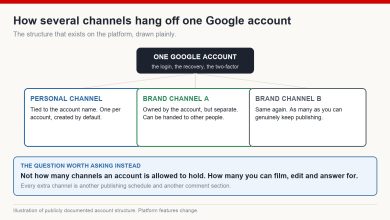
Everything a channel is made of sits on somebody else’s platform: the subscriber list, the archive, the analytics, the revenue. None of it is portable, and the terms can change without your involvement. Most creators discover this in the worst possible way – a strike, a demonetisation, a policy rewritten between one upload and the next.
The realistic response is not to abandon the platform. It is to notice which parts of your operation you could rebuild if access disappeared tomorrow, and to hold those parts yourself.
| What you have | Who actually holds it | What to keep on your side |
|---|---|---|
| Subscribers | The platform. You cannot export them or contact them directly. | An email list, or a publishing tool where the list belongs to you. |
| Your videos | Shared. Removal is their decision. | Masters and project files, backed up somewhere you control. |
| Your numbers | The platform, and only while your account is live. | A monthly record in your own spreadsheet. |
| Your process | You, but only if it is written down. | One page describing how a video gets made. |
Backing up masters is the row with a real cost attached, and it is worth checking what your storage actually allows before you rely on it – the same before-you-commit habit we applied tool by tool in free until minute forty.
The third row is the one people neglect and later regret – which is exactly why we argued for keeping your own monthly record in a bad month is data, not a verdict. The fourth is the difference between a channel and a business, and it is the test we set in one channel is a hobby, five is a system.
The safety part, written plainly
Never type your recovery phrase into a website. Not to “validate” a wallet, not to claim anything, not to fix an error. There is no legitimate reason a website needs it, and handing it over is indistinguishable from giving away everything in the wallet on purpose.
Download only from the official site. Search adverts and app-store lookalikes are a standing problem in this space. Type the address yourself.
Assume unsolicited help is not help. Anyone who appears in your replies or messages offering to sort out a wallet problem is running a script, not a support desk.
And to be explicit about what this article is not: nothing here is financial advice, no part of it is a recommendation to buy or hold anything, and the only tools worth trying from this list on day one are the ones that involve no money at all.
Frequently asked questions
Do I need cryptocurrency to try any of this?
No. Brave, Presearch and Odysee need nothing but a download or a sign-up. The wallet-based tools are a separate decision entirely.
What is a seed phrase, in one sentence?
A list of words that is the wallet – whoever has it has the contents, and there is no reset, no support line and no reversal.
Should I move my channel to a decentralised platform?
Not as a replacement. The audiences are not comparable. Mirroring content is a reasonable experiment; migrating is not.
What is the single most useful item on the list?
For most people, a tracker-blocking browser, followed by owning your own subscriber list. Both are available today and neither involves a wallet.
Take the two-minute one
Install the browser. Set the search engine as default for a week. That is the entire zero-risk portion of this subject, and it is genuinely worth doing.
Then, separately and with no deadline, do the part that actually protects you: write down which pieces of your channel you could rebuild if the account vanished tomorrow, and start holding those pieces yourself. That work is unglamorous, needs no new technology, and is worth more than every other row in the table combined.
Learning a lot does not make anyone good. Doing a lot does.
If you want the structure that turns that into a habit, that is what our free challenge is built for: no barrier to entry, a genuine commitment to action, and a refundable commitment fee you get back when you finish. You are not paying for the knowledge. You are betting on yourself finishing, and we hold the stake.
Want the list with official links? Comment KEYS on the original reel and we will send it over, along with the three rules we follow before trying any of these. Leave your name in the comment and we will reply to you directly rather than to the thread.
For more on building channels for English-speaking audiences, that is what we work on at mmoyoutube.com.