Faceless YouTube Channel Case Study: How FailArmy Built a 5-Billion-View Machine
The night a 213-million-view video rewired how I think about YouTube
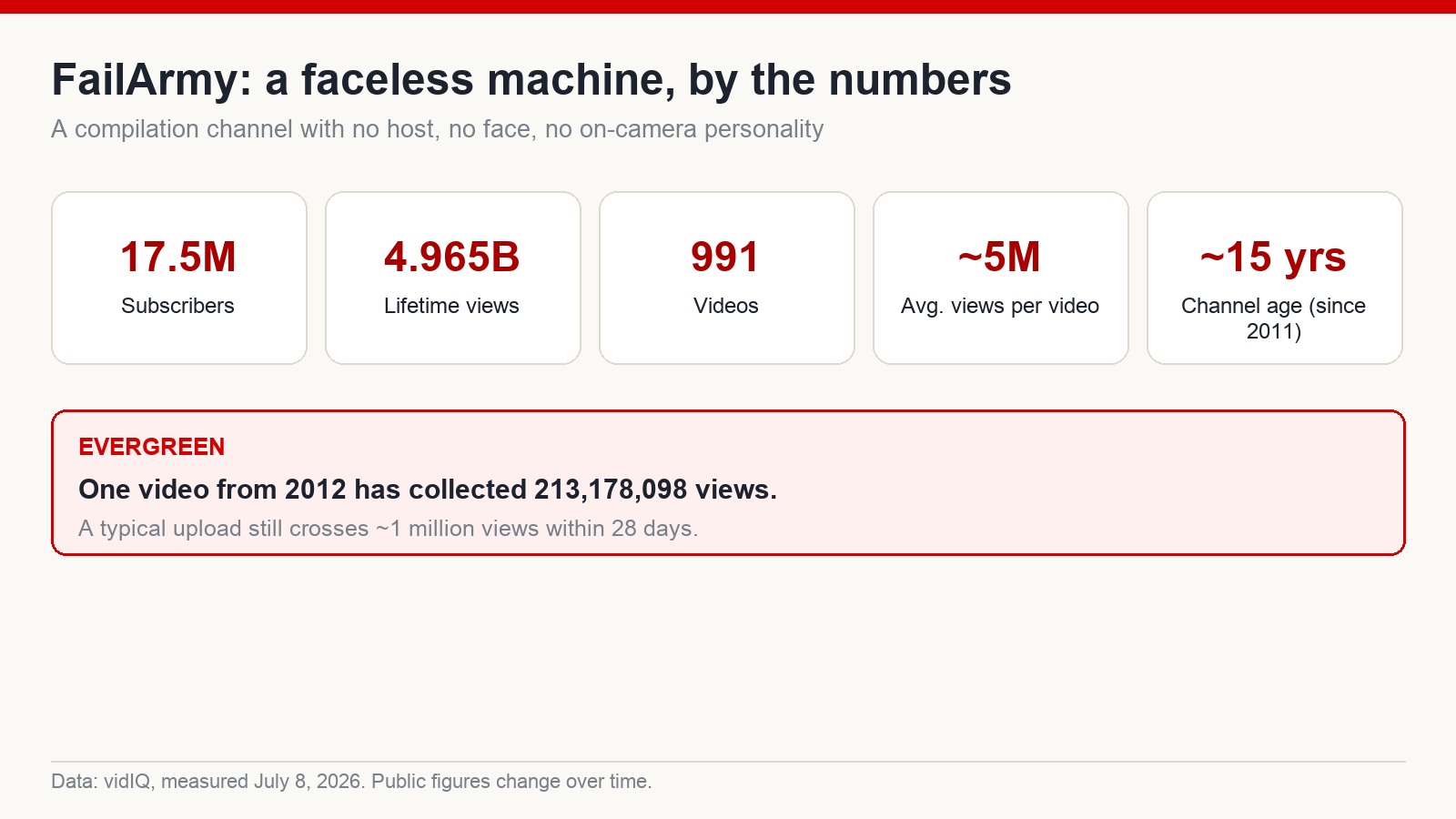
Two in the morning, hand resting on the mouse, and I was staring at a number I could not make sense of: 213,178,098 views. The video is called The Ultimate Girls Fail Compilation | Try Not to Laugh. It belongs to a channel called FailArmy. It was uploaded in 2012.
Read that year again. 2012. Fourteen years later, that single upload is still collecting views, still gathering likes (more than 381,000 of them), like a tap nobody ever bothered to close. Built once. Paid out for fourteen years.
At the time I had been teaching myself YouTube for about four years with almost nothing to show for it, because I was holding onto one belief that turned out to be expensive: that you have to be on camera to get views. That you need a face, a personality, a host. So I sat there feeling equal parts admiration and irritation, and I named the three things that were actually keeping me stuck. If you are reading this, I would bet money you are carrying at least one of them.
Fear number one: getting hit with a copyright strike. You finally finish something decent and then lie awake wondering whether you will open your laptop tomorrow to find monetization switched off. Fear number two: publishing consistently and watching the view counter sit at two digits, day after day. Fear number three, the quiet one: not knowing where the raw material is supposed to come from. Filming yourself feels exposing. Using other people’s footage feels illegal. So you stand at the crossroads and do nothing.
Then I started digging into FailArmy properly, and the numbers got strange. 17.5 million subscribers. 4,965,126,449 lifetime views, call it 4.965 billion. 991 videos, which works out to roughly five million views per upload across the life of the channel. The channel was created on July 5, 2011, so it is coming up on fifteen years old.
But the number is not what made me sit still. This is what did: 17.5 million subscribers and not one face. No host. No star. No personality anyone could name. I had been certain that getting big on YouTube meant putting yourself on screen, and here was a machine doing nearly five billion views without a single person stepping in front of a camera.
That night I finally understood what I was looking at. FailArmy is not an entertainment channel. It is a content machine. In this breakdown I am going to open that machine up: the business model, the content formula, the title template, the upload rhythm. And more importantly, I will draw a hard line through the middle of it, so you copy the parts that are safe to copy and leave the parts that would get your channel killed.
The business model: why FailArmy is allowed to do this and you are not
I want to be blunt here, because this is the part where I almost shot myself in the foot. When I first started chasing English-speaking audiences, I looked at million-view compilation channels and thought the job was simple: collect other people’s best clips, stitch them together, upload, collect ad revenue. It sounds reasonable right up until you learn one thing. What I was about to do and what FailArmy is actually doing look identical from the outside and are completely different underneath. That difference is the exact thing you are afraid of: copyright.
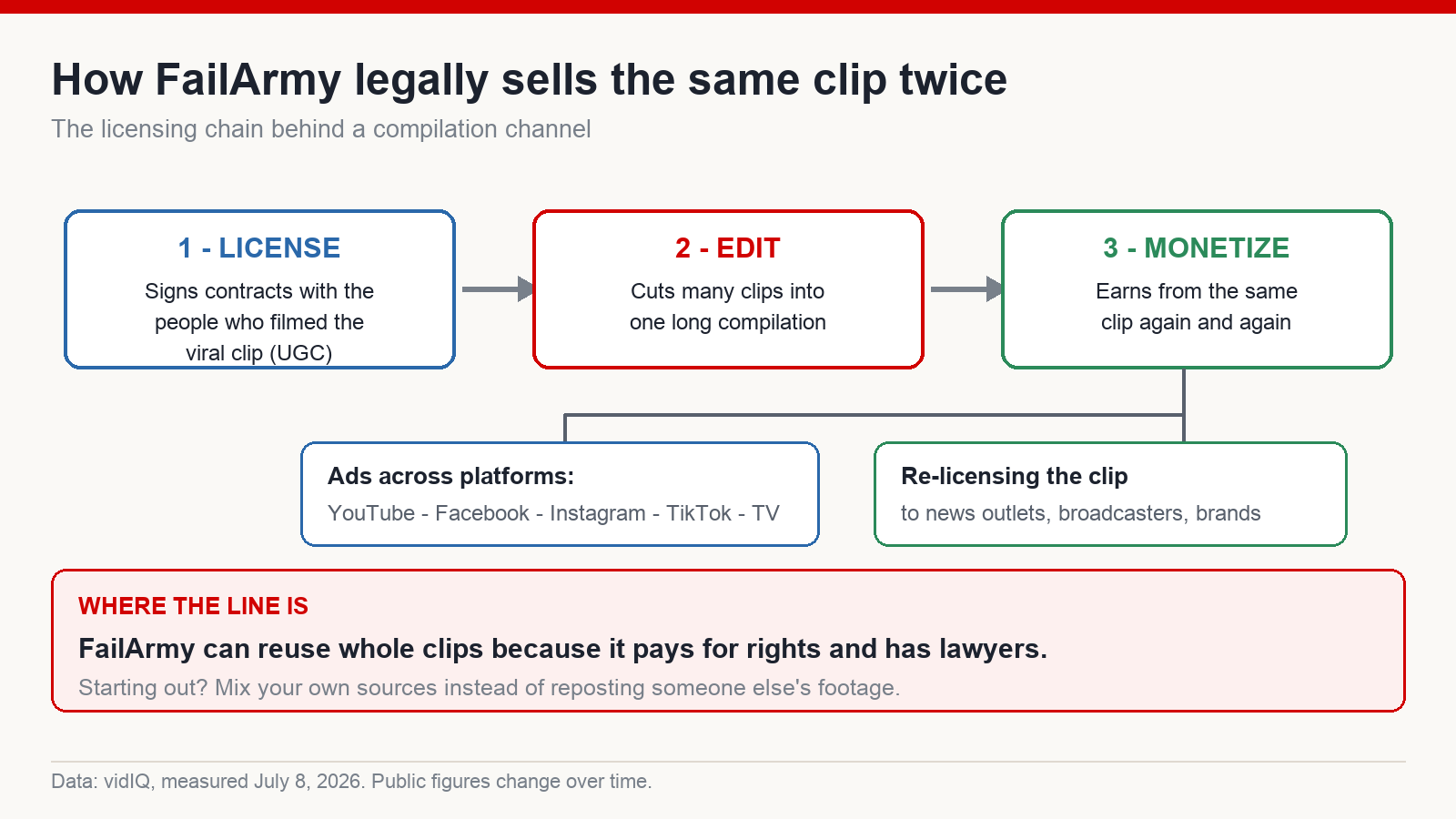
Behind FailArmy there is no guy in a rented room. The channel is operated by Jukin Media, now trading as Trusted Media Brands, a company whose entire business is acquiring and licensing viral user-generated footage. Behind the funny compilations sits a company with money and a legal department.
Their model runs in three beats. One: buy the rights to individual clips, with real contracts signed by the person who actually filmed the footage. Two: edit those licensed clips into compilations, which is what you watch on YouTube. Three: monetize the same material everywhere at once, on YouTube, Facebook, Instagram, TikTok and even broadcast television, and then license the individual clips onward to news outlets and brands. One clip gets sold several times over.
Now slow down for this part. FailArmy can do that because it pays for the rights and has lawyers to back it up. That is the entire reason it is legal. If you are an individual starting out, with a thin budget and no legal team, you do not have either of those things. So take this seriously: you cannot copy the “collect other people’s clips” part of the model. Reposting someone else’s footage without licensing it is the shortest known route to a copyright strike, demonetization, and in the worst case losing a channel you spent months building.
I am not trying to scare you, and I am definitely not selling a get-rich-quick idea. I want you to understand the rules of the game before you put anything on the table. So what does a beginner actually do instead? That is the next section.
The safe route: blend five sources and keep every borrowed second short
FailArmy has the budget to license footage and you do not. Does that mean the whole plan of building a faceless YouTube channel for high-value English-speaking markets is dead? No. There is another road, and it is the one I have been walking for years.
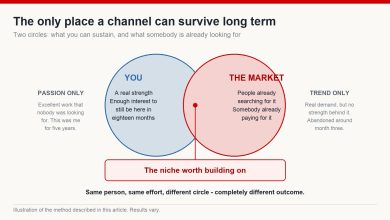
My rule fits in one line: blend everything, go pure on nothing. Do not imitate FailArmy by running a single source. Instead, mix five kinds of raw material into every video you build:
- Short fair-use clips from YouTube, every excerpt under five seconds.
- Licensed stock footage that you actually bought.
- Footage you film yourself, even on a phone.
- AI-generated shots and motion.
- Your own recorded audio, including ASMR-style sound.
Inside that framework, the FailArmy approach is source number one and nothing more. You have four other buckets to dilute with, so that no single clip carries the video and no rights holder can point at your upload and say that is mine.
Read this next part slowly, because it is the line between safe and reckless. Fair use, the way I apply it, is not “repost the clip and pray nobody notices.” It has three hard rules. Every excerpt stays under five seconds. Avoid broadcaster and studio footage entirely, because those organisations have aggressive legal teams. And always blend sources, so no single piece of borrowed material dominates the runtime. FailArmy gets to use whole clips because it paid for them. You have not paid, so you blend.
And I have to say the honest thing here. “Under five seconds” is not a magic shield. Fair use is a grey area decided case by case, and YouTube’s Content ID system can flag you even when you believe you are in the clear. Short excerpts plus heavy blending lowers your risk; it does not delete it. If a specific clip makes you uneasy, drop it, and for anything serious talk to someone who actually practises copyright law rather than taking my word for it.
This road is real, but it takes discipline. It is not a button. Nothing about slicing footage on a Tuesday makes money appear on Wednesday. What it does give you is a way to start today, with the phone and the laptop you already own, without spending anything on licensing and without needing a lawyer on retainer.
The content formula: why “people falling over” never runs out of audience
Would you believe a video edited in 2012 is still bringing in traffic today? The Ultimate Girls Fail Compilation sits at 213,178,098 views as of July 2026. Edited once, then left alone, and for fourteen years it has kept pulling. A newer one, Expensive Fails | Total Idiots 2022, went up in late 2021 and has passed 19 million. People tripping, breaking things, having a spectacularly bad day: none of that ever goes out of fashion.
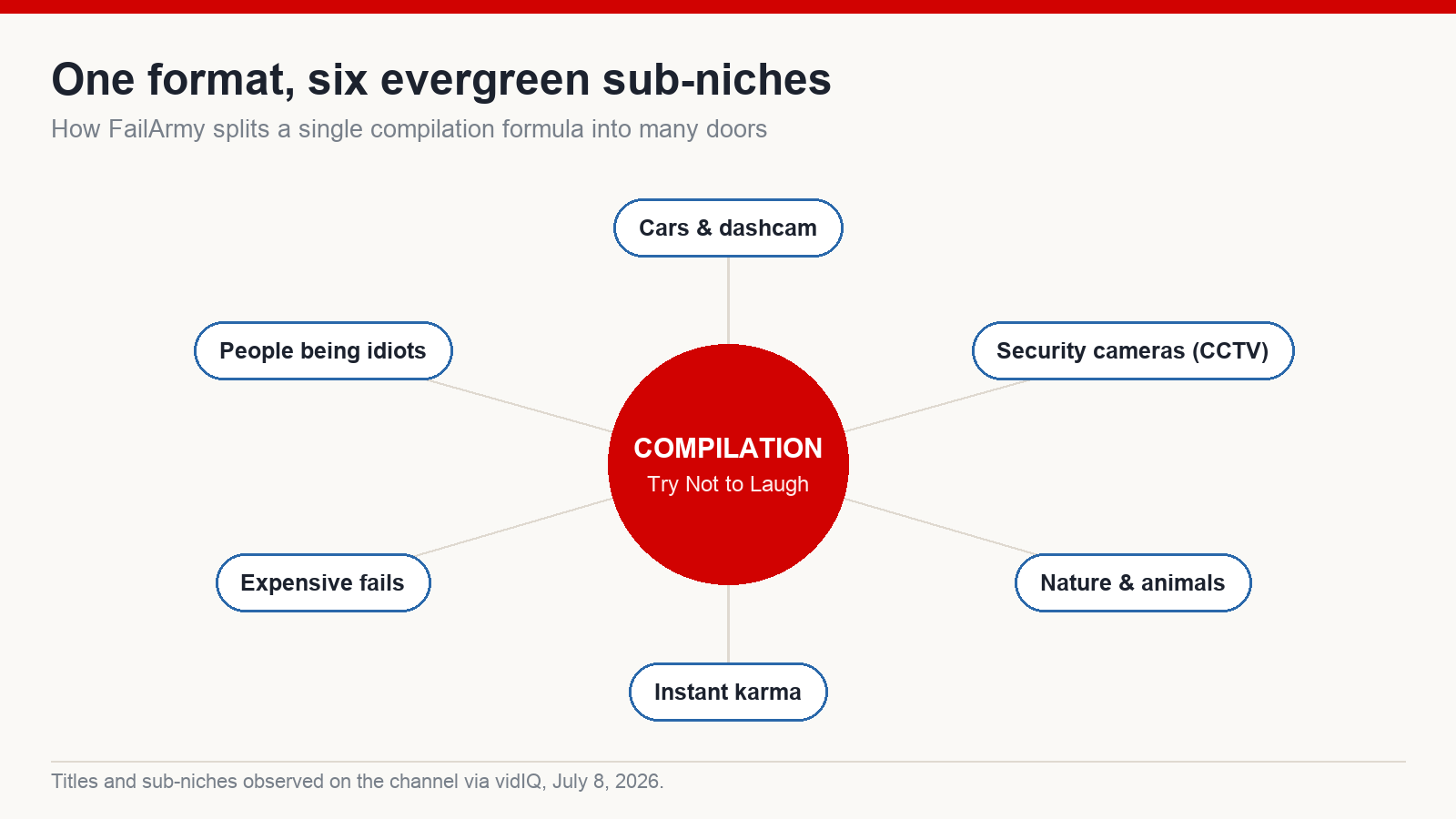
This is where I used to get it wrong. I kept hunting for a niche that was clever and untouched, then burned out when it produced nothing. FailArmy does the exact opposite. It takes an ancient format, the fail compilation, and splits it into sub-niches to widen the net.
Same formula, several doors in:
- Cars and dashcam: Idiots in Cars, Insane Dashcam Fails, Stupid Drivers Caught on Camera.
- Security cameras: Security Camera Disasters, Best of CCTV, Hilarious CCTV Fails.
- Nature and animals: Damn Nature You Scary, Wild Animal Encounters, People vs Nature Fails.
- Instant karma and expensive mistakes: Funny Instant Karma Fails, Expensive Fails, People Being Idiots.
One machine, but every sub-niche is a fresh entry point for a stranger.
And here is the part that matters most if you are building for audiences outside your own country. They pick universal emotions: laughter, shock, suspense. Emotions that do not require language. Someone in Berlin, someone in Osaka and someone in Ohio all laugh at the same person slipping on ice. No narration, no subtitles, no language barrier. That is exactly why emotion-driven compilations travel so well into markets where advertisers pay more per thousand views, and why you do not need flawless English to compete there. What you earn per thousand views still swings wildly by niche, season and audience country, so treat those rates as a range, never a promise.
But keep the boundary in mind. What you are learning here is how to choose a niche and how to package emotion, not how to source clips. Borrow the frame, borrow the emotional logic, and then fill it using your own five-source blend.
Titles and thumbnails: packaging emotion so the click happens
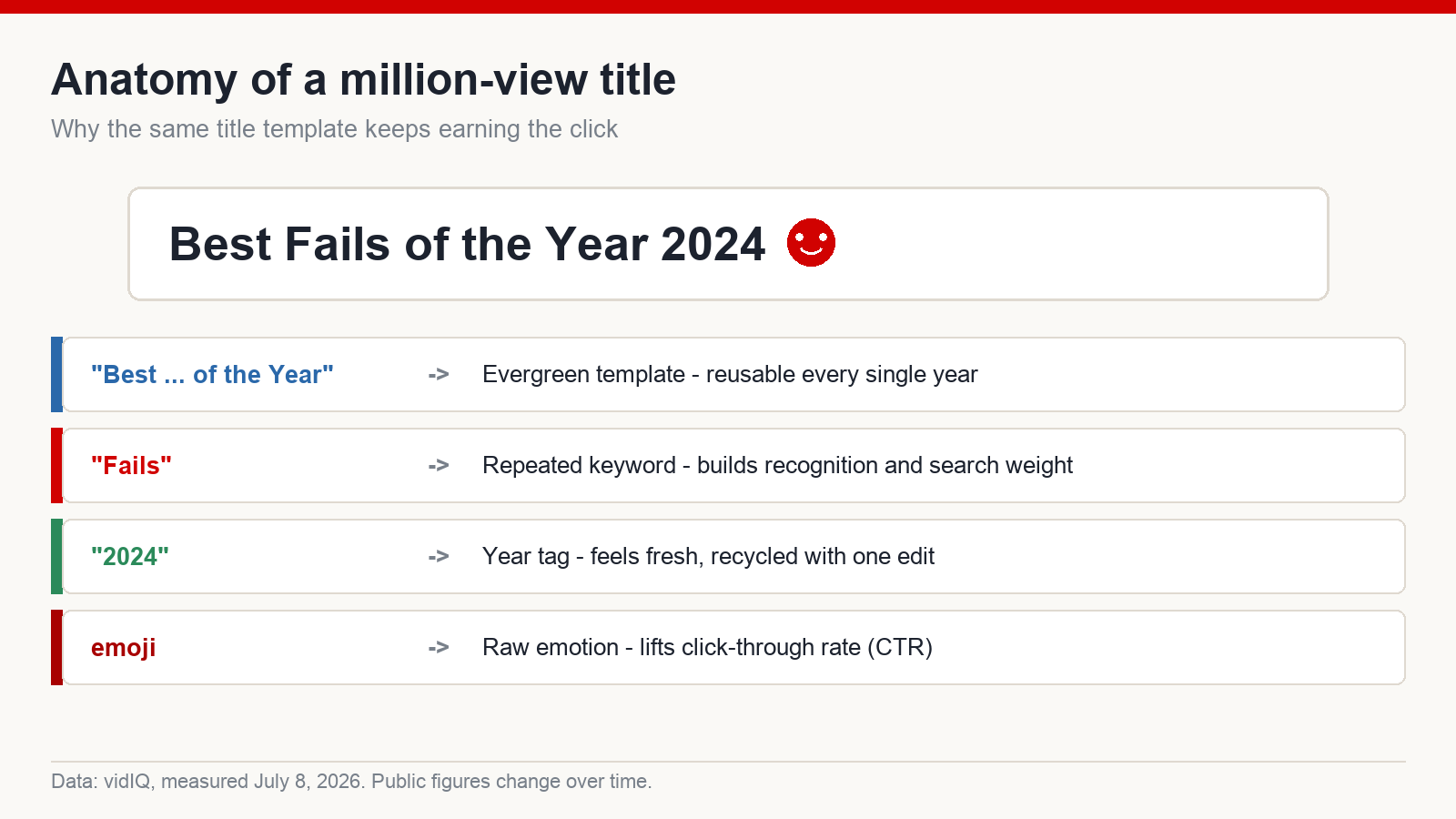
I will admit something. I used to assume million-view channels had a genius editor somewhere writing every headline by hand. Then I sat down and pulled FailArmy’s titles apart, and I laughed at myself, because there is no genius. There is a template, repeated to the point of boredom.
Look at them. “Try Not to Laugh Challenge.” “Best Fails of the Week.” “Best Fails of the Year.” “Stupid Drivers Caught on Camera.” “Damn Nature You Scary.” “People Being Idiots.” See the pattern? A handful of keywords repeated relentlessly, Fails and Try Not to Laugh, so all the search weight piles onto one phrase. A year tag bolted on, so next year you swap one number and reuse the whole thing. And one blunt adjective punched into the middle: Insane, Expensive, Shocking, Idiots. On the thumbnail, a crying-laughing or horrified face, the kind of signal that needs no translation.
Relieved? You should be, because this is the part you can lift almost intact. It is packaging technique, not borrowed content, so there is no rights question attached to it. You do not have to reinvent yourself every morning, which is the thing that actually grinds creators down and makes them quit. Build one good template, pour new material into it, done.
One ordering rule I repeat constantly to the creators I coach: thumbnail first, then title, then content. Yes, the thumbnail comes before the video. The emotion has to land on the screen before anyone has watched a single second. They click because the image made them curious, the title confirms the promise, and only then does the content get a chance to keep them. Getting that order backwards is why so many genuinely good videos sit at zero.
Upload rhythm and Shorts: the part almost nobody manages to copy
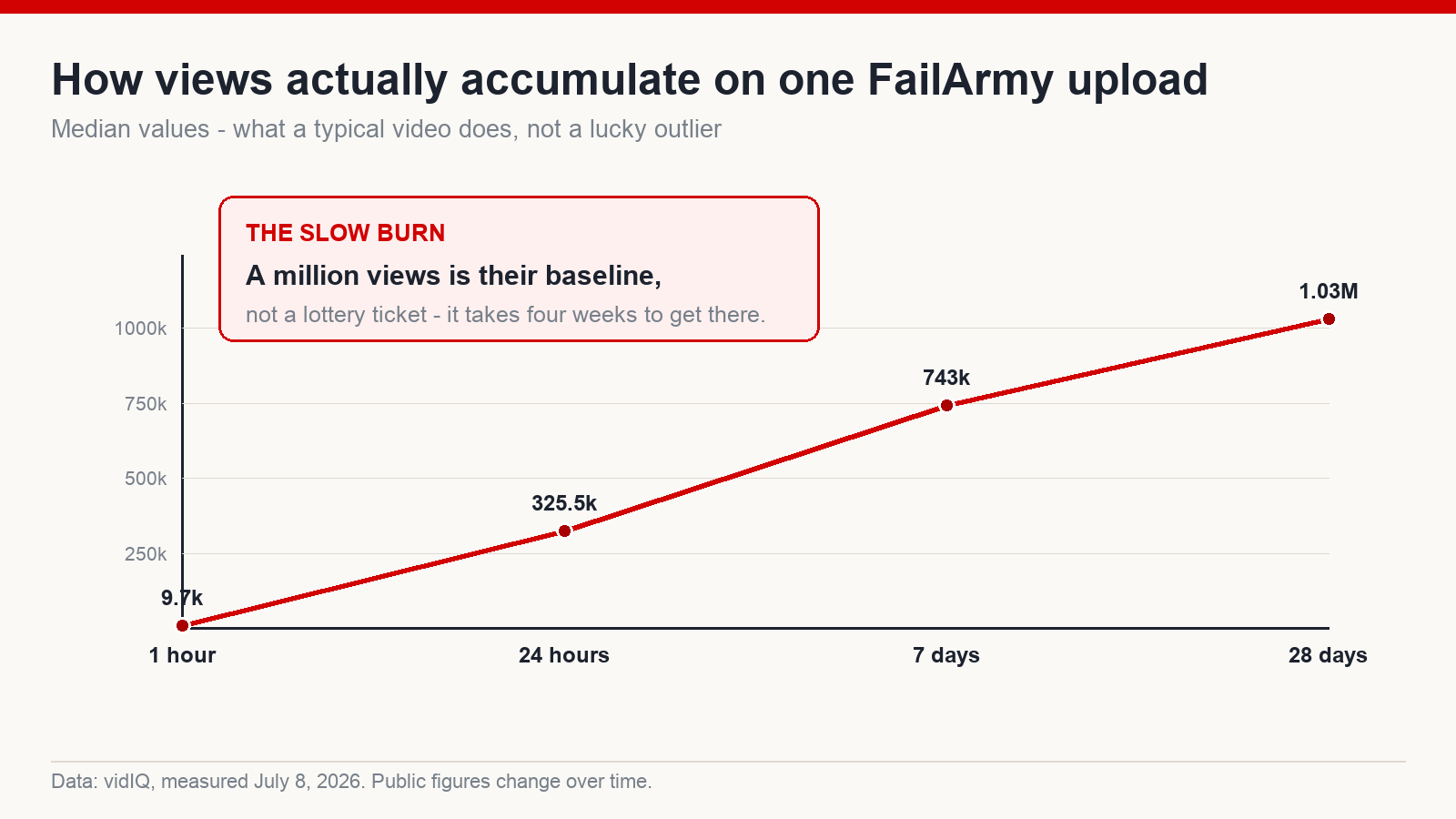
Here is the number that genuinely unsettled me while I was pulling this channel apart. It was not any single million-view video. It was the cadence.
Over the most recent thirty days, the channel published around 28 long-form videos. Nearly one per day. Shorts do not get drip-fed either: roughly 50 of them went live on a single date, July 7, 2026. Not “when inspiration strikes.” Not “when the mood is right.” Steady as a stamping press.
Now sit up for this. A fresh FailArmy upload averages about 9,700 views in its first hour, which sounds tiny. Leave it alone though. At 24 hours the median is 325,500. At seven days, 743,000. At a full 28 days, the median video reaches 1,031,000 views. Four weeks, one million. And that is not a lottery winner, that is their ordinary video.
Do you see where this hurts? Views do not explode. They crawl. They crawl for four weeks and only then look impressive. Which means anyone demanding a result tomorrow will quit precisely when their video was about to lift.
I will be straight with you: content can be learned, niches can be imitated, title templates can be copied. The discipline of publishing on schedule for years, though, is a wall most people never get over. I know it in my bones, because I was one of the people who did not. My first years were pure “film it when I feel like it,” a few days on and then the laptop closed for a fortnight because I was discouraged. The channel died, and it deserved to. Things only started moving when I locked myself into a publishing checklist and accepted that views accumulate by the week instead of exploding overnight.
One correction so you do not set yourself up to fail: FailArmy ships daily because there is a team behind it and a warehouse of pre-licensed footage. Working alone, do not chase that number or you will be finished inside a fortnight. Start with a cadence you can actually hold. Two or three videos a week is fine. Consistent and survivable beats a frantic month followed by silence.
How many uploads a solo creator should actually attempt, and how to slice one build into a week of Shorts, is a whole subject of its own. I broke it down separately in the posting-schedule breakdown.
Where to start this week
Back to that night and the 213 million views on a compilation from 2012. Do you know what it actually changed for me? It did not turn me into someone who reposts other people’s clips. It taught me the opposite: what is worth stealing from a machine like FailArmy is not the footage it owns, it is the way it thinks.
So before you close this tab, let me sort the pile into two.
Copy this, almost verbatim: the consistency (around 28 uploads in the last 30 days, near daily), the evergreen instinct (one title template with a year tag, reused annually), the packaging discipline (thumbnail and title do the talking before anyone presses play), and the multi-platform spread with Shorts published in batches so the algorithm never forgets you exist.
Do not copy this: the part where a company pays for clip licences, employs lawyers and re-licenses footage onward. You and I, starting out, have none of that. Copying it is self-harm. Your version is the five-source blend, every borrowed excerpt under five seconds, pure on nothing.
If I compress the whole thing into four steps you can start this week:
- Pick one universally readable emotion to build around: laughter, shock or suspense.
- Gather material through the five-source blend, every borrowed excerpt under five seconds. Never repost someone’s clip whole.
- Build one repeatable title and thumbnail template instead of inventing a new one each time.
- Publish at a rhythm you can hold, batch your Shorts, and accept that views compound over weeks rather than overnight.
Do not wait until you feel ready. That day does not arrive on its own. This week, assemble one compilation from five sources with every excerpt under five seconds. A clumsy video that exists beats a perfect plan that lives in your head.
And a question to leave you with: which emotion are you going to build your first faceless YouTube channel around, laughter, shock or suspense?
Frequently asked questions
What exactly is a compilation or “content-licensing” channel?
It is a channel that does not originate its footage from scratch. It takes existing clips, either licensed, self-filmed or blended from several sources, and edits them into new videos, usually compilations, monetized through ads and onward licensing. FailArmy is the textbook example: nearly five billion views and 17.5 million subscribers without a single presenter on camera.
Will a FailArmy-style compilation channel get copyright strikes?
It will if you repost other people’s clips without licensing or permission. FailArmy is fine because it buys rights and employs lawyers. A beginner should not imitate that specific part. You lower the risk by keeping excerpts under five seconds, avoiding broadcaster footage and blending several sources, but understand that this reduces risk rather than eliminating it. Fair use is decided case by case, so when a clip worries you, consult someone with real legal expertise.
Can a faceless YouTube channel aimed at foreign audiences actually earn?
The model is real, and FailArmy demonstrates it at scale. What any individual earns depends on niche, quality, consistency and a healthy dose of algorithmic luck, and nobody can promise you a figure. I am not offering a shortcut to wealth; I am saying this is a route with evidence behind it, and it costs time and discipline.
Where should a beginner get raw material from?
From the five-source blend: fair-use excerpts under five seconds, licensed stock footage, footage you shoot yourself, AI-generated shots and your own recorded audio. Do not go pure on any one of them. Pick a universal emotion, build one reusable title and thumbnail template, and publish at a pace you can maintain.
Written by Phuc, a YouTube trainer who has been building on the platform since 2017 (nine years) and specialises in faceless channels aimed at viewers in the US, UK, Germany and Japan. My first four years were mostly failure, because I was convinced I had to be on camera before anything would work, and I only found the faceless route after rebuilding my approach from scratch. Everything above comes from that rebuild, not from theory.
The full step-by-step system I use with the creators I coach lives at mmoyoutube.com.
Disclaimer: this article shares personal experience and opinion. It is not legal advice and it is not a promise of income. Results vary, and YouTube’s policies and payout rates change over time. FailArmy figures were measured with vidIQ on July 8, 2026 and will have moved since. For specific copyright questions, speak to a qualified legal professional before you publish.
One Comment