Demand First: Planning a Channel Around What People Already Search For
I once published close to twenty videos to a channel that went nowhere. The thumbnails were decent, the editing was careful, the subjects were things I found genuinely interesting. Views stayed in the dozens. For a while I was convinced the system had decided against me.
What had actually happened was simpler and more embarrassing. I was making videos about what I wanted to talk about, and then, afterwards, looking for keywords to attach to them. The research was real. It was just being used as decoration on a decision that had already been made.
The fix was not a better tool or a cleverer title. It was reversing the order of operations.
Two orders, identical work
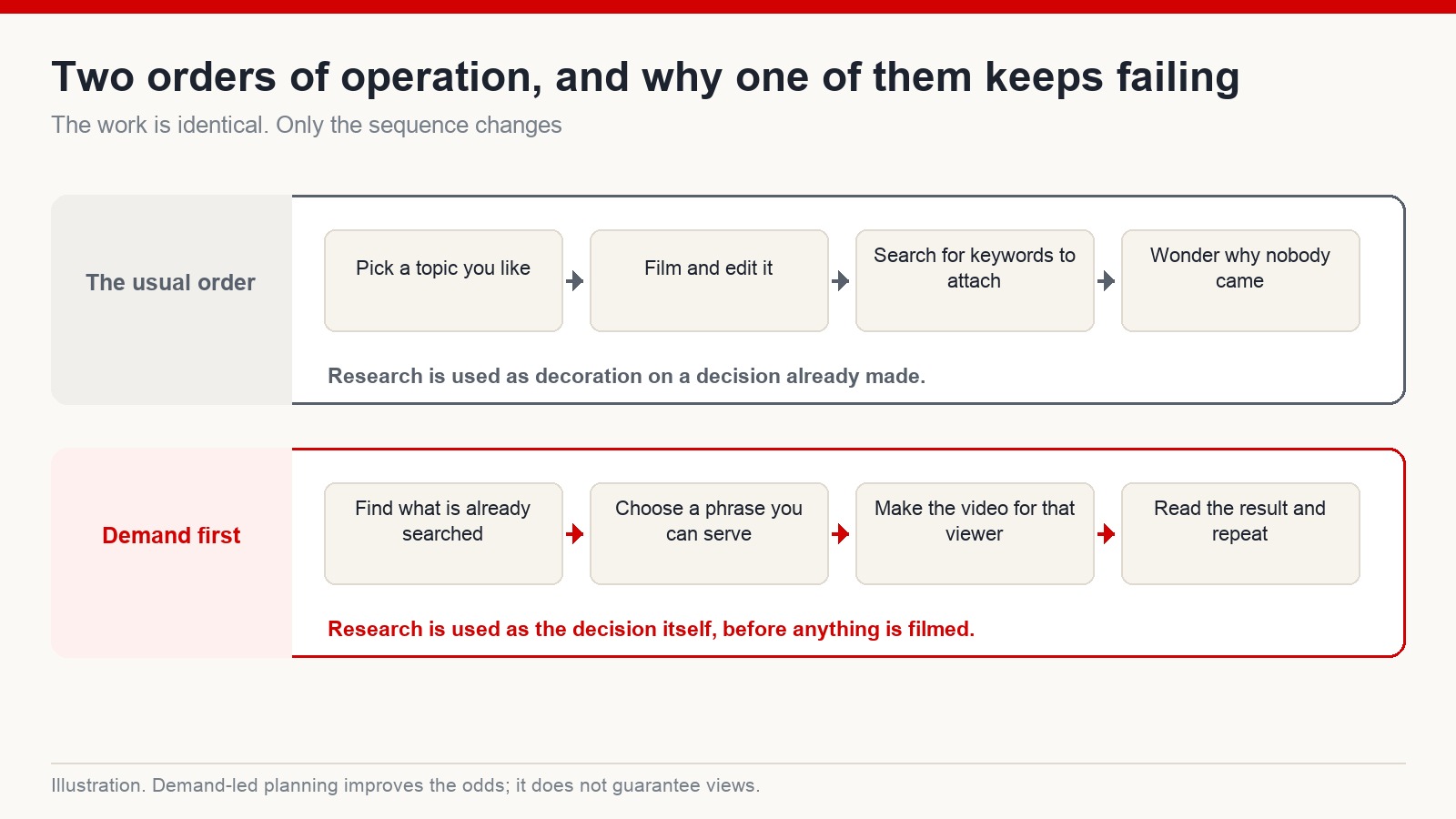
The usual order. Pick a topic you like. Film and edit it. Search for keywords to attach. Wonder why nobody came. Every step is real work, and the research at step three cannot change anything, because the video already exists.
Demand first. Find what people are already looking for. Choose a phrase you can actually serve well. Make the video for that specific viewer. Read what happened and repeat. Same tasks, different sequence, and now the research is the decision rather than an afterthought.
This sounds obvious written down. It is very hard to do, because it means sometimes not making the video you were excited about, which is the single most common reason creators quietly go back to the first order.
What optimisation is actually for
It is worth being precise, because the word covers two different things.
Optimisation is how a system works out what a video is about, who it should be shown to, and when. It is not a set of tricks to please an algorithm. It is a description problem: if the video is described clearly and consistently, it can be matched to people; if it is described vaguely, it cannot.
Done properly, that matching does not only produce search traffic. A video that is clearly about a specific thing, watched by people who wanted that thing, becomes something the system can confidently suggest alongside similar videos — which is where most of the reach on a growing channel comes from.
Narrow beats broad, for a reason that is not about ranking
The instinct on a new channel is to aim at the biggest subjects available. It goes badly, and the usual explanation — too much competition — is only half of it.
A broad phrase brings people with a dozen different intentions. Most of them wanted something else, and their leaving is the loudest thing your video says about itself. A narrow phrase brings fewer people who mostly wanted exactly this, and they stay. That behaviour is what gets a video shown to more people.
So the advantage of narrowing is not a ranking trick. It is that it stops you being shown to an audience that was never going to stay.
One caveat, because it is easy to over-apply this: competition is not determined by demand alone. A small phrase inside a subject full of well-resourced channels can be harder than a much larger phrase that nobody has bothered to answer properly. Read the results page before deciding.
Building the set, not the phrase
A single keyword gets you one video. What a channel needs is a set of related phrases that overlap enough to look like one subject from the outside.
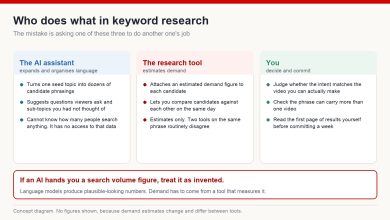
An AI assistant is genuinely useful for the first half of this: expanding a broad subject into candidate phrasings, sub-topics and the questions people ask around it. Give it one instruction that matters more than the rest — do not invent numbers — because a model will happily produce a tidy table of search volumes, and every figure in it is fiction.
Then verify each candidate in a research tool, in the market you actually publish to, and read the first page of results yourself for the survivors. What you are looking for is not the biggest figure. It is a cluster of phrases you could make twenty or thirty videos inside without the channel looking like it changed subject.
Consistency at the channel level
Once the set exists, there are a few places a channel repeats what it is about. None of them ranks a video on its own, and I would be careful with anyone who tells you otherwise.
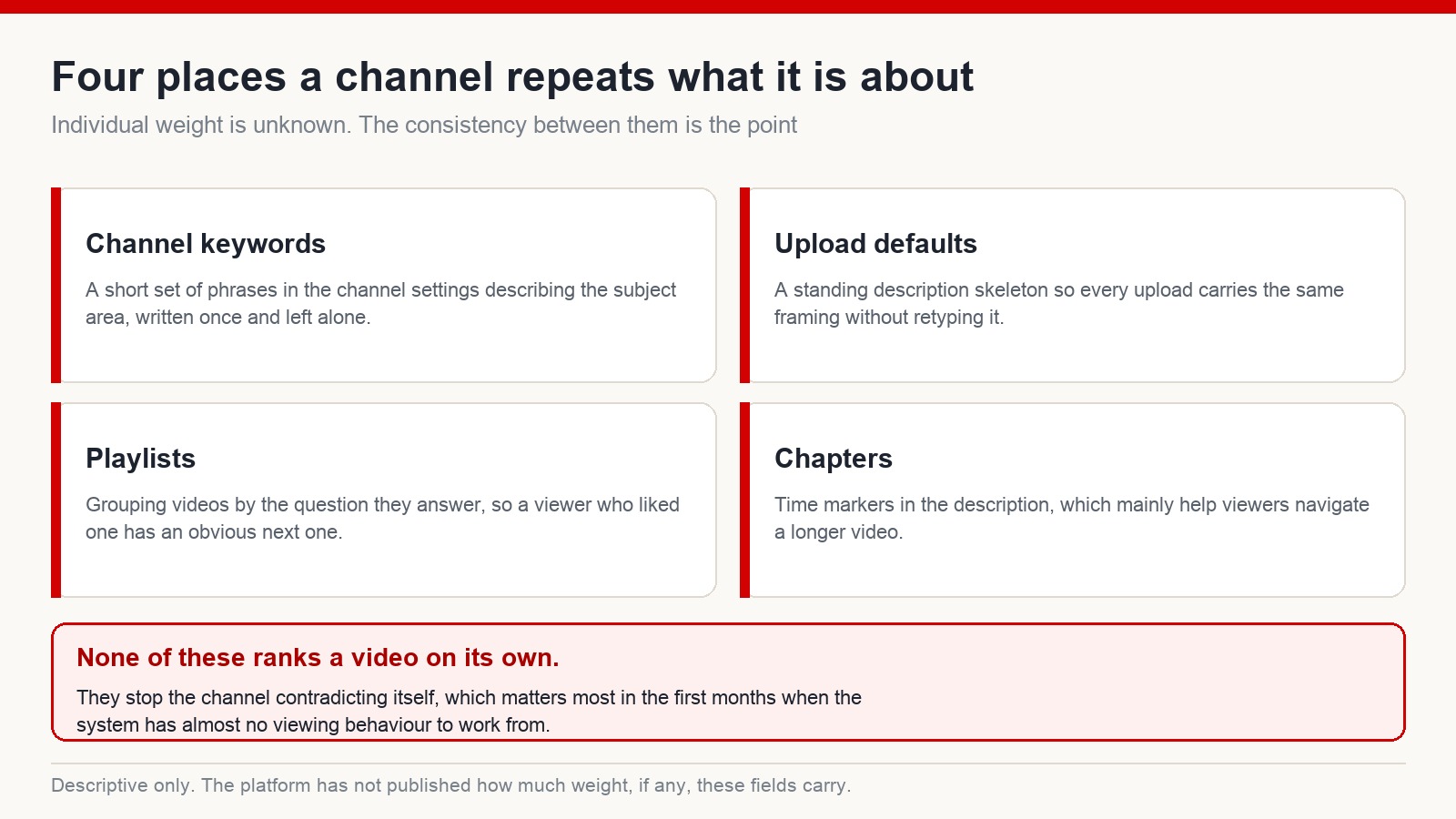
Channel keywords. A short set of phrases in the channel settings describing your subject area. Write them once, keep them narrow, and leave them alone.
Upload defaults. A standing description skeleton so every video carries the same framing without you retyping it. The value here is mostly that it stops you being inconsistent when you are tired.
Playlists. Group videos by the question they answer rather than by upload date, so a viewer who liked one has an obvious next one. This is the one with the clearest direct benefit, because it affects what a real person does next.
Chapters. Time markers in the description. They mainly help viewers navigate a longer video, which is reason enough.
What these four do collectively is stop the channel contradicting itself. That matters most in the first months, when there is almost no viewing behaviour for the system to work from and the words are most of what it has.
The channel name
People spend a long time trying to find a name that sounds impressive. The more useful property is being distinct.
A name that is nearly identical to three larger channels in the same niche is a problem for viewers, who cannot find you again, and for search, which has several similar things to choose between. A name nobody else is using is easier to search for, easier to remember, and easier to distinguish. Sounding clever is optional; being confusable is expensive.
Being found is not the same as being watched
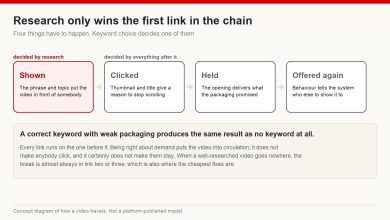
All of the above only gets a video in front of somebody. The thumbnail and the title decide whether anything happens next, and they are read together, in about a second, on a page full of alternatives.
What makes people stop is usually one of two things. Curiosity — a gap they want closed. Or recognition — the sense that the video is about their specific situation. A title that is only the search phrase, correctly placed, often provides neither. The usable move is to keep the phrase whole and add a short clause that supplies the reason to watch now.
The limit worth stating: a curiosity hook the video cannot pay off is worse than no hook at all, because people leave in the first thirty seconds and that departure is the strongest signal the video produces.
Engagement, honestly
Comments, likes and how people watch are part of what the system reads, so it is reasonable to invite a response — asking a real question at a natural point, or asking which of two things a viewer is stuck on.
Two boundaries. A prompt only works if the video earned the response; asking for comments on a video nobody finished changes nothing. And anything involving artificially generated engagement — bought views, reciprocal viewing groups, comment exchanges — is against platform policy and puts the channel at risk. It belongs in a warning, not in a strategy.
Where to start
If you are planning a new channel, the sequence is: choose a subject with demand you can verify, build a set of phrases inside it that could carry thirty videos, make the channel-level description consistent, then spend your remaining effort on packaging and the first minute of each video.
That will not guarantee anything. Demand estimates are estimates, platform behaviour changes, subjects get crowded, and two channels doing identical things in the same niche can get very different results. What demand-first planning reliably removes is the failure you cannot recover from afterwards: a year of good work aimed at nobody.
Frequently asked questions
Does optimisation still matter?
Yes, in the narrow sense of making a video legible — clearly about one thing, aimed at one kind of viewer. It has never been a set of tricks, and the tricks that used to work mostly stopped.
How should a new channel choose phrases?
Narrow enough that the audience is obvious, with demand you can verify in a tool, and clustered so you can make many videos in the same territory rather than one.
Is optimisation enough to make a video travel?
No. It decides whether the video can be shown at all. The packaging decides whether it is clicked, and the first minute decides whether it is watched — and those two decide almost everything after.
Do channel keywords do anything?
The platform has not published how much weight, if any, they carry. Fill them in accurately, keep them narrow, and do not expect them to move views on their own.
How long before this shows results?
Longer than most people expect, and it varies enormously by subject and market. Search-led videos in particular accumulate slowly, so judging one in its first forty-eight hours measures the wrong thing.
If you want the full sequence — subject, keyword set, packaging — for a faceless channel aimed at English-speaking audiences, that is what I teach at mmoyoutube.com. Results vary by channel, subject and market.