4 Ways to Optimize a Faceless YouTube Channel for the US Market
For a long stretch of my career I watched exactly one number: views.
A hundred thousand. Half a million. A million. It sounds fantastic right up until the revenue report arrives and refuses to match the excitement. It took me a while to absorb the thing nobody bothered to tell me when I started in 2017:
Not all views are worth the same.
The same 100,000 views can be worth dramatically different amounts depending on where the viewers live. Traffic from the United States sits in one of the most expensive advertising markets on earth. Traffic from markets where advertisers barely bid does not. That single fact is why so many creators, myself included, deliberately build faceless channels aimed at the US and other Tier 1 audiences.
But aiming at that audience and actually reaching it are two different projects. You have to understand how they search, what makes them click, and what makes them stay. Below are the four things I keep coming back to when someone asks how to point a channel at the US market.
1. Read the value of your views, not the volume
The default beginner behaviour is to open the analytics tab, look at the view count, and feel good or bad about it. That number is close to meaningless on its own.
Creators who earn consistently are reading a wider dashboard:
- RPM – what you actually keep per 1,000 views
- CPM – what advertisers are paying per 1,000 ad impressions
- Viewer geography – which countries your watch time comes from
- Advertiser demand in your niche – some subjects simply attract more bidding than others
Those four together explain almost every “why is my revenue so low” question I get.
Why the US market gets prioritised
American advertisers spend heavily in categories like finance, technology, software, insurance and health. Where competition for attention is that intense, the price per impression rises, and creators reaching that audience see it reflected in their RPM.
I want to be careful here, though, because this is where expectations go wrong:
Publishing in English does not automatically produce a high RPM.
You still need the right niche, the right audience and genuine demand. Flawless English attached to a subject nobody is searching for earns very little. Language is a prerequisite, not a strategy.
The encouraging half of that is you do not need to be fluent to start. Between AI scripting, translation and voice tools, the practical barrier is far lower than it was even three years ago. What AI will not do for you is understand the audience – that part stays your job.
2. Put a number in the title
Scroll through the titles winning on US YouTube and a pattern shows up almost immediately. Numbers everywhere:
- 3 Simple Ways To Save Money
- 5 AI Tools You Should Try
- 7 Habits That Changed My Life
- 10 Retirement Mistakes To Avoid
- 100 Productivity Hacks
Why do they keep working? A number does four things at once. It makes an abstract promise concrete. It is easy to catch while someone is scrolling. It creates a small itch of curiosity about what made the list. And it sets a clear expectation of what the next few minutes contain.
The figures that recur most often are 3, 5, 7, 10, 15, 50, 100 and 500.
But the number itself is the easy part. This is the part that decides whether it helps or hurts:
The content has to actually deliver what the number promised.
Promise ten methods and skim through four vague ones, and retention falls apart in the first two minutes. YouTube reads that as a poor recommendation and stops serving the video. A number that oversells is worse than no number at all.
3. Use AI thumbnails – but stay honest about them
The question I get most often about AI imagery is some version of: will YouTube penalise me for this?
As things stand, using AI-generated images in a thumbnail is not in itself a policy violation. What matters is whether the image is honest about what it is:
- It must not seriously mislead the viewer about the content
- It must not fabricate a real event or present invented footage as documentary
- It must not be built to deceive
I push on this because it is the line that decides whether a channel has a future. A sensational fake thumbnail can pull a burst of clicks. It also trains your audience to distrust you, tanks retention when reality does not match the picture, and puts you on the wrong side of platform policy – which changes, and rarely in favour of the people gaming it.
What AI actually gives you
Used properly, image generation is a genuine advantage for a faceless channel:
- original artwork rather than stock everyone else is also using
- far faster iteration
- the ability to test several thumbnail directions for one video
- a cinematic look on subjects that are hard to photograph
A wildlife, finance, tech or mystery thumbnail that would once have meant a licensing budget can now be drafted in minutes.
What makes a thumbnail work
The reliable formula is unglamorous:
- one clear subject
- one legible emotion
- strong contrast
- very little text
A thumbnail is not a summary of the video. Its only job is to interrupt the scroll and create enough curiosity to earn the click. Tell the whole story in the image and you have removed the reason to open it.
4. Blend the search title and the emotional title
This is the technique large channels use constantly without ever describing it. It starts with recognising that there are two distinct kinds of titles.
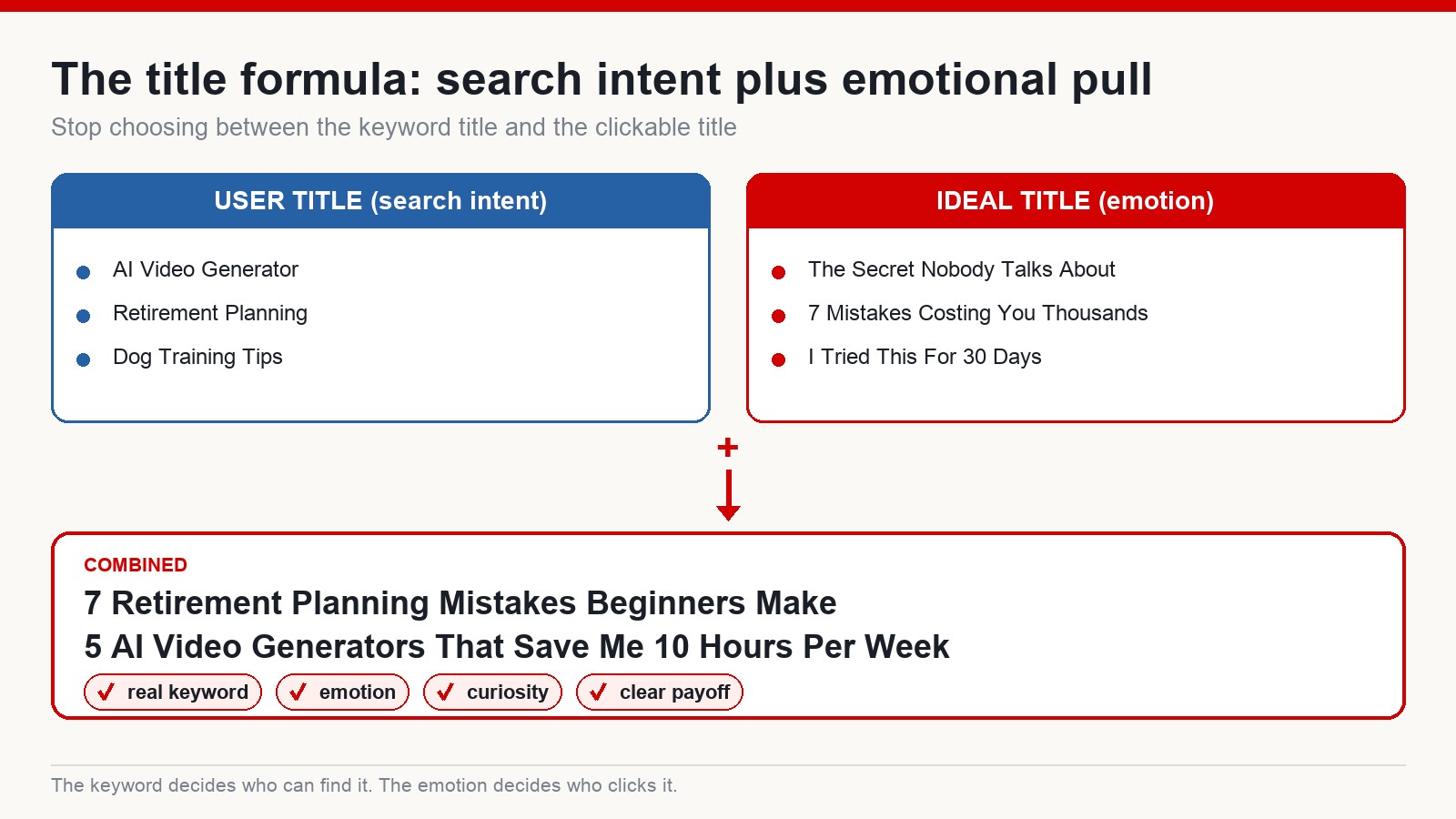
The search title
Built on real demand – phrases with genuine search volume and obvious intent:
- AI Video Generator
- Retirement Planning
- Dog Training Tips
These bring stable discovery, attract precisely the right viewer, and keep working long after the upload date.
The emotional title
Built on feeling and curiosity:
- The Secret Nobody Talks About
- 7 Mistakes Costing You Thousands
- I Tried This For 30 Days
These earn a higher click-through rate and spread faster, but they can fade quickly once the novelty passes.
Combine them instead of choosing
Most people treat this as an either/or decision. It is not. Use the keyword as the base and layer the emotion on top.
Start with Retirement Planning. Turn it into: 7 Retirement Planning Mistakes Beginners Make.
Start with AI Video Generator. Turn it into: 5 AI Video Generators That Save Me 10 Hours Per Week.
Now you have all four ingredients in one line: a real keyword, an emotional angle, a hook of curiosity, and a clear benefit. The keyword decides who is able to find it. The emotion decides who bothers to click.
What actually matters most in the US market
People assume the secret lives in titles, thumbnails or the latest AI tool. In my experience it does not. It is something duller and much harder to shortcut:
Understanding what the audience genuinely wants.
If there is no demand for a topic, no thumbnail rescues it. No title trick rescues it. You are optimising the packaging of something nobody asked for.
This is why the creators who do well spend a surprising share of their week on research rather than editing – studying the big channels in their niche, hunting for smaller channels that are climbing unusually fast, mapping the exact phrases viewers type, and watching how search behaviour shifts. The editing timeline is where the work becomes visible, but the research is where the outcome is decided.
Wrapping up
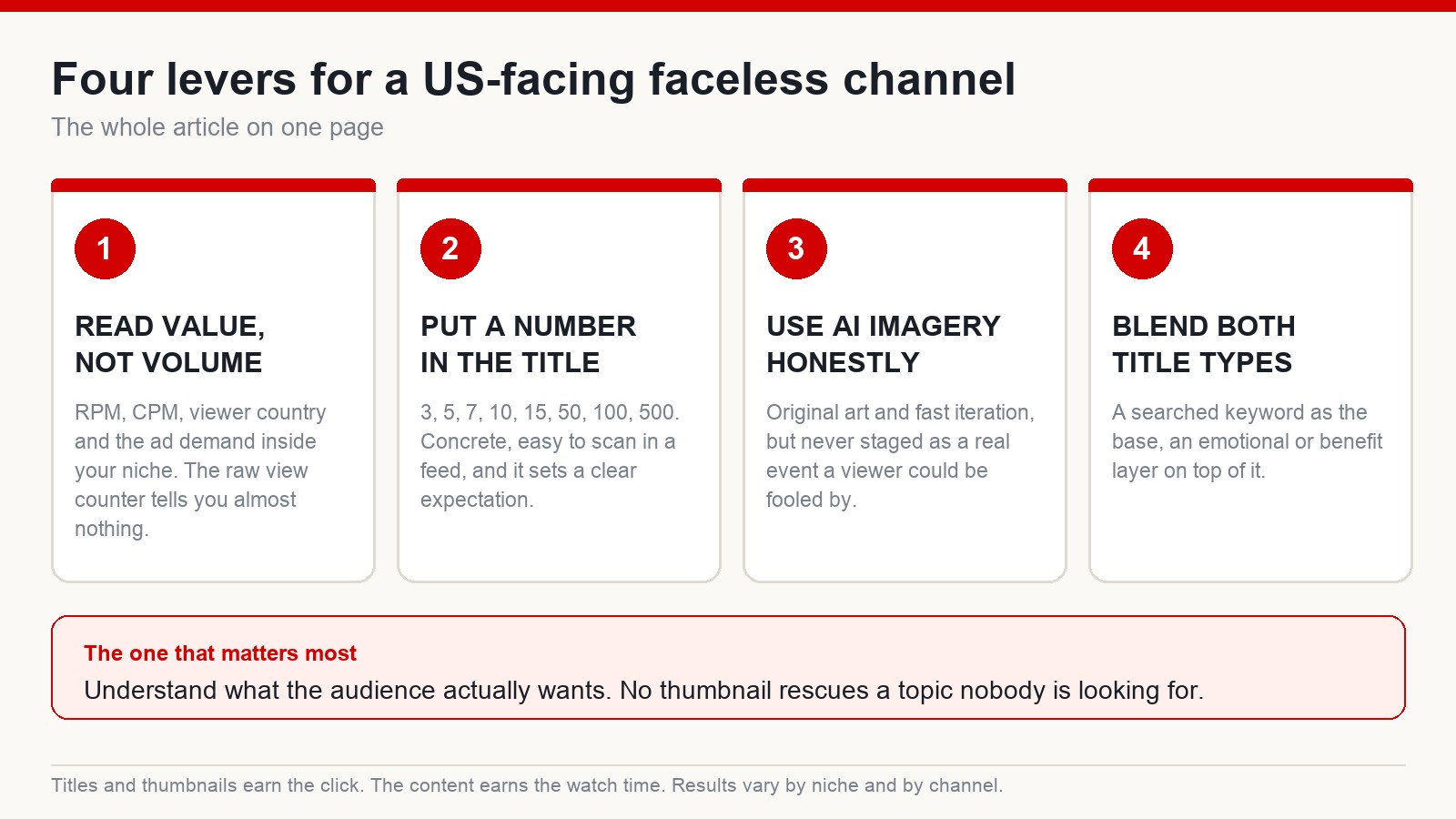
If you are building a faceless channel for the US market, four things carry most of the weight:
- Build for an audience advertisers are actively competing to reach.
- Use specific numbers to make titles concrete and scannable.
- Use AI imagery for original, fast, honest thumbnails.
- Blend the search title with the emotional title instead of picking one.
And underneath all of it, the thing I repeat to everyone I work with:
The title and thumbnail get someone to click. The content is what makes them stay.
Retention is what turns a single good video into a channel that keeps growing, rather than a spike that flares and dies.
Frequently asked questions
Does publishing in English guarantee a high RPM?
No. RPM depends on your niche, where your viewers are, and how much advertiser demand exists around your subject. English is a necessary condition, not a sufficient one.
Should every title contain a number?
No. Use one when it adds real information or gives the video a clear structure. Forced onto a title that does not need it, a number just looks formulaic.
Are AI thumbnails safe to use?
Generally yes, provided they are not deceptive and do not present fabricated scenes as real events. Platform policy on synthetic media does evolve, so it is worth re-reading the current rules periodically.
How should the two title types be combined?
Anchor the title on a keyword people genuinely search for, then add an emotional angle or a specific benefit. Keyword first, emotion second.
What decides whether a channel works in the US market?
Real audience demand, content quality and retention. Everything else is optimisation on top of those three, and results still vary from channel to channel.
If you are aiming at the US market, do not only study how to make videos. Study what the audience is looking for, why the large channels in your niche are winning, and which smaller channels are climbing right now. Once the demand is clear, titles, thumbnails and scripts get much easier to write. That research process is the core of what I teach at mmoyoutube.com.