Comparing Yourself to Other YouTubers Is Costing You Videos
There is a kind of tiredness that has nothing to do with how much work you did. It comes from opening a feed.
Someone’s video just crossed a million. Someone else posted a revenue screenshot. A third person announced a milestone with a caption about consistency. You have not published in three weeks and you are not sure why, except that every time you open your own editor it feels pointless before you start.
That is the cost people never account for. Comparison does not just feel bad. It reliably converts into fewer published videos, which is the one thing guaranteed to keep the gap open.
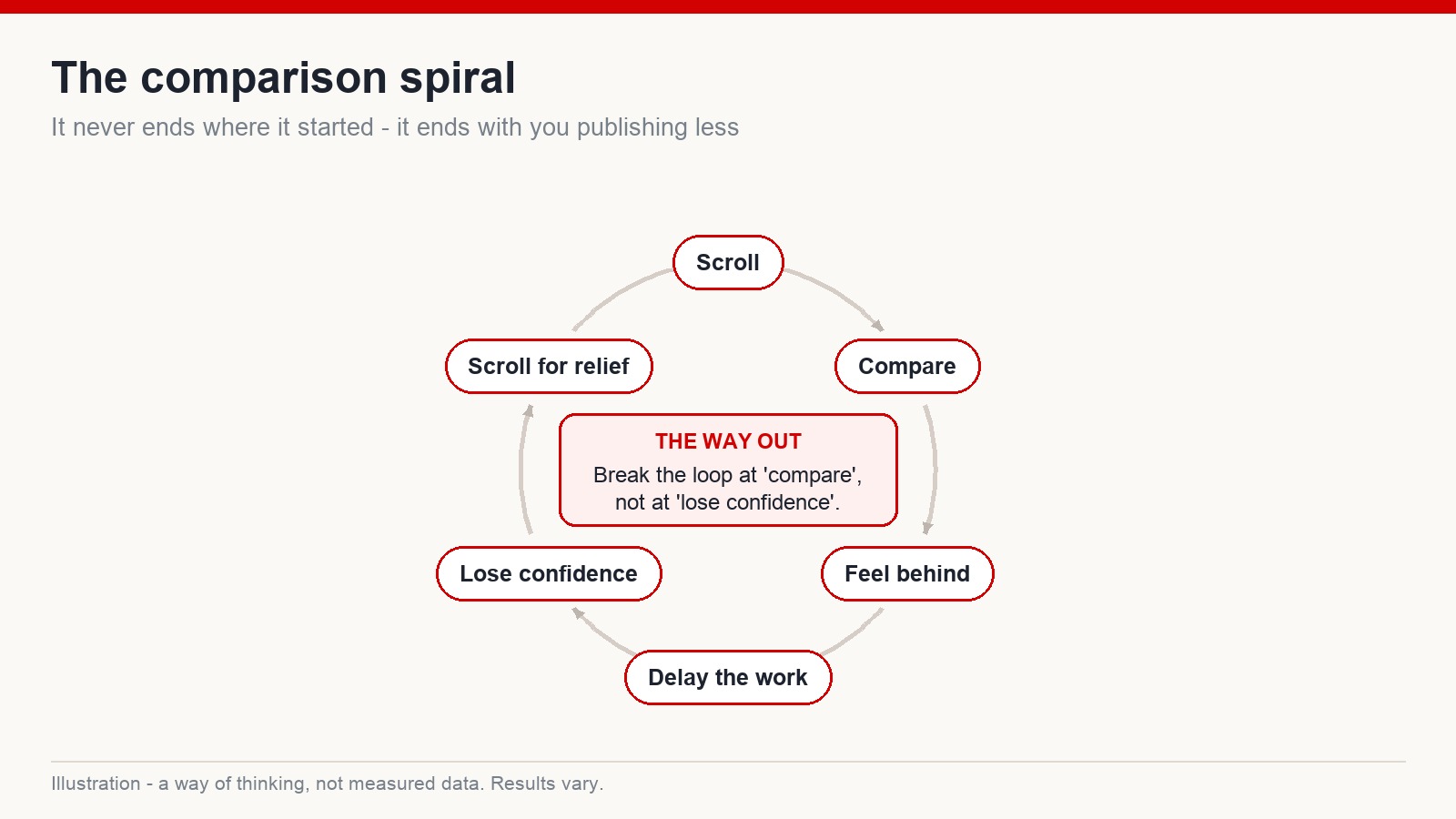
The spiral runs in a predictable order
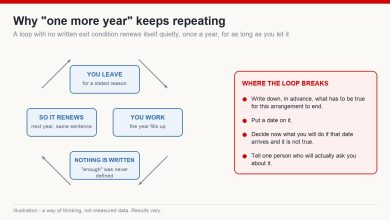
It always goes the same way. You scroll. You compare. You feel behind. You delay the work, because starting from behind is more unpleasant than starting from neutral. Your confidence drops, because now you have evidence that you are someone who does not follow through. And the cheapest available relief from that feeling is to scroll again.
The loop is self-feeding, and the trap is that it feels like research. You tell yourself you are studying the competition. What you are actually doing is collecting reasons.
The useful thing to notice is where the loop can be cut. Most people try to break it at “lose confidence” — waiting to feel better before working. That never works, because confidence is produced by the work, not required for it. You break it at compare: the moment you catch yourself measuring your week against somebody’s announcement, and you close the tab and open the doc.
You are comparing your whole week to somebody’s best day
Here is the structural problem with a feed. It is not lying to you. It is just not a sample.
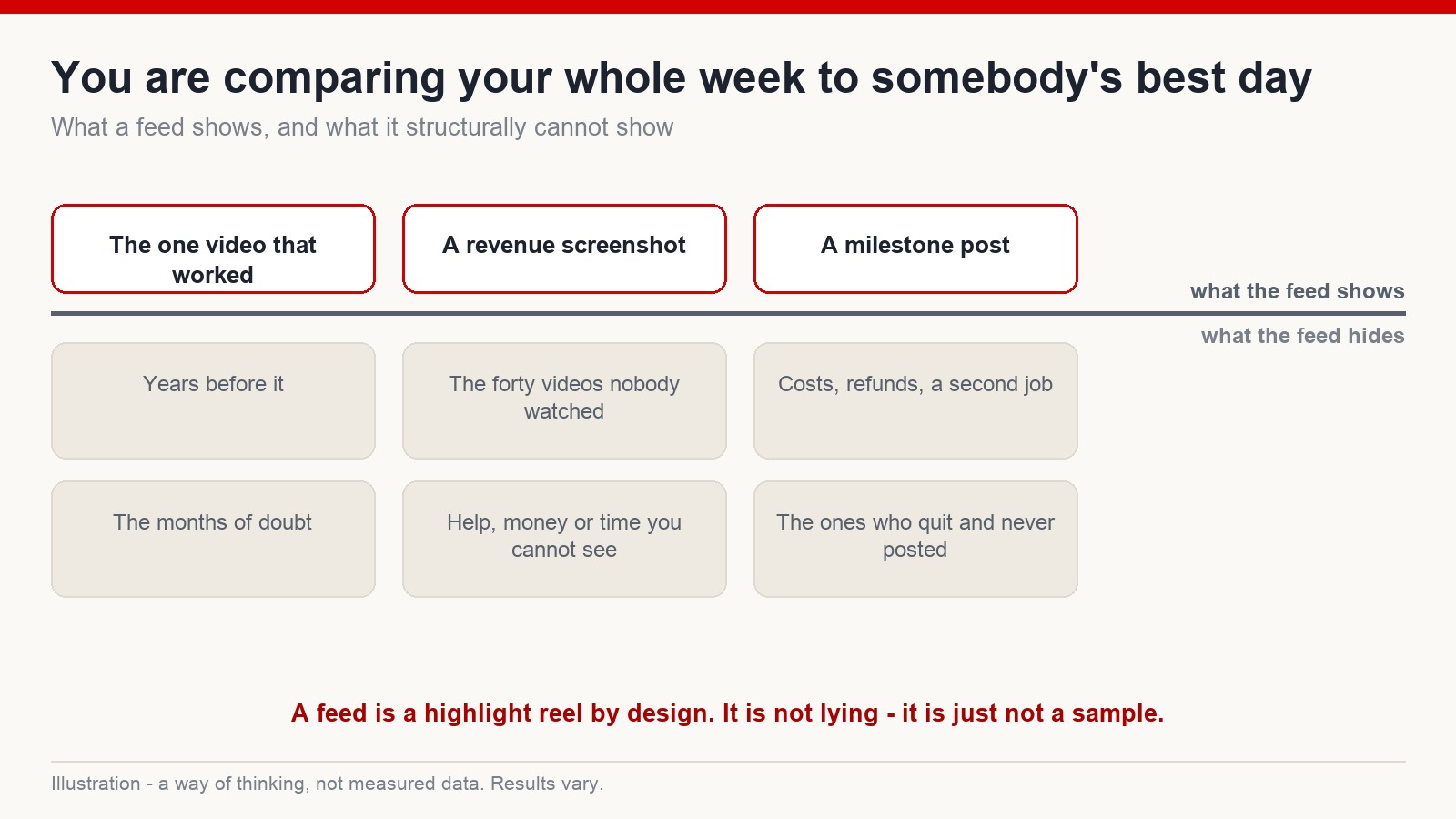
What a feed shows: the one video that worked. A good month, screenshotted. A milestone worth posting about.
What a feed cannot show, by design: the years that happened first. The forty videos nobody watched. The costs, the refunds, the second job paying for it. The months of doubt. The help, money or time somebody had that you cannot see from outside. And most importantly, everyone who tried the same thing and quit, who by definition never posted about it.
Nobody publishes the quiet Tuesday where nothing worked. So the picture you are measuring yourself against is not a distorted version of reality — it is a highlight reel, doing exactly what it was built to do. Judging your ordinary week against it is a category error, not a character flaw.
While you are wanting, you forget what is already on the desk
The other half of the exhaustion is that wanting crowds out counting.
You want a big channel, and forget you own a phone that shoots better video than broadcast cameras did fifteen years ago. You want a production team, and forget an AI assistant can help you outline, draft and pressure-test a script tonight. You want a studio, and forget how many working channels started in a corner of a bedroom with a cheap microphone and an old laptop.
Right now, most likely, you have: a working body, a clear head, an internet connection that will teach you almost anything, a free platform to publish on, free editing and design tools, and at least one real experience worth telling someone about.
That is not a shortage of resources. It is a shortage of one decision — start with what is already on the desk.
Plenty of people genuinely are constrained, and I am not going to pretend otherwise. But a lot of people who feel stuck are not short of tools. They have a phone they only scroll with, an internet connection they only compare with, and free evenings they spend watching other people build things.
Waiting for more is the most expensive habit in this business
The waiting sounds reasonable every time. When I have a proper camera. When I can afford the course. When work calms down. When I feel more confident. When I actually know what I am doing.
But while you wait for better gear, someone published their first video on a phone. While you wait for the perfect idea, someone tested ten topics and now knows which one has a pulse. While you wait to stop being afraid, someone got used to flopping, fixed the thing, and published again.
Nobody starts complete. Everyone who starts is short of something — money, skill, confidence, experience, equipment, support. The only difference is that they began with what they had.
The first video changes your status, not your life
Do not dismiss the first one. It will probably get very few views, no comments and no revenue, and it will be clumsy. That is fine, because its job is different.
It moves you from someone who thinks about this to someone who has done it. From wanting to testing. From watching the game to being in it.
And once you are in it, you start generating the only thing that actually improves a channel: your own data. Which topics show a signal. Whether anyone clicks your thumbnail. Whether your hook holds people past the first thirty seconds. What your delivery sounds like to someone who is not you. None of that is available from the sidelines, at any price.
A small idea is a legitimate starting point
People wait for a big idea. You do not need one. Channels start from things like:
- Something you went through and learned from.
- A mistake that cost you, explained so it costs someone else less.
- A skill you are currently learning, documented honestly as you learn it.
- A tool you figured out, explained more clearly than the manual does.
- A problem beginners in your niche keep hitting.
You do not have to be an expert. Viewers often do not want someone twelve years ahead of them; they want someone three steps ahead who remembers what confused them. Making content from the position of a person genuinely learning is a real format, not a consolation prize — as long as you are honest about where you are standing.
Gratitude is not the opposite of ambition
There is a misreading of “be content with what you have” that turns it into an excuse for stopping. That is not what it does.
Being content is not lying down. It is refusing to punish yourself over things you do not have yet. It is looking at what you do have and using it as a starting line rather than as evidence of failure.
Done properly, it produces action. You have your health, so you use it to learn. You have a phone, so you record something. You have an internet connection, so you build a skill with it. Correctly applied, gratitude is not passive — it is what makes starting from where you are feel possible instead of humiliating.
Do one real thing today
Not the whole plan. One item, small enough that a bad day cannot stop it, real enough that it produces evidence.
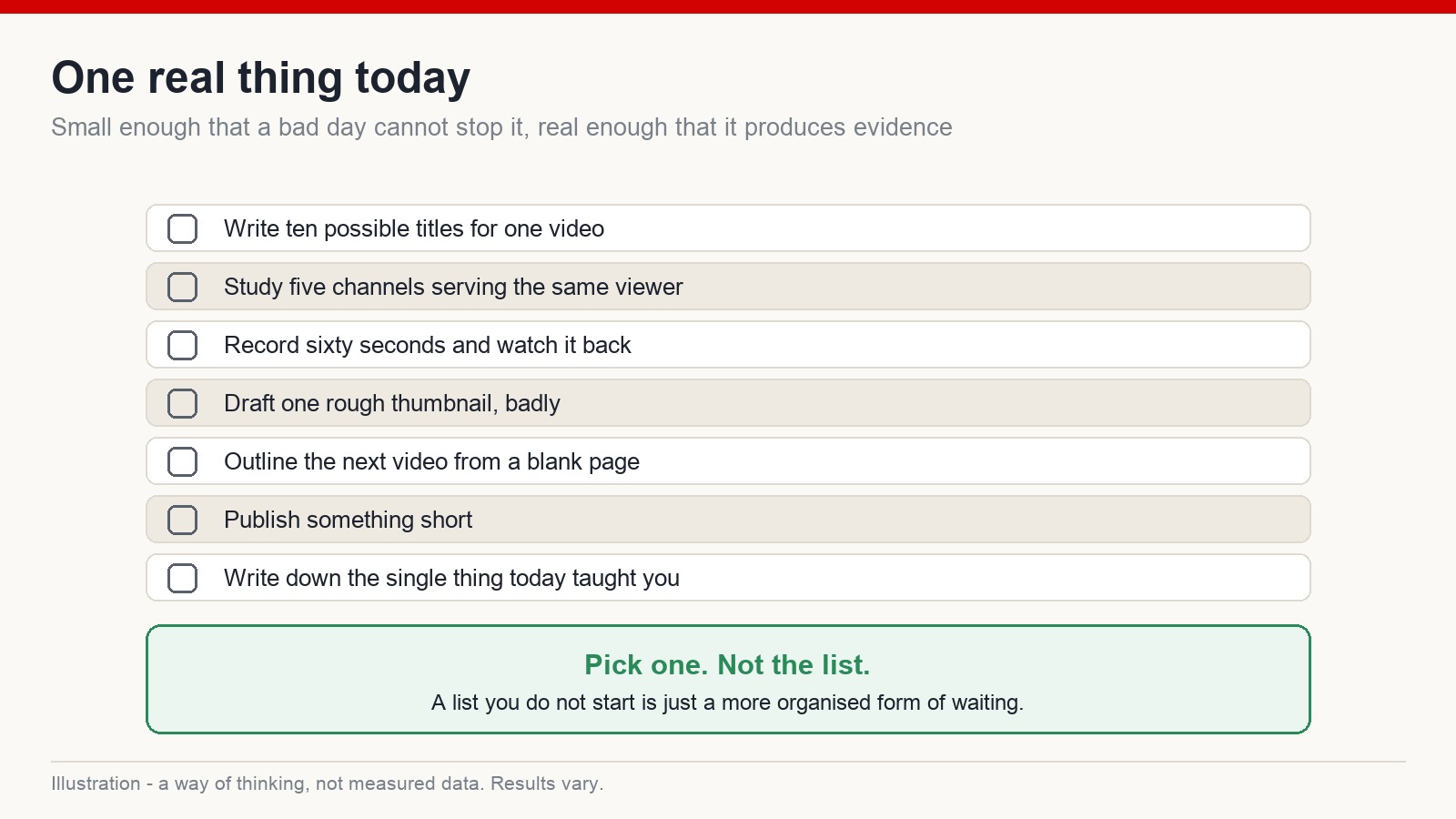
- Write ten possible titles for one video.
- Study five channels serving the same viewer you want.
- Record sixty seconds and watch it back.
- Draft one rough thumbnail, badly.
- Outline the next video from a blank page.
- Publish something short.
- Write down the single thing today taught you.
Pick one. Not the list. A list you never start is just a more organised form of waiting.
And if you want a comparison to make, make an internal one. Is this thumbnail better than your last five? Did this hook hold longer than your median? Is this script tighter than the one before it? That comparison is honest, it is available today, and unlike the feed, it actually tells you what to change.
Nobody’s results here are guaranteed. Outcomes vary enormously by niche, market and how long you keep going, and platform rules shift without notice. But the gap between you and the person whose post ruined your morning is almost never talent. It is a few hundred published videos and the years that came with them — and the only way to close it is to add to your own count.
So: what do you already have? Start from that.
Frequently asked questions
How do I stop comparing myself to other YouTubers?
Break the loop at the comparison itself rather than waiting to feel confident again. In practice that means limiting how much time you spend watching other creators’ announcements, and replacing the external comparison with an internal one — measuring this video against your own last ten instead of against somebody’s best month.
Why does watching successful creators make me publish less?
Because it makes the gap feel like a verdict rather than a distance. Feeling behind makes starting more unpleasant, delay lowers confidence, and lower confidence sends you back to scrolling. The spiral is predictable, which is also what makes it interruptible.
Can I start a YouTube channel with just a phone?
Yes. A modern phone records perfectly usable video, free apps handle editing and thumbnails, and no viewer has ever clicked away because of the sensor size. Ideas, consistency and improvement matter far more than gear at the start.
Do I need to be an expert before I start?
No, but you do need to be honest about your level. Content made from the position of someone actively learning works well, because the audience closest to your level finds it more useful than advice from someone who has forgotten what was hard. Just do not present yourself as further along than you are.
How do I stop procrastinating on my first video?
Shrink the target until it is embarrassingly small. Not “build a successful channel” — write one title, record sixty seconds, outline one video. The point is to break the spell, and small concrete actions do that in a way that ambitious plans reliably do not.
If you want a structured starting point for an English-language channel, that is what I teach at mmoyoutube.com.