Why Viewers Comment, And How To Leave Room For It
There was a period when I published on a schedule and nothing moved. The thumbnails were fine. The titles were fine. The tags and descriptions were as tidy as anyone could want. The videos went out and landed with a small, polite thud.
What I was missing was not a technical setting. It was that I had made a run of videos nobody had any reason to respond to. Every question was answered, every loop closed, every point argued through to its conclusion. There was nothing left for a viewer to do except leave.
I have been making YouTube content since 2017, mostly faceless channels for viewers in the US, the UK, Germany and Japan. This is what I eventually understood about comment sections: you do not add engagement at the end of a video. You leave room for it in the middle.
Five reasons anybody types anything
Every comment you have ever received came from one of a small number of impulses. It is worth knowing which, because you can write for them deliberately.
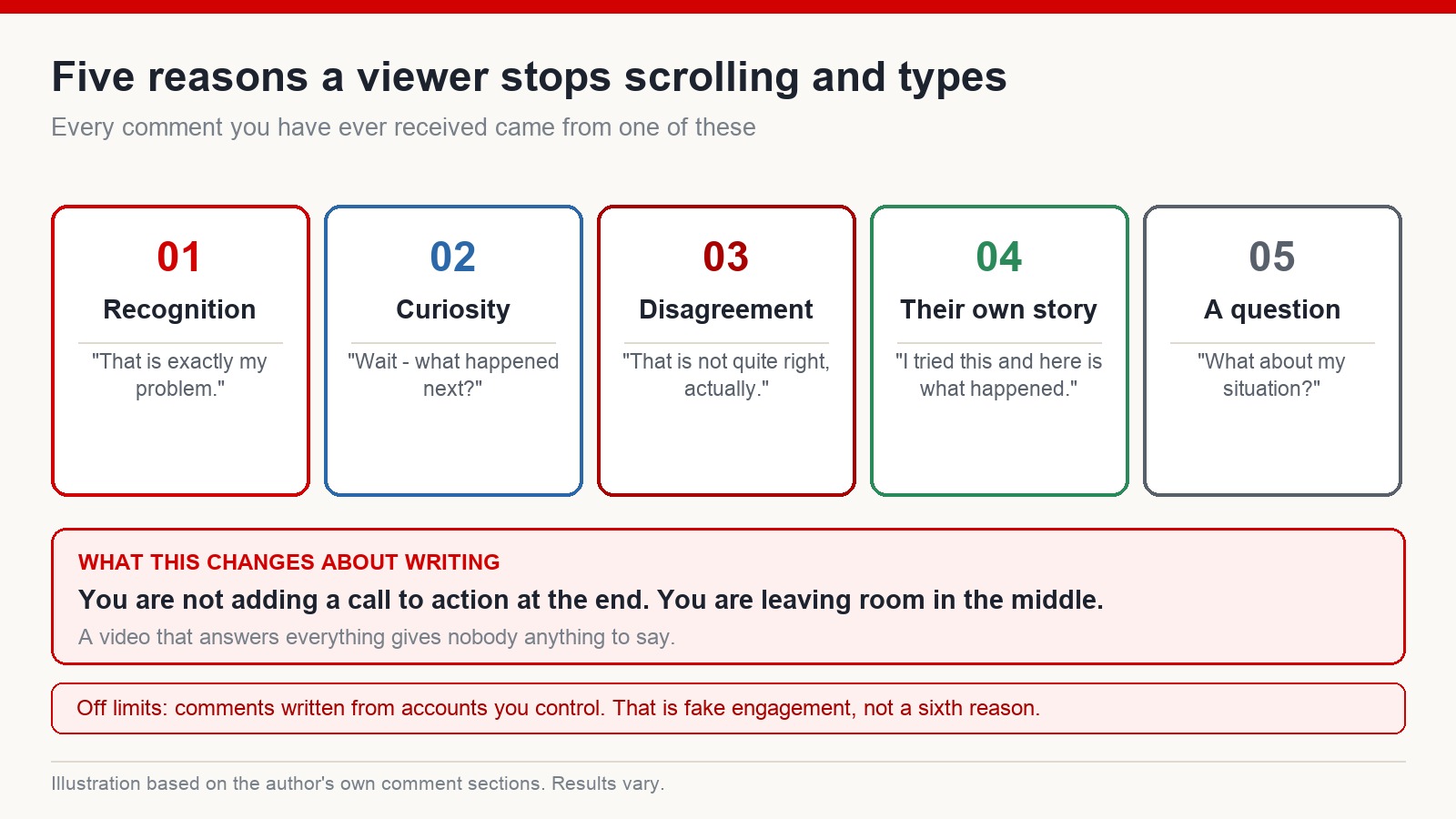
Recognition. “That is exactly my problem.” The strongest of the five by some distance. When somebody hears their own situation described more precisely than they could describe it themselves, they respond – not to be helpful, but because being understood is a small shock.
Curiosity. An open loop. Something was set up and not resolved, and the viewer wants to know.
Disagreement. Say something arguable and people will argue. This is uncomfortable to design for, and it is why videos that take a position outperform videos that survey every position neutrally.
Their own story. “I tried this and here is what happened.” Give people a natural slot to put their experience into and a surprising number will take it.
A question. Their situation is not quite the one you described, and they want to know what to do about the difference.
Notice what is not on that list: being asked to comment. “Let me know what you think below” produces almost nothing on its own, because it does not trigger any of the five. It is an instruction, not a reason.
The opening is where you win or lose the rest
Most videos that go nowhere do not fail on content. They fail in the first fifteen seconds, because the opening was ordinary and gave nobody a reason to stay through the part that was good.
Two things reliably hold people. The first is an information gap: state that something surprising is true and delay the explanation. The second is recognition, used immediately – open by naming the exact situation the viewer is in. “If your videos are getting impressions and no clicks” is a better opening line than anything about what the video will cover, because a specific slice of the audience has just been told the video is about them.
A caution on the technique, because it is easy to overdo: an opening promise that the video does not keep costs you more than a dull opening. People leave faster when they feel misled than when they are mildly bored, and that shows up in the retention graph in the first minute.
Ask something small enough to answer
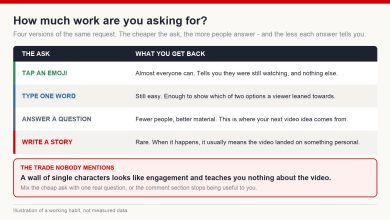
The most common mistake in comment prompts is asking a question that is far too large.
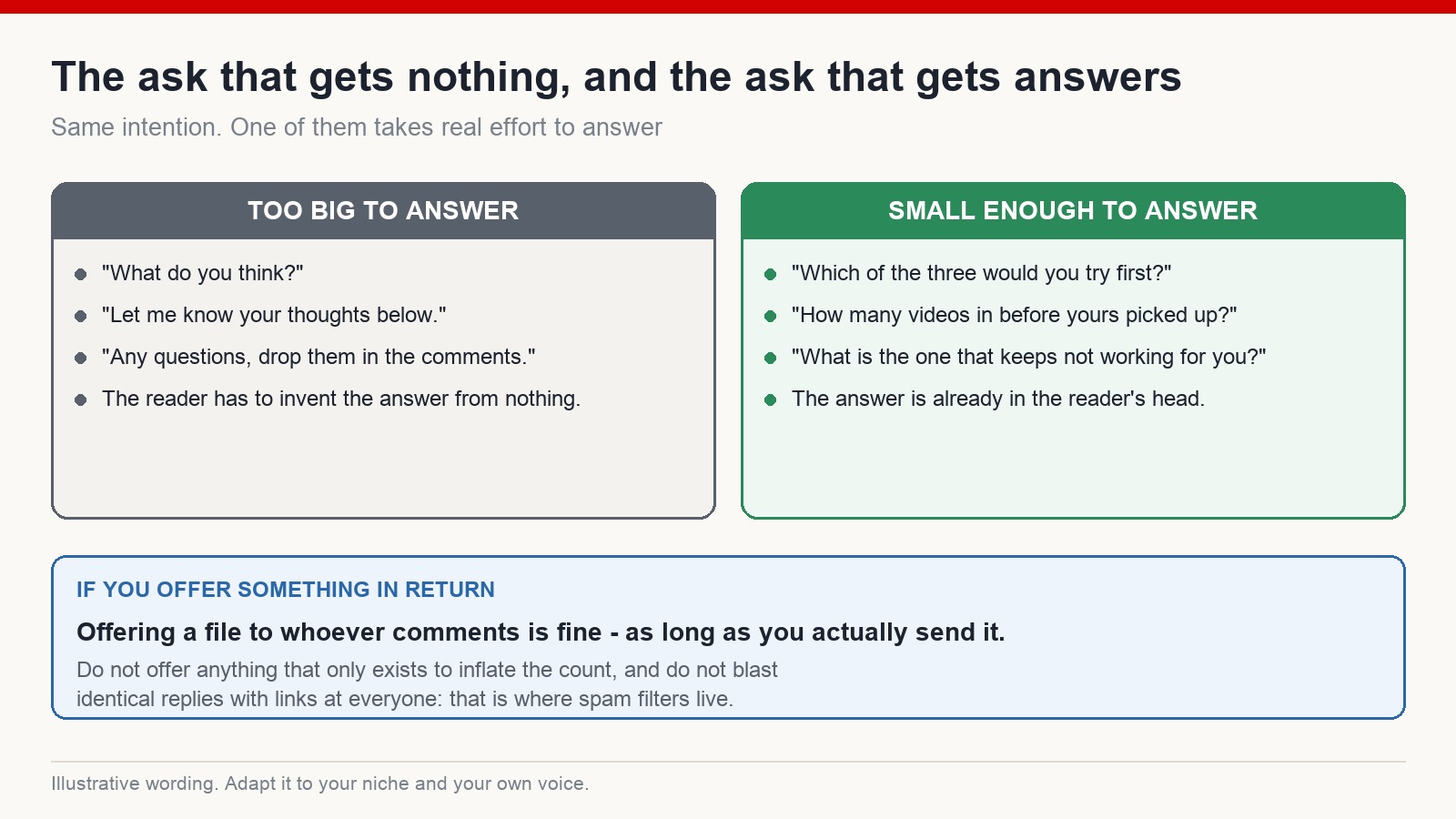
“What do you think?” requires the viewer to invent an answer from scratch, choose a framing, and write a paragraph. Most people will not do that for a stranger. “Which of the three would you try first?” requires them to type one word, and the answer is already in their head by the time you ask.
Small, specific, already-formed. Those are the three properties of a question that gets answered:
- “How many videos in were you before yours started picking up?”
- “Which of these is the one that keeps not working for you?”
- “Are you doing this on a phone or a laptop?”
And placement matters as much as phrasing. If the only question you ask arrives in the outro, you are asking the smallest audience the video will ever have.
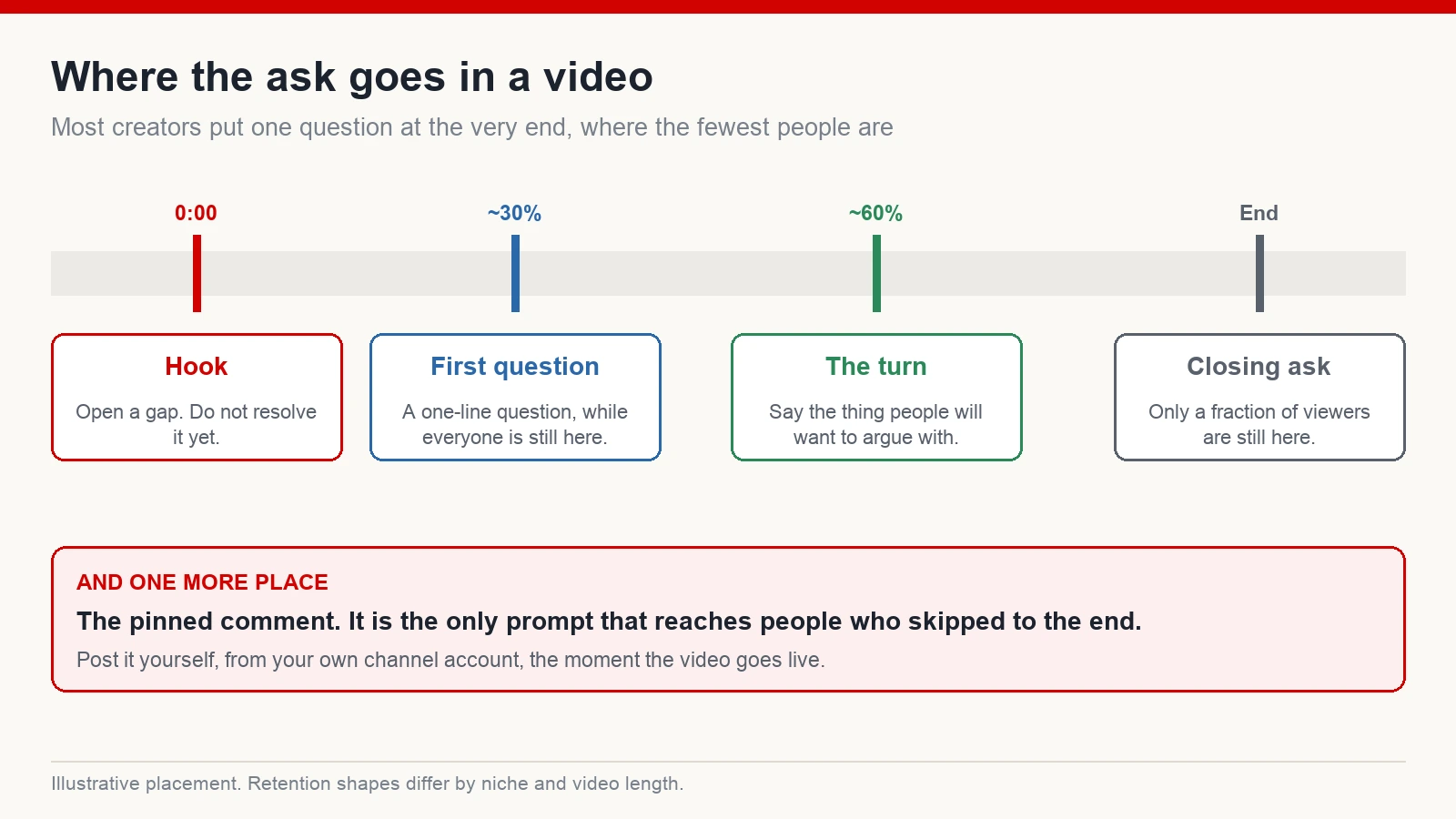
Put a short one about a third of the way through, while most people are still watching. Save the genuinely arguable point for somewhere around the middle – that is where disagreement does its work. Keep the closing ask by all means, but stop treating it as the main one, and put the same question in the pinned comment so it reaches the people who never got that far.
Offering something in return – and where that goes wrong
Offering a file, a checklist or a template to people who comment is legitimate, and it works, because the reader gets something rather than doing you a favour. Two conditions attach to it.
The first is that you have to actually send the thing. An offer used purely to inflate a comment count is a promise you broke in public, under your own video, where everyone can see it.
The second is that you must not reply to fifty comments with the same message and the same link. Repetitive comments posted at scale are spam under YouTube’s spam and deceptive practices policy, and the fact that a human pressed the button each time does not change what the pattern looks like. If you are handing something out, send it through a route that is built for it rather than pasting an identical line under every reply.
The line that is not a technique
There is a sixth thing people do to get comments, and it does not belong on the list above: writing them from accounts they control.
It gets described as priming the conversation, or making the section look alive so that real viewers join in. Under YouTube’s policy it is fake engagement – engagement that does not come from real people with genuine interest – and the documented consequences run from having the metrics removed to having the channel terminated. Separate emails and isolated browser profiles do not put it in a different category, because the category is about who the account belongs to, not about how well the accounts are separated.
It also fails on its own terms. A comment you wrote yourself teaches you nothing about your audience, and the whole reason to care about comments is that they tell you things you did not know.
Old comments are the best briefing you will get
Here is the habit I would keep if I had to drop everything else in this article: go back through videos from one or two months ago and read the comments properly.
The same questions come up again and again. When three separate people ask how to avoid a particular mistake, that is not three comments – that is a video with a confirmed audience, described by the people who will watch it. It moves you from guessing at topics to answering demand that has already been expressed in writing.
It is also the cheapest research available. No keyword tool, no competitor analysis, no spreadsheet. Just the people who already watch you, telling you what they still do not have.
Why do videos with a lot of comments often do better?
Comments indicate that viewers cared enough to participate, and that generally travels with the things the recommendation system does measure, such as how long people stay. How much weight comments carry directly is not published, so compare a video against the median of your own last ten uploads rather than against a number from a blog post.
How important is the opening really?
The first fifteen seconds decide whether the rest of the video gets watched. That is visible in the retention graph of any video you have ever published.
Does asking people to comment a single character work?
It lowers the effort barrier, so it does produce responses. It also produces a comment section full of single characters, which tells you nothing. A short specific question is more work for the viewer and worth considerably more to you.
Does a pinned comment help?
It is the one prompt that reaches people who skipped to the end, so it is a good place to put your question. Post it yourself, from your channel account, when the video goes live.
How do I avoid being flagged for engagement spam?
Do not use accounts you control, do not post repetitive comments at scale, and do not paste the same link under dozens of replies. Ask real questions and answer the people who show up.
The question worth asking about your own videos
Before publishing the next one, ask whether it gives anyone a reason to say something. Not whether it is informative – whether it leaves a gap, takes a position, or describes somebody’s situation precisely enough that they feel seen.
A video that answers everything gives nobody anything to say. That is not a small stylistic point; it is the difference between publishing at people and having a channel.
If you want the rest of the process for building a faceless channel for an English-speaking audience, that is what we work through at mmoyoutube.com.