Niche Within a Niche: The Three-Layer Drill for Choosing What to Make
“If the niche is that small, who is even going to watch?”
Two people start channels in the same month. The first picks something enormous to be safe – cooking, history, travel – on the reasoning that a bigger subject means more people who might click. He works hard and publishes on schedule, and the channel stays on the floor. The second picks a corner so narrow that describing it out loud makes people wince. Her videos start creeping upward almost immediately.
And I know what just went through your head, because it goes through everyone’s: a corner that small must be starving for viewers. Surely that is the riskier bet.
That fear is reasonable. You are afraid of spending a month filming and editing and publishing on time, and ending with nothing – nobody watching, nobody staying. So you cling to the big subject, because the big subject feels safe.
I have to be blunt about this, because after years of teaching it is the single most common mistake I see, and I only recognise it so quickly because I was the first person in that story. I held the enormous subject and watched the channel sink.
Picking a big subject does not make you safer. It puts you shoulder to shoulder with tens of thousands of people saying almost exactly the same thing, which makes you invisible. This article is about the fix: why a small niche is not a viewer shortage, and how to dig one narrow enough to win.
The thing you have backwards: small means right, not scarce
In your head the big subject is a big lake, a big lake holds more fish, therefore fishing is easier. It sounds obviously true. It is the trap that buried most beginners, me included.
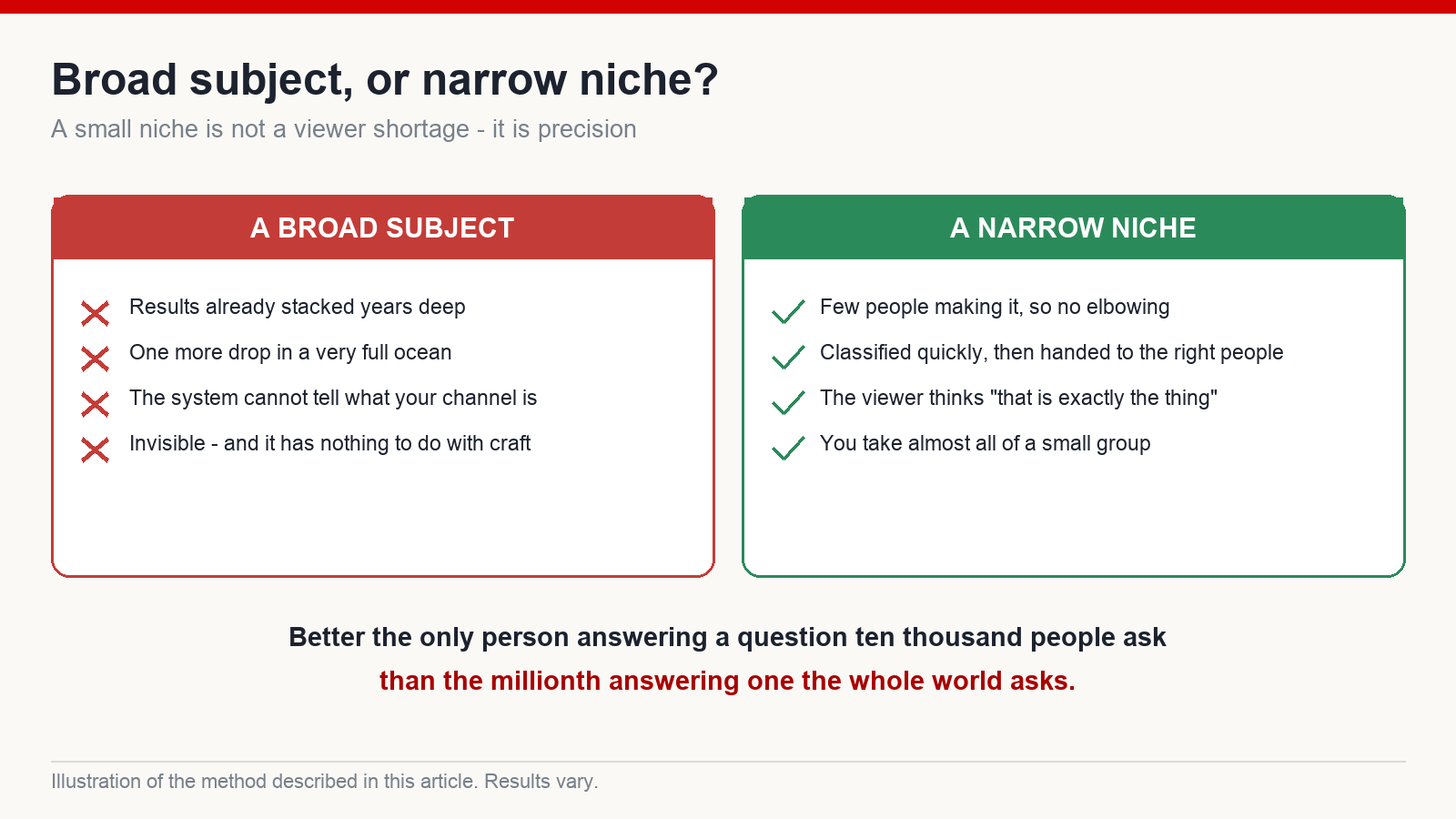
A big subject is not a big opportunity. It is the most contested ground there is. Search for “easy dinner recipes” or “world history explained” and you get results stacked years deep, from channels that put down roots long before you arrived. Dropping a video in there is a drop into an ocean. Not because your work is bad – because in that crowd nobody has any way of noticing you.
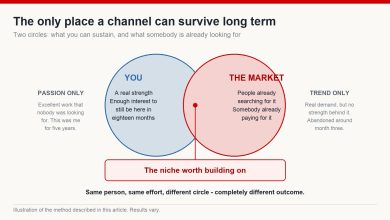
A narrow niche inverts all of it. Fewer people are making it, so you are not elbowing anyone. More importantly, when you say one very specific thing consistently, a recommendation system can classify you immediately – it knows what your channel is about and who to hand it to. And the viewer, typing a question that has been quietly bothering them, sees your video and thinks that is exactly the thing. So they stay, they finish it, and they click the next one.
Here is the sentence that unties the fear: a smaller total audience is not the same as fewer views. In a small group you take almost all of it. In a huge group you get a rounding error. It is better to be the only person answering a question ten thousand people are asking than the millionth person answering a question the whole world is asking.
Small does not mean scarce. Small means precise.
The three-layer drill: subject, niche, niche-within-a-niche
Fine in theory. What does “dig narrower” actually mean in practice? This is where most people get stuck, so here is the frame I use on myself.
When you sit down to think about content, your brain stops at a single large word: cooking, travel, cars. That is layer one. Most creators building for an international audience die there – or, worse, die at layer two while believing they have dug deep enough.
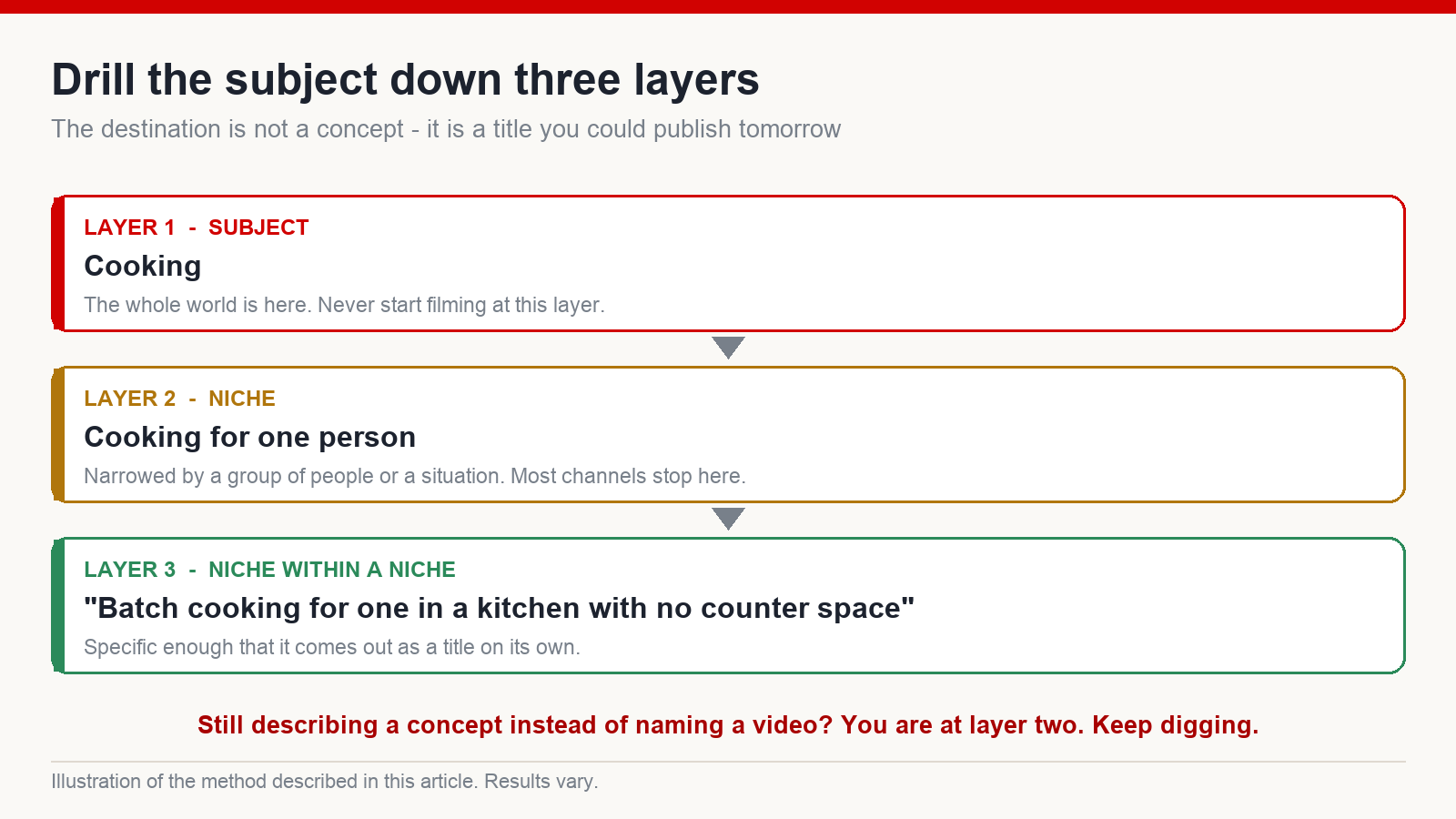
Layer one is the subject. “Cooking.” Never start filming here. The whole world is talking about it, the results are already full, and you are one more drop.
Layer two is the niche – narrowed by a group of people or a situation. Cooking becomes cooking for one person. Places becomes places in the United States the public is not allowed to enter. Cars becomes keeping a twenty-year-old car alive. Much tighter. But stop here and you are still making the exact video another hundred channels are making.
Layer three is where it starts paying – a niche-within-a-niche, one question or one situation specific enough that it comes out as a title on its own. Cooking for one becomes “batch cooking for one person in a kitchen with no counter space”. Restricted places becomes “seventeen places in the United States you are not allowed to enter”, then splits again state by state. Old cars becomes “the five parts that fail first on a twenty-year-old car, in order”.
See the pattern? The destination is not an interesting concept you can nod at. The destination is a specific video title – something a stranger can read and know instantly what the video contains.
Your turn. Write your subject on one line. Pull it to layer two: which group of people, or which situation? Then force it to layer three: which question is specific enough to become a title? If what you have written is still a concept rather than a title, you are stuck at layer two. Keep digging.
Narrow is not enough: the niche has to touch a life
Now the second trap, sitting immediately behind the first.
People absorb the “dig narrower” idea, chop their subject down to something microscopic, and produce a video as dry as a dictionary page read aloud. “The main varieties of X.” “A list of regulations by region.” Narrow enough, accurate enough, and you finish it having felt nothing. Narrow and lifeless still sinks.
Because nobody clicks a video to look something up. Looking things up is what search engines and encyclopedias are for. People stay because they find a question they have privately wondered about and nobody has answered properly, or a situation that resembles their own, or a very human curiosity. Look back at the restricted-places example: what holds a viewer is not the list of regulations, it is the question of why anyone would seal a place off from the public in the first place. There is a person in that question.
The way I put it to creators I work with: a good video fills a gap in somebody’s ordinary day. People spend a lot less time talking to each other than they used to. Somebody eats alone, gets home from work, opens a phone – and your video, if you have made it right, becomes the voice that sits with them and untangles the thing they were wondering about. Only a niche connected to real situations and real people can play that part.
So run one test before you start filming: does this narrow corner touch a real question, a real curiosity, a real situation in the viewer’s life? If it touches only a keyword and not a person, dig further, or change the angle. A niche that works always has a real human standing behind it.
Do not publish orphans: build a cluster
Say you have dug to a niche-within-a-niche that touches a life. There is one more mistake waiting: making that one video, then wandering off to an unrelated subject. I call those orphan videos – standing alone, nothing beside them, sink or swim on luck.
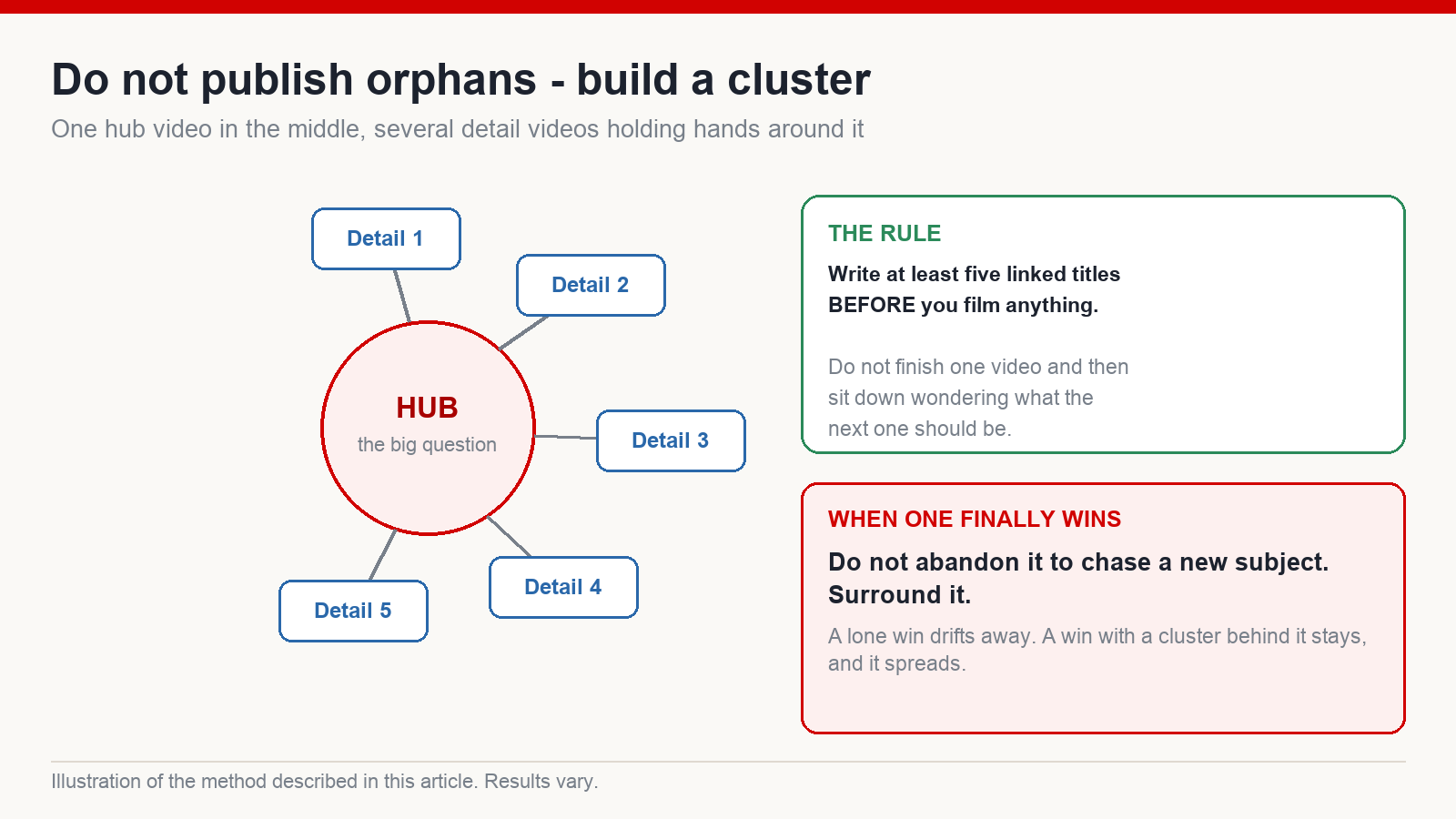
The alternative is not complicated. Instead of packing a subject into one video, split it into three to six that hold hands: one broad video in the middle, several detailed ones around it. If you have met the hub-and-spoke idea in blogging – one overview page, several deeper pages branching off – this is that, in video. The hub answers the big question; each spoke opens one smaller thing the viewer became curious about while watching.
The rule I want you to keep: write at least five linked titles before you film anything. Do not finish one video and then sit down to wonder what the next one should be. Plan the whole cluster up front, because that is the only way you see the thread running through it.
Why bother? Because two levels lift each other. The first video gets watched – that is level one. You dig into the niche inside that video, split off smaller angles, and that is level two. Take a subject like keeping chickens in a back garden: once it starts getting views, you split off “how many hens for a household of four”, “what to do when a hen stops laying”, “the winter set-up nobody warns you about”. Each child question is its own video, and they all pull toward the same cluster.
And here is the part that matters most. When one of your videos finally wins, do not abandon it to chase a brand new subject. Surround it. Build a run of related videos around the winner so it pulls them up with it. A lone win drifts away. A win with a cluster behind it stays, and it spreads.
Remember the fear at the top of this article – that a small niche starves? This mechanism is the answer to it. A small niche does not starve, because no win ever has to stand on its own.
Learn the format, do not take the content
One last trap, and it waits for you at the exact moment you have chosen your niche and do not yet know how to build the videos.
Nearly everyone does this: they find a channel already winning in that space and copy it almost wholesale. Same subject, same shot order, sometimes the same opening line. I do not blame anyone for it. The thing is working; imitation is the obvious move.
But stop your hand here. What is worth taking from a competitor is not the content – it is the format. How they frame a video. How they open the first three seconds so you do not scroll away. How they carry you from one idea to the next without a gap where you could leave. Take that structure. Then write your own title, your own script, and attach it to your niche and your story. Lift the content and you are a blurred photocopy of the original, and you have lost the one thing that would have made anyone remember your channel among a thousand similar ones.
There is a harder reason too, and it goes to the fear that keeps people awake: getting demonetized for inauthentic content. Taking somebody else’s material is the shortest road to being duplicative, and duplication is exactly what platforms are built to detect and demote. Originality here is not a clever way of gaming a system. It is how you survive. The channels that last have a voice; they are not the ones that copy well.
One small habit when you study competitors: read them in their original language. Do not let the platform auto-translate titles and descriptions into yours and then take your understanding from that – the nuance you are trying to learn is exactly what gets lost. And verify every number they state before you repeat it. A detail you got wrong today becomes the reason someone stops trusting your channel tomorrow.
Five checks before you film
The whole article, compressed into five questions. Give yourself one minute before you start the next video – not to make life difficult, but so you do not lose three days to something that was already dead in the planning.
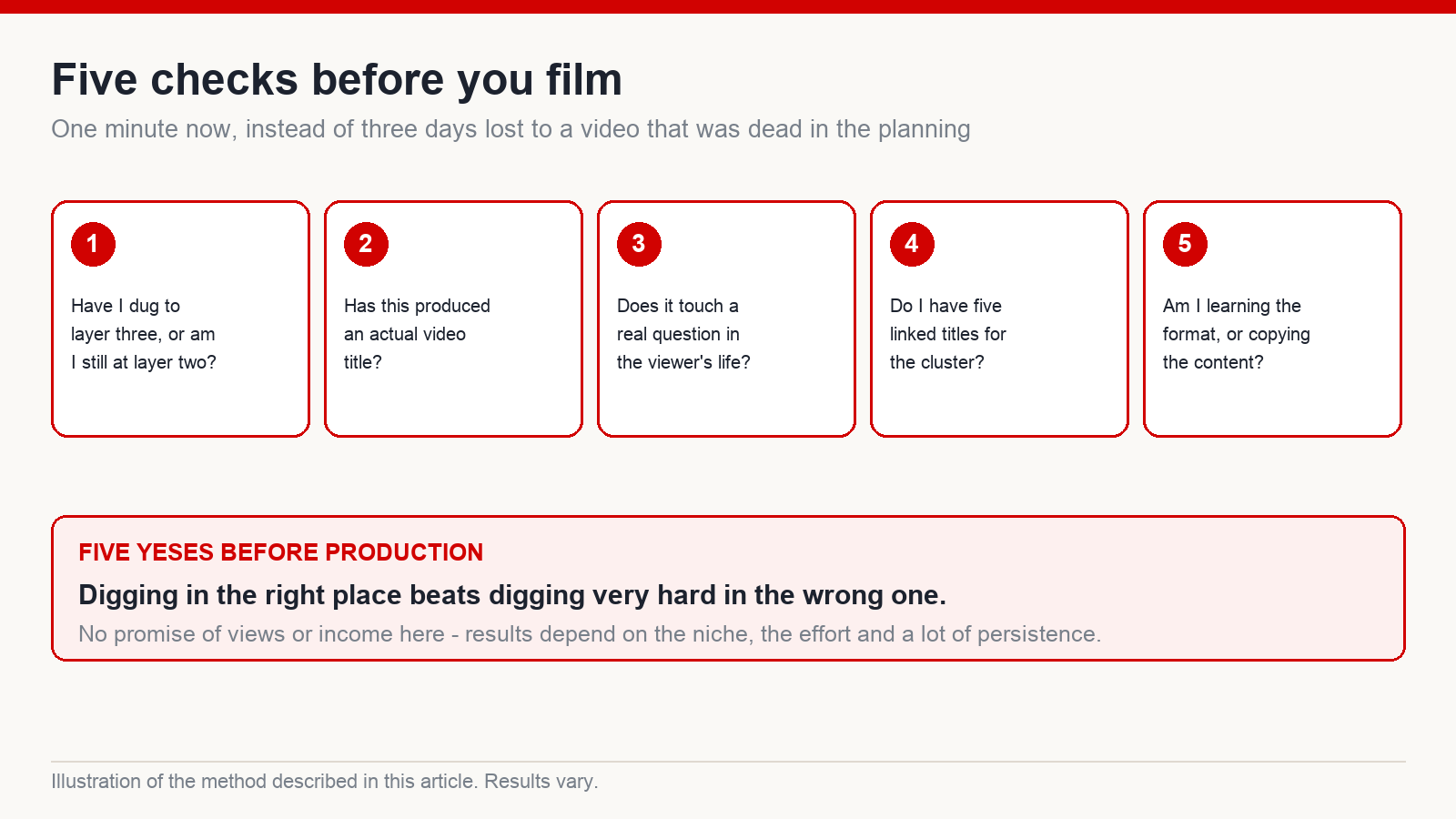
- Have I dug to layer three, or am I still at layer two? Subject, niche, niche-within-a-niche. Most people stop far too early and mistake a category for a corner.
- Has this produced an actual video title? If you are still describing a concept and cannot name a video, you have not finished digging.
- Does it touch a real question or worry in the viewer’s life? A narrow niche as dry as a dictionary page still loses.
- Do I have at least five linked titles for the cluster? No orphans. Five names on paper before the first camera goes on.
- Am I learning the format, or copying the content? Take the structure and the pacing. Write your own everything else.
Remember the two people at the start. The one who lost did not lose on craft. He lost on position – and position is the one thing you can change tonight.
Do not try to solve all of this in one sitting. Do one small thing: take a subject, drill it to layer three, and write five linked titles. Finish that and you are ahead of most people who will read this. I am not promising views or income – nobody honest promises that, and results depend on the niche, the effort and a good deal of persistence. What I am certain of is that digging in the right place beats digging very hard in the wrong one. If you want a structured English-language programme that walks through this process day by day, that is what I run at mmoyoutube.com.
Will a very narrow niche run out of topics after a few videos?
Usually the opposite. A niche narrow enough to touch real life tends to generate dozens of child questions – answer one and three more appear. What actually runs dry is a dry niche: one that touches a keyword but never a person. That one is exhausted in four videos.
How do I know whether I have reached layer three or am still stuck at layer two?
Read your niche out loud. If it is still a general noun – “vintage cars”, “insomnia”, “cooking” – you are at layer two. When it comes out as something a stranger could hear and instantly know what the video contains, you have reached layer three.
Somebody is already making videos in my niche. Should I drop it?
No – not straight away. Somebody being there means there is an audience there, which is a good signal, not a warning. Your job is to learn their format and then enter with your own angle and your own story, which is the whole point of the section above on formats.
How many videos should a cluster contain?
Three to six is a comfortable working size: one broad hub and several detailed spokes around it. The number matters less than the sequencing – write the titles before you film, so you can see the thread that connects them rather than inventing it afterwards.
Is a small niche riskier than a broad one?
Different risk, not more of it. In a broad subject the risk is being invisible next to channels you cannot out-produce. In a narrow one the risk is choosing a corner nobody actually searches for. The second risk is the one you can test cheaply before you commit, which is why I prefer it.