When Your Own Catalogue Starts to Look Mass-Produced
There is a failure mode that only shows up once a channel is producing well. The workflow is smooth, the tools are set up, the output is steady, and somewhere around the thirtieth upload the numbers start sliding – not because any single video got worse, but because all of them started looking the same.
This is the quiet cost of an efficient production line. Efficiency comes from repetition, and repetition is exactly what makes a catalogue feel machine-made. The channel that produced one good video a week has become a channel producing five near-identical ones, and both the audience and the platform notice.
What sameness actually costs you
Two separate problems, and it helps to keep them apart.
The first is a viewer problem, and it is the one that bites first. Someone who watched three of your videos has learned your shape: the same opening sentence structure, the same voice at the same pace, the same stock clips, the same beat where the point arrives. Once they can predict it, they stop watching to find out and start watching to confirm – and then they stop watching.
The second is a policy problem. YouTube’s monetisation rules ask whether content is original and authentic, and mass-produced or templated output is named directly in that context. That is not a rule about using AI, which is permitted; it is a rule about output that carries no meaningful contribution of your own. A catalogue assembled from the same skeleton, the same narration style and the same footage, over and over, is exactly the shape the policy describes.
Worth stating plainly, because a lot of advice on this subject is really advice on evading detection: varying things so a scanner does not catch you is not a strategy and it is against the rules. The point of everything below is to make the videos genuinely different for the person watching them. That is the only version that survives.
The sameness audit
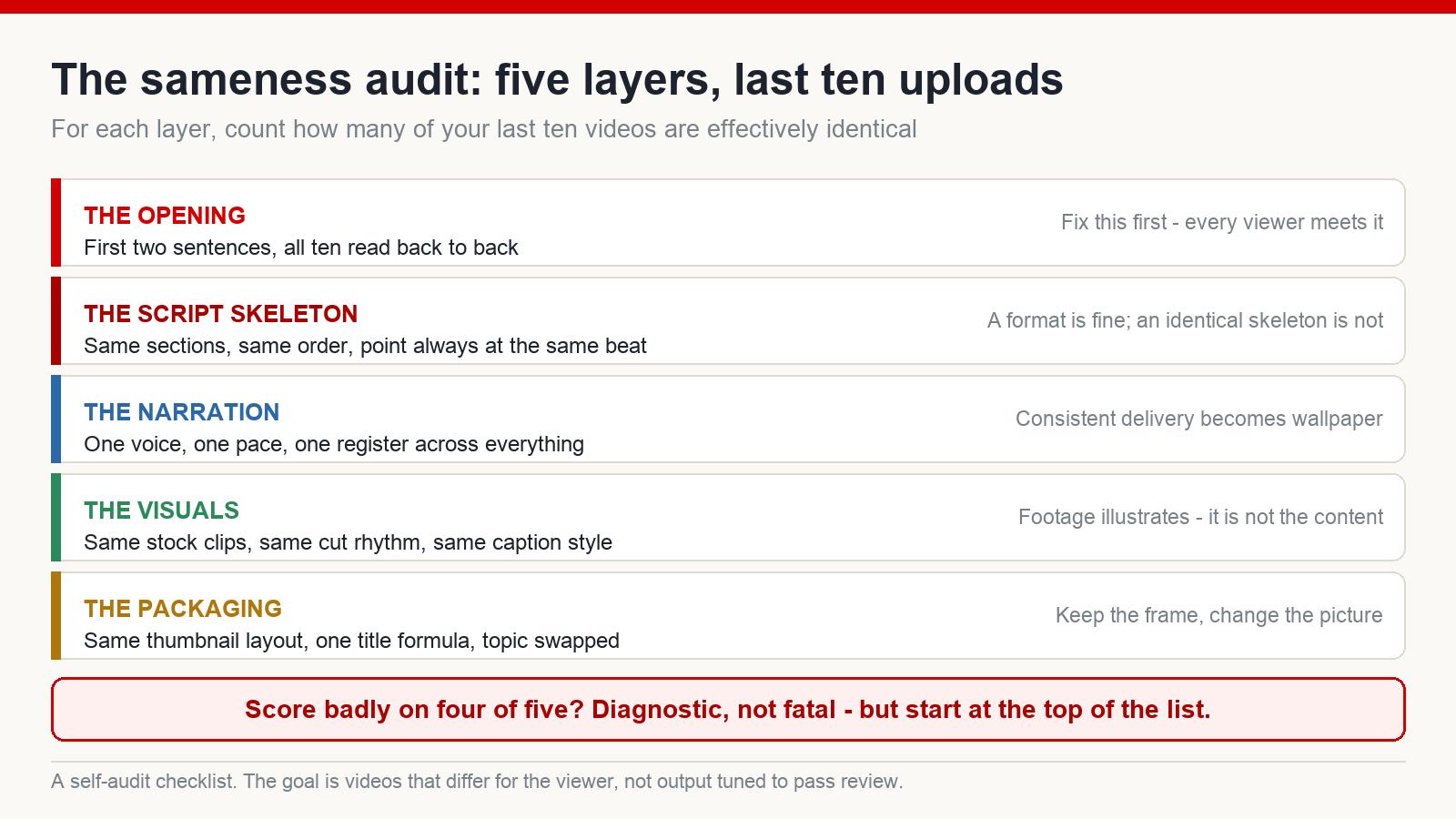
Open your last ten uploads and check five layers. For each one, count how many of the ten are effectively identical.
The opening. Read the first two sentences of all ten. If they are the same sentence with the nouns swapped, that is the layer to fix first, because it is the one every viewer meets.
The script skeleton. Same number of sections, same order, the point always arriving at the same moment, the same closing structure. A recognisable format is fine. An identical skeleton is not.
The narration. One voice, one pace, one emotional register across everything. Even a good synthetic voice becomes wallpaper when nothing about the delivery ever changes.
The visuals. The same handful of stock clips reappearing, the same cut rhythm, the same caption style. If someone could identify your video from four seconds of B-roll and not in a good way, this layer needs work.
The packaging. Same thumbnail layout, same colour, same crop, same text position, and titles built from a single formula with the topic swapped.
Most channels that have been running an efficient workflow score badly on four of these five. That is diagnostic, not fatal.
What should repeat, and what should not
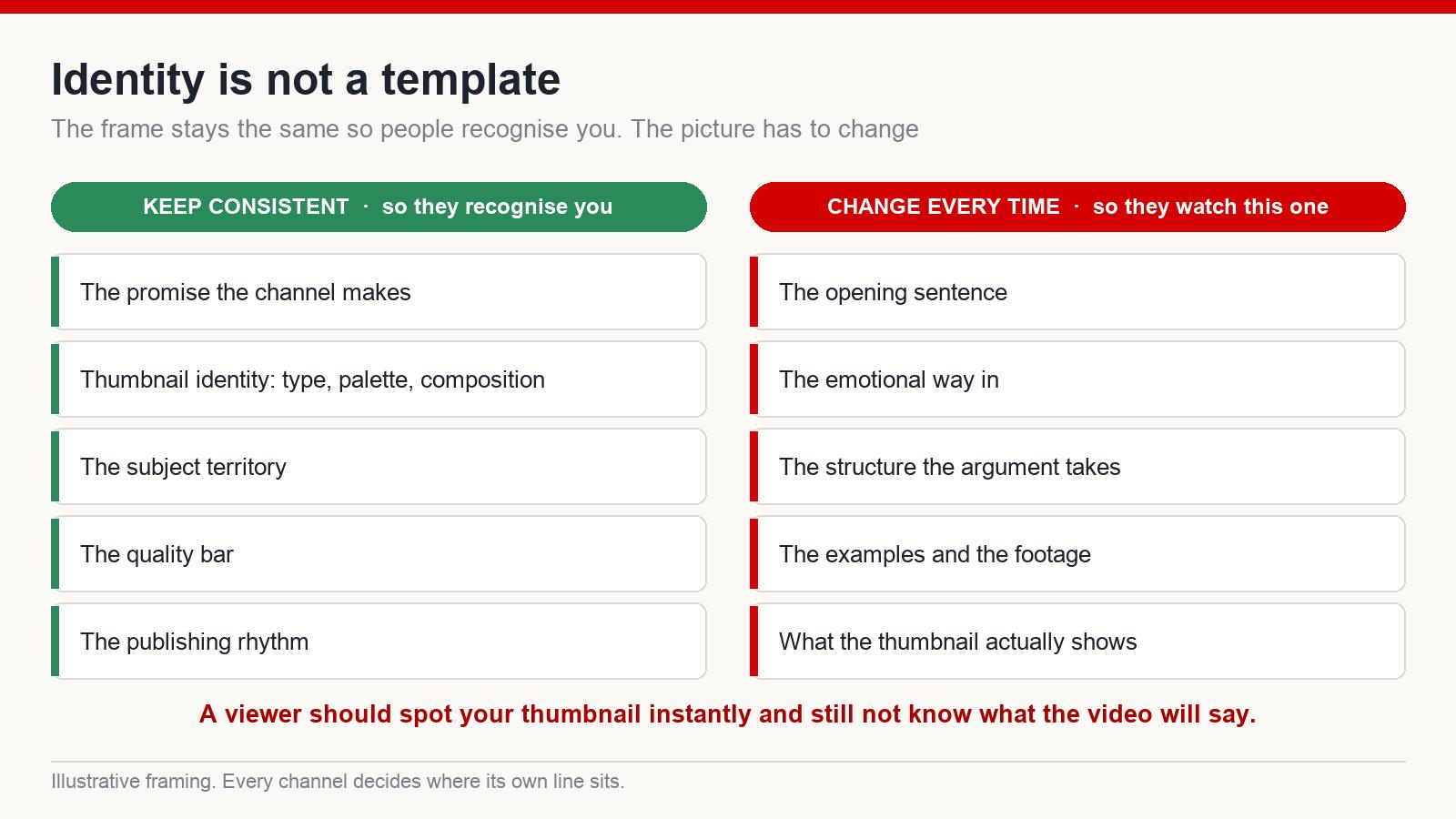
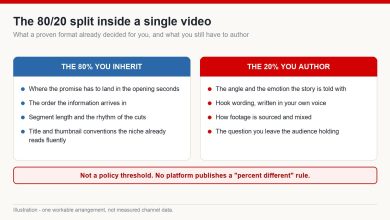
The obvious over-correction is to make every video different from every other one, which destroys the thing consistency was buying you. Viewers need to recognise your channel in a crowded feed. The distinction is between identity and template.
Keep consistent: the promise the channel makes, the visual identity of the thumbnails – a typeface, a palette, a compositional habit – the general subject territory, the quality bar, and the publishing rhythm. These are what make someone recognise you.
Change every time: the opening sentence, the emotional entry point, the specific structure the argument takes, the examples, the footage, and what the thumbnail is actually showing. These are what make someone watch this one.
Put another way: the frame stays, the picture changes. A viewer should be able to spot your thumbnail instantly and still not know what the video is going to say.
The opening is where to spend the effort
If you fix one layer, fix this one. It is the highest-leverage thirty seconds in the whole production, and it is usually the most templated part of an efficient workflow.
The same subject can be entered from completely different directions:
- Through a question – something that appears to be true but is not, stated as a puzzle.
- Through a problem – naming the exact situation the viewer is in right now.
- Through a specific case – one channel, one week, one thing that happened.
- Through an admission – what you got wrong, and how long it took to notice.
- Through the audience – naming precisely who this is for and who it is not for.
Five videos on the same subject, opened five different ways, are five genuinely different viewing experiences. Five videos opened with the same sentence are one video published five times.
Titles that differ in angle, not in wording
A common half-measure: changing the title while leaving the angle untouched. “How to do X”, “A guide to X”, “X for beginners” and “Getting started with X” are four titles and one video. Nothing has been added.
Changing the angle means changing what the video argues, not what it is called. From a single subject you can build the common mistake, the workflow that produced a result, the thing the platform dislikes, the case where the standard advice fails, and the version for someone with different constraints. Those are five different videos that happen to share a topic.
Stock footage is illustration, not content
Worth being blunt, because this is where a lot of catalogues go thin. If the video is licensed clips plus a generated voice reading a summary, there is nothing in it that is yours, and both the viewer and the review process are correct to treat it as low effort.
Footage supports the point. The point has to come from somewhere: analysis, a position, a comparison nobody else made, an explanation of why something works rather than a description of it. Two videos can use the same clips and be entirely different pieces of work, provided the thinking layered over them differs.
Where AI belongs in this
Nothing here is an argument against generation tools. They are genuinely good at the parts of production that are labour: research summaries, first drafts, restructuring, variant titles, catching what a script forgot to cover.
The failure is not using them. It is running one prompt across a whole catalogue and shipping what comes back. A model given the same instruction returns work in the same shape every time, and that shape becomes your channel’s shape. Use it to draft, then do the part it cannot: bring what you have actually seen, take a position, and make the thing specific.
One practical note: if a video uses synthetic voice or generated visuals in a way that could be mistaken for real, disclose it. YouTube requires that disclosure for realistic altered or synthetic content, and viewers who feel misled leave and do not come back.
What a fixed catalogue looks like
Not a slower channel. The same subject territory, the same rhythm, the same identity in the thumbnails – and ten uploads where the first sentences all differ, the structures differ, the examples come from different places, and someone reading the titles can see ten distinct arguments rather than one topic phrased ten ways.
That takes longer per video than duplicating a template. It is also the difference between a catalogue that ages and one that compounds.
Frequently asked questions
Is it a problem to publish several videos on one subject?
No – depth is usually an advantage. The problem is publishing several videos with one argument. Same subject, different angles is a series. Same subject, same angle is repetition.
Does using the same synthetic voice throughout cause issues?
A consistent voice is part of a channel’s identity and is not itself a problem. The risk is when voice, pace, structure and script style are all identical too, so nothing distinguishes one upload from another.
Can stock footage get a channel flagged?
Licensed footage used as illustration is normal practice. The concern arises when footage is the whole video and nothing original has been added on top of it.
Should I copy the thumbnail style of a video that performed well?
Study why it worked – the tension it created, the question it raised – and then build your own visual identity. Copying the layout gets you a thumbnail that looks like someone else’s channel.
How much variation is enough?
There is no percentage, and any figure offered is invented. The workable test is whether a regular viewer, shown two of your videos, would describe them as two different pieces of work. If not, keep going.
The test worth running this week
Read the first two sentences of your last ten uploads back to back. Most people find the exercise uncomfortable, and that discomfort is the finding. Fix the openings first, then the structures, then the packaging – in that order, because that is the order the viewer meets them in.
If you want a structured approach to production that scales without flattening into a template, that is what we work on at mmoyoutube.com.