Live Stream Dosage: Setting Length, Frequency and a Stopping Rule
Whenever I suggest live streaming to someone whose channel has gone quiet, the reply is always the same two questions. How long does a session have to be, and how many times a week?
Fair questions, and I understand why people want numbers. But the numbers on their own are useless, because the reason most people get nothing out of this is not that they picked the wrong length. It is that they ran the attempt in a way that could not produce an answer either way.
So this piece is about dosage: what to set, why, and how to structure the attempt so that at the end of it you actually know something.
One thing to be honest about before anything else. Streaming is not a spell. Some channels respond within a few sessions, some take much longer, and some never respond because the problem was never distribution in the first place. Anyone offering you a guaranteed outcome here is selling something.
Why a fifteen-minute session does nothing
The most common version of this attempt is: go live for ten or fifteen minutes, close it, and conclude a week later that streaming does not work.
The mechanism you are trying to use is watched time. A session produces value because people stay in it for a long stretch, and a long stretch is exactly what a short session cannot produce even if everything else goes well. Fifteen minutes with a handful of viewers is a rounding error against a channel’s history. There is nothing there to read.
That is the whole reason a floor exists. It is not that thirty minutes is a magic threshold. It is that below roughly that, you have not generated enough of anything for the result to mean either yes or no.
Setting the length
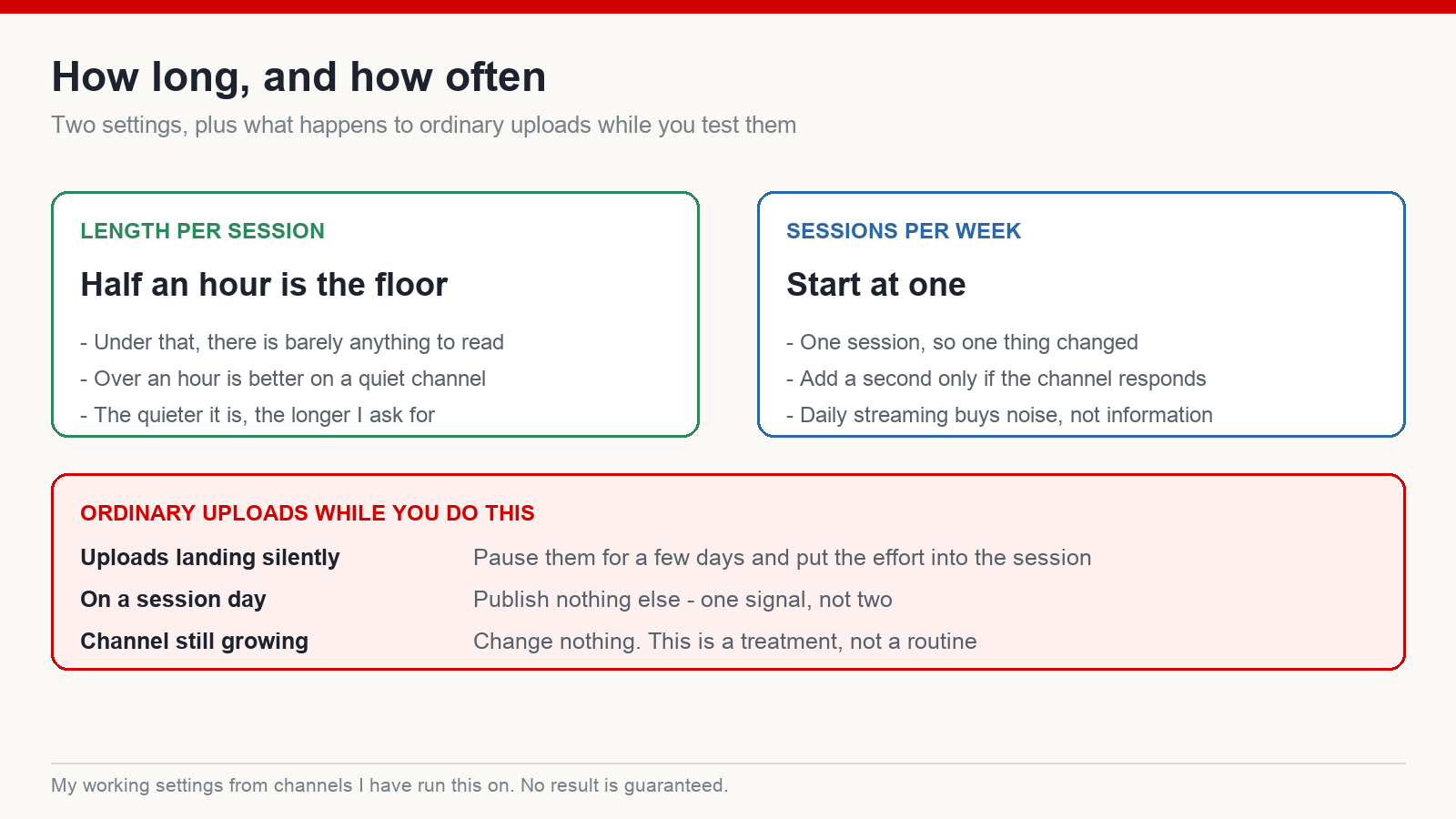
My working rule, drawn from channels I have run this on rather than from any published figure: half an hour is the floor, over an hour is better, and the quieter the channel the longer I want the session to run. On a channel that has gone almost completely dark I will ask for something closer to an hour and a half.
Length is a means, though, not a target. A ninety-minute session nobody stays for is worse than a forty-minute one people watch, because the point was never the clock – it was the accumulated minutes people actually spent.
You also do not need to talk to a camera for ninety minutes. The usual approach is to prepare one genuinely new video of your own and push it out through streaming software – OBS Studio or a legitimate streaming service – so the session runs as a broadcast of your own new work. Two conditions on that, and they are not negotiable: the video has to be new material you made, and the tools have to be legitimate ones. This is a scheduling technique, not a way around the rules.
Setting the frequency
Start at one session a week. One.
The temptation to go daily is strong, because a channel in trouble makes you want to do everything at once. Three reasons not to.
- Attribution. If you stream daily, change the packaging, and pause your uploads all in the same week, something may well move – and you will have no way to know which change moved it. The point of the exercise is to learn what your channel responds to.
- Stamina. Daily sessions burn out almost everyone within a fortnight, and a recovery attempt abandoned in week two tells you nothing.
- Quality. Each session is supposed to be built around a video worth watching. Seven a week and the quality floor collapses, which defeats the entire purpose.
If the channel responds, add a second weekly session. Not before, and not more than that until the second one has also been given time.
Structure the attempt so it can be read
This is the part almost nobody does, and it is the part that turns a hopeful gesture into an experiment.
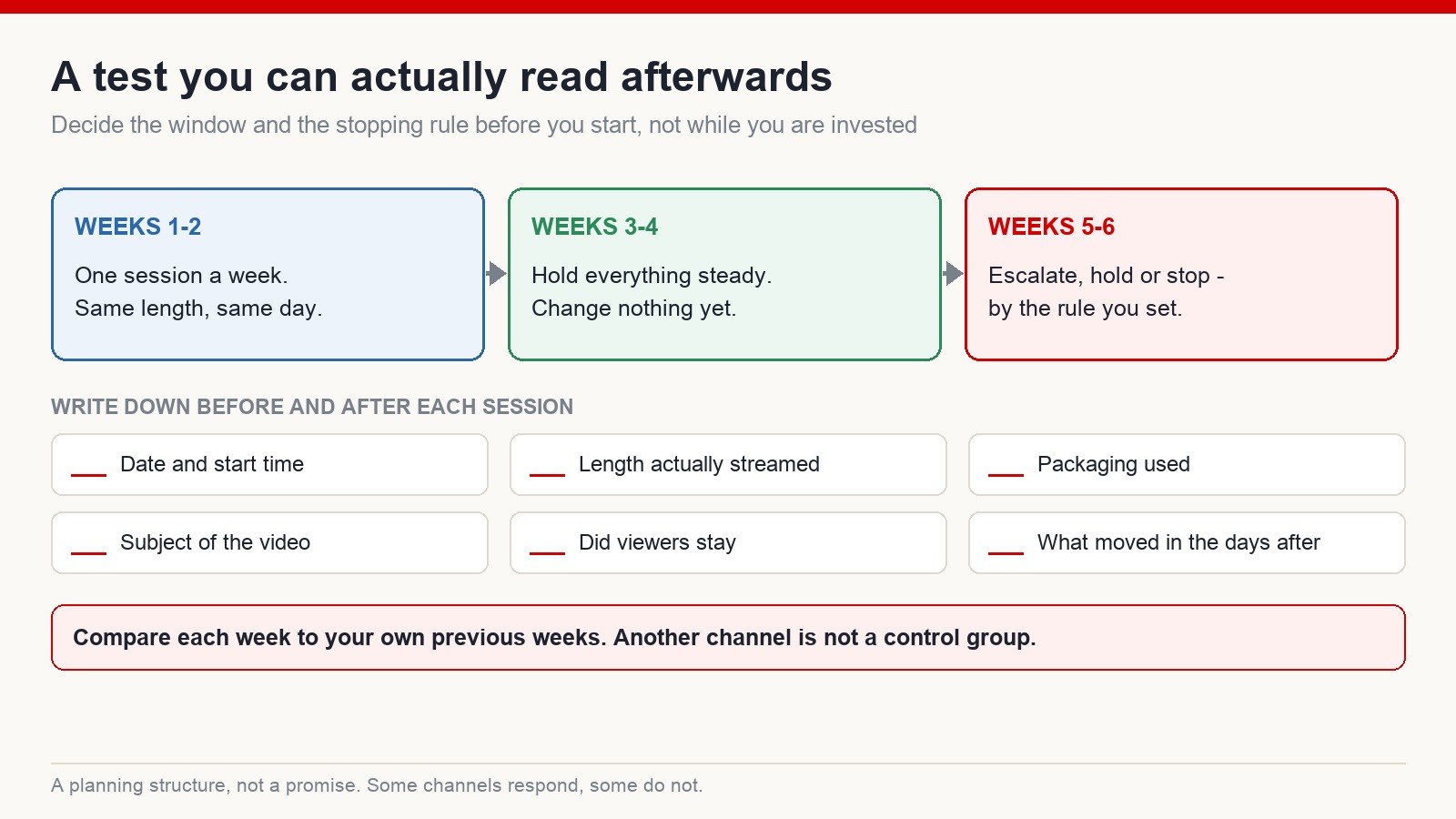
Pick a window in advance and commit to it. I use six weeks, because it is long enough for a pattern to appear and short enough that you have not thrown a quarter at a guess.
Weeks one and two. One session a week. Same length, same day, same approach. You are establishing a baseline, not optimizing.
Weeks three and four. Hold everything steady. Resist changing anything, however much you want to. Four sessions run identically are worth more than eight run differently.
Weeks five and six. Now decide, using the rule you wrote down at the start: escalate to two sessions a week, hold as you are, or stop.
Write the stopping rule before week one. Something like: if nothing has moved in my own impressions and views by the end of week six, I stop and go and look at the content itself. Deciding that in advance is far easier than deciding it in week six when you are emotionally invested in the attempt working.
And keep a log. Before and after each session, note the date and time, how long you actually streamed, which packaging you used, what the video was about, whether viewers stayed, and what moved in the days after. It takes two minutes and it is the entire difference between running an experiment and simply hoping.
What to compare against
Compare each week to your own previous weeks. Not to a screenshot from someone else’s channel, not to a number quoted in a video.
Your channel’s own recent history shares your niche, your audience and your back catalogue, which makes it the only fair comparison available – and a genuinely good one. Another creator’s channel is a different experiment with different variables, and reading your results against theirs will make you change things for no reason.
The signals worth watching are: whether your ordinary videos start being shown to people again after a run of sessions, whether viewers stay inside the sessions or leave immediately, and how a week with two sessions compares with a week that had one.
Three outcomes are possible. The channel starts being distributed again, in which case keep going and gradually bring uploads back. Nothing moves at all, in which case the problem was probably never distribution and the honest next step is the content. Or something shifts slightly – the most common result, and the one that calls for patience rather than a decision.
The line not to cross
A quiet channel makes people desperate, and desperation is what services selling views and engagement are built on.
Do not buy views, do not buy subscribers, do not arrange reciprocal viewing schemes. Beyond the policy risk, they poison the only thing this exercise was for: knowing what your real audience does. Once the numbers are contaminated you cannot read them, and you have paid money to make yourself blind.
Streaming is a legitimate move made with legitimate tools. Keep it that way and the worst case is that you learn the problem is elsewhere – which is still worth six weeks.
Frequently asked questions
Is there a minimum session length that works?
Not a magic one. Half an hour is where I stop considering a session too small to read, and longer is generally better on a quiet channel – but a long session nobody watches is worse than a shorter one they stay in.
Should I stream every day if the channel is really struggling?
I would not. Daily sessions make it impossible to attribute any change, and most people abandon the attempt before it has run long enough to mean anything.
Do I keep uploading normally during this?
If uploads are landing silently, pause them for a few days and concentrate. On a session day, publish nothing else. If the channel is still growing steadily, do none of this – it is a treatment, not a routine.
How long before I decide it is not working?
Decide that in advance. Six weeks is the window I use, with a written rule about what would count as no response.
If you want the whole recovery sequence in context, along with how I build channels for English-speaking audiences, that is what I work on at mmoyoutube.com.