Build for Monetization From Day One: What Actually Gets a Channel Eligible
Almost everybody starts a channel with the same target in the back of their mind: get monetization turned on. And almost everybody responds to that target the same way, by uploading as much as possible and hoping volume does the rest.
It rarely does. What I have watched instead, over nine years of making YouTube videos and working with creators building channels for English-speaking audiences, is that the channels which get there earlier are usually not the ones publishing most. They are the ones that were built as if they were already going to qualify.
This is the part of YouTube monetization requirements nobody can shortcut, and the part you actually control.
First, the honest version
There is no method, service or trick that turns monetization on faster. There is a set of published requirements, and there is the work that moves a channel toward them. Anything sold as an accelerator is either doing the ordinary work or doing something that gets channels terminated.
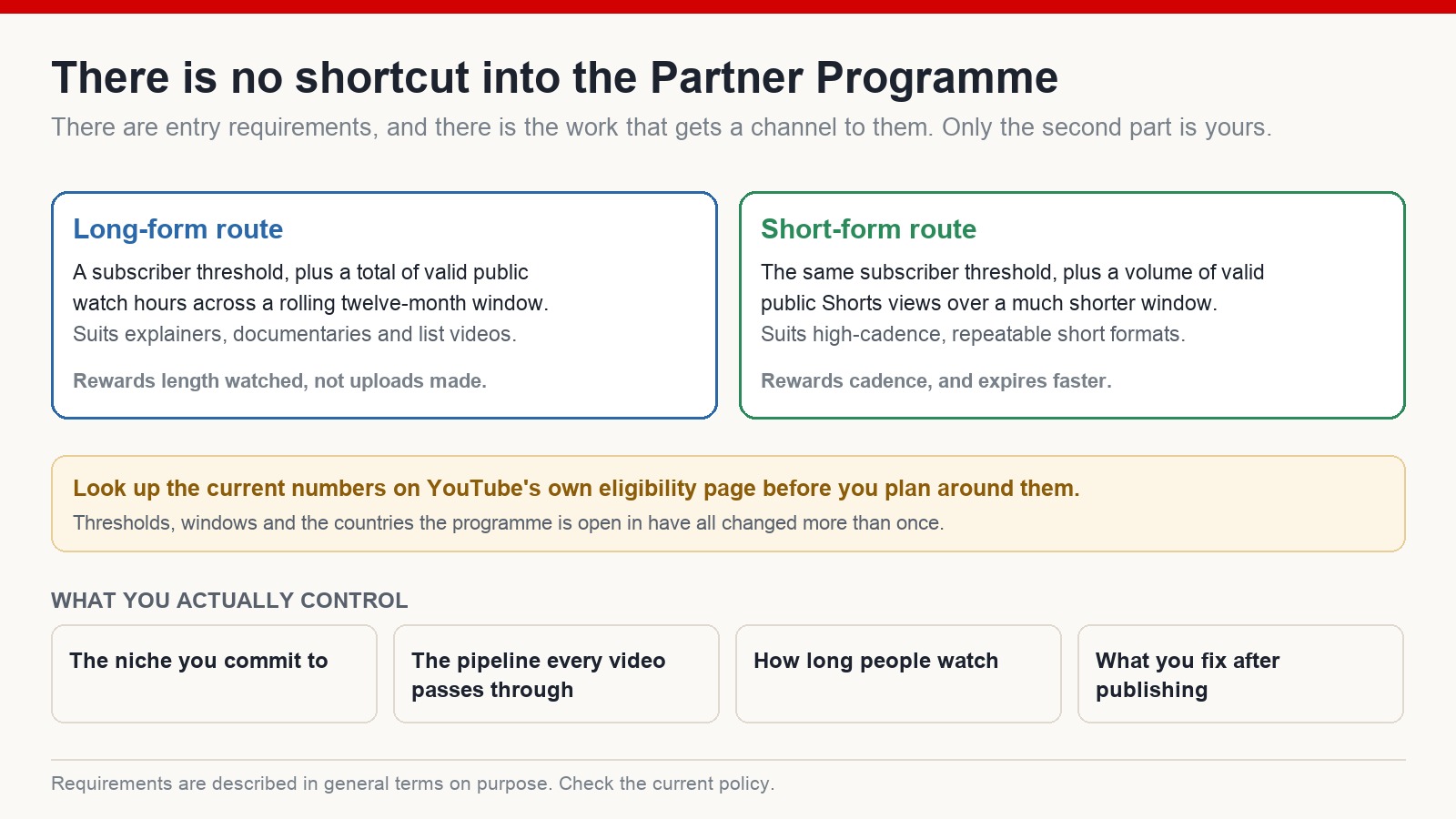
Broadly, there are two doors. One counts valid public watch hours on long-form video across a rolling window; the other counts valid public Shorts views over a shorter window. Both sit on top of a subscriber threshold, and both require the channel to be in good standing under the platform’s policies and in a country where the programme is open.
I am describing them in general terms deliberately. The exact numbers, the length of the windows, the tiers available and the countries covered have all changed more than once, and an article is the wrong place to learn them. Read them on YouTube’s own eligibility page before you plan around them, and check again in six months.
The arithmetic nobody does
Here is the thing that changed how I plan a channel. Watch time is a multiplication, not a queue:
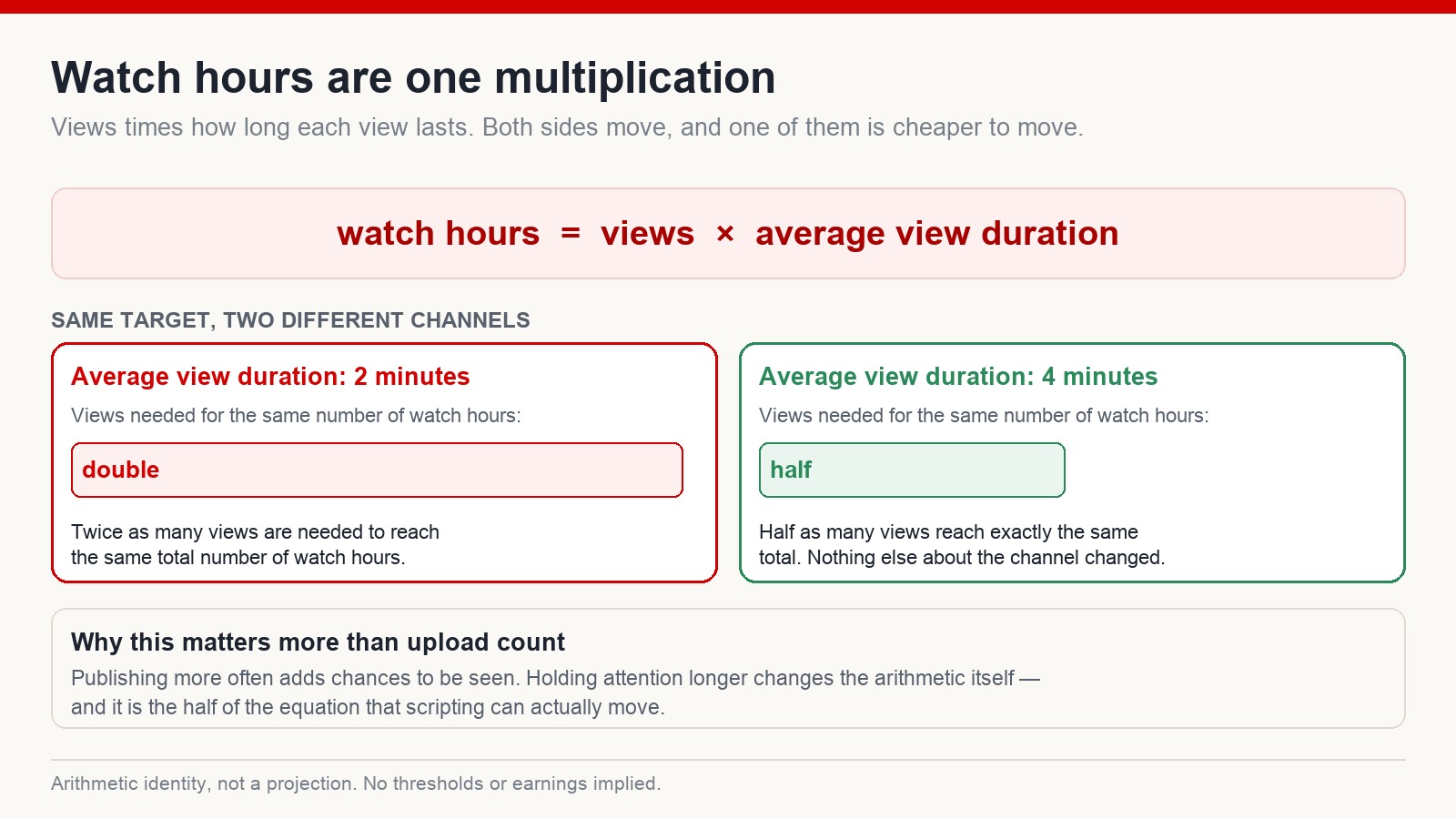
Watch hours equal views multiplied by how long each view lasts. Both sides move. Publishing more often adds chances to be found — but doubling how long people stay changes the arithmetic itself, and halves how many views the same total needs. That half of the equation is the one scripting, structure and pacing can actually reach.
It is also why “just upload every day” is such expensive advice. Ten rushed videos that lose people in the first minute can be worth less than three that hold an audience, and they cost far more to make.
What actually moves a channel toward eligibility
1. Pick a niche you can still stand in six months
Not the one with the biggest numbers. The one where you can produce continuously, where you can tell one video from the next, and where an audience that likes video three has a reason to want video four. A channel that changes subject every month never accumulates the returning viewers that make watch time compound.
2. Run every video through the same pipeline
Research, script, produce, title, thumbnail, a final check before publishing, and a look at the data afterwards. Written down, in that order, every time. The point of a pipeline is not discipline for its own sake — it is that quality stops depending on how you felt that week, and that when something goes wrong you can tell which stage did it.
3. Publish at a rate you can sustain
Consistency helps for unglamorous reasons: more chances to be shown to people, more data to learn from, and a habit forming on the viewer’s side. But a schedule you cannot hold does more damage than a slower one you can. Pick the cadence you can still meet in month four.
4. Treat the library as the asset
A video that answers a question people will still be asking next year keeps working long after the week you published it. A video tied to a passing moment stops. Evergreen material is what turns a back catalogue into something that accumulates rather than expires — and accumulation is exactly what a rolling watch-hour window rewards.
5. Test one thing at a time
Titles, thumbnails, video length, opening structure, publishing day. Change one, wait for enough videos to see a pattern, keep what worked. Changing five at once teaches you nothing, which is the usual reason people conclude that “nothing works”.
6. Use AI where it saves time, not where it removes you
Research, outlines, first drafts, caption files, keeping a production document tidy — all fair. What does not work is using a model to rewrite somebody else’s video and publishing the result at volume. It is thin, audiences feel it, and reused content is a policy problem as well as a quality one.
7. Read the data on a schedule, not on a mood
Once a month is enough. Look at how many people clicked, how far they watched, where they left, where the traffic came from, and whether anyone came back. Compare against the recent median of your own channel — not against benchmarks from somebody else’s niche, format and audience, which tell you nothing about yours.
8. Do not open a second channel to go faster
Starting another channel before the first one has a repeatable process does not double your progress. It halves your attention and doubles the number of things that can go wrong. Expand once a model works and you can afford to keep both at the same standard.
The requirement people forget
Eligibility is not only a counting exercise. A channel also has to be in good standing: no active strikes, monetization-friendly content, no reused material, and no artificial traffic. That last point deserves saying plainly, because the promise of a shortcut is everywhere — views bought from a service are not valid views, and channels that use them can end up further from the programme than when they started, or removed from it entirely.
The same applies to engagement bait (“comment 1 if you agree”), misleading thumbnails and metadata stuffing. Every one of them is a policy risk taken to move a number that would move anyway with better work.
Frequently asked questions
Is there a way to turn on monetization immediately? No. You meet the published requirements and pass review, or you do not.
Does uploading more get me there faster? More uploads create more chances to be seen, which helps — up to the point where quality drops. Past that point extra uploads mostly add work.
Can AI shorten the road? It can shorten production. It cannot supply the thing a viewer stays for, and a library of near-identical generated videos is a fragile foundation.
Do Shorts count toward the long-form requirement? They are counted separately, under their own route and their own window. Check the current rules rather than assuming either one carries the other.
What if I am close and nothing is moving? Look at how long people watch rather than how many videos you have. That is the half of the multiplication with the most room in it.
Where to start
Take your last ten videos and write two columns: how long the average view lasted, and whether the topic will still be searched next year. If most of the answers in the second column are “no”, the library is expiring as fast as you build it, and that is the first thing to change.
Nothing here is a promise about outcomes. Channels differ, niches differ, requirements change, and plenty of good channels take longer than their owners expected. If you want the full process I use for building faceless channels aimed at international audiences, it is at mmoyoutube.com.