Choose a YouTube Channel Name You Will Not Outgrow
Almost every rename request I get comes from a creator whose name was not a mistake. It was correct on day one. The channel was about one thing, the name said that thing, and it worked. Then the channel grew, the content widened, the tool in the name stopped being the tool everyone used — and a name that fit perfectly at twenty videos was quietly holding the channel back at two hundred.
I have been building YouTube channels since 2017, mostly faceless channels for English-speaking audiences, and this is the naming question I now care about more than any other. Not “does it sound good” and not “is it available”. Those get answered in an afternoon. The question that matters is: will this name still fit the channel I want to be running in three years?
The Three Ways a Name Expires
1. It contains something that dates
A year. A platform feature. A tool that is currently everywhere and will not be in eighteen months. Names built on whatever is peaking right now are the fastest to age, and they age visibly — a viewer can tell roughly when you registered the channel just by reading it.
The awkward part is that this feels smart at the time. The word is searched heavily, everyone recognises it, and putting it in the name looks like riding a wave. You are not riding it. You are welding your identity to it.
2. It locks you to a topic narrower than your ambition
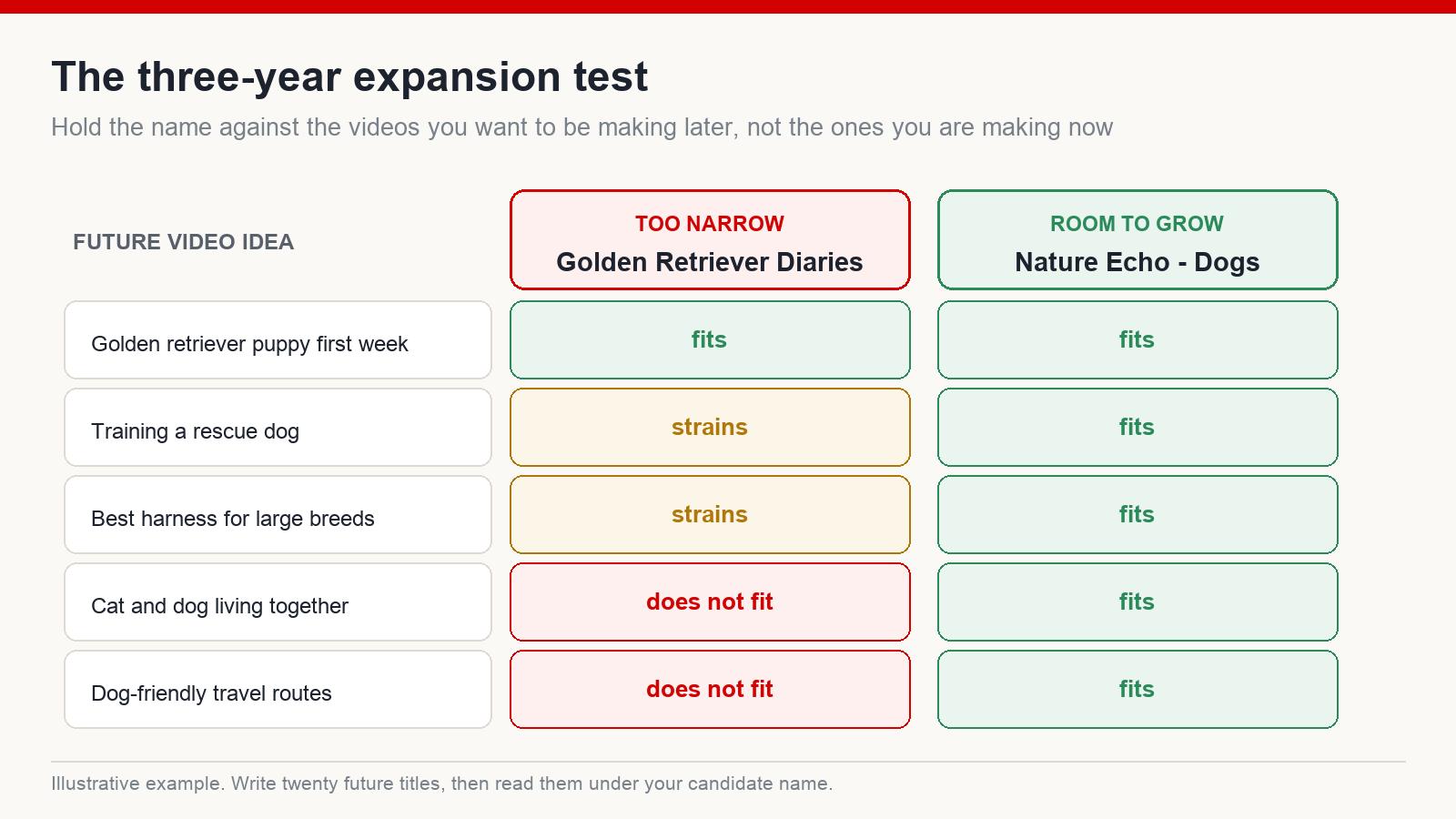
A name like Golden Retriever Diaries is clear, memorable and completely honest. It is also a fence. The day you want to publish about another breed, or about dog training generally, the name argues with the video. Viewers notice that argument even when they cannot name it.
The fix is not to go vague. Animal Content Hub solves the fence problem by meaning nothing. The fix is to name the lane one level above the thing you are making today: broad enough to hold your next hundred videos, narrow enough that a stranger understands the promise.
3. It locks the channel to one person or one place
A name built around your own name gives you a strong personal brand and one structural problem: nobody else can ever front it. If your plan involves other presenters, an editor taking over production, or eventually handing the channel to someone else, a person-led name makes all of that harder. Geographic names do something similar in a different direction — they win local recognition and quietly cap the audience at people who feel that place is about them.
Put the Expiring Part Where You Can Remove It
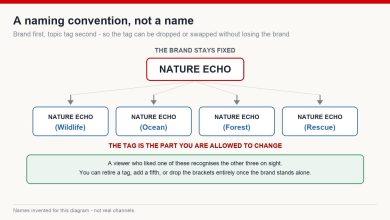
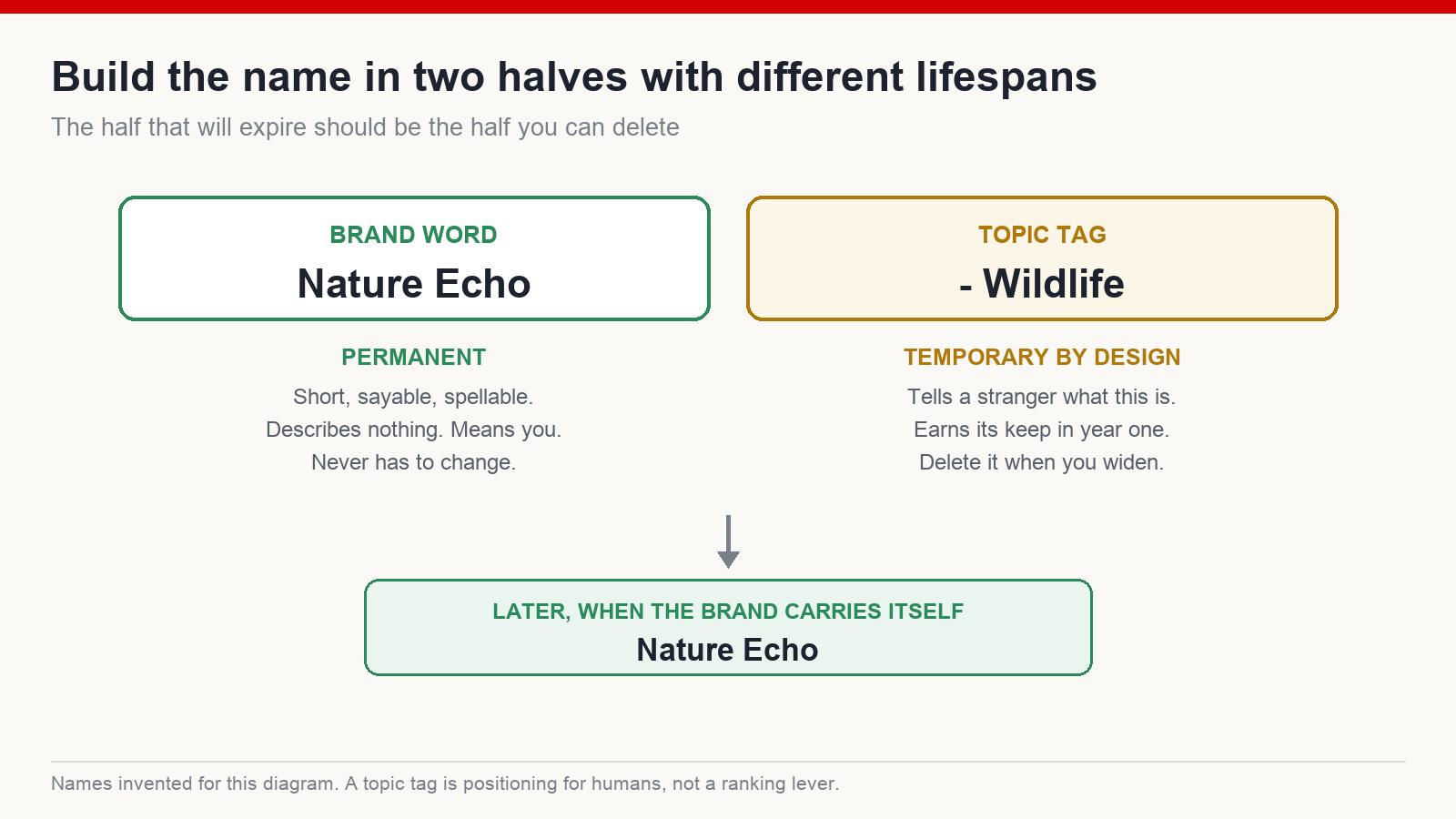
Here is the structural trick that solves most of this. Split the name into two halves with different lifespans.
The brand word is permanent. It does not have to describe anything. It has to be short, sayable, spellable and unclaimed in your niche.
The topic tag is temporary by design. It sits after the brand word, separated by a dash or brackets, and it states what the channel is about right now: Nature Echo – Wildlife, Wisdom Path (Retirement), Calm Journey – Sleep Sounds.
The tag earns its keep in the first year, when nobody recognises the brand half yet and a viewer scanning a feed needs to know in one glance what this channel is for. It also gives you a clean exit: when the channel widens or the brand can stand on its own, you delete the tag. The identity does not change, only the label narrows to its permanent part. Compare that with rebuilding a name where the topic is fused into the brand word — there is nothing to delete there, only a full rename.
One correction worth making, because it gets repeated a lot: a topic tag is positioning, not a ranking mechanism. It helps a human understand you in half a second. Do not choose your tag as though it were a search field, and do not expect it to move you up results.
Choosing a Tag Word That Lasts
Three filters, applied in order.
- Too broad fails. Video, Online, Media, Content. These words tell a viewer nothing and make your name indistinguishable from thousands of others.
- Too fashionable fails. If the word arrived in the last year and is currently in every thumbnail in your niche, it is a trend, not a category. Trends make excellent video topics and terrible name components.
- The survivor is a category word. Wildlife. Retirement. Sleep. Woodworking. Personal finance. These describe what people want, not what is currently popular, and people wanted them a decade ago too.
A quick way to test the third filter: would this word have made sense in your niche five years ago, and will it still make sense in five more? If yes twice, it is a category. If no, it is a trend wearing a category’s clothes.
Three Postures, Three Ceilings
Beyond the words themselves, a name takes a posture, and each posture comes with a ceiling worth choosing deliberately rather than discovering later.
- Person-led. Your name at the front. Fastest trust, strongest personality, hardest to hand off or step away from. Best when you intend to be visible for years.
- Studio-led. A brand word that reads like an operation — Creator Lab, Growth Studio. Neutral about who is behind it, comfortable across several channels, slower to feel personal.
- Subject-led. The brand word evokes the topic itself — Nature Echo, Wisdom Path. Easiest to understand instantly, easiest to expand within one lane, hardest to take somewhere completely different.
None of these is better. They are different bets about what the channel becomes. Faceless channels usually do best on subject-led or studio-led, for the obvious reason that there is no face to attach a personal name to.
The Three-Year Expansion Test
This takes fifteen minutes and it is the only naming exercise I insist on.
- Write down ten videos you plan to make in the next two months.
- Write down ten videos you would like to be making in three years, when the channel is bigger and you are bored of the current format.
- Put the candidate name at the top of that list of twenty.
- Read each line and ask whether the title sits comfortably under that name, or whether a viewer would find it odd.
A durable name covers all twenty. A narrow name covers the first ten and starts to strain on the second batch. If more than a couple of your three-year videos look strange under the name, you have found the fence before you built the channel behind it, which is the entire point of doing this on paper.
Small Details That Cost More Than They Look
- Do not set the whole name in capitals. It is harder to scan in a list of channels and it reads as shouting rather than as a brand.
- Avoid special characters and decorative symbols. Anything a viewer cannot type is a barrier between them and finding you again.
- Avoid characters that look like other characters. A zero standing in for an O is clever exactly once and confusing forever after.
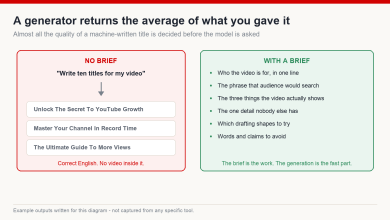
- Do not stack keywords. A name assembled out of every phrase you would like to rank for stops functioning as a name. It reads as machine output, and people do not subscribe to machine output.
When the Name Really Has Expired
There is a difference between a name that limits you and a name you are simply tired of. You are the only person looking at it every day; your audience sees it for a second at a time.
Real expiry signals are concrete: you are avoiding video topics because they would look wrong under the name; the name states a format you no longer make; a word in it has dated to the point where viewers assume the channel is inactive. Those justify a rename, and doing it earlier is always cheaper than doing it later, because the recognition you have to rebuild only grows.
Boredom is not a signal. It is just Tuesday.
Frequently asked questions
Does a keyword in my channel name help me rank? Treat it as positioning for humans rather than a ranking lever. It helps a viewer understand the channel instantly, which is valuable on its own.
How narrow is too narrow? If the name would not survive your three-year list of video ideas, it is too narrow. If a stranger cannot tell what the channel is about at all, it is too broad.
Should I add my niche keyword now and remove it later? That is exactly what the removable tag is for. Add it while you are unknown, delete it when the brand half carries the recognition on its own.
Is a person-led name a mistake for a faceless channel? Not a mistake, but an odd fit. A faceless format is built to run without a presenter, and a personal name reintroduces the dependency you removed.
The Short Version
Names expire for three reasons: they contain something that dates, they fence the channel into a topic narrower than your ambition, or they tie it to one person or place. Build the name as a permanent brand word plus a removable topic tag, choose a category word rather than a trend word for that tag, pick your posture on purpose, and run the twenty-video expansion test before you register anything.
If you are building faceless channels for English-speaking audiences and want the rest of the setup decisions in one place, that is what I write about at mmoyoutube.com.