How to Put a Keyword in Your YouTube Channel Name Without Killing the Brand
The one field almost nobody optimises
Creators will happily spend three hours on a thumbnail, another hour rewriting a title, and twenty minutes fiddling with a description. Then they pick the channel name in about forty seconds, usually while the sign-up form is open, and never touch it again.
Which is odd, because the channel name is the only piece of text that appears next to every single video you will ever publish. It is on the search results page, under the recommendation, at the top of the comments, in the subscription feed. It is also the thing a viewer has to be able to remember if they are ever going to look you up on purpose.
This is not an argument for stuffing keywords into it. It is an argument for choosing it deliberately, with one relevant word doing some work, and then leaving it alone for years.
What a channel name can and cannot do
Let me be careful here, because this topic collects a lot of confident nonsense.
YouTube has never published anything saying the channel name carries ranking weight, and I would not plan around the idea that it does. What is observable is simpler and still useful:
- Your name is matched when someone searches for you or for the topic in channel results
- A viewer who sees “Ledger Lane (Personal Finance)” knows instantly what the channel is, before clicking anything
- A consistent name plus a consistent topic makes the channel legible to human beings, which is the group that actually subscribes
So the honest framing for a youtube channel name is that it is a positioning decision with a small discovery benefit attached, not an SEO lever. Choose it for the viewer first and the system second, and you will make the right call either way.
Two formulas that hold up
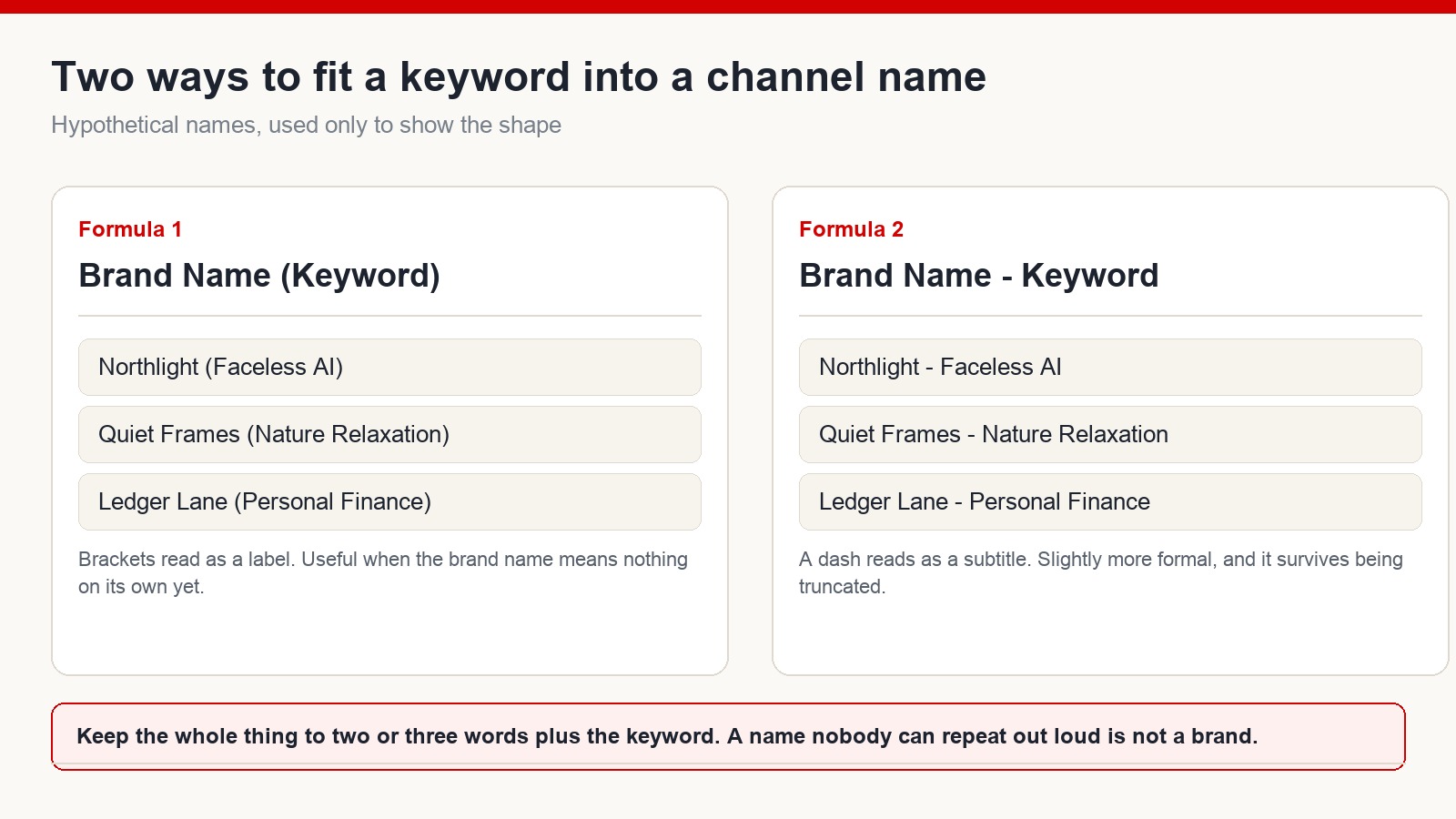
Almost every well-named channel I look at is using one of two shapes. The examples below are invented — they are there to show the structure, not to recommend a niche.
Formula 1: Brand Name (Keyword)
Northlight (Faceless AI). Quiet Frames (Nature Relaxation). Ledger Lane (Personal Finance).
The brackets read as a label rather than as part of the name, which is exactly what you want when your brand word means nothing to anyone yet. A new viewer reads the bracket, understands the channel in one second, and the brand still gets to be a brand.
Formula 2: Brand Name – Keyword
Northlight – Faceless AI. Quiet Frames – Nature Relaxation. Ledger Lane – Personal Finance.
A dash reads as a subtitle. Slightly more formal, and it has one practical advantage: when the name gets truncated in a narrow layout, the brand half survives and the keyword half is what disappears — which is the right way round.
Either works. Pick one and be consistent with it everywhere, including on any other platform you publish to.
Keep it short enough to say out loud
The test I use is not visual, it is spoken: can someone say the name once, in conversation, and can the other person find it afterwards?
Two or three words for the brand, plus the keyword, is about the ceiling. Beyond that, people stop repeating it, and word of mouth is one of the few distribution channels you fully own.
Long names also fail quietly in the interface. They get cut off in sidebars, on phones and in comment threads, and the part that gets cut is usually the part you cared about.
Do not name yourself after a bigger channel
This is the mistake I see most often from people starting out, and it is usually well-intentioned: the niche leader is called something, and a name in the same shape feels like it signals membership of the category.
What it actually does:
- Every search that could have found you finds them instead, because they have the watch history
- Viewers who did find you cannot reliably tell the two of you apart, so they do not remember which one they liked
- You spend years building recognition that partly accrues to somebody else
Before you commit, search the name in YouTube, in Google, and in the platform search of anywhere else you plan to publish. If something established comes back that is close, pick another name. It costs nothing now and is expensive later.
Capitalisation is a brand decision, not a rule
There is no correct answer here, only consistency. All capitals, title case, or capitalising only the brand half — each reads differently and each is fine.
What matters is that whatever you choose appears identically in every place your name shows up: the channel, the watermark, the banner, the description, other platforms. Inconsistent capitalisation looks like two different accounts to a casual reader, which is precisely the impression you are trying to avoid.
The channel name is not a tag field
This is a genuine point of confusion, so it is worth separating clearly.
The channel name is brand-facing. It can be capitalised however you like, it can contain a space or a dash or brackets, and it is written to be read by people.
Tags are machine-facing. Keep them lowercase and consistent — faceless youtube channel, ai video generator, personal finance for beginners. There is no branding to do in a tag field, so do not do any.
Mixing the two habits produces the worst of both: a name that reads like metadata and tags that read like a logo.
Which keyword actually belongs in the name
Not every phrase from your research is a candidate. Three groups are worth considering, and they behave differently.
Demand keywords
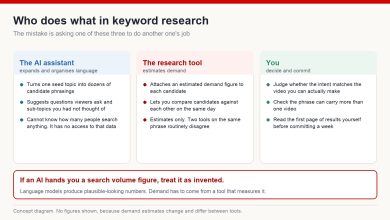
Terms people genuinely type, which you can sanity-check in a research tool: faceless youtube channel, ai video generator, personal finance for beginners. These attract the right viewer, but volume figures from any tool are estimates and they move, so use them for ordering candidates rather than as a measurement.
Topic keywords
Terms that describe the whole direction of the channel rather than one search: wildlife, personal finance, language learning, technology explained. These age far better, which matters a great deal for something you are stamping on every video for the next five years.
Long-tail keywords
Four words or more, lower competition, closer to a specific need: how to start a faceless youtube channel, budget travel for solo travellers. These are excellent for video titles. In a channel name they are usually too long — better to let them shape the content plan than the branding.
If you have to choose, the topic keyword is normally the safer thing to put in the name, because a name is a long-term commitment and specific demand terms date faster than categories do.
The five ways this goes wrong
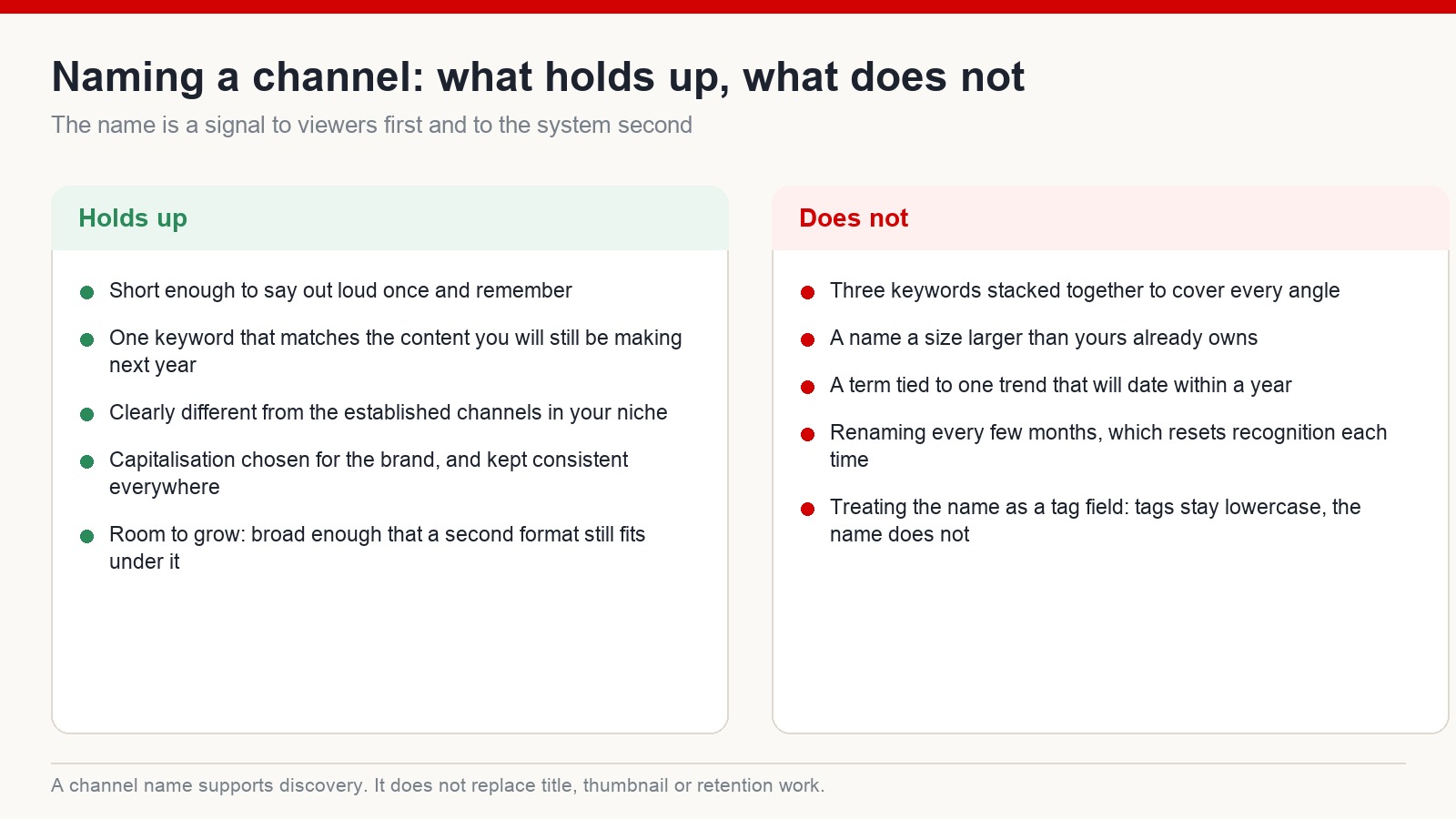
- Three keywords stacked together to cover every angle. It reads as spam and it commits you to nothing.
- A near-copy of a larger channel, which hands your recognition to them.
- A term tied to one trend, which will look dated inside a year and cannot be quietly removed later.
- Renaming every few months, which resets whatever recognition you had built each time.
- No brand at all — a pure keyword name that nobody can become a fan of, because there is nothing there to be a fan of.
The last one is subtle and common. A channel called nothing but its category can be found, but it cannot be loved, and the channels that last are the ones people feel loyal to.
Should I put a keyword in my channel name at all?
One is usually worth it, mostly for the viewer: it tells a stranger what the channel is before they click anything. Do not treat it as a ranking mechanism, and do not add a second one.
How long should a channel name be?
Short enough to say out loud once and be remembered afterwards. In practice that is two or three words plus the keyword. Longer names get truncated in the interface and repeated by nobody.
Is it a problem if a bigger channel has a similar name?
Yes, and it is worth avoiding from the start. You will be competing for the same searches with none of the history, and viewers will confuse the two of you in the direction that does not help you.
Does the keyword in my name need to be lowercase?
No. The name is branding — capitalise it however suits you, as long as you are consistent everywhere. Lowercase is a convention for tags, not for names.
Choose it once, then leave it alone
A channel name will not rescue weak content, and no naming formula compensates for a video nobody finishes. Title, thumbnail and retention still decide almost everything.
What a good name does is remove friction: it tells strangers what you are, it is easy to repeat, and it does not need changing when the channel grows. Given that you will be carrying it for years, half an hour of deliberate thought at the start is one of the cheapest decisions available to you.
If you want the full process for building a faceless channel aimed at English-speaking audiences, that is what I teach at mmoyoutube.com.