The Pinned Comment: How To Write One That Actually Does A Job
For a long time I treated the pinned comment as a formality. Publish the video, pin something like “thanks for watching everyone”, forget it existed. It was the last item on a checklist rather than a piece of the video.
What changed my mind was noticing what larger channels put there. Their pinned comments were not pleasantries. They were doing a job: pointing somewhere specific, opening a question, setting up whatever came next. Nothing about them was decorative.
I have been making YouTube content since 2017, mostly faceless channels aimed at viewers in the US, the UK, Germany and Japan. The pinned comment is one of the few pieces of a video you can rewrite after publishing, for free, in thirty seconds. That alone makes it worth getting right.
Why the position is worth more than the words
The pin sits in the first thing a viewer sees when they scroll down. Not the second thing, not somewhere in a description nobody expands – the first. It is also the only element of a video that reaches people who skipped straight to the end and people who paused halfway, at the same time.
That makes it a soft call to action. It can redirect attention without interrupting anything, which is more than can be said for the same request shouted over the outro.
One caution before the tactics. You will find a lot of confident claims about exactly how much a pinned comment moves watch time or subscriber count. I cannot verify any of them and neither can anyone else outside YouTube. What I can tell you is what to measure: after you change how you write pins, compare the session behaviour on your next few videos against the median of your own last ten uploads. Your channel’s own history is the only benchmark that means anything.
The anatomy of a pin that does something
Four lines, in this order.
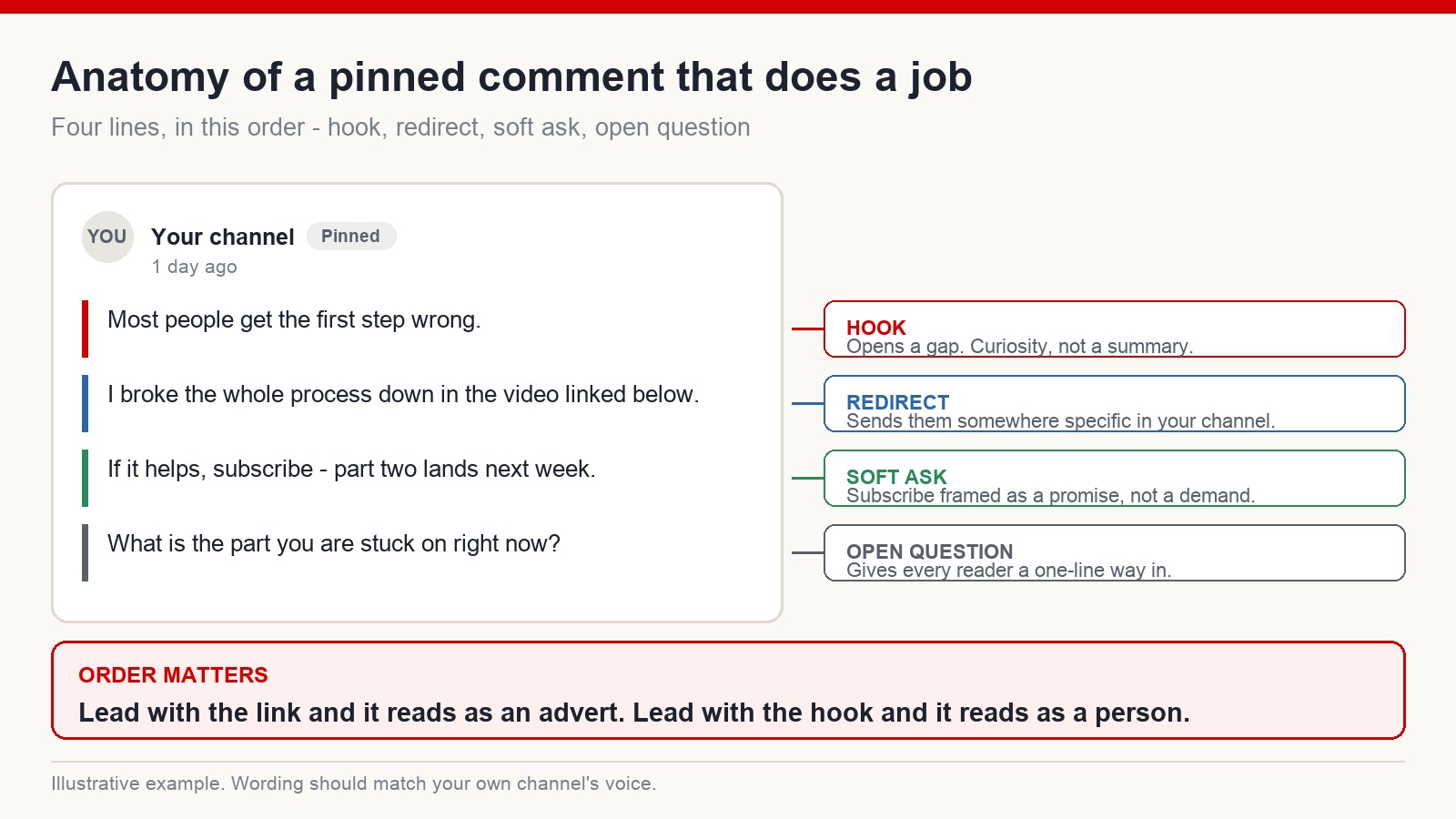
A hook. One line that opens a gap rather than summarising the video. “Most people get the first step wrong” makes someone want the next sentence. “In this video I explain three tips” does not.
A redirect. Send them somewhere specific: the next video in the sequence, the playlist, the deeper version of the thing they just watched. Specific beats general. “The full walkthrough is here” is a destination; “check out my other videos” is a shrug.
A soft ask. Subscribe, framed as what arrives next rather than as a favour.
An open question. One line that any viewer can answer without effort. This is what turns the pin into a conversation instead of a notice board.
The order is not cosmetic. Lead with the link and the whole thing reads as an advert, and people scroll past adverts by reflex. Lead with the hook and it reads as a person who has something else to say.
Rewrite the subscribe line
“Like, share and subscribe” is the single most ignored sentence on the platform. Not because asking is wrong, but because it asks for a favour and offers nothing in return. The viewer is being told to do something with no stated reason.
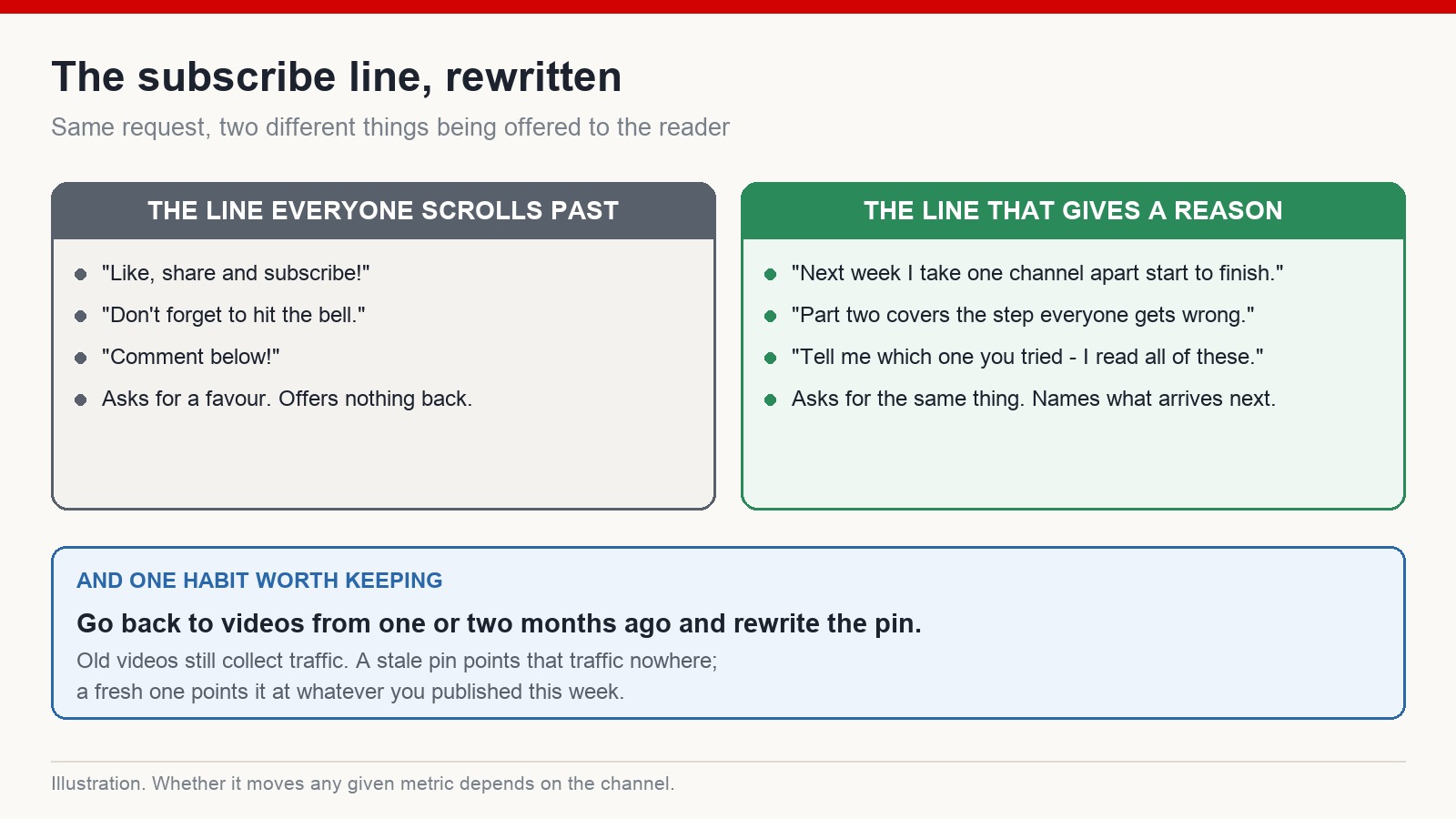
Compare it with: “Next week I take one channel apart start to finish – if that is useful, subscribe.” Same request. Completely different transaction. The viewer now knows what they are subscribing for, which is the only information that has ever made anybody press the button.
The same logic applies to the redirect. Do not open with a bare link. Lead with the reason:
“A lot of people asked how I keep the click-through rate steady when the output goes up. I broke that down properly in the video below.”
That reads as somebody answering a question. “Watch this video now” reads as a banner ad, and gets treated like one.
The habit that costs nothing: go back and rewrite old pins
Most creators only think about the pin on publishing day. Meanwhile the videos from two months ago are still collecting traffic – often more of it than the new one, because they have had time to accumulate.
Every one of those has a pinned comment that points at something stale, or at nothing at all. Going back through your last ten or fifteen uploads and rewriting the pins to point at whatever you published this week takes an afternoon and does not require making anything new. It is the highest-leverage boring job on a channel.
The same applies to playlists. A pin is a decent bridge into a sequence, and a viewer who moves from one video into an ordered playlist behaves very differently from one who lands, watches, and leaves.
Post it immediately, and from your own account
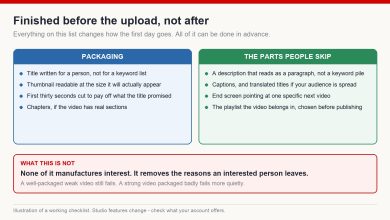
The pin only works on people who see it, which means it needs to be there from the first minute. Write it before you publish and pin it the moment the video goes live – not the following morning, by which time the first wave of viewers has already been and gone.
It also has to come from your own channel account. That is not a stylistic preference: it is the difference between a creator talking to an audience and a comment section propped up by accounts somebody owns, which is a subject I will come back to below.
One more reason the pin earns its place: it is the only prompt in the whole video that reaches people who skipped straight to the end. A question in the outro reaches the smallest audience the video will ever have. The pin reaches everyone who scrolls.
Using a tool to draft pins, and the line around it
Drafting five versions of a hook and picking the one that sounds least like marketing is a reasonable use of a writing tool. Testing different angles is reasonable. Writing the pin in your target audience’s language when it is not your first language is reasonable.
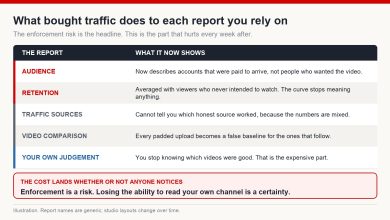
What is not reasonable, and not allowed, is posting comments from accounts you control in order to make a video look busier than it is. That is fake engagement under YouTube’s spam and deceptive practices policy, and running those accounts on separate emails or isolated browser profiles does not move it into a different category. The pin is powerful precisely because it comes from you, publicly, under your channel name. A comment section propped up by accounts you own is not engagement; it is a liability sitting under every video you have made.
The same policy covers the other easy mistake: pasting the same promotional comment, with a link, under dozens of videos. Repetitive comments posted at scale are spam regardless of who typed them.
A checklist for the pin
- Opens with curiosity, not a summary
- Points at one specific place, not “my other videos”
- Frames the subscribe as what arrives next
- Ends with a question a viewer can answer in five words
- Posted from your own channel account, on publishing day
- Rewritten on older videos when something new goes up
Does a pinned comment affect watch time?
It can, if it sends viewers to something else of yours that they then watch. Whether it moves the number on any particular channel is not something anyone can promise. Measure it against the median of your own recent uploads rather than against a figure from a blog post.
Should I put the link at the very start of the pin?
No. Give the reason first, then the link. A pin that opens with a URL reads as promotion and gets skipped.
How often should I update pinned comments?
When you publish something new, when an older video starts picking up views again, or when you want to try different wording. There is no schedule; it is a five-minute job whenever you have a reason.
Is it fine to use a writing tool to draft the pin?
Yes, for brainstorming hooks and phrasings. Rewrite the result in your own voice – a pin that sounds generated undoes the point of pinning anything.
What language should the pin be in?
The language of the audience you are making the video for. If that is not your first language, draft it with a translation tool and read it back carefully before posting.
Try it on the next upload
Write the next pin in the order above – hook, redirect, soft ask, open question – then watch what people do underneath it. It is the cheapest experiment available on a channel: no filming, no editing, no upload, and you can rewrite it as many times as you like.
If you want the rest of the process for building a faceless channel for an English-speaking audience, that is what we work through at mmoyoutube.com.