How to Hire a YouTube Editor – and Keep Them Past Week Three
You paid on time. Every month, no arguments, no late transfers. And the work still did not come out right. If that has happened to you, you are not bad at money – you are missing something I did not have a name for either, for far too long.
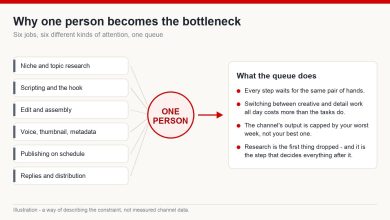
Mine looked like this: two in the morning, finishing an edit that was not my job. The editor had gone quiet. No message, no warning. A faceless channel sounds light when you describe it – screen recordings, a voice track, upload. It stops being light the moment the whole line runs through one person’s hands.
It took me years to work out that the problem was almost never the person I hired. It was where I sat them.
Hiring the wrong temperament costs more than hiring slowly
Wait an extra week to find the right person and you lose a week. Hire the wrong one and you lose the training, the half-finished work, the momentum of everyone around them, and then you run the whole search again. The maths is not close.
But my biggest mistake was quieter than a bad hire. I kept putting good people into work that ran against their nature, then wondered why they were slow at it. That is not a performance problem. That is asking a fish to climb a tree and grading it on the climb.
One example I still think about. I hired an editor off three sample videos – clean cuts, tidy subtitles, obvious craft. Three weeks later she asked to leave. Nothing was wrong with her skills. The seat I had put her in meant eight silent hours a day trimming frames, and she was someone who needed to talk, pitch, argue about ideas. I had hired the right skill and the wrong temperament, and I lost both.
A quick way to read temperament before you hire
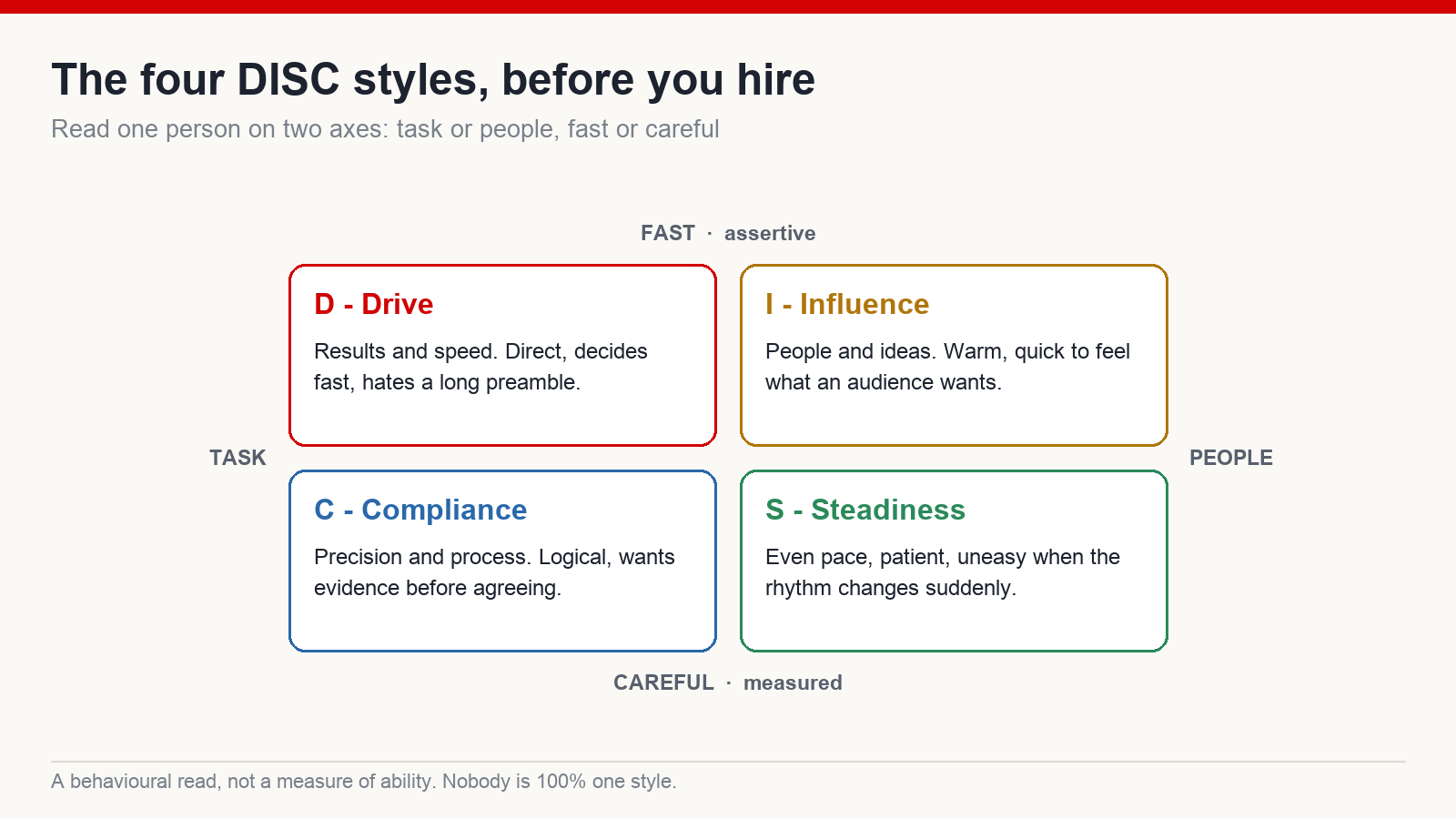
The lens I use is DISC – a behavioural model that sorts working styles into four tendencies. It is not a science of ability and it is not a personality diagnosis. It is a rough read on how somebody prefers to work, which is exactly the thing a portfolio never tells you.
Two questions get you most of the way there. Does this person orient towards the task or towards people? Do they move fast and assertive, or careful and measured? The four styles fall out of those two axes.
- D – Drive. Results and speed. Hand them a video and the first question back is what it is supposed to achieve. Direct, decides quickly, has no patience for preamble.
- I – Influence. People and ideas. This is who writes the hook that lands, because they can feel what a stranger on the other side of the screen actually wants.
- S – Steadiness. Even pace, patient, reliable. Publishes the same number of videos this week as last week without being chased. Dislikes sudden changes of plan.
- C – Compliance. Precision and process. Spots the cut that is one frame late and the subtitle line that broke. Wants evidence before agreeing to anything.
The framework traces back to the psychologist William Moulton Marston in the 1920s and 30s; the commercial questionnaires came much later. Two cautions before you use it. Nobody is a pure type – almost everyone is a blend with one or two dominant tendencies, and behaviour also shifts with context. And a label is not a verdict on what somebody is capable of.
Interview for temperament, not just for skills
Skills are the surface. You can see those in a portfolio in four minutes. What you cannot see is whether the work you are about to hand over will feel like breathing to this person or like holding their breath.
So ask questions that make temperament visible:
- Describe your ideal working day, hour by hour.
- Do you prefer work that repeats, or work that is different every time?
- Do you do your best thinking alone or around other people?
- Tell me about a project you enjoyed so much you lost track of time. What specifically were you doing?
- When a brief changes at the last minute, what is your honest first reaction?
Then listen for where they light up. It is usually obvious. Someone applying for an editing seat who talks mostly about events, collaboration and being around people is telling you something. So is someone applying to run the channel who visibly flinches at the idea of making a call without more data.
Neither answer makes them a bad hire. It makes them a bad fit for that chair, which is different, and much cheaper to notice now than in week three.
Skills are teachable. Temperament mostly is not.
This is the line I would tattoo on a new hiring manager. A missing skill is a training problem – annoying, solvable, usually a few weeks. A mismatch between the person and the shape of the work is not solvable by trying harder, and pretending otherwise just burns a good person slowly.
Two directions of the same failure:
Push a precision-and-process person into live community work – replying in real time, being visibly cheerful at strangers, hustling for early distribution – and they wilt. Not because they are difficult. Because they are standing in the wrong place.
Do the reverse and it hurts just as much. Take someone whose whole gift is reading an audience and put them on eight hours of frame-level assembly, and you will get two weeks of good work followed by a resignation. Repetition kills that person’s engine.
Seated correctly, the same people run without pushing. Editing suits precision, with enough steadiness to sit through the long stretch. Deciding what gets made and what gets dropped suits someone who can commit fast. Holding the production rhythm week after week – the thing nearly every small team is short of – suits the steady one.
Keeping people is two things, and neither of them is pay
I used to think retention was a salary question. Pay well, they stay; pay badly, they leave. That was wrong in a way that cost me people.
The ones who left were not underpaid. They left because every single day they were handed the exact work that grated on them, and then heard instructions delivered in a register they could not hear. Fix those two things and most retention problems disappear.
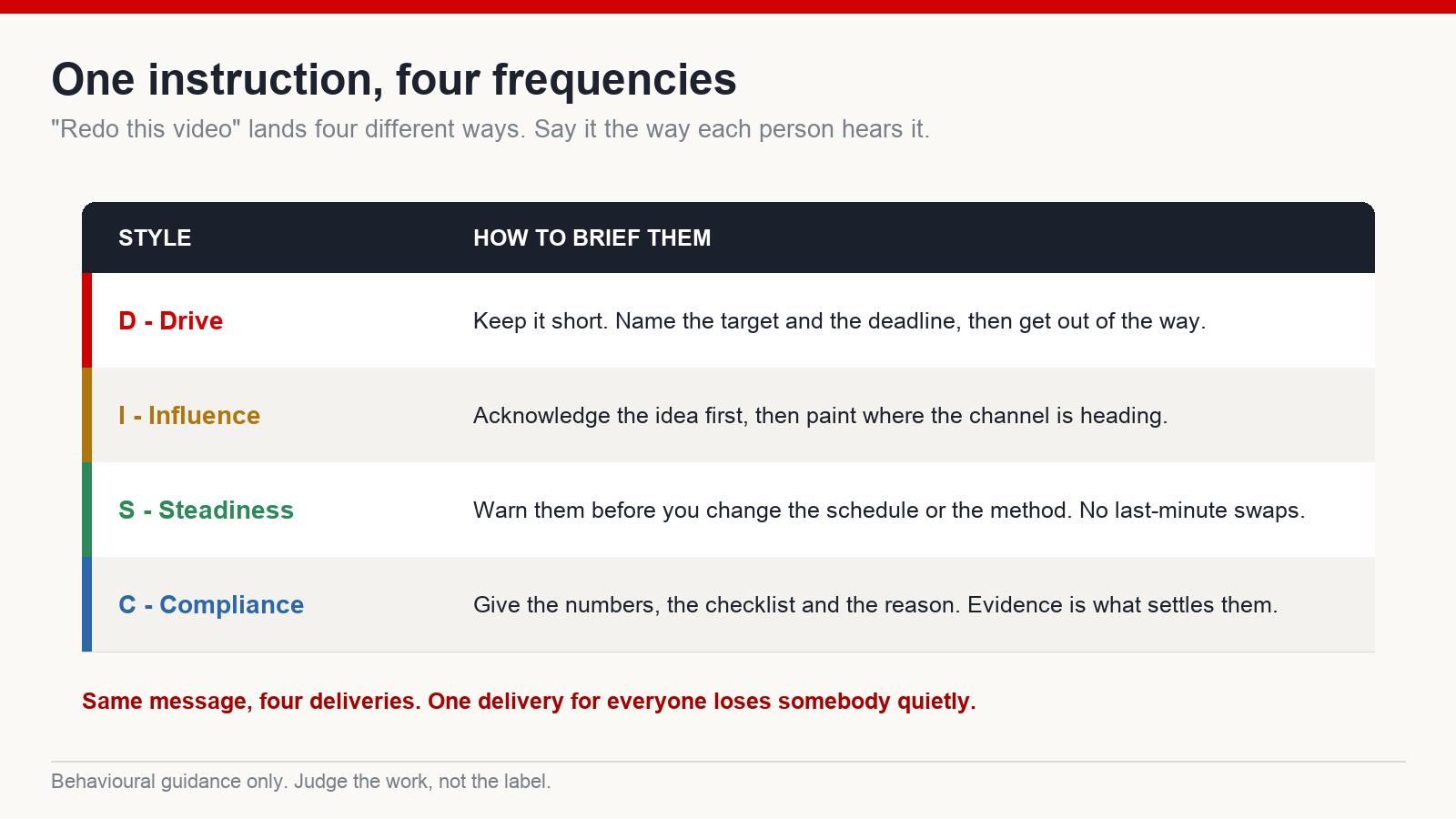
The second one is the part people underestimate. Take one sentence – “this video needs redoing” – and watch it land four different ways:
- Drive: keep it short. Name the target, name the deadline, then get out of the way. Three sentences of context and you have lost them.
- Influence: acknowledge what worked first, then describe where the channel is heading. They run on momentum, and momentum comes from being seen.
- Steadiness: warn them before the schedule or the method changes. Never drop a reversal on them at the end of the day.
- Compliance: skip the encouragement. Give the numbers, the checklist and the reason the cut has to move. Evidence is what settles them.
Say it one way to all four and it works for one of them. The other three absorb it quietly and start looking around.
Score people the way they already measure themselves
Reviews go wrong the same way briefings do. The results-driven person wants to know what the video did – so review them on outcomes. The precision person wants to know whether it was built to standard – so review them against a quality checklist. Give each of them the other one’s yardstick and they will both feel misjudged.
Pairing those two on the same piece of work is the most useful combination I have found. One pushes for speed, the other holds the quality line, and the two forces drag each other back to something sensible in the middle.
Hire for the gap, not for someone like you
Look at the team you already have before you write the job post. A team where everyone reads the audience well is a lively place with a lot of ideas and a lot of missed deadlines – it is short of precision. A team of precise, steady people is solid as concrete and slow to try anything new – it is short of decisiveness and short of instinct for what is moving right now.
Most people hire the person they enjoyed talking to, which usually means the person most like them. That is how a team ends up leaning hard in one direction with nobody to correct it.
None of this works without a written process
I have to be honest about the limit of everything above, because it is the part I got wrong last. You can read temperament correctly, seat everyone perfectly, keep them happy – and the team can still stall.
The thing that stalls it is almost never intelligence. In my experience coaching creators, the real barrier is that people will not follow a process they have already been handed. That is my own observation from years of teaching, not a measured statistic, but it has been consistent enough that I now plan around it.
The mechanism has a name I use privately: the illusion of competence. A week in, a month in, someone decides they have the shape of it and starts skipping steps before they have executed the process correctly even once. The way out is unglamorous – put the ego down and follow it exactly as given. Do first, understand after.
I once watched a room full of people, each holding a printed checklist, fail to complete an instruction as simple as putting four coloured pens in a stated order. Nobody opened the sheet in their hand. It was not difficult. It was a discipline problem, and discipline shows itself in the smallest task in the room.
So every seat runs on the same spine: a written checklist. Lettered sections, numbered steps inside each section, in the order they must happen, ticked off as they are done. Put it in a spreadsheet or print it and tape it beside the monitor. It is embarrassingly basic. It is also the difference between a team and three people with a group chat.
Temperament tells you who belongs in which chair. Process is what keeps them in the chair producing work.
Frequently asked questions
Should I make candidates take a DISC test before hiring?
I would not make it a gate. It is a reference tool for behaviour, not a measure of ability, and behaviour changes with context. A questionnaire will not tell you how somebody works under a real deadline. Give them a small paid task and watch instead – that tells you more than any score.
Which temperament suits a video editor?
Usually someone precision-led, with a steady streak. Editing demands exactness on every cut, every music beat, every subtitle line, and it demands tolerating that repetition without going flat. Treat it as a starting hypothesis, not a rule – plenty of excellent editors do not fit the pattern.
My team is only two people. Does any of this apply?
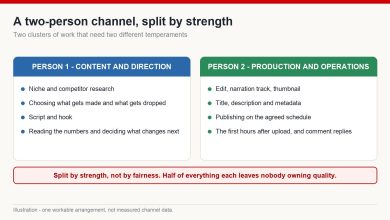
Yes, in a simpler form. One person researches and writes, the other edits. The first seat suits someone creative and decisive; the second suits someone precise and durable. Do not hard-label either of them – watch how they actually work and adjust.
How do I tell a bad hire from a badly seated one?
Move one task. Take the part of the job that seems to be draining them, swap it for something closer to their grain, and give it two weeks. A badly seated person visibly comes back to life. Someone who was genuinely a mismatch for the work stays flat – and now you know, without having guessed.
Is it worth hiring at all on a small channel?
Only when the work is genuinely more than one person can carry and you have a written process to hand over. Hiring before the process exists just gives you someone to confuse. Results vary widely, and a team increases your fixed costs before it increases anything else – go in with that clearly in mind.
I have been building faceless channels for English-speaking audiences since 2017, and every rule above came from getting it wrong first, usually expensively. If you want to go deeper into building that kind of channel with people behind it, that is what I write about at mmoyoutube.com.