Advanced YouTube Script: Write the Whole Video Before You Open the Editor
For a long stretch I believed the answer to YouTube was volume. Publish more, publish faster, and eventually one of them would break out. I have since gone through hundreds of videos that outperformed everything around them, and the pattern was almost never volume. The channels pulling ahead were usually publishing less than the ones stuck.
What separated them was the part nobody films: the script. Not a bullet list of talking points, but a written plan for every scene — what it says, what is on screen, how it ends, and what it hands to the next one. That is what I mean by an advanced YouTube script, and it is the single change that moved my results the most.
I have been making YouTube videos since 2017, most of it on faceless channels aimed at English-speaking viewers. This is the scripting process I would hand to anyone starting again.
Why the script decides how far a video travels
Most creators spend their time where the work is visible: editing, sound design, thumbnail iterations. All of that matters. But the platform does not grade craftsmanship — it reads behaviour. Whether people keep watching. Whether they leave in the first half minute. Whether they click something else on your channel afterwards.
Beautiful footage does not produce those signals on its own. Sequence does. A viewer stays because something is unresolved and they want it resolved, and that is a writing decision made long before the edit. This is also why two videos with similar view counts can perform very differently in every metric that follows — watch time, session length, how long the recommendation keeps running. Results vary by niche and audience, and platform behaviour changes, so treat this as a direction rather than a formula.
The slow part is the part that pays
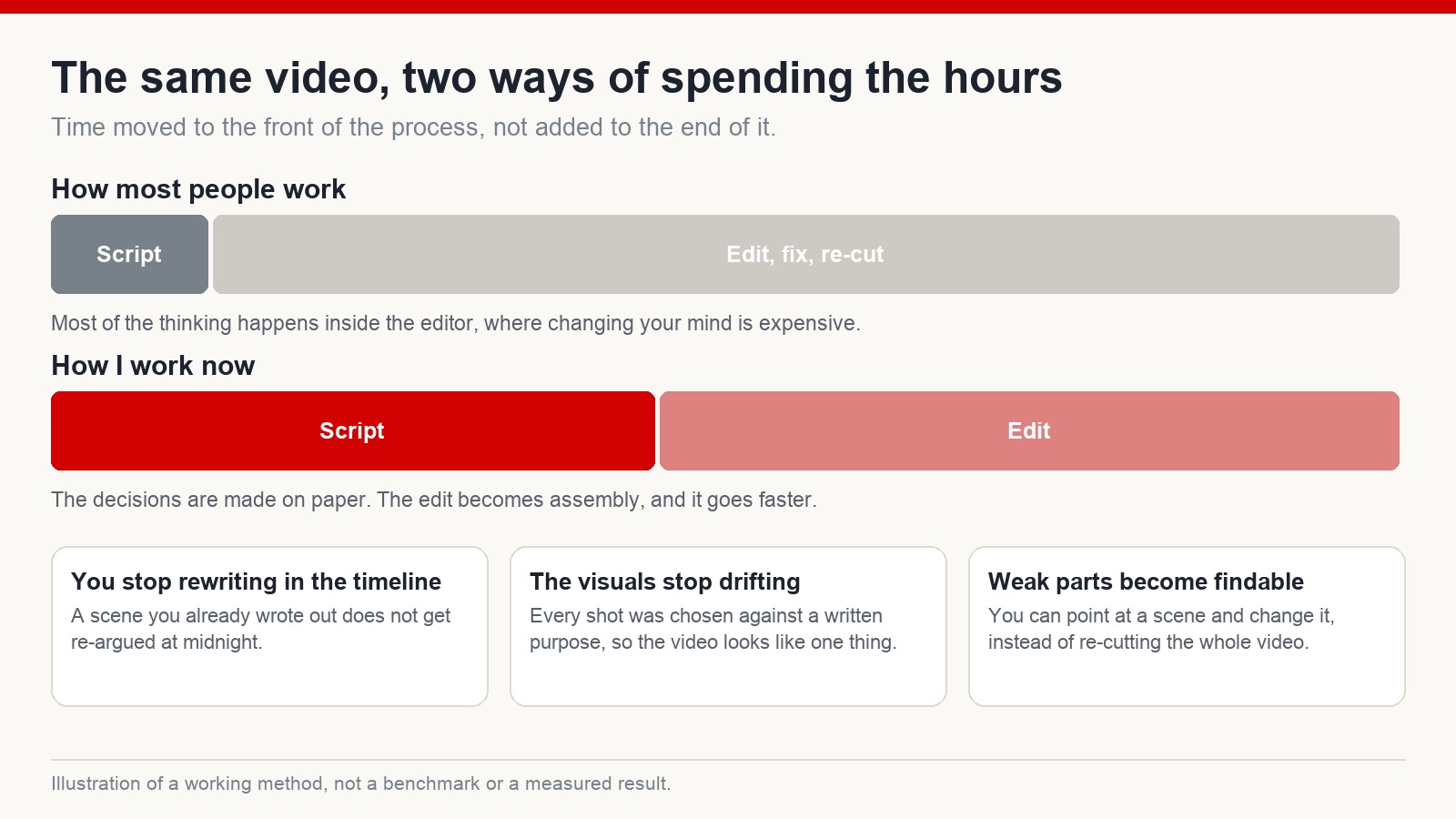
Here is the rule I keep coming back to: the work that feels slow is usually the work that compounds. If a video currently takes you three hours end to end, try spending two additional hours on nothing but the script before you open the editor.
It sounds like a bad trade until you do it once. A finished script means you stop making decisions inside the timeline, which is the most expensive place to change your mind. Fewer re-cuts. Fewer visuals that do not match the line they sit under. Fewer 1 a.m. sessions where you rebuild the middle because it drags and you cannot say why.
Almost every time, that is a better use of five hours than pushing out two more average uploads.
Break the video into scenes, not blocks
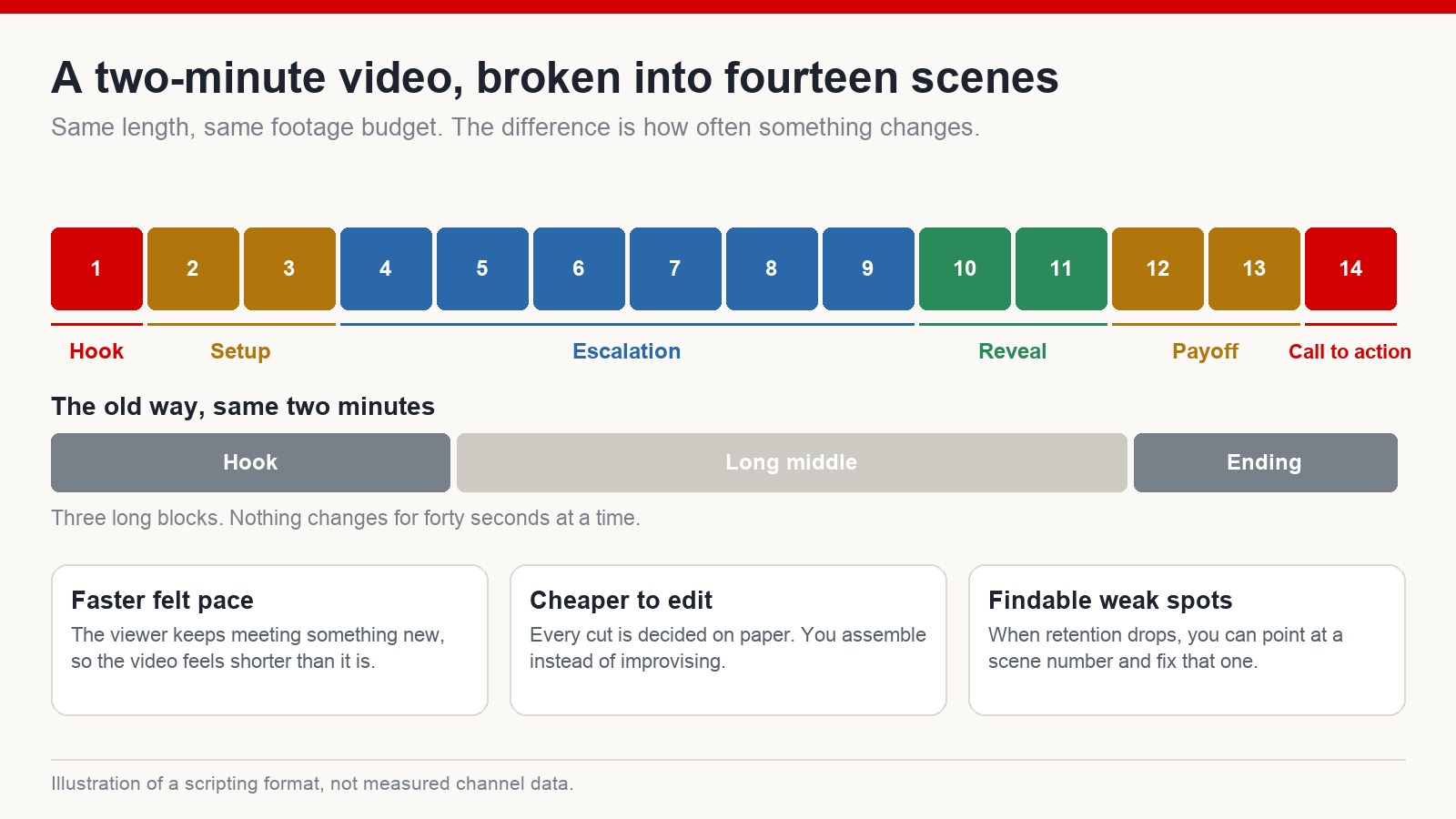
A two-minute video should not be three long slabs of content. Cut it into short scenes — roughly twelve to fifteen for two minutes. Same runtime, same footage budget; the difference is how often something changes on screen.
That is most of why AI-assisted videos often feel faster than their length suggests. Nothing sits still. The viewer keeps arriving at something new, and a video that keeps introducing things feels shorter than one that explains at a constant temperature.
Six fields per scene
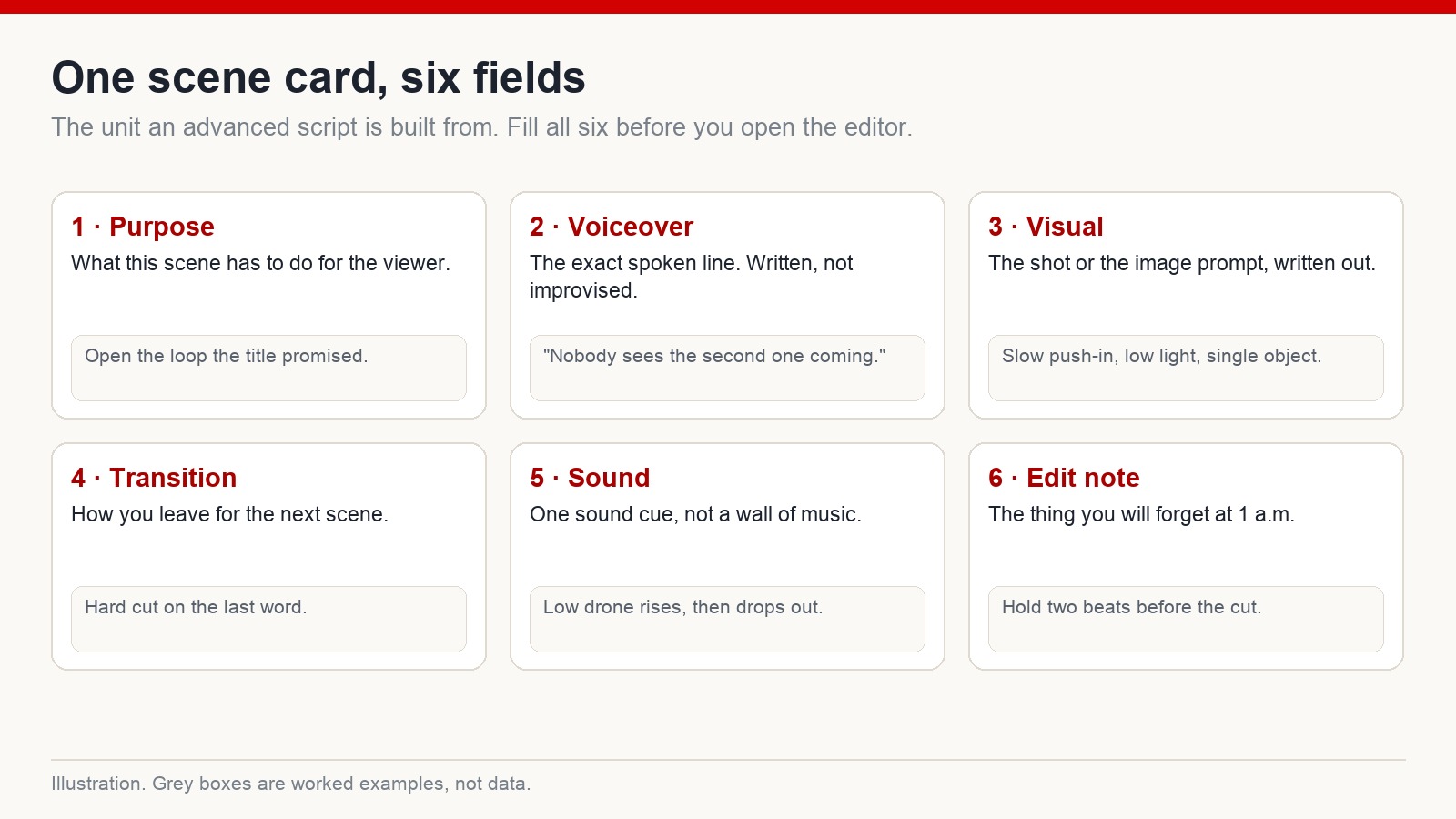
Every scene in my script has the same six fields. If one is empty, the scene is not written yet.
- Purpose — what this scene has to do for the viewer.
- Voiceover — the exact spoken line, written out, not improvised at the mic.
- Visual — the shot, the stock search term, or the image prompt.
- Transition — how you leave for the next scene.
- Sound — one cue, not a wall of music.
- Edit note — the thing you will otherwise forget.
A filled-in card looks like this:
Scene 4 · Purpose: open the loop the title promised.
Voiceover: “The second one is the one nobody sees coming.”
Visual: slow push-in, low light, a single object in frame.
Transition: hard cut on the last word.
Sound: low drone rises, then drops out.
Edit note: hold two beats of silence before the cut.
Writing at that resolution feels tedious for the first two videos and then becomes the fastest part of your week, because the edit turns into assembly.
The opening is a separate piece of writing
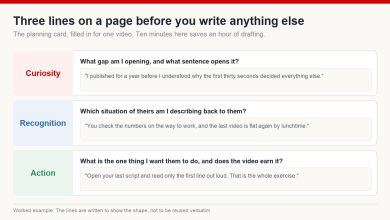
The first few seconds are not the beginning of the script. They are their own job, and they deserve their own draft. Skip the introductions, the channel branding, the “before we get started” — none of it earns the next thirty seconds.
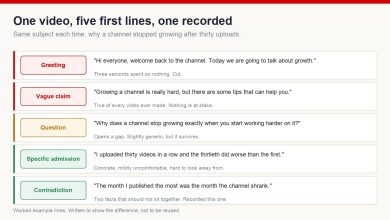
Openings that have worked for me, in the words I would actually record:
- “I went looking for why a channel this size was losing money, and the answer was in the first line of every script.”
- “If you are publishing on schedule and nothing is moving, the problem is probably not your upload count.”
- “Nobody warned me about this one, and it cost me about a year.”
Each of those opens a gap. The gap buys attention, attention buys watch time, and watch time is what the distribution system is reading. That chain is the entire argument for spending an hour on twelve words.
Use AI as an analyst, not as a copier
The most common mistake I see is pulling a competitor’s transcript and asking a model to rewrite it. What comes out is a slightly worse version of something that already exists. No point of view, no reason for anyone to subscribe, and a real risk of being treated as repetitious content.
Point the model at the analysis instead. Prompts I actually use:
“Here is the transcript of a video that performed well in my niche. Map its structure: where the opening ends, where the tension rises, where the payoff lands, and what question it keeps unanswered. Do not rewrite it.”
“Given that structure, propose three angles on the same subject that argue something different from this video.”
“Turn the angle I picked into fourteen scenes with a purpose line for each. Leave the voiceover blank — I am writing that.”
That is a research assistant. The structure you may study; the words, the examples, the evidence and the voice have to be yours. Reusing someone else’s narration or footage is not research, it breaks platform policy, and it can cost you the channel.
Be different enough to be worth subscribing to
Plenty of AI-assisted channels struggle for one reason: everything on them could have come from anywhere. Viewers find nothing new, and there is nothing distinct for the platform to reward.
The fix is not to abandon the tools. It is to put something in that only you can supply — a position you actually hold, a mistake you made, a comparison you ran yourself, an example from your own work. A model cannot generate that, and it is what turns a video into a channel.
Evergreen first, generated shots second
My working ratio: the overwhelming majority of the runtime carries evergreen value — the skill, the process, the reasoning, the thing that will still be true next year. A small remainder is generated or stock imagery used to illustrate, because a talking point with nothing to look at drags.
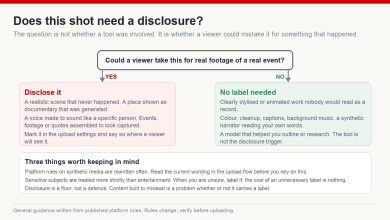
If a scene is entirely AI-generated, say so on screen. It costs you nothing, it reads as confidence rather than apology, and it is the direction platform disclosure rules keep moving in anyway.
What I would do with two spare hours
AI has changed how fast video can be produced. It has not changed what makes a video worth finishing. The creators doing well are not the fastest ones; they are the ones putting their hours where the hours matter.
Given two extra hours on any video, I would spend both of them on the script. Not because it guarantees anything — nothing on this platform does — but because it is the only part of the process that improves every other part downstream.
Frequently asked questions
How is an advanced script different from a normal one?
A normal script lists what you will say. An advanced script also fixes the visual, the transition, the sound cue and the editing note for every scene, so the whole video is decided before the editor opens.
Should I let a model write the entire script?
No. Models are good at analysing structure, proposing angles and drafting scene purposes. The voice, the examples and the argument should be yours — that is the part with any value in it.
Do short videos really need that many scenes?
Yes, and arguably more. Shorter runtimes are less forgiving: if nothing changes for twenty seconds, the viewer is already gone.
Will a better script increase what a channel earns?
It can improve watch time, retention and engagement, which are the signals that decide how widely a video is shown. Earnings depend on far more than that — topic, audience market, season, advertiser demand — so treat a better script as a lever, not a promise.
If you want the full process for building a faceless channel for English-speaking audiences, that is what I teach at mmoyoutube.com.