Titles, Thumbnails and Upload Schedule for a Rescue Live Stream
Whenever I suggest live streaming to someone whose channel has gone quiet, the strategy part lands easily. It is the practical part that stops people cold, and it is always the same two questions: what do I put as the title and thumbnail, and do I keep uploading normal videos while I do this?
Both questions deserve a proper answer, because getting them wrong is how a reasonable idea turns into a wasted month.
What a rescue stream actually is
A quick definition first, because the phrase makes people imagine something it is not.
I am not talking about sitting in front of a camera improvising for an hour. The method I use is this: you produce a brand new video – your own content, made properly – and you deliver it to the channel as a live broadcast rather than as an ordinary upload, using an encoder such as OBS Studio or a legitimate streaming service.
The reason to do this is that the live format is currently getting distribution that ordinary uploads on a quiet channel are not. You are choosing a format the platform is investing in. That is not a loophole, and it should not be sold to you as one.
One honest caveat before anything else: this is a patient strategy, not a switch. Some channels respond, some do not, and how a platform treats any format can change without notice. If you want the reassurance of a guaranteed outcome, nobody working in this field can give you one.
Option A: design the packaging from scratch
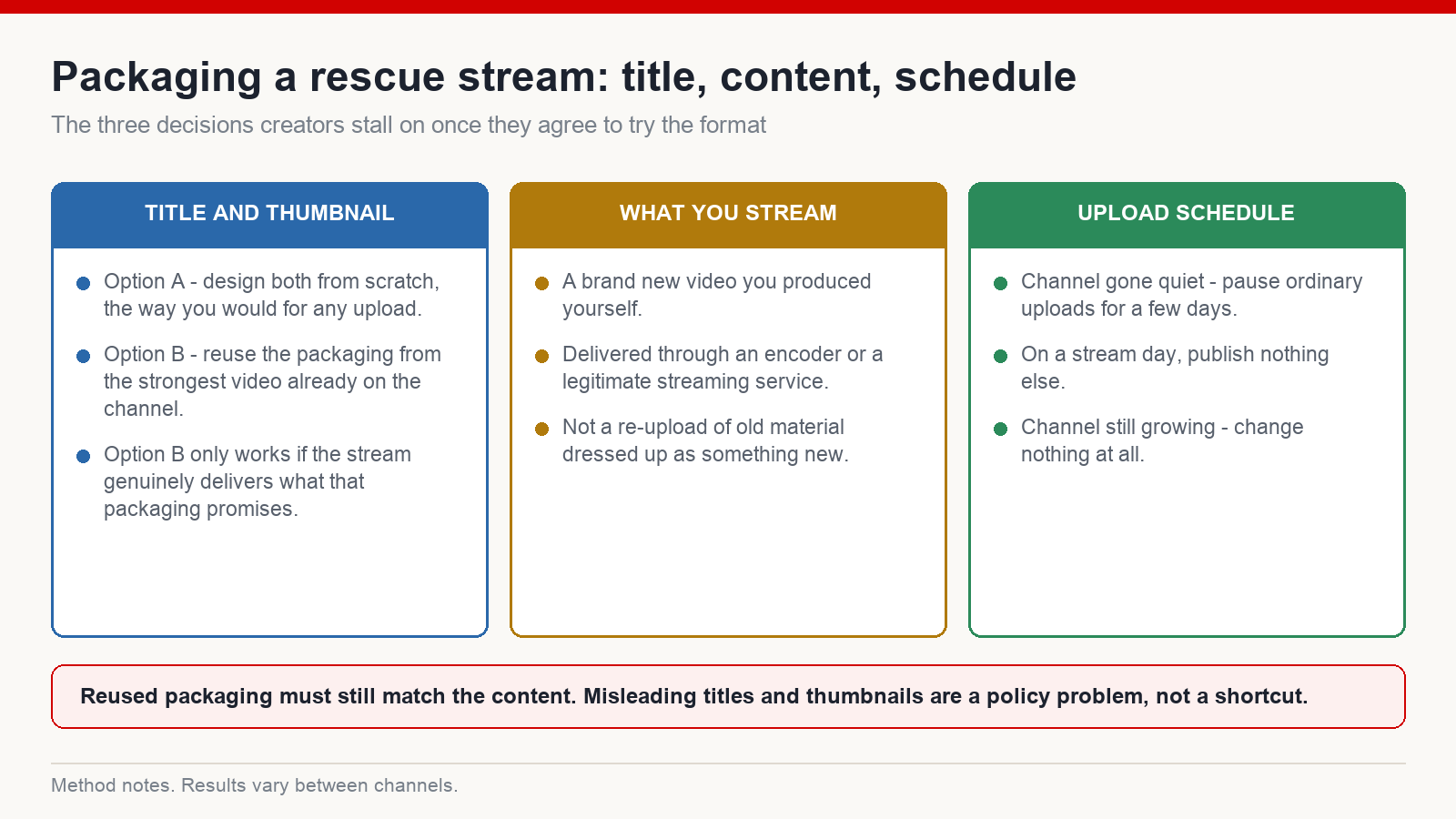
Write a new title and build a new thumbnail specifically for the stream, exactly as you would for any upload you cared about.
This is the right choice when you want to test a different angle on your subject, or when the channel simply does not have a standout video worth borrowing from yet. It is also the choice that teaches you the most, because whatever happens is attributable to something you made deliberately.
If you go this way, the thing to obsess over is not the title on its own or the image on its own. It is whether the two of them are telling the same story. A thumbnail that raises a question and a title that answers it before you click will underperform a pair that work together, every time.
Option B: reuse the packaging that already worked
Open your own channel, find the video that pulled the most attention, and use its title and thumbnail for the stream.
The logic is unglamorous and sound: something on your channel has already been tested against real people and won. Rather than guessing what might appeal, you are starting from a piece of packaging your own audience has already voted for. It is the same instinct behind studying the titles of videos that travelled widely in your niche, except you are studying the evidence you already own.
This is usually what I suggest to someone whose channel is struggling and whose energy is limited. It removes one large guess from a situation that already has too many.
The line Option B must not cross
Here is where people get themselves into trouble, so I want to be blunt about it.
Reusing packaging means borrowing the shell – the wording and the image – because it has proven pulling power. It does not mean re-uploading the old video. The content going out must be the new one you made.
And the shell has to still be honest. If your best-performing title promises a specific thing and your stream delivers something unrelated, you have not borrowed a proven asset – you have written a misleading title. Platforms treat titles and thumbnails that misrepresent content as a policy problem, and they are right to. The trick is choosing packaging that your new content genuinely fulfils. If nothing on your channel fits that description, use Option A.
So which one?
There is no universally correct answer, which is why I give people both.
Take Option A if you have the time and you want to try a new angle. Take Option B if the channel is weak, you want to conserve effort, and something in your library genuinely matches what you are about to stream.
Best of all, alternate. Use proven packaging this week, build something new next week, and compare the two against each other. After a handful of streams you are no longer choosing between two opinions – you are reading your own results. That comparison is worth more than anything I can tell you in an article.
How long, and how often
My rule of thumb, developed from the channels I have worked on rather than from any published figure: aim for at least 30 to 45 minutes, and preferably longer than an hour. The quieter the channel, the longer I want the stream to run. With one creator whose channel had gone almost completely dark, I asked for something closer to 90 minutes per session, because the whole point is to generate enough watched minutes for the system to have something to react to.
On frequency, start with one stream a week. One. Resist the urge to flood the channel before you know how it responds. If you see movement – and judge that against your own channel’s recent history, not against a number somebody quoted online – then add a second weekly stream.
The reason for going slowly is not caution for its own sake. It is that if you change four things at once you will never know which one mattered.
The upload schedule while you are doing this
Now the second question. It has three answers, and which one applies depends entirely on what your channel is currently doing.
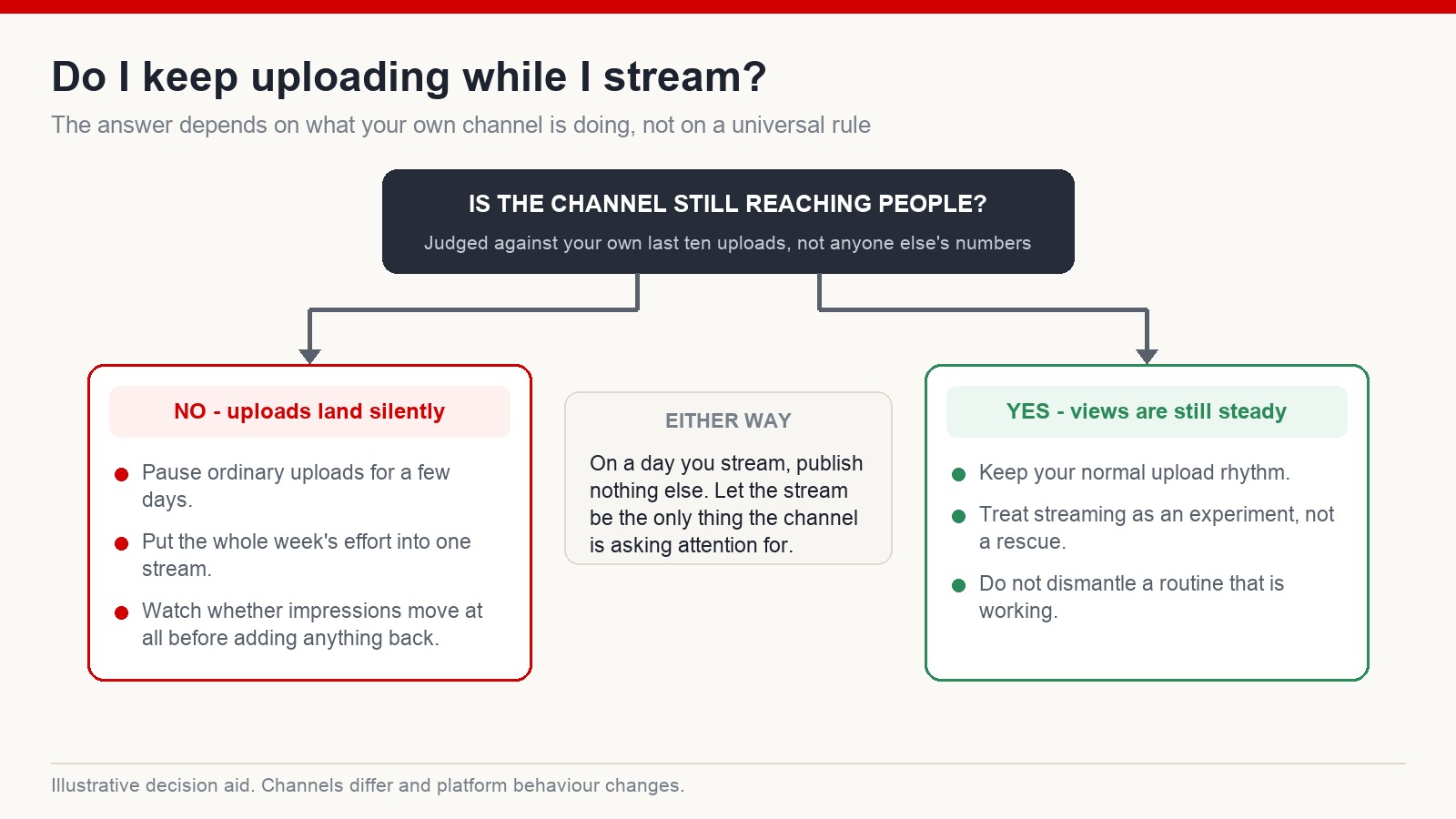
If uploads are landing silently
This is the case that needs treating. Pause ordinary uploads for a few days and put everything into the stream.
People resist this, because publishing feels like progress. But if you are producing video after video and none of them reach anyone, you are spending your entire week to receive no usable information. Stop, concentrate on one thing, and watch whether anything moves. A single clear signal beats five ambiguous ones.
On a day you stream, publish nothing else
Small rule, frequently ignored. If you are streaming today, that is the only thing you publish today.
Let the stream be the one thing your channel is asking attention for. Splitting your audience’s attention – and the channel’s – between two pieces of content on the same day serves neither.
If the channel is still growing, change nothing
If your views are steady and your videos are still reaching people, you do not need any of this. Keep your normal rhythm.
Live streaming here is a treatment for a channel that has lost distribution. A healthy channel does not need treating. I have watched people dismantle a routine that was working because they read that streaming was effective, and that is a self-inflicted wound. If you want to try the format on a healthy channel, treat it as an experiment layered on top of what you already do, not as a replacement for it.
What to watch, instead of hoping
Whichever combination you pick, write down what you did before each stream: which packaging option, how long, what day. Then compare each stream to your own previous ones rather than to anything external.
Nobody else’s channel is a useful benchmark for yours. Different niche, different audience, different history. Your own last ten pieces of content are the only fair comparison you have, and they are a genuinely good one.
Frequently asked questions
Can I stream a pre-recorded video?
Yes – that is precisely the method described here, delivered through an encoder. Platforms also offer a premiere feature designed for exactly this situation, which gives a pre-recorded upload a scheduled live moment with a live chat. Both are legitimate. Check the current rules where you publish before you commit to either, because these features get revised.
Is reusing my best title and thumbnail allowed?
Reusing your own packaging is your decision to make. What is not acceptable is packaging that misrepresents what the viewer is about to watch. Reuse it when the new content genuinely delivers on that promise, and write something new when it does not.
How many streams before I know whether this is working?
More than one, and there is no fixed number I can honestly give you. Judge it over several weeks against your own channel’s recent baseline, and be ready for the answer to be that this particular channel is not responding.
Should I stop uploading permanently?
No. The pause is temporary and diagnostic – a few days to get a clean reading. Ordinary uploads remain the foundation of a channel; the stream is a nudge, not a replacement.
Does the stream have to be long to count?
Longer sessions generate more watched minutes, which is the whole mechanism. But a long stream nobody watches is not better than a short one people stay for. Length is a means, not a target.
Where this leaves you
Three decisions, then. Pick a packaging approach and be honest about what it promises. Run the stream long enough to be worth noticing, starting once a week. And match your upload schedule to what your channel is actually doing rather than to a rule you read somewhere.
What I cannot tell you is whether it will work for your channel. I have seen quiet channels come back this way and I have seen channels where nothing shifted. What you control is the method, the honesty of the packaging, and your patience with a slow signal.
If you want the wider system this fits into – choosing a subject, building for an English-speaking audience, and reading your own data rather than someone else’s benchmarks – that is what I teach at mmoyoutube.com.