The Ten Habits a Channel Is Actually Built On
Almost every beginner is quietly waiting for the same thing: the video that changes everything. One upload takes off, the subscriber count moves, and from that point the channel is a different channel.
It does happen. It is also a terrible plan, because you cannot schedule it and you cannot repeat it on demand. When I look at the creators who are still here years later – and I have been making faceless videos since 2017, mostly for audiences in the US, the UK, Germany and Japan – what they have in common is not one lucky upload. It is a set of unglamorous habits that were running long before anything worked.
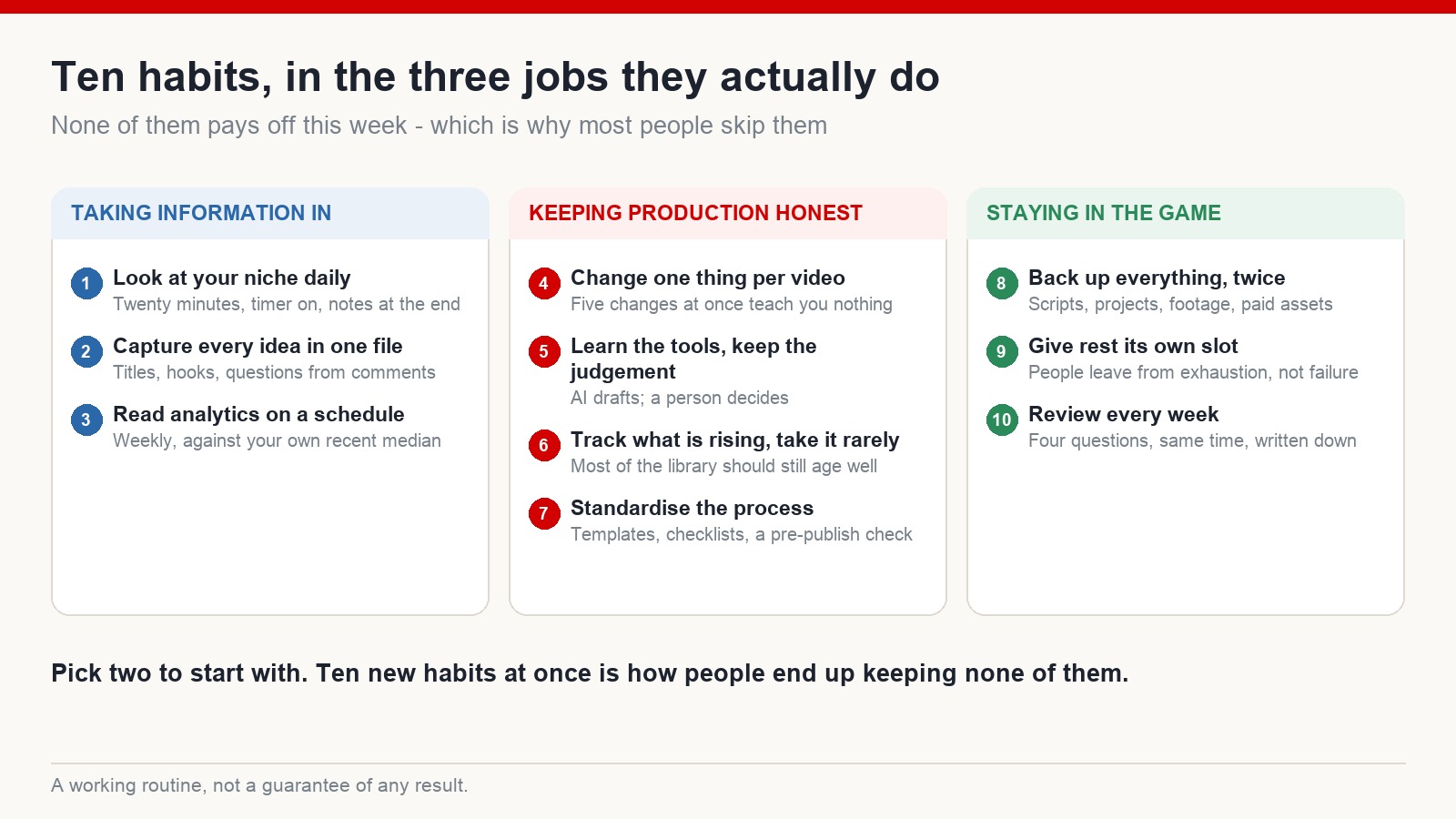
None of the ten below produces a result this week. Together, over a hundred videos, they are most of the difference.
1. Look at your niche every day, briefly
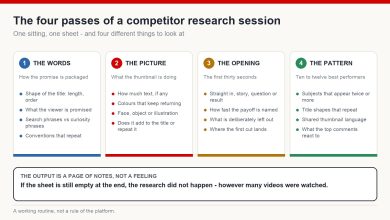
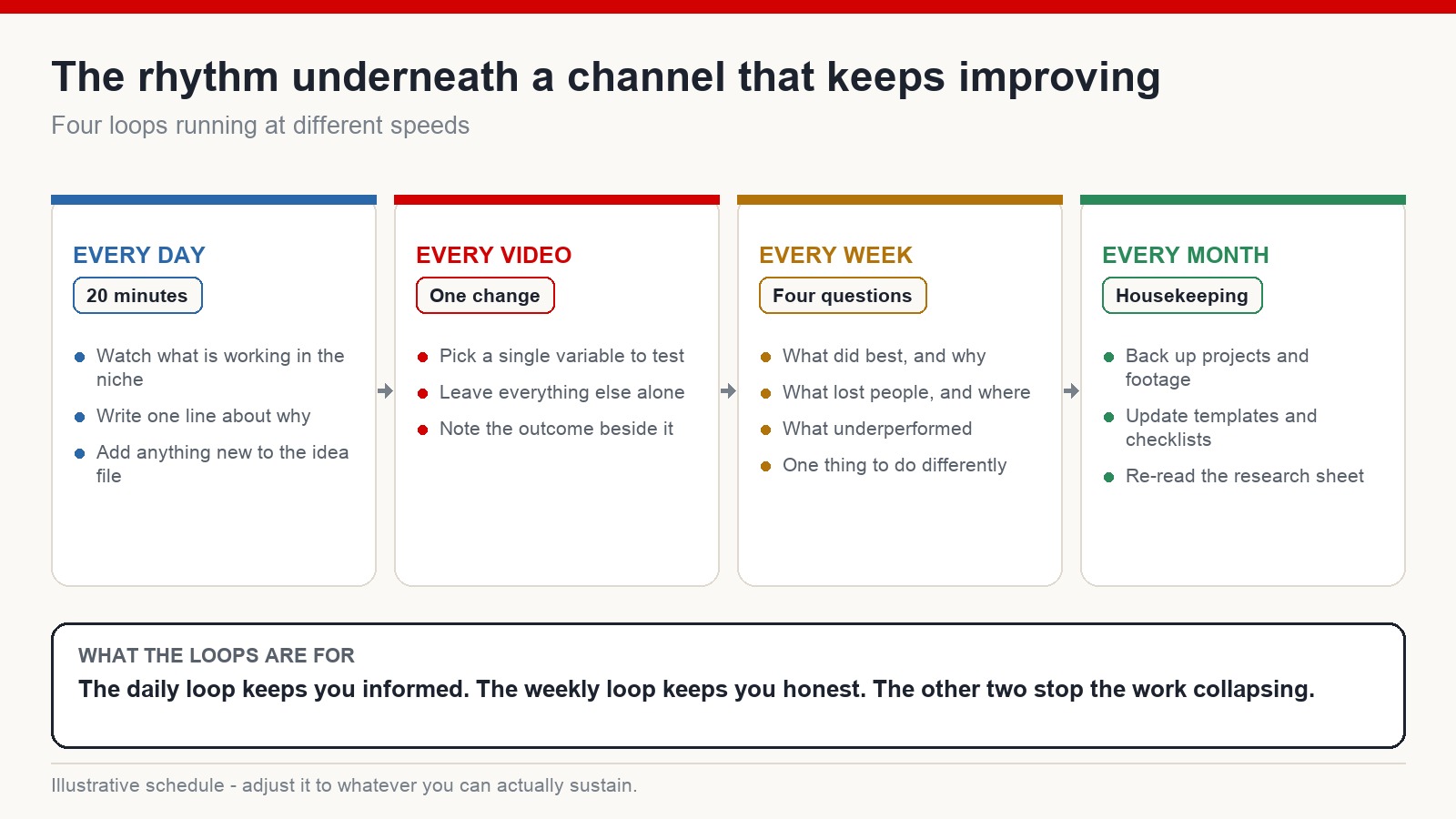
YouTube moves, and so does what an audience wants from a subject. Twenty minutes a day is enough: watch what is doing well in your space, notice how it is told, look at how the titles and thumbnails are built, and register anything that is new.
Two things make this a habit rather than a distraction. Put a timer on it, and write something down at the end. Watching without notes is just consumption with a professional excuse attached.
2. Capture every idea in one place
Ideas arrive at inconvenient moments and leave immediately. The fix is boring: one file, always reachable, where everything goes – a title fragment, an opening line, a subject, a question that keeps appearing in your comments, something a viewer said better than you would have.
After a few months this file is the reason you never sit down to a blank page. It is also more useful than a brainstorm, because everything in it arrived attached to a real moment rather than being invented under pressure.
3. Read your analytics on a schedule, not on impulse
Most people open Studio when they publish, refresh it compulsively for two days, and ignore it the rest of the month. That is exactly backwards.
Pick a fixed time – once a week is plenty – and look at the same handful of things: click-through, average view duration, where traffic came from, and how many viewers came back. Then compare each number against your own recent median rather than against a figure you read somewhere. Public benchmarks are averages across wildly different channels, formats and countries. Your own last ten videos are the only fair comparison you have.
4. Change one thing at a time
There is no formula that transfers cleanly between channels, so you are always running a small experiment. The mistake is running five at once.
If you change the opening, the thumbnail style, the length and the topic in the same upload, a good result teaches you nothing because you cannot tell which change caused it. Pick one variable per video, give it two or three uploads before you judge it, and write the outcome next to it in your notes.
5. Keep learning the tools, including AI – and keep the judgement
AI has genuinely changed how fast some parts of this job can be done: research summaries, outlines, first drafts, captions, organising material, translating notes. Refusing to learn it is a self-imposed handicap.
What it does not do is decide. It does not know which idea is worth an afternoon, whether a claim is true, or what your audience will find insulting. And volume produced without judgement is its own hazard – mass-produced, near-identical uploads are precisely the pattern platforms have been getting stricter about. Use the tools to remove drudgery, not to remove yourself.
6. Watch what is rising without being pulled around by it
Knowing what is moving in your subject is useful: it tells you what people are curious about right now and where the attention is going. Acting on all of it is not.
The practical version is to keep a short list of things that are heating up, and to take one occasionally when it genuinely fits the channel. The bulk of what you publish should still be work that will make sense to someone who finds it a year from now.
7. Back up everything, in more than one place
Nobody thinks about this until the day it matters, and then it is the only thing that matters. Project files, scripts, thumbnails, original footage, anything you paid for – kept in at least two places, one of them not in the same building or the same account.
The reason is not only disaster. A well-organised archive is what makes it cheap to re-cut an old video, reuse footage, or fix something two years later without rebuilding it from scratch.
8. Standardise the process
Once you know roughly how you make a video, write the steps down. A script template, a thumbnail template, a shot checklist, and a short list of things to verify before you hit publish.
Three things get better immediately: you make fewer stupid mistakes, each video costs less energy, and the work becomes something you could hand to another person. A channel that only exists inside your head cannot grow past what your head can hold.
9. Protect your time and your attention deliberately
Output is not the same as progress. Someone producing four videos a week with no time left to think usually plateaus faster than someone producing one and studying the result.
Give research, production, learning, analysis and rest their own slots rather than letting production eat all of them. Rest is on that list on purpose – a channel is a multi-year project, and the most common reason people leave is not failure, it is exhaustion.
10. Review at the end of every week
Four questions, twenty minutes, same time each week. Which video did best, and what is the most likely reason? What kept people watching? What underperformed, and what would I change? What is the one thing I will do differently next week?
The review is what turns a hundred uploads into a hundred lessons instead of the same lesson a hundred times. Without it, most creators keep repeating the same mistake with better production values.
How to start without trying to do all ten
Adopting ten habits at once is how people adopt none of them. Pick two.
If you are early, the two with the highest return are usually the daily look at your niche and the weekly review – one keeps you informed, the other keeps you honest. Run those for a month before adding anything else. Once they stop requiring willpower, add a third.
Why this is the boring answer, and the true one
Nothing here produces a result you can see next week. That is precisely why it works: the creators who quit are the ones who needed the result next week.
A channel that lasts is not made of one good video. It is made of somebody who studied their niche most days, wrote down what they noticed, tested one thing at a time, kept their material organised, and looked back honestly every seven days. Do that for a year and the channel you have at the end is not the same channel, whether or not any single upload ever took off.
Frequently asked questions
Which habit matters most for a beginner?
Daily niche research and a weekly review. The first keeps you connected to what your audience actually responds to; the second stops you repeating mistakes. Everything else builds more easily once those two are running.
Do I need to use AI to make videos?
No. It can save real time on research, outlines and drafts, but it decides nothing for you, and volume without judgement creates more problems than it solves. Treat it as a tool you learn, not a strategy.
How often should I look at my analytics?
Check after a video has had time to settle, then review properly once a week or once a month. Watching the first forty-eight hours obsessively tells you very little and costs a lot of attention.
How long before these habits show up in the numbers?
Longer than feels reasonable – think in terms of months and dozens of videos, not weeks. Results vary a great deal between niches, formats and audiences, and nothing here guarantees any particular outcome.
Is it worth writing a process down for a one-person channel?
Especially then. A written process is what keeps quality steady on the weeks when you are tired, and it is the only version of your channel that can ever be handed to someone else.
If you want the wider system these habits sit inside – how the research, packaging and production fit together for an English-speaking audience – that is what I teach at mmoyoutube.com.