Hope Is Not a Strategy: The Boring Work That Actually Grows a Channel
There is a sentence I keep coming back to after nine years of building channels: if something does not add up, it does not last.
It sounds harsh until you notice how often the thing that does not add up is a plan. Wanting views without ever asking whether a stranger understands your title. Wanting clicks without learning what a thumbnail is for. Wanting to be recommended without checking whether the people who clicked actually stayed. Wanting income while skipping every step that produces it.
None of that is laziness, usually. It is a much more common mistake: treating hope as though it were a strategy.
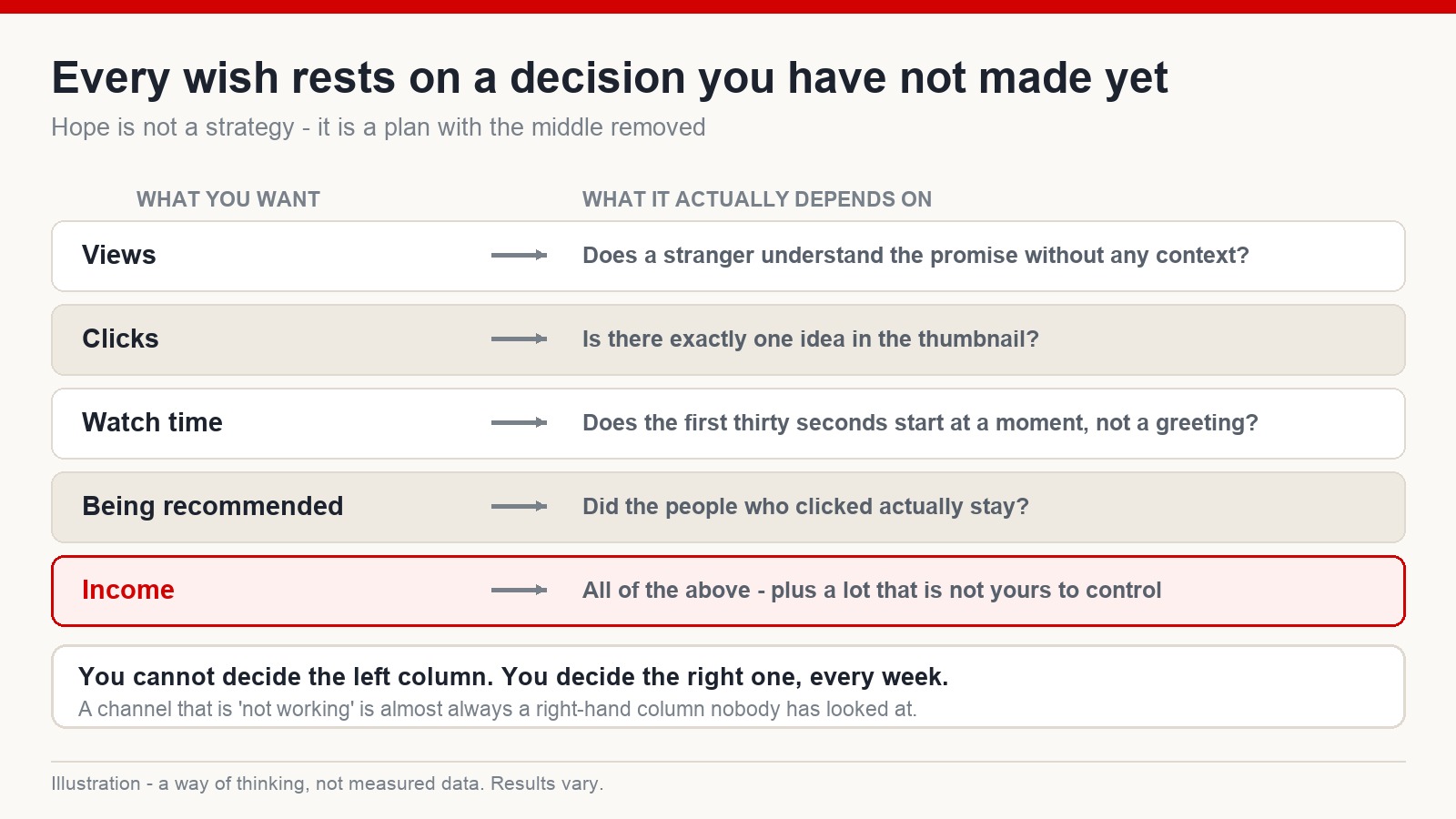
Every wish rests on a decision you have not made yet
Line them up and the gap is obvious:
- Views depend on whether a stranger, with no context, understands what the video is promising.
- Clicks depend on whether there is exactly one idea in the thumbnail.
- Watch time depends on whether the first thirty seconds start at a moment instead of a greeting.
- Being recommended depends on whether the people who clicked stayed.
- Income depends on all of the above, plus a great deal that is not yours to control at all.
You cannot decide the left-hand column. You decide the right-hand one, every week. A channel described as “not working” is nearly always a right-hand column that nobody has looked at directly.
Three sentences that are almost never the real problem
“The niche is dead.” Occasionally true. Far more often, other channels are still serving that audience perfectly well and the difference is packaging. Before retiring a subject, go and check whether anyone is currently getting views in it. If they are, the subject is alive and something in your delivery is not.
“The algorithm does not like me.” Recommendation systems respond to viewer behaviour: did people click, did they stay, did they come back. That is not a personality. It is a scoreboard for decisions you made in the thumbnail, the first minute and the topic.
“Other people are just lucky.” Sometimes, genuinely. But luck compounds for the person taking more shots with a better process, and it is invisible to the person taking fewer shots and changing everything after each one.
These sentences are all comfortable, which is exactly what makes them dangerous. They explain the outcome without asking anything of you.
The work most people skip: an honest competitor teardown
If I could make beginners do one thing before anything else, it would be this. Not because it is clever, but because almost nobody does it, which makes it a genuine edge.
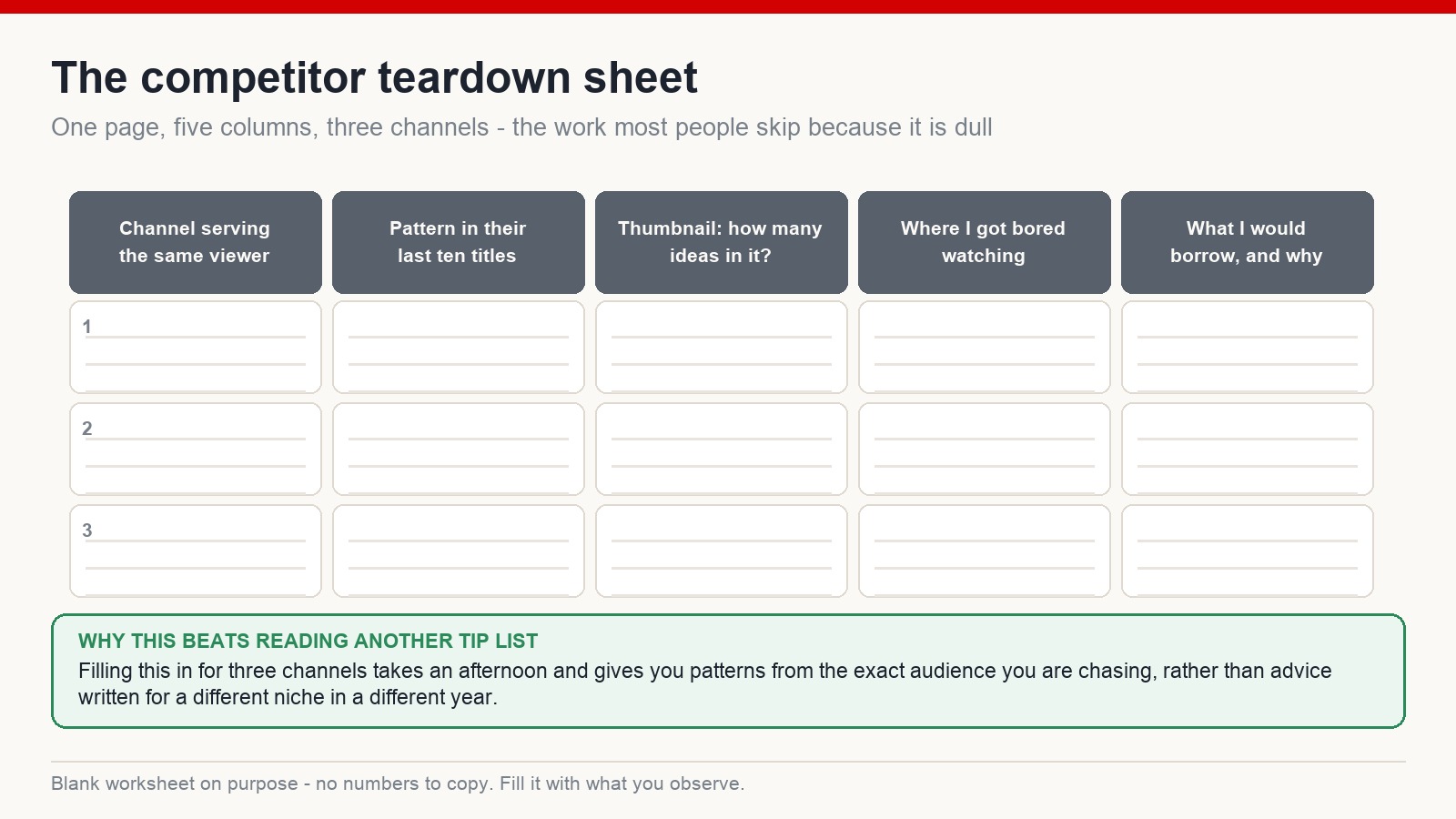
One page, five columns, three channels serving the same viewer as you:
- The channel. Not the biggest one in the category — one serving the same person you wrote down as your target.
- The pattern in their last ten titles. Write all ten out. Patterns you cannot see when you read titles one at a time appear immediately when they are stacked.
- How many ideas are in the thumbnail. Count them. You will find the ones that travel usually carry one.
- Where you got bored watching. Watch three of their videos as a viewer, not as a student, and mark the timestamp where your attention drifted. That moment is a lesson about your own pacing.
- What you would borrow, and why. Structure, not content. Copying a topic gets you a worse version of their video; borrowing a structure gets you your own.
An afternoon of this gives you patterns drawn from the exact audience you are chasing, which is worth more than a stack of general advice written for a different niche in a different year.
Beating people who are further ahead than you
The realistic version of competing is not out-thinking anyone. It is doing the specific things established channels have stopped bothering with, usually because they are dull.
- They copy title formats from each other. You go and find out what the viewer is actually trying to solve, from comments and search phrases.
- They reuse a thumbnail template. You make two versions and pick the one that beats the median of your own last ten.
- They open with a long introduction because their subscribers tolerate it. You cut yours to nothing, because nobody owes you that patience yet.
- They publish to fill a slot. You spend twenty minutes reading where viewers left the previous video before you write the next.
- They use AI to produce more. You use it to research faster, then make the same number of better videos.
None of that is a secret. It is simply work with no visible reward on the day you do it, which is precisely why the field stays open.
The loop, and why it has to be one change at a time
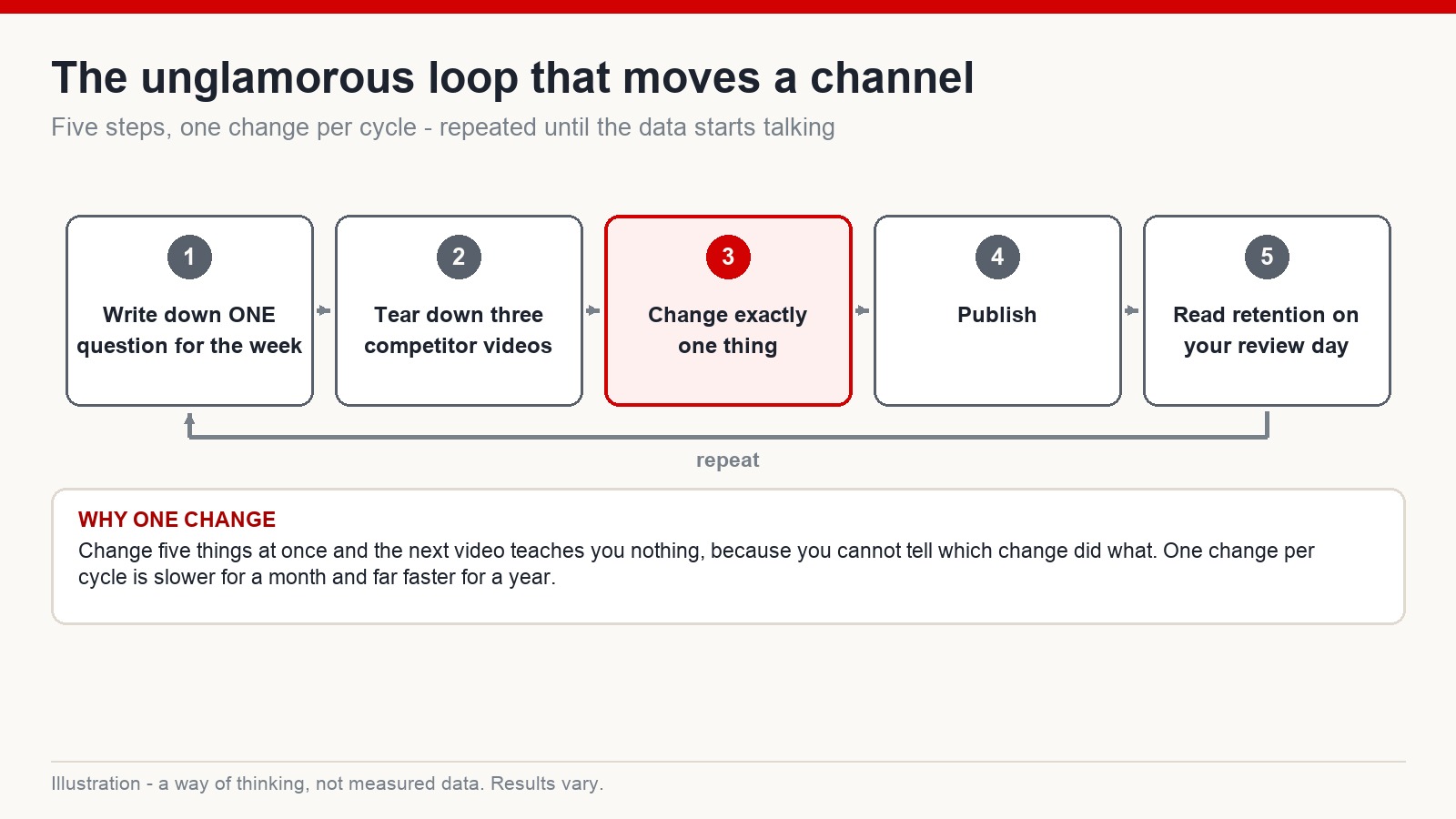
The whole method fits in five steps: write down one question for the week, tear down three competitor videos that touch it, change exactly one thing, publish, and read your retention on a fixed review day. Then go round again.
The step everyone breaks is the third. It is tempting to fix the title, the thumbnail, the length, the intro and the topic all at once — and then the next video teaches you nothing, because you cannot tell which change did what. One change per cycle feels slow for a month and is dramatically faster over a year.
Action produces motivation, not the other way round
“I will start when I feel motivated” is the most expensive sentence in this business, and it is backwards.
Write one idea down and the work feels smaller. Record sixty seconds and you have proof you can do it. Publish something imperfect and you stop being a person who is going to start a channel. Get your first real data and you become curious, which is a much better engine than enthusiasm because it does not run out on a bad Tuesday.
So make the entry point small and specific: one outline, one draft title, one thumbnail sketch, one competitor teardown. Not “work on the channel today”. The feeling you are waiting for arrives after you begin, most of the time, and the rest of the time the work still got done.
Change the packaging, keep the core
Platforms shift. Formats saturate. A thumbnail style that stands out this year blends into the background next year, and production tools change faster than either. Staying still is not a strategy any more than hoping is.
So change freely: the format, the length, the way you open, the research process, the tools. Change the topic if the evidence says the audience is not there.
What should not change is the reason a viewer trusts the channel. You can use every tool available to make things faster, and still be the person who checks a claim before publishing it, who does not overstate a result, who makes the video they said they would make in the title. That is not a moral position; it is the only durable asset on a platform where everything else is copyable within a week.
And to be clear about outcomes, since this is the kind of article that invites promises: a good process does not entitle anyone to views or income. Results vary enormously between creators doing similar work, and platform rules change without notice. What a process gives you is a reliable way to keep improving decisions — which is the only part of this that has ever been under anyone’s control.
Frequently asked questions
How do I do competitor research on YouTube properly?
Pick three channels serving the same viewer as you, then record four things for each: the pattern across their last ten titles, how many ideas are in their thumbnails, the timestamp where your own attention drifted while watching, and the one structural idea you would borrow. Structure, not topics.
How do I know whether my niche is actually dead?
Check whether anyone is currently getting attention in it. If other channels are serving that audience and you are not, the problem is packaging or delivery rather than demand. Genuine saturation looks like nobody growing there, not like you specifically struggling.
Why should I only change one thing per video?
Because otherwise your next upload is uninterpretable. If you change the title, thumbnail, length and topic together and the video does better, you have learned nothing you can repeat. One change per cycle turns each upload into a readable experiment.
Is it fine to use AI when making videos?
As a research and drafting assistant, yes, and it saves real time. As a way to mass-produce videos with nothing of your own in them, it tends to produce work that neither viewers nor the platform value, and it puts a channel at risk under policies about spam and unoriginal content.
What should I do first if my channel is stuck?
Something small and concrete today rather than a new plan: write down one question, tear down three competitor videos against it, and change one thing on the next upload. A stalled channel is more often short of specific decisions than short of effort.
If you would rather run that loop with a structure already built around it, that is what I teach at mmoyoutube.com.