Thirty-One Retypes in a Month: Count Yours, Then Name Them
Someone counted how many times they typed “make this shorter but keep the main points” in a month. Thirty-one.
Thirty-one times typing roughly the same sentence, slightly differently each time, getting slightly different results, and quietly blaming the model when the output drifted.
That last part is the interesting bit. The model was not drifting. The instruction was.
Why the output drifts when you did not change anything
You did change something. You changed the words, because nobody types the same sentence twice by hand.
| Your intent → | What you typed → | What the model heard → | What came back → | What you did next |
|---|---|---|---|---|
| Unchanged all month Halve this email, keep the point |
Different every time “Make this shorter but keep the main points” · “tighten this” · “cut the fluff” |
Three different instructions Nothing defines how short, or which points are main |
Three different shapes One trimmed, one rewritten, one bullet list |
Corrected it by hand Two or three follow-ups, every time |
| With a command: Same |
With a command: “/SHORTEN [email]” |
With a command: One fixed instruction |
With a command: Half the length, key points kept |
With a command: Nothing. It was right |
“Shorter” has no number in it. “Main points” has no test. Faced with an instruction that does not define its own success, the model picks a reasonable interpretation – a slightly different reasonable interpretation each time. That is not a flaw to fix with a better model. It is a gap you left, and you fill it by writing the instruction down once.
The retype audit: five columns, one week
You cannot name what you have not noticed. So before collecting anyone else’s command list, spend a week noticing your own.
| Column | What goes in it | Worked example |
|---|---|---|
| The sentence you typed | Write it as you actually typed it, not tidied up | “make this shorter but keep the main points” |
| How many times | A tally for one week, then multiply | 8 in a week → roughly 31 a month |
| What varied | The part you re-specified each time | How short. Whether bullets were allowed |
| What you always wanted | The version you would accept without edits | Half the length, same key points, no bullets |
| The name | One word, unambiguous, never typed by accident | /SHORTEN |
Most people finish the week with between five and ten repeated sentences, and two or three that dominate. Those two or three are worth more than the other ninety-odd commands you could copy from a list, because they describe work you actually do.
Doing the counting first also answers a question people ask too late: which of the ninety-nine do I need? The audit answers it in your own handwriting. It is the same principle as the time audit in where do the hours actually go – count before you optimise.
The post this came from
Watch the reel
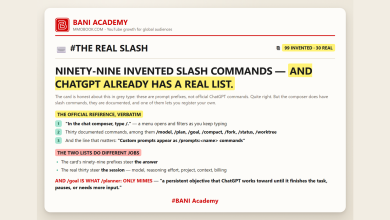
Ninety-nine commands, grouped by job – email, writing, career, social and more. Posted on the BANI Academy page.
Five from the ninety-nine, written out properly
The reel’s set runs to ninety-nine, grouped by job: email, writing, career, social and more. A name alone is not a command, though. Here are five of them with the definition that makes them behave the same every time.
| Command | Takes | Definition worth writing down | When you reach for it |
|---|---|---|---|
| /SHORTEN | [email] |
Halve the length. Keep every point that changes what the reader does. No bullets unless the original had them. | Long replies you have already written |
| /PROOF | [text] |
Fix typos, grammar and punctuation only. Change nothing else. Return the corrected text with no commentary. | The last pass before publishing |
| /TLDR | [paste] |
Three bullets, most important first, under fifteen words each. No introduction. | The document you do not want to read |
| /BLINDSPOT | [plan] |
List what this plan assumes but does not say. Rank by how badly it breaks if wrong. No reassurance. | Before committing to a decision |
| /PREMORTEM | [plan] |
It is six months later and this failed. Give the three most likely causes, most probable first, and one early warning sign for each. | Anything with a deadline or a budget |
Notice that the last two are not writing shortcuts at all. /BLINDSPOT and /PREMORTEM are thinking shortcuts, and they are the ones most likely to change an outcome rather than a paragraph – the upstream work we argued for in most people use AI to draft.
Where to keep the definitions depends on where you work: a file in a commands folder for tool-based assistants, or the standing instructions of a project for chat-based ones. Both setups, side by side, are in save once, call in one word – that article covers the plumbing, this one covers finding and naming the right ones.
What thirty-one retypes actually cost
Typing a sentence takes seconds, so the arithmetic looks trivial. It is not the typing that costs you.
Each of those thirty-one attempts came back in a shape you had not quite asked for, so each one needed reading, judging and usually one follow-up. Call it two minutes of attention per round rather than ten seconds of typing, and a month of one repeated sentence is an hour of your life – spent re-explaining something you already knew you wanted.
There is a second cost that is harder to see. Every drifting answer teaches you, quietly, that the tool is unreliable, and you start checking output you would otherwise trust. A defined command removes that doubt: when the answer always has the same shape, you stop inspecting it and start using it. That is the real return, and it is why the audit is worth a week of tallying.
What makes a name stick
A badly named command is one you never use. Four rules cover it.
One job per name. If a command both shortens and rewrites the tone, you will never be sure which you are getting. Split it.
Say what it does, not how it feels. /SHORTEN and /PROOF are obvious a month later. /POLISH and /MAGIC are not.
Do not use a word you type in normal writing. A command called /note will fire when you did not mean it. This is why the slash matters: it marks the word as an instruction rather than content.
Name it what you already say. If you think of it as “cut this in half”, /CUTHALF will come to mind faster than something more elegant. The reel has exactly that command, which suggests someone else made the same discovery.
When not to make a command
Three cases where a shortcut is the wrong tool. A one-off task – if you will do it twice, write the prompt properly and move on. Anything needing fresh judgement, such as deciding which video to make: the input changes every time, so a fixed instruction adds nothing. And anything where you want variety – a command exists to remove variation, which is a bad trade when you are looking for options rather than an answer.
Used well, the saving is not really the typing. It is the follow-ups you stop needing: the “no, shorter”, “without the intro”, “keep the numbers” that turn one answer into four. That loop, and what it costs, is in you are paying for retries. And if you have collected someone else’s prompt pack before, the discipline of keeping only what you use is the same one in the one part that decides whether a prompt works.
Frequently asked questions
Will these work in a new chat?
Only where the definition lives – a commands file, or the project whose instructions hold them. Elsewhere it is just a word the model will guess at.
Are they built into Claude?
No. You write them yourself. That is the point: they describe your work, in your words.
How many should I have?
As many as your audit found repeated three times or more. For most people that is five, not ninety-nine.
What if I forget the names?
Then the name was wrong. Rename it to the word you would have typed anyway.
Count for one week, name the top three
Keep a note open for five days and write down every instruction you type into an assistant. On Friday, count. Take the three you typed most, write each one properly – a quantity, an order, one exclusion – give it a blunt name, and save it where every chat can see it.
You write them once. That is the only cost, and it is paid back the first week.
Learning a lot does not make anyone good. Doing a lot does.
If you want the structure that turns that into a habit, that is what our free challenge is built for: no barrier to entry, a genuine commitment to action, and a refundable commitment fee you get back when you finish. You are not paying for the knowledge. You are betting on yourself finishing, and we hold the stake.
What is the sentence you keep retyping? Drop it in the comments on the original reel and we will tell you what to name it.
For more on building channels for English-speaking audiences, that is what we work on at mmoyoutube.com.
One Comment