The Research Was Right and the Video Still Failed
There is a particular kind of frustration that only shows up after you have got good at research. You check demand properly. You pick a phrase people genuinely type. You write a title that carries it. And the video does nothing at all — fewer views than the ones you made before you knew what you were doing.
I spent months in that state on a channel aimed at English-speaking viewers. Every day was keyword work. I would open the tools, read competitor titles, study descriptions, and then assemble a title that contained as many relevant phrases as I could fit. The more phrases it held, the safer I felt. Surely now the system would understand what the video was.
The opposite happened. Almost nobody clicked. I blamed the algorithm, then the difficulty of starting a new channel, then the market. It took looking at my own numbers properly to see that the research had not failed. It had worked exactly as intended, and then everything after it had gone wrong.
Research only wins the first link in the chain
A video that gets watched has to clear four separate things, in order.
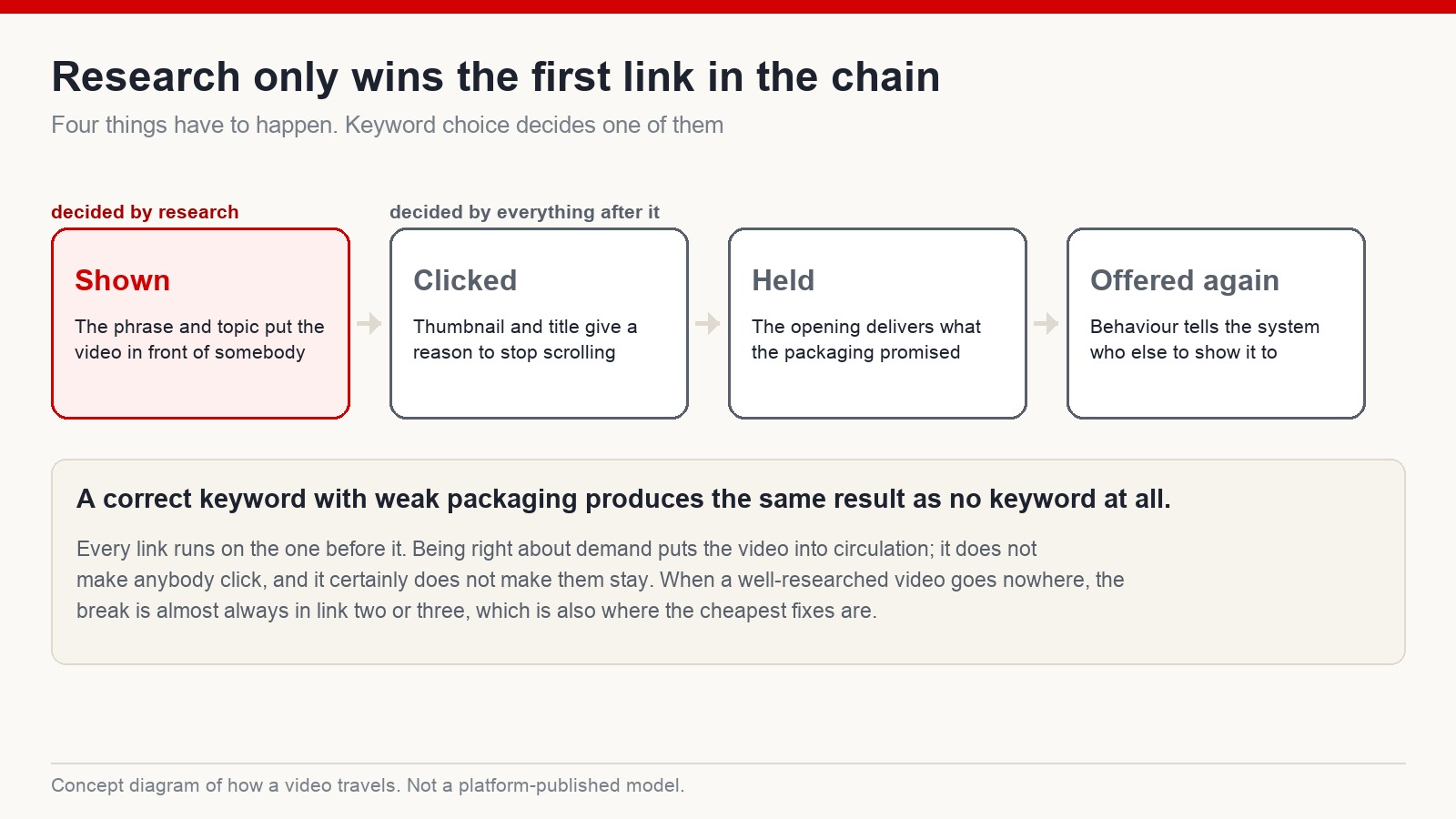
It has to be shown to somebody. It has to be clicked. It has to hold the person who clicked. And then, based on how those people behaved, it has to be offered again to more people.
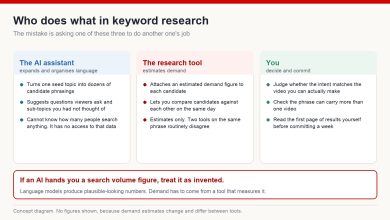
Keyword research decides the first one and touches the second. It has no influence at all on the third and fourth. So when a well-researched video goes nowhere, the break is almost always in link two or three — which is also where the cheapest fixes live, and where almost nobody looks, because they are busy re-checking the research.
What a stuffed title actually does
The habit I had was cramming. A title like this one:
How To Make Money Online With AI | AI Side Hustle | Make Money Fast | AI Business Ideas
It contains every phrase I had researched. It also tells a human being exactly one thing: that this is not worth their attention. Nobody talks like that. The pattern is instantly recognisable as something assembled for a machine, and readers are far better at spotting that than we like to admit.
Compare it with something like I Tried Making Money With AI for a Month. Here Is What Actually Happened. Fewer phrases. One clear promise. A reason to click today.
The point is not that keywords in titles are bad. It is that the title has to survive being read by a person, and a person is deciding in about a second while scrolling past a dozen alternatives.
Optimising for the system and forgetting the human
Platforms do not make money when a title contains the right words. They make money when people keep watching. So the things that get rewarded are the things that keep people watching, and a title full of phrases with no reason to care produces the same behaviour as a title with no phrases at all: nobody clicks.
Viewers are not impatient. They are choosing, quickly, from a lot of options. What they need is a reason to stop, and that reason is either curiosity, a benefit, or recognition of their own situation. None of those come from stuffing.
Research will not rescue a weak thumbnail
For a stretch I put all of my effort into the words and treated the image as an export step. My reasoning was that if the research was right, people would find the video and watch it.
But the image is read before the words are. On a phone, it occupies most of the space the video gets. Title and thumbnail work as a pair — the image stops the scroll, the words explain what the stop was for — and when one of the two is weak, the pair fails regardless of how good the other half is.
The specific failure worth naming: a title and a thumbnail that promise different things. Even when both are individually decent, a viewer reading them together gets a muddled idea of what the video is, and a muddled idea does not produce a click.
Treating research as something you do once
Most creators publish and move on. The video goes up, the next one goes into production, and nobody ever revisits the first one.
Meanwhile the people whose channels are actually growing keep working on videos after publication. Not endlessly, and not on everything — but when something under-performs relative to their own recent uploads, they change one element and watch what happens.
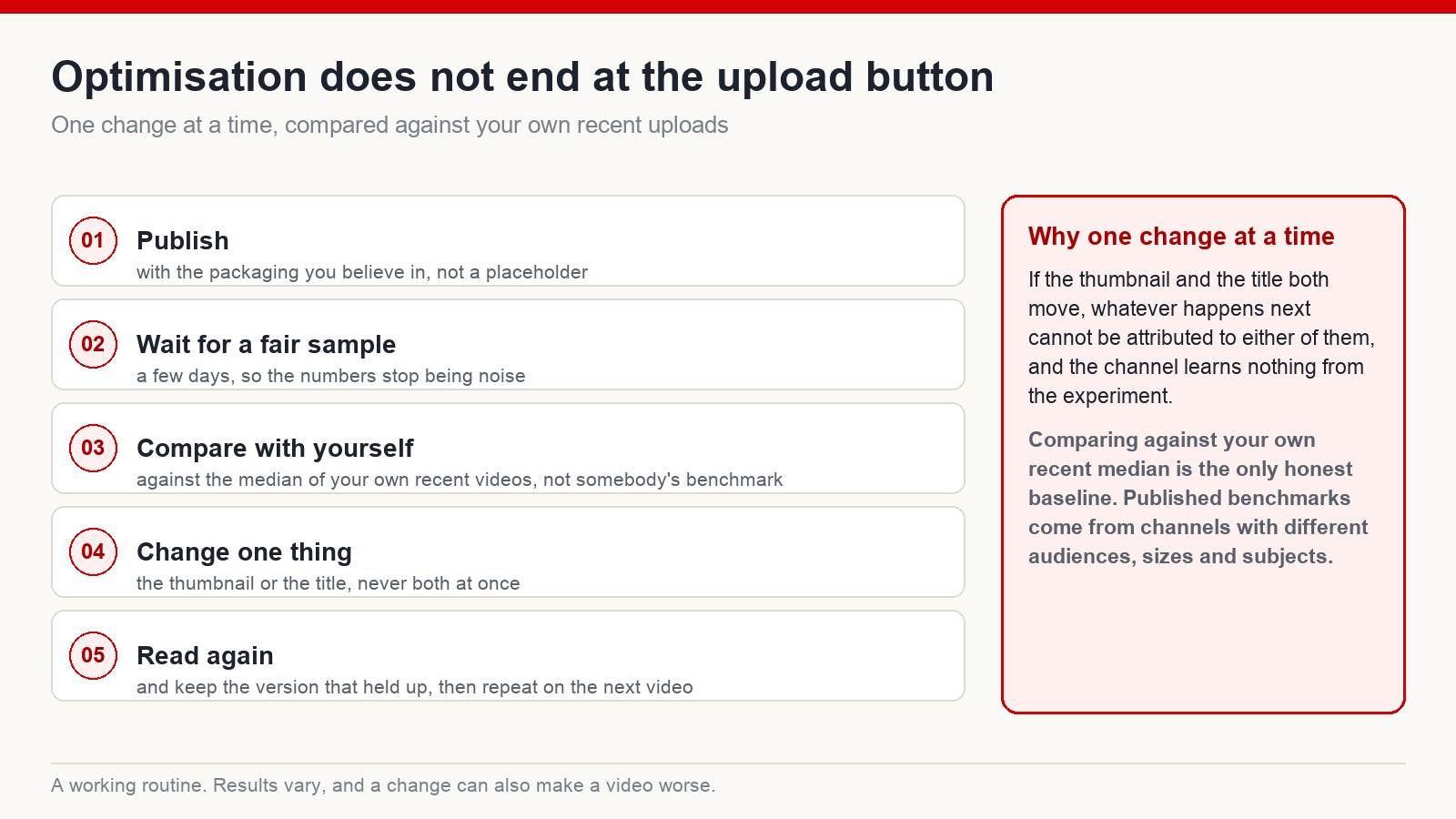
Two rules make this worth doing rather than actively harmful.
Change one thing at a time. If the thumbnail and the title both move, whatever happens next cannot be attributed to either, and you have spent a week learning nothing.
Compare against yourself. The only honest baseline is the median of your own recent uploads. Published benchmark figures come from channels with different subjects, audiences and sizes, and chasing somebody else’s number tells you nothing about whether this video is doing well for you.
It is also worth saying plainly that a change can make things worse. Swapping a thumbnail on a video that is quietly doing fine is a real way to lose the thing you had.
The strongest signal is what happens after the click
You can get somebody to click. If they leave twenty seconds later, that departure is the loudest thing the video says about itself, and no amount of research fixes it.
What gets measured after the click is behaviour: whether people stay, how long, whether they go on to something else on the channel, whether they come back. Those are the things that decide whether a video keeps being shown to new people or quietly stops.
Which reframes the whole exercise. Research buys you an audition. The content decides whether you get called back.
The questions I ask now
The change that mattered was not a better tool. It was swapping the question I asked before publishing.
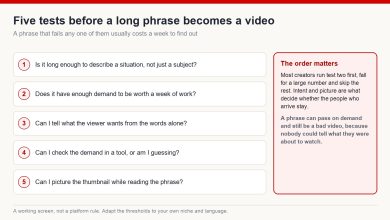
I used to ask whether the title had enough keywords in it. Now I ask: what is the person watching this actually stuck on? What would make them stop scrolling? Would I click this myself, honestly, if it were not mine? Does the thumbnail show the one moment the title is promising? And does the first thirty seconds deliver that thing, or does it delay it behind an introduction?
Click-through improved. Retention improved. More videos got picked up. Not because the research got better — it was always fine — but because I stopped treating research as the whole job.
What this does not promise
Fixing the links after research improves your odds. It does not guarantee views, and there is no combination of title, thumbnail and opening that makes a video succeed reliably. Platform behaviour shifts, subjects get crowded, and two channels doing the same things in the same niche can get very different outcomes.
What you can control is that a video which was going to be found is not thrown away at the click or in the first minute. That is a real amount of waste to remove, and it is where most of the recoverable value sits.
Frequently asked questions
Does keyword research still matter?
Yes — it decides whether a video has any chance of being shown to the right people. It just cannot decide anything that happens afterwards.
Should I put my keyword in the title?
Once, in natural word order, inside a sentence a person would actually say. Repeating it or bolting on variants makes the title read as spam and costs you clicks.
Is it worth changing the title of a published video?
It can be, when the video is under-performing against your own recent median. Change one element, give it a fair sample, and accept that the change might make things worse.
What matters more, the title or the thumbnail?
They are read together and fail together. The more useful question is whether they promise the same thing.
Why do my well-optimised videos still get no views?
Usually because the break is after the research: the packaging gives nobody a reason to click, or the opening does not deliver what was promised. Both are visible in your own analytics if you compare videos against each other rather than against outside benchmarks.
If you want the whole process — research, packaging and the post-publish loop — laid out for a faceless channel aimed at English-speaking audiences, that is what I teach at mmoyoutube.com. Results vary by channel, subject and market.