How To Read A YouTube Growth System Before You Pay For It
Somebody in a creator group will eventually tell you about a method. It has a name – a place name, usually, or an initial, something that sounds like it came out of a lab rather than a forum. The name is doing a lot of work. It turns a tactic into a discipline, and it makes a question you could have answered in five minutes feel like something you need to buy access to.
I have been making YouTube videos since 2017 and I have watched a dozen of these come and go. The names change. The contents almost never do. Underneath, one of two things is true: it is ordinary craft with a brand name stapled to it, or it is a policy violation dressed up as a technique.
This piece is about telling the difference before you pay for it, because the second kind is expensive in ways that do not show up on the invoice.
The thing being sold is almost always the same
Strip the branding off most of these systems and you find a variation on one idea: get a set of accounts you control – or accounts controlled by people who owe you a favour – to watch, like and comment on a new video so it starts with some numbers on the board.
The sophistication is in the packaging. Accounts should be old, not new. Each should have a watch history in the right topic. They should be spread across separate devices or browser profiles. They should behave like real viewers: search rather than paste a link, watch a proportion of the video rather than all of it, comment in their own words.
All that effort is spent making the traffic look authentic. None of it makes the traffic authentic. Every version of this is the same act – engagement created by the person who benefits from it – and that is exactly what YouTube’s spam and deceptive practices policy describes as fake engagement. The documented consequences are that the metrics get removed, that videos can be taken down, and that repeated cases end channels.
The argument that does not depend on getting caught
People discount the policy argument because they know somebody who has been doing it for a year and is fine. So here is the second argument, which lands whether or not anyone ever notices.
Padded early traffic destroys the only instrument you have.
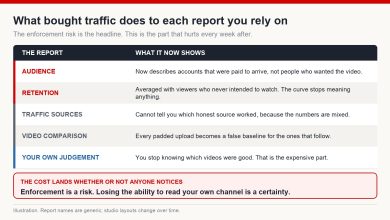
Your analytics exist to tell you which videos worked. The moment some of your viewers were arranged rather than interested, every report downstream is describing a mixture. Your retention curve now averages people who wanted the video with people who were performing watching it. Your audience data describes accounts, not viewers. Your traffic sources cannot tell you which honest channel of distribution was worth repeating. And because each padded upload becomes the baseline the next one is compared against, the damage compounds quietly for months.
You end up flying a channel with an altimeter you tampered with yourself. The platform’s enforcement is a risk. Losing the ability to read your own channel is a certainty.
Five things worth noticing in the offer itself
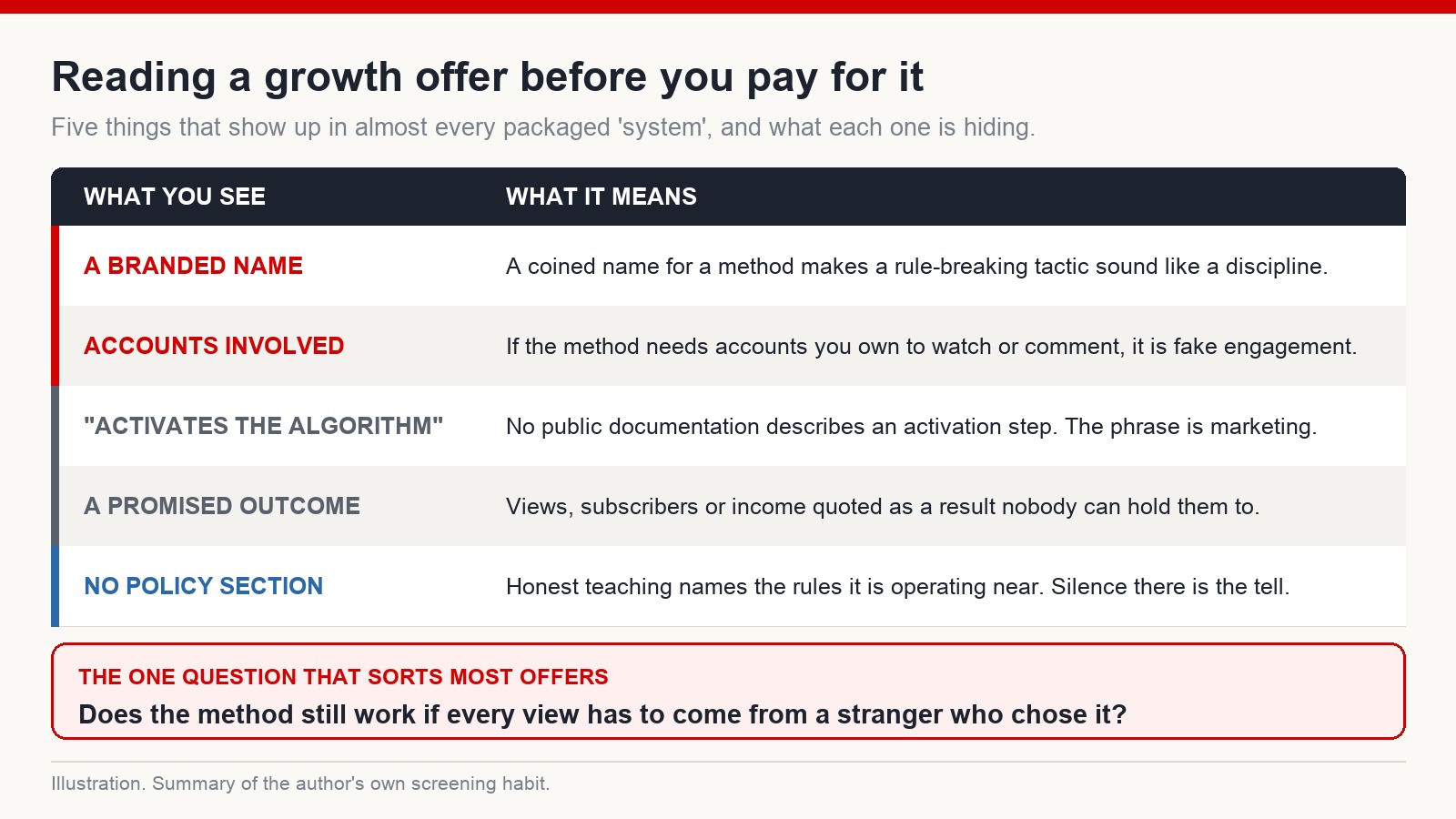
A coined name. Real craft does not need proprietary branding. Nobody has to invent a name for “write a better opening”, because you can check that advice against a hundred sources for free. A branded name is often there because the plain description would sound like what it is.
Accounts in the method. If any step involves accounts you create, buy, rent or borrow in order to watch or interact with your own content, that is the whole game. Everything before and after it is decoration.
Machine language about the algorithm. Phrases like activating distribution, triggering the recommendation engine or unlocking the browse feature imply switches nobody has documented. YouTube publishes plenty about what it measures. It does not publish an activation step, because there isn’t one to publish.
A promised outcome. Views, subscribers, monetisation dates or income quoted as a result. No honest teacher can promise any of those, because none of them are inside the teacher’s control – and results genuinely do vary between channels, topics and years.
Nothing about the rules. This is the quietest tell and the most reliable one. Any teacher working near the line will name the line, because the students who cross it lose their channels. Silence there means either they have not thought about it or they would rather you did not.
What you can check, and what you can never check
Before paying for anything, sort the claims into two piles.
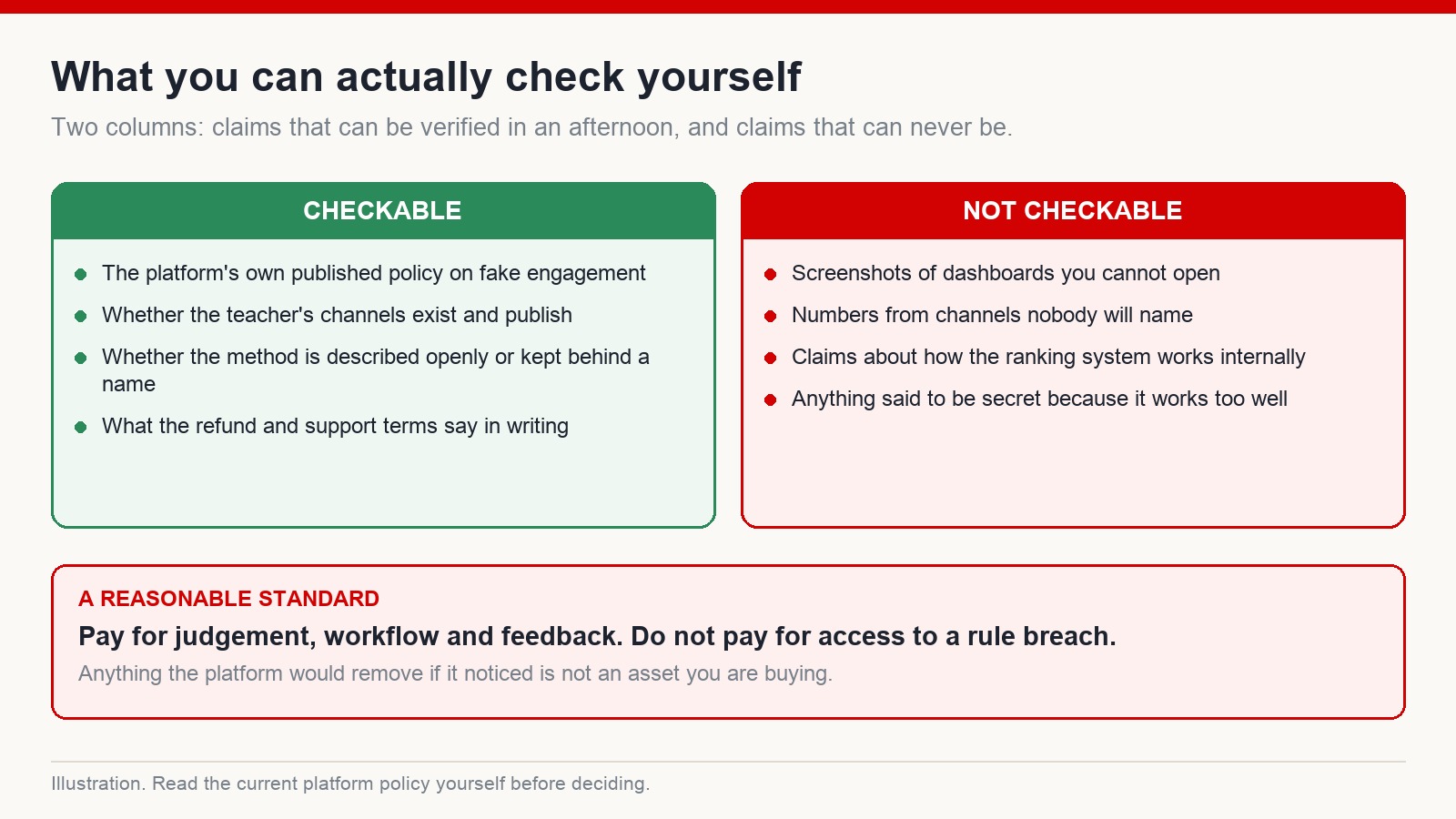
Checkable: the platform’s published policies, which are free and take twenty minutes to read. Whether the person teaching has channels that exist and publish. Whether the method is described openly enough that you can evaluate it, or kept behind a name until after payment. What the refund terms say in writing.
Not checkable, ever: screenshots of dashboards you cannot open. Numbers attributed to channels nobody will name. Any claim about how the ranking system works internally. And the classic – that the method must stay secret because it stops working when too many people know.
That last one deserves a moment. A genuine method survives being explained. Search optimisation, better packaging, stronger openings: all publicly described, all still effective. The things that stop working when they become widely known are usually the things that were being detected and shut down anyway.
The question that sorts most offers in one line
Does the method still work if every single view has to come from a stranger who chose to watch?
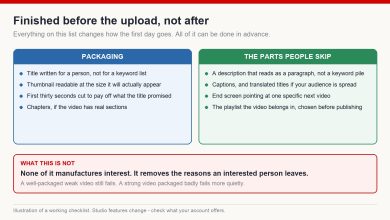
If yes, you are buying craft. Topic selection, packaging, structure, how to read your own numbers – these are all legitimately worth paying for, because judgement and feedback are hard to get alone.
If no, you are buying a rule breach, and you are paying someone to take a risk you carry.
What people are half-remembering
There is a real observation buried under all of this, which is why it keeps convincing sensible people.
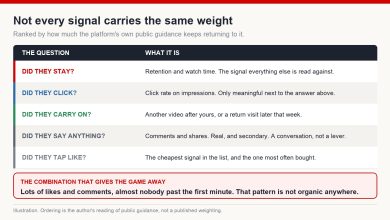
The first viewers of a video do matter – not because there is a threshold to cross, but because they are the sample the platform learns from. It shows the video to a small group that looks likely to want it, watches what they do, and decides whether to widen the test. That much is uncontroversial.
The conclusion people draw is that the sample should therefore be improved. But you cannot improve a sample by adding fake members to it. You can only stop it describing anyone. The honest version of the same insight is to make sure the first people who see it are people who would have chosen it anyway: an email list, a community where you have been a real participant for months, another platform where you already publish, your own back catalogue pointing at it.
That takes longer to build than a set of accounts. It is also the only version that keeps working.
If you already bought one
Nobody needs a lecture. Stop the traffic entirely rather than tapering it – half-stopped data is still unusable. Leave your existing videos up; deleting them takes the honest views and the real comments with them, and it does not undo anything. Then publish three or four uploads with nothing added, and treat those as the first real data your channel has produced. Your new baseline is the median of the clean uploads, not anything from before.
Is a named growth system automatically a scam?
Not automatically. Some are ordinary teaching with a marketing name on top. Judge it by whether the method involves accounts you control, and by whether the person will describe it plainly before payment.
What if the accounts are old and carefully separated?
Age and separation change how convincing the traffic looks. They do not change who created it. The policy is about the source of the interaction, not the quality of the disguise.
Is it against the rules to have more than one Google account?
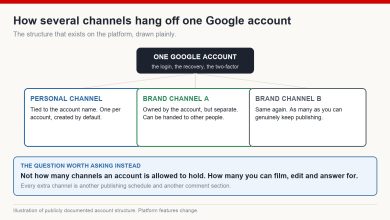
No. People have work and personal accounts for perfectly ordinary reasons. What matters is whether those accounts are being used to interact with your own content in order to move its numbers.
How do I know if a course is worth the money?
Ask what you get if the method is removed from it. If a workflow, feedback on your videos and a way of choosing topics remain, there is something there. If nothing remains, you were paying for the shortcut.
Does any of this guarantee growth?
No, and be suspicious of anyone who says otherwise. Doing the honest version well improves your odds. It does not remove the possibility that a topic is simply not in demand.
The short version
A name is not a method. Ask whether the thing being taught survives the condition that every view must come from a stranger who wanted it. Read the platform’s own policy before you read anyone’s sales page. And keep your numbers clean, because the moment they stop describing real people, you have paid to lose your own instruments.
If you want the rest of the process for building a faceless channel aimed at an English-speaking audience, that is what we work through at mmoyoutube.com.