How to Start a YouTube Channel With No Money (Use What You Already Have)
There is a specific kind of tiredness that has nothing to do with how much you did today. It comes from how much you want. More income, faster. More skill than the person next to you. An audience. A car. A life that reads as successful from the outside.
And the more you want, the shorter you feel: short on money, short on opportunities, short on contacts, short on gear, short on luck. Eventually you end up sitting there watching other people ship, wondering why nothing is moving for you.
After nine years of building YouTube channels for viewers in the US, the UK, Germany and Japan — most of them faceless, most of them started with almost nothing — I am fairly sure the problem is rarely a shortage. It is that nobody ever asks the other question: what do I already have?

Wanting more than you have is its own kind of exhaustion
I have talked to a lot of people who want to start a channel. Every one of them has the dream fully rendered: monetisation on, videos on the recommended feed, an English-speaking audience, better ad rates, a steady month.
Then I ask whether they have published anything yet, and the room goes quiet. Not because they own nothing, but because they are staring at the list of things they do not own: no camera, no microphone, no fast computer, no editing skill, no face for it, no voice for it, no team, no ad budget.
So they wait. For the gear, for the confidence, for the savings, for a clear window in the calendar. YouTube does not reward waiting. It rewards publishing, testing, being wrong in public, fixing it, and publishing again.
You are probably not starting from zero
Unhappiness is not usually caused by having nothing. It is caused by never counting what is already in your hands, and so never using it to build the next thing.
Look at what you can most likely reach right now, today:
- A working body and a clear head.
- A phone that records better video than a broadcast camera did fifteen years ago.
- An internet connection that will teach you anything you are willing to sit with.
- A YouTube account that costs nothing to open.
- An AI assistant that can help you plan, outline and pressure-test scripts.
- A free editor like CapCut, and a free design tool like Canva for thumbnails.
- A real story to tell, and something that once hurt enough to make you serious.
That is not a shortage of tools. That is a shortage of decisions. Specifically one decision: start with what is already on the desk.
A phone is a complete studio now
Video used to be expensive. You needed a camera, a capture card, an editing suite, technical training, ideally a room that did not echo. That world is gone. A mid-range phone shoots usable footage. A free app cuts it. A small idea becomes a script. A true story holds attention better than production value does.
The question is not what device you own. It is what you point that device at. The same phone can be an eight-hour scrolling machine, a comparison engine that makes you feel behind, or the first tool in a business. Same hardware. Entirely different outcome.
Not being a native English speaker changes less than people assume, too. Pick formats where language carries less weight — process, ambience, tutorials with clear visuals, faceless narration you can script and refine — and the barrier drops sharply.
Waiting until you are ready is the most expensive habit in this business
This is the trap almost every beginner falls into. When I have a proper camera, I will start. When I finish learning to edit, I will publish. When work calms down. When I feel more confident.
Confidence does not arrive before the work; it is produced by the work. You are not good and then you publish. You publish, and the response shows you exactly which part of you is not good yet. Nobody gets a perfect strategy on day one either. You get it by shipping ten videos and reading what happened: which thumbnails earned clicks, which hooks held, which topics people bothered to comment on.
YouTube is a practical craft. Nobody has ever improved at it by thinking harder in private.
The first video exists to break the deadlock
Your first video will be rough. The lighting will be off, your voice will wobble, the script will run long, the thumbnail will look homemade. It might get seven views, and three of them will be you.
It does not matter, because that video does one job that nothing else can do: it converts you from a person who wants to make videos into a person who makes videos. That is not a small distinction. It is the whole distinction.
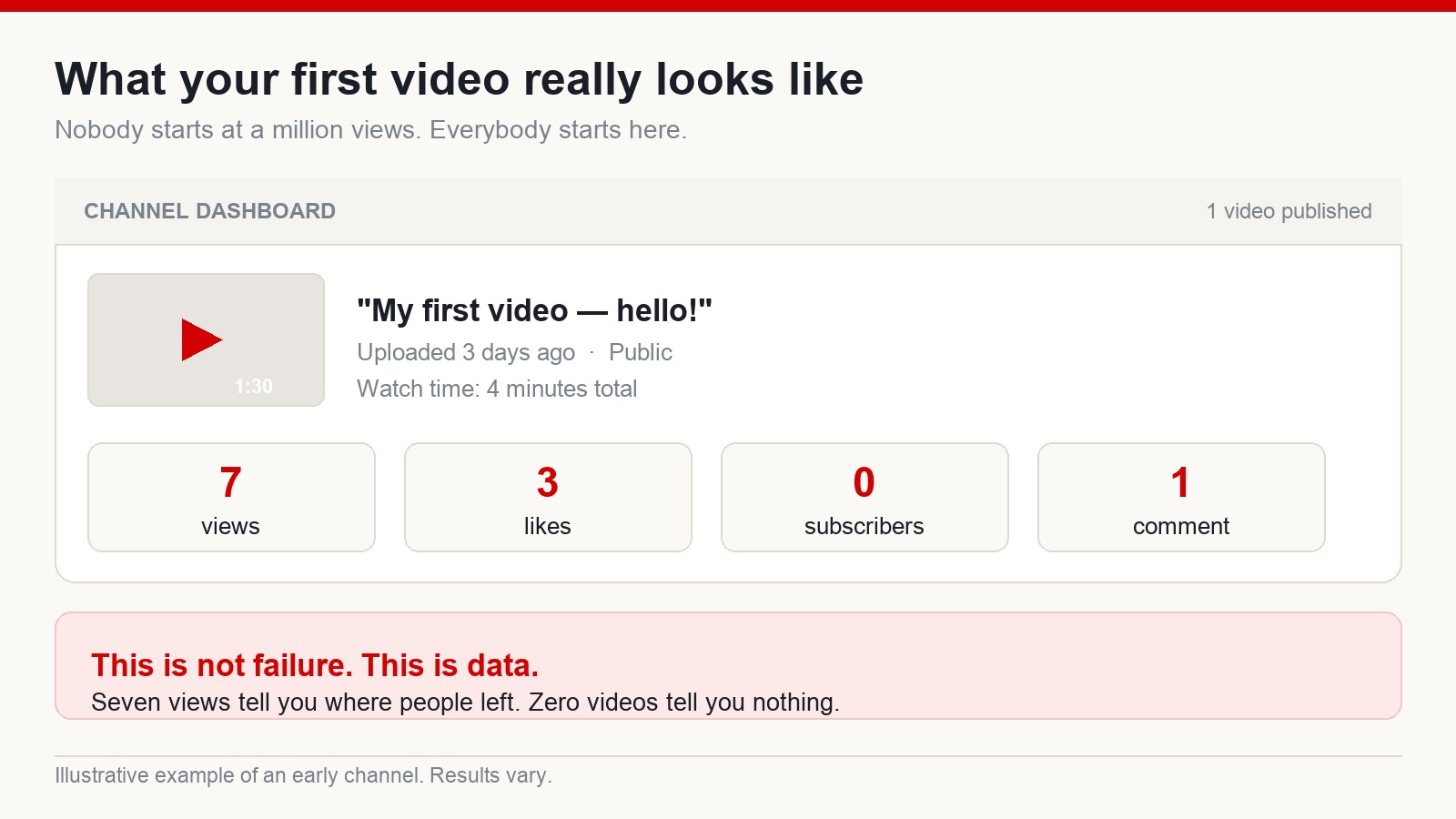
Once a video exists, you have something to correct. You can see where viewers left. You can tell whether the title undersold it. You can hear that you talk too long before getting to the point. You can find out whether you even enjoy this niche. Without an upload, all of that is speculation. With one, it is evidence.
Small ideas open big channels
You do not need a magnificent concept. Trying to invent a million-view series on day one is a very effective way to publish nothing for six months. Start smaller than feels respectable:
- “What I learned in my first month of building a channel from scratch”
- “How to start making videos when you have no budget at all”
- “Five mistakes that keep beginner videos at zero views”
- “I used an AI assistant to plan a week of scripts — here is what worked”
- “Making my first thumbnail in a free design tool”
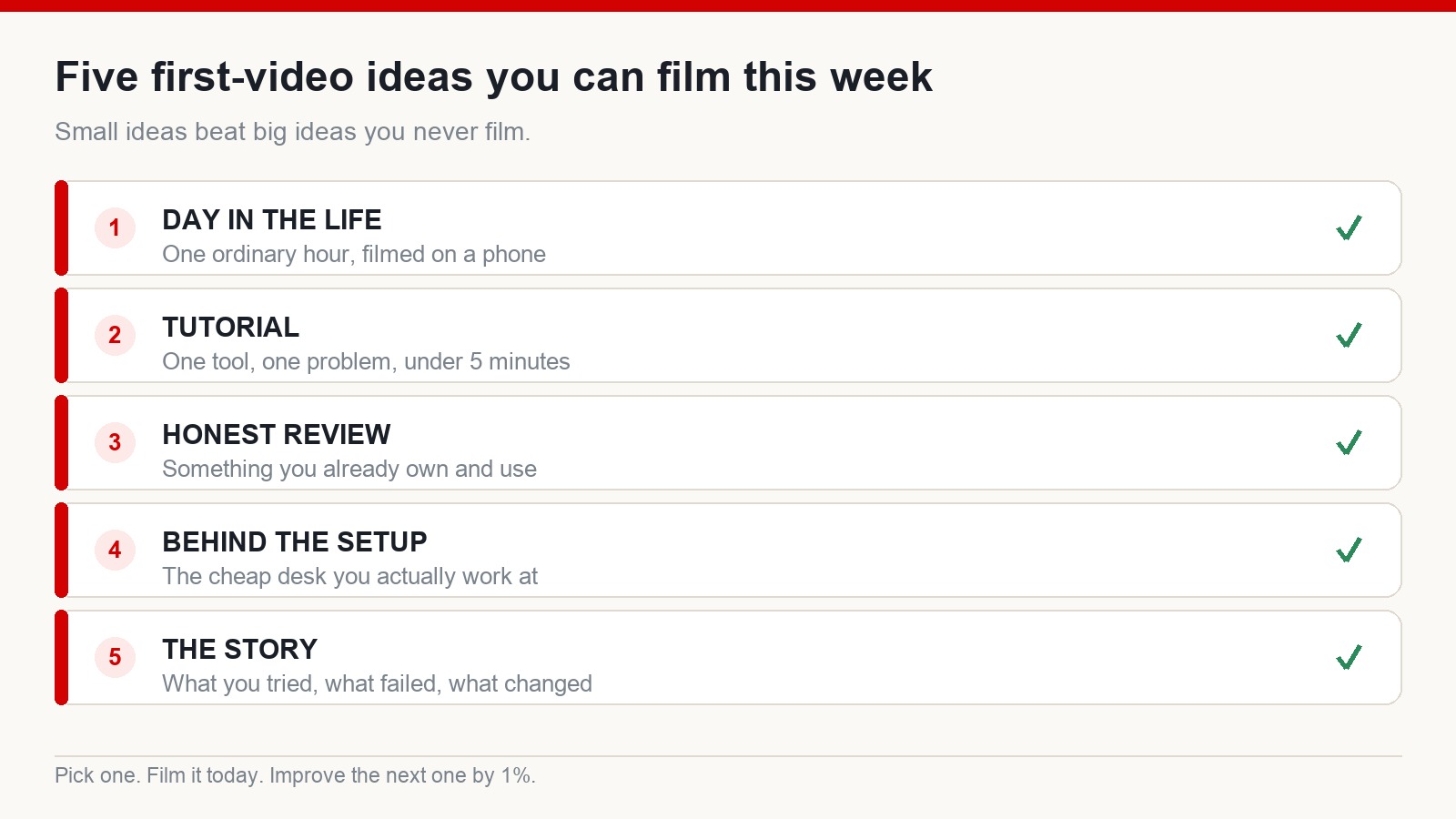
A small idea that lands on a real problem still gets recommended. Viewers are not asking you to be impressive. They are asking you to be useful, and to feel like someone who understands their situation. That recognition is where trust starts, and on YouTube trust outperforms polish over any meaningful stretch of time.
“Enough” is not the same as “settling”
People hear be content with what you have and assume it means lower your ambition. It does not. It means stop letting the size of the gap blind you to the resources in your hands.
You can still want the large channel, the monetised account, the income that does not depend on one employer. But you build it out of the smallest available capital: a clear head, an hour in the evening, a phone, an idea, and the discipline to repeat. One video. One lesson a week. One thumbnail improved. One hook rewritten. One retention graph read properly to find out where people leave. That is ambition with a working mechanism attached.
A five-step start using only what you already own
If you have no idea where to begin, keep it dull and concrete. This is the sequence I give people who are starting cold.
1. Write down ten things you already have
Not what is missing. What exists. A phone. Internet. Two free hours after dinner. A failure you learned something from. Ten years in a trade nobody has explained on video. Basic AI tools. A quiet corner of a room. A reason to change. Written out, the list usually surprises people: you are not empty-handed, you were just facing the wrong direction.
2. Pick a narrow audience, not a broad topic
Do not make content “about YouTube” or “about money”. Choose a specific person: someone filming on a phone with no budget, someone who wants a second income but cannot invest first, someone drawn to stories about people rebuilding, someone who wants a faceless channel using AI tools, someone in manual work looking for a digital skill. The narrower the audience, the easier every future decision becomes.
3. Publish something within twenty-four hours
Short script. Filmed on the phone. Cut in a free editor. Thumbnail in a free design tool. Upload. Your first video does not need to be good. It needs to exist, because nothing can be improved until it does.
4. Ship ten videos before you judge anything
One upload tells you nothing; the variance is enormous. Publish at least ten, then compare: which held attention longer, which title earned more clicks, which topic pulled comments, which one the system decided to show to strangers. That is real data. Run the channel on feeling plus data, not feeling alone.
5. Make each video one per cent better than the last
No leaps required. A sharper hook. Shorter sentences. Fewer words on the thumbnail. Cleaner audio. Less rambling in the middle. A call to action that does not sound like a script. Thirty videos later you are simply not the person who made the first one. Compounding is the only reliable advantage a beginner has.
Nobody is actually starting from nothing
There is a line I keep coming back to: nobody is poor, some people just have not started yet. I do not read that as everyone having money. I read it as everyone having something to begin with.
Some people start with knowledge. Some with a trade. Some with a story. Some with an old phone and thirty minutes after everyone else is asleep. The real poverty is often not in the bank account — it is in the habit of postponing: always “next month”, always wanting the large result while refusing the small step, always planning the channel and never opening the upload page.
One more thing worth saying plainly, because it is where beginners lose years: where your viewers live changes what a view is worth, sometimes dramatically. That is a real consideration when you choose a market. It is not a reason to skip the part where you learn to make something people want to watch. Ad rates, policies and demand all move; the ability to hold attention is the only asset that keeps its value.
So what is actually in your hands?
The important question was never “what am I missing”. It is “what do I have”. A phone? A connection? A story you have never told? One small skill? A pain you came through? A goal big enough to get you up early?
If the answer is yes to any of those, you have a starting point, and it is worth more than you think. Every large channel was once at zero subscribers. Every video with a huge view count began with someone pressing upload while nobody was watching. Nobody is born a creator. People become creators by making things.
Frequently asked questions
Why does wanting more make me feel worse?
Because attention aimed only at what you lack produces a permanent sense of deficit. It fuels comparison, drains motivation, and turns into delay. Counting what you already have puts you back into action.
Can you start a YouTube channel with no money?
Yes. A phone, an internet connection, a free editor, a free design tool and your own ideas are enough to publish. Early on, the job is learning to make content people finish and posting consistently. This is based on personal experience rather than a promise about income — outcomes depend on your niche, your effort and factors outside anyone’s control.
What should my first video be about?
Take one small problem your intended viewer actually has, write a short script, film it on your phone, edit it simply and publish. Do not wait for perfect.
Does being content kill ambition?
No. It removes the comparison and the exhaustion that come with it. You can still aim high; you just start from what is real instead of stalling over what is absent.
How many videos should a beginner publish before judging the channel?
At least ten. Then look at click-through rate, retention, comments and which topics the platform pushed further, and adjust from there.
Film the first one today
What is in your hands right now? A phone? A small idea? A story you have never told anyone? A free evening? A reason to change something? Start there. Stop planning, stop waiting for conditions, stop saying “when I am ready”. Film the first one today.
If you want the full sequence — choosing a niche, scripting, filming on a phone, editing, thumbnails, basic SEO and growing a channel for an English-speaking audience — that is what we walk through at mmoyoutube.com. No promises about results; just the order to do things in.
You are not missing nearly as much as you think. You just have not started.