Generated Visuals, Real Trust: Disclosing Synthetic Footage Without Deflating the Video
A faceless channel has no face to vouch for it. There is no presenter the audience recognises, no studio, no visible person to put their name against the claims. What stands in for all of that is a much thinner thing: the sense, built up over several videos, that this channel does not lie to you.
Which is why the arrival of generated footage, generated voices and generated stills is a bigger question for faceless creators than for anyone else. Not because the tools are bad — most of my own production would be impossible without some of them — but because the one asset the format runs on is the easiest to lose. A viewer who works out on their own that a scene was fabricated does not conclude “clever production”. They conclude that they were being handled.
The question is not whether a tool was involved
The confusion I see most often is creators asking whether using a model at all requires a disclosure. It does not, and framing it that way leads to two bad outcomes: labelling everything, which is noise, or labelling nothing, which is a problem.
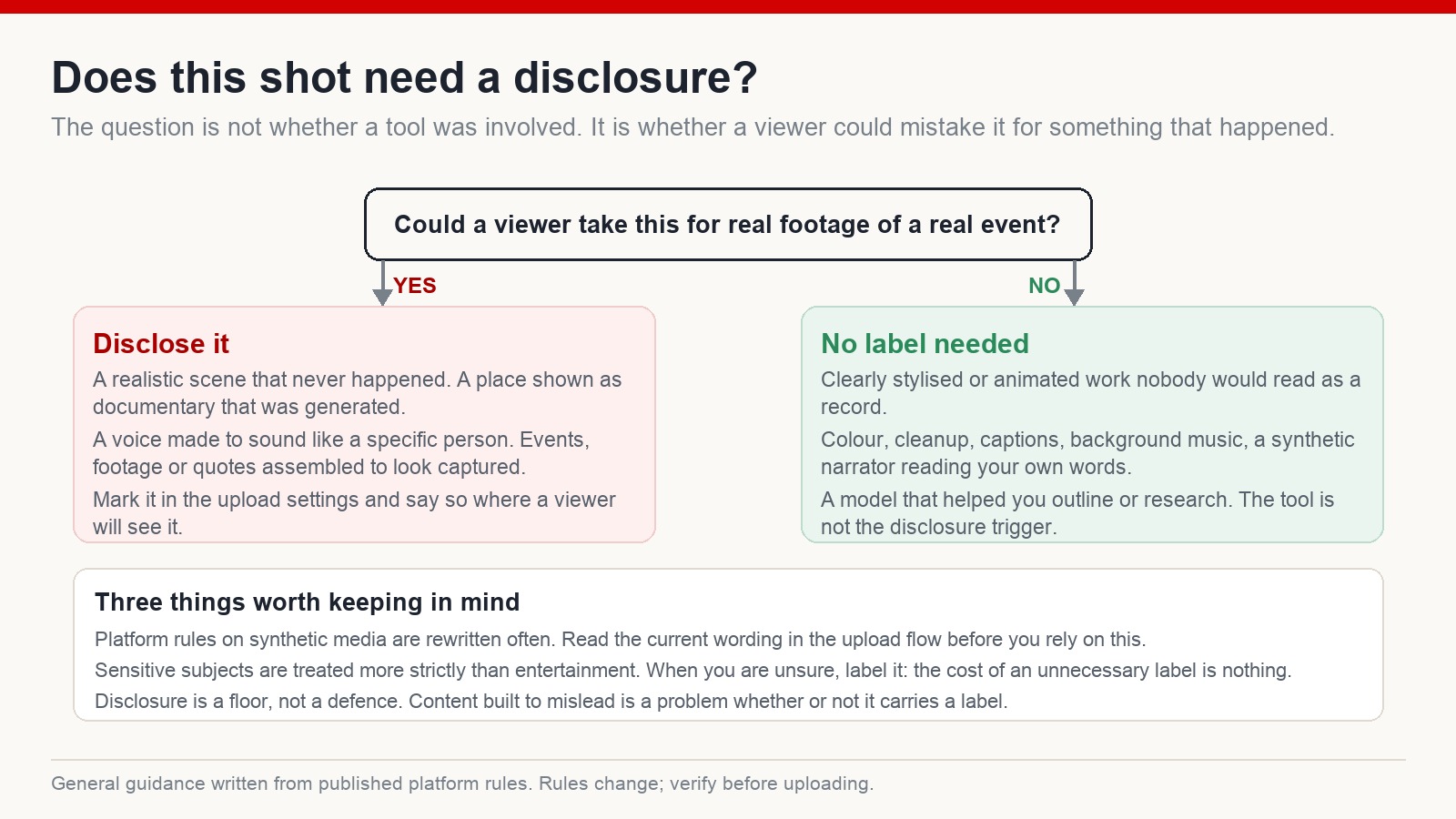
The useful question is narrower. Could a viewer take this for a record of something that actually happened? That is the line the platform’s rules are drawn around, and it is also the line that matters to an audience.
What sits on the disclose side
Realistic material that depicts something that did not occur. A generated scene presented as documentary footage of a place. A reconstruction of an event shown without saying it is a reconstruction. A voice built to sound like a specific real person. Quotes, footage or moments assembled to look as though they were captured.
The test is not how good the imitation is. It is whether an ordinary viewer, watching at normal speed, could reasonably believe they were looking at a recording of reality.
What does not need a label
Clearly stylised work — animation, illustration, obviously unreal imagery — is not pretending to be a record, so nobody is misled. Neither is production assistance: colour work, cleanup, captions, background music, or a synthetic narrator reading words you wrote. A model that helped you outline, research or tidy a script is not a disclosure trigger either; the words are still yours.
Two caveats worth carrying. Platform rules on synthetic media have been rewritten several times in recent years, so read the current wording in the upload flow rather than trusting any article, this one included. And where you are unsure, label it. An unnecessary label costs you nothing, and topics that touch health, money, elections or public safety are treated far more strictly than entertainment.
Where the note goes without deflating the video
The objection I hear is that disclosure ruins the atmosphere. That is only true when it is done clumsily, and it is worth separating what is required from what is craft.
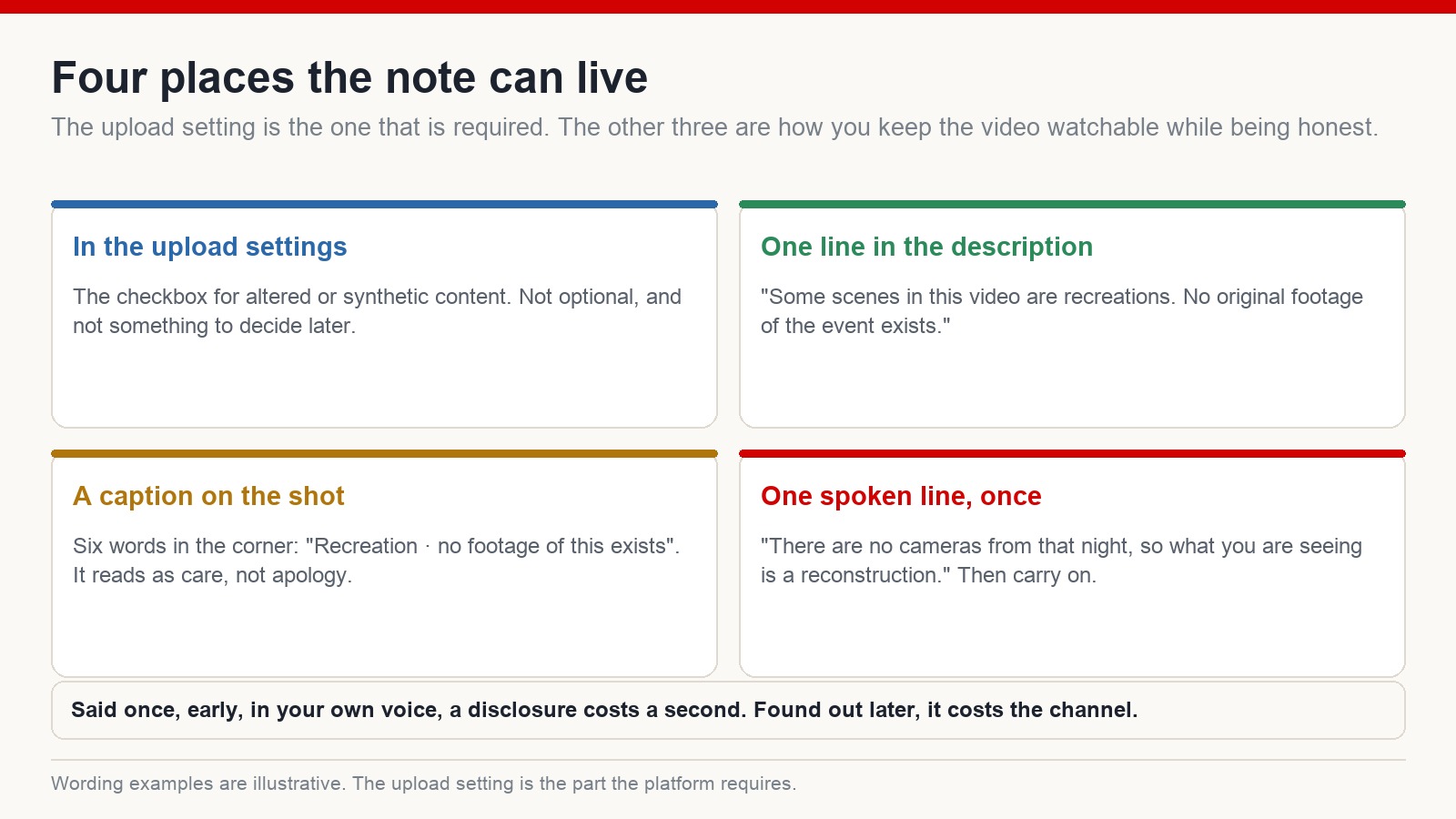
The required part is the upload setting: the box for altered or synthetic content. That is not a stylistic choice and not something to leave for later.
The craft part is everything else. A line in the description does most of the work. A short caption in the corner of the shot itself — six words, no fuss — reads as care rather than apology. And when a whole segment is reconstructed, one spoken line, early, in your own narration, handles it better than any label: there are no cameras from that night, so what you are seeing is a reconstruction. Then carry on with the story.
Write the disclosure into the script, not after it
This is the part that turns a compliance chore into something useful. If you know at scripting time which scenes will be generated, you can write the acknowledgement as a sentence that belongs in the video rather than bolting an apology on afterwards.
Practically, that means adding a column to whatever scene document you already use: what this shot is, where it comes from, and whether it needs saying out loud. Most shots will not. The two or three that do get a line written for them at the same time as the rest of the narration, in the same voice, so they do not sound like a legal notice dropped into the middle of a story.
A disclosure delivered once, early, in your own voice, costs a second of runtime. The same information discovered by a viewer in the comments costs the channel.
How much of a video should be generated at all
Separate from any rule is an editorial question: what proportion of a video is material you actually worked out, and what proportion was produced by a tool because it was fast?
My own working answer is that the substance — the research, the argument, the order things arrive in, the specifics only I have — should be the large majority, and generated material should be filling gaps that real material cannot fill. Reverse that ratio and you have a video that took an afternoon and says nothing anyone could not get elsewhere, which is a fragile thing to build a channel on regardless of what is disclosed.
Disclosure is also not a defence. A video built to mislead is a problem whether or not it carries a label, and a channel producing near-identical bulk output does not become durable by ticking a box.
A short routine before you upload
Run through the finished video once with a single question in mind: is there anything here a viewer could mistake for a record of something real? Note the timestamps. Decide for each whether it needs a spoken line, a caption, a description note, or nothing. Set the upload toggle if any of them are realistic. Then check that the description says what it needs to say without turning into a disclaimer wall.
It takes a few minutes, and it is the cheapest insurance a faceless channel can buy.
The plain version
Tools are not the risk. Pretending is the risk. Use whatever produces the video you want, be straightforward about what the viewer is looking at, and keep the part that cannot be generated — your research, your judgement, your point of view — as the majority of what you publish. Nothing here guarantees an outcome, and platform rules will keep moving. Being honest about what people are watching survives the rule changes.
Frequently asked questions
Do I have to disclose an AI voiceover?
Reading your own script in a synthetic voice is production assistance, not a fabricated record, so it generally does not require the altered-content label. Making a voice sound like a specific real person is a different matter entirely.
Does disclosing hurt reach?
There is no reliable public evidence either way, and anyone quoting you a figure is guessing. The known risk sits on the other side: being caught not disclosing.
What about stock footage that is not mine?
That is a licensing question rather than a disclosure one. Use footage you have the rights to use, and follow whatever attribution the licence requires.
Where exactly is the setting?
It appears in the details step when you upload, worded around altered or synthetic content. The exact placement and wording change from time to time, so read what is actually on the screen.
Should I say it out loud in every video?
No. Only where a scene could be mistaken for a record. Saying it constantly trains viewers to stop hearing it.
If you want the full process for building a faceless channel aimed at English-speaking audiences, that is what I teach at mmoyoutube.com.