Working Away From Home: How to Stop “One More Year” From Repeating
The holiday ends and the bags come out again. Tickets get booked, the house gets quieter, and somebody stands at the door watching you go.
On the way back there is usually a sentence in your head, and it is almost always the same one. A few more years and things will be different.
I have said it. What I did not notice for a long time is that I kept saying it, in the same words, in successive years — and that this is not really a motivation problem. It is a specification problem.
Why "one more year" renews itself
An arrangement you never defined the end of does not end. It just quietly rolls over.
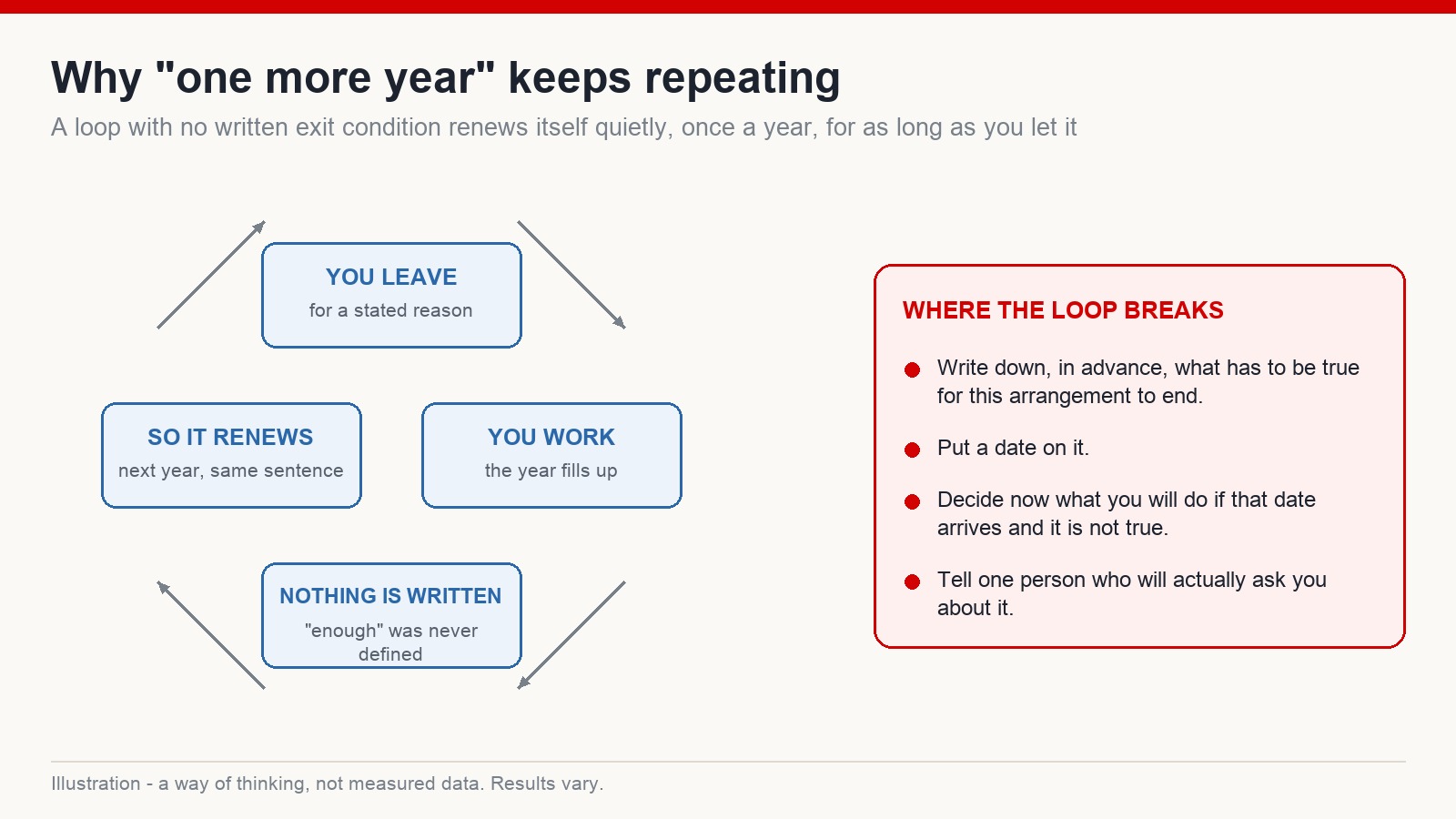
You leave for a stated reason. The year fills up with real work and real obligations. Nobody ever wrote down what "enough" would look like. So when the same date comes round, there is no test to fail, and the default is to continue.
The people waiting for you do not have a test either. They have a vague sense that this is temporary, which is why the conversation each year is emotional rather than practical. Everyone is negotiating a deal whose terms were never written.
Write the condition down before the year starts
This is the whole intervention, and it takes twenty minutes.
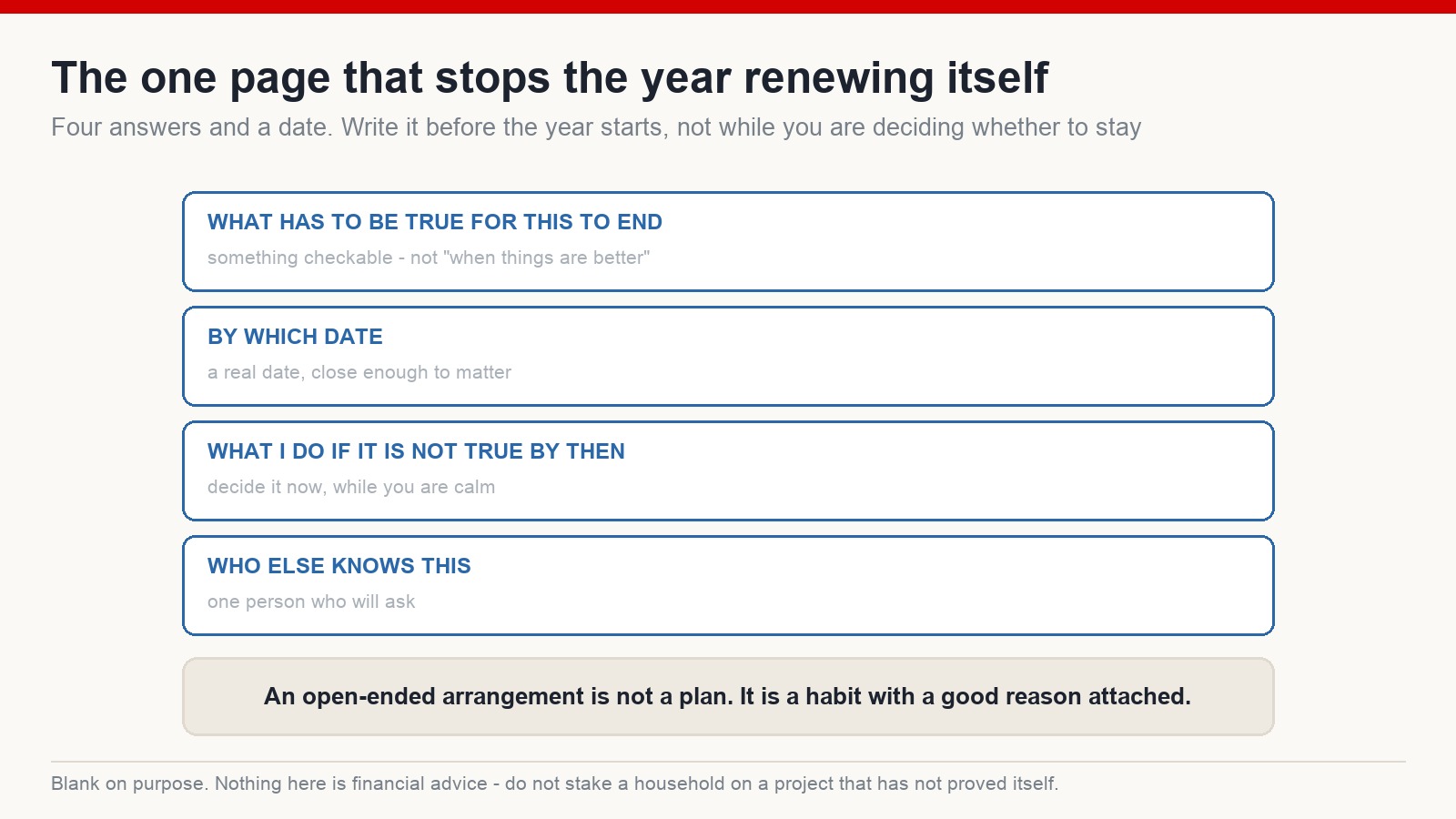
- What has to be true for this to end? Something checkable. "When things are better" is not a condition, it is a mood. "When I can cover the household costs from work I can do from anywhere for six consecutive months" is a condition.
- By which date? A real one. Close enough that you will still recognise the person who wrote it.
- What will you do if that date arrives and it is not true? Decide it now, calmly, rather than in the moment when every reason to continue will feel urgent.
- Who else knows? One person who will actually ask. A condition nobody can see is a wish.
None of this makes the year easier. It stops the year from renewing itself without a decision, which is a different and more useful thing.
What you are actually optimising for
It is worth being precise about the goal, because it changes what you build.
Most people in this situation do not want to be wealthy. They want the option of choosing where they are — to work without the location being decided by the work. Those two aims produce different plans. Chasing income alone can easily make you less able to leave, because the money is attached to the place.
So the question for any year is not only how much came in. It is whether anything you did this year travels.
A survival year and a compounding year look identical from inside
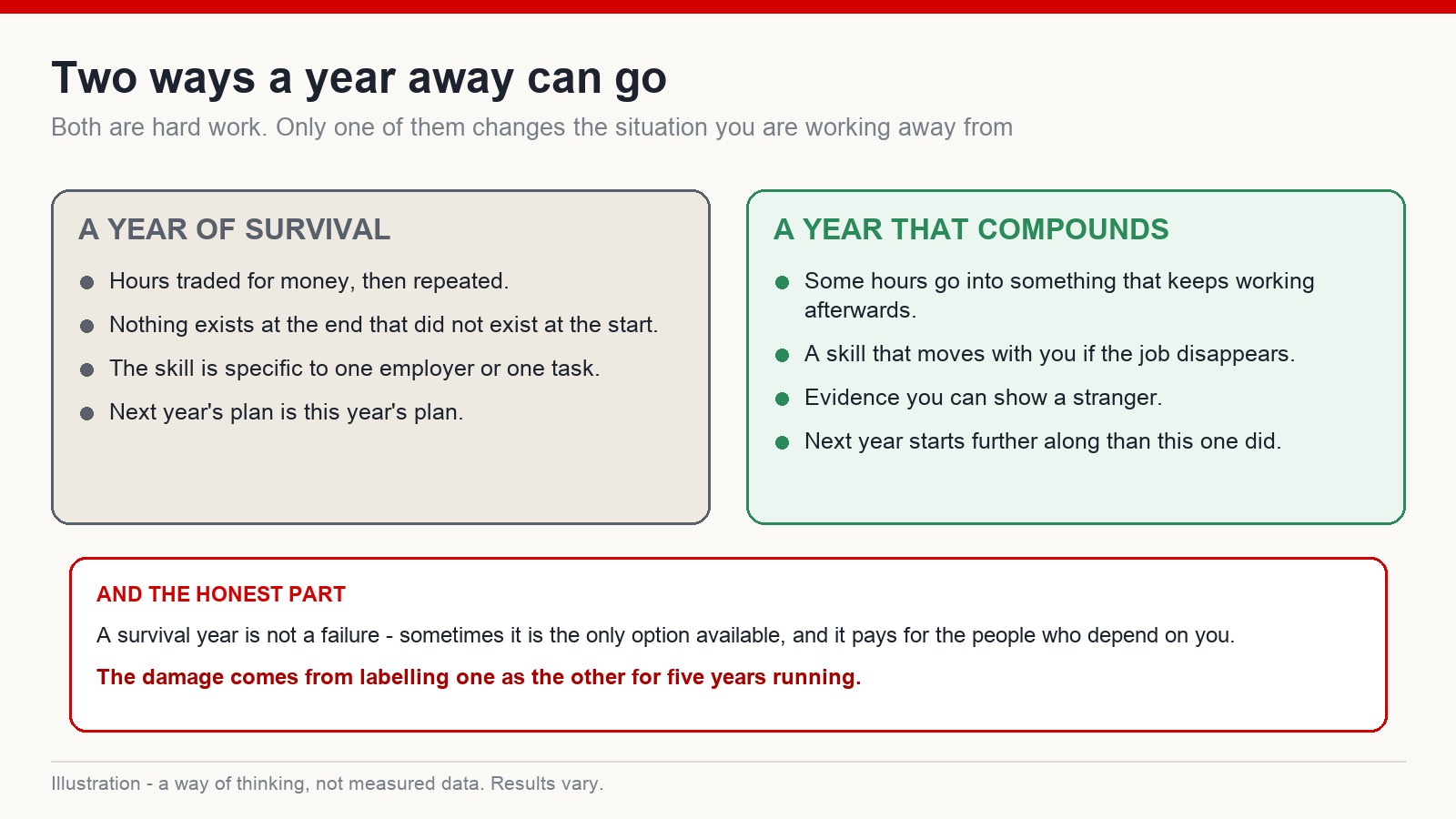
Both are exhausting. Both involve long days and not much sleep. The difference only shows up in what exists at the end.
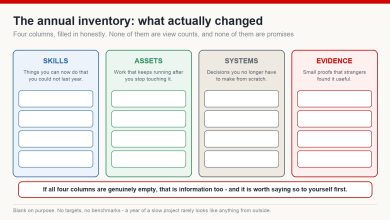
A compounding year leaves behind at least one of three things: a skill that moves with you if the job disappears, work that keeps running when you stop touching it, or evidence you can show a stranger. A survival year leaves the same situation, twelve months later.
I want to be careful here, because this is the point where articles like this usually start sneering at people with no options. A survival year is not a failure. Sometimes it is the only thing available, and it pays for people who depend on you, which is not a small achievement. The damage comes from calling one thing the other for five years in a row.
The realistic version of building something on the side
If the plan is to build work you can do from anywhere — a channel, a craft, a service — here is the honest shape of it.
You will have a handful of hours a week, not evenings of clear focus. Tired hours are worth less than rested ones, so the weekly total matters less than whether the work survives a bad week. Something that needs four good evenings will collapse the first time life interferes.
It is slow. Most channels take far longer than the stories suggest, results vary enormously between people and subjects, and nothing about a recommendation system is promised to anyone.
Which leads to the part I will not soften: do not quit stable income on the strength of a project that has not proved itself. Nothing here is financial advice, and the correct order is almost always to build the alternative while the current arrangement still pays, not instead of it. Anyone telling you to burn the boats is not the one holding your household together if it goes wrong.
Reduce the distance now, not only at the end
The trap in this whole way of thinking is treating presence as a prize you unlock later. "Once this works, I will be around properly."
Meanwhile the person who stayed is doing the daily work alone. Children do not pause. Parents get older on their own schedule, not yours. Some of what you are deferring cannot be bought back at any income.
So while the long plan runs, spend something now. A fixed call at a fixed time that does not get moved for work. One visit brought forward instead of postponed. Being genuinely present for the days you do have, rather than half-present with a phone in your hand. These are small, and they are the only part of the plan that is guaranteed to happen.
If you are going to be away, be away on purpose, with an end written down — not on the assumption that next year will explain itself.
How do I stop repeating "just one more year"?
Write a checkable condition, a date, and what you will do if the date arrives and the condition is not met. Tell one person. The sentence repeats because nothing is written, not because you lack discipline.
Should I quit my job to build something online?
Not on hope. Build it alongside stable income until it has produced real, repeated evidence, and treat any timeline you read as a rough story rather than a plan. This is a personal view, not financial advice — your circumstances and obligations matter more than any general rule.
How do I tell whether this year was worth it?
Ask whether anything you built this year travels with you: a transferable skill, work that keeps running without you, or evidence you can show someone. If none of the three exists, the year paid the bills but did not change the arrangement.
If you want a structured way to build an English-language channel alongside a full-time job, that is what I put together at mmoyoutube.com.