How to Read Your Competitors’ Titles and Find Keywords You Can Win
There is a mistake almost everybody makes in their first month, and I made it too.
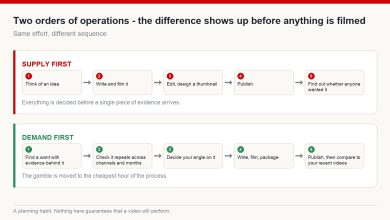
You sit down, think up a video idea, write your own title, design your own thumbnail, and publish. It feels like the honest way to work. Then the video gets forty views and you conclude that the algorithm is against new channels.
It usually is not. The problem is that nothing in that process ever checked whether anybody wanted the video in the first place.
YouTube does not reward original ideas. It rewards ideas an audience has already proved it wants, made better than the version currently on offer. Which means the most useful hour you can spend is not brainstorming – it is reading other people’s channels properly.
I have been making videos since 2017, mostly faceless channels aimed at viewers in the US, the UK, Germany and Japan, and competitor research is still the first thing I do before any new channel or any new run of videos.
Reading competitors is not copying them
Worth clearing this up first, because the phrase makes people uncomfortable.
Copying is taking someone’s video, their script or their footage. That is both against the rules and a dead end – a reupload has no reason to exist and nothing to build on.
Reading is different. You are not after their content. You are after the reasoning underneath it: which phrase brought people in, what problem the viewer actually had, why this particular framing got clicked when three similar videos did not. That reasoning is not owned by anybody. It is just visible if you look carefully.
Think of it as market research that happens to be published in public.
Start with the name, not the videos
Most people skip straight to the top videos. Spend ten minutes on the channel names first, because they tell you the conventions of the niche – and conventions are what make a new channel read as native rather than as an outsider.
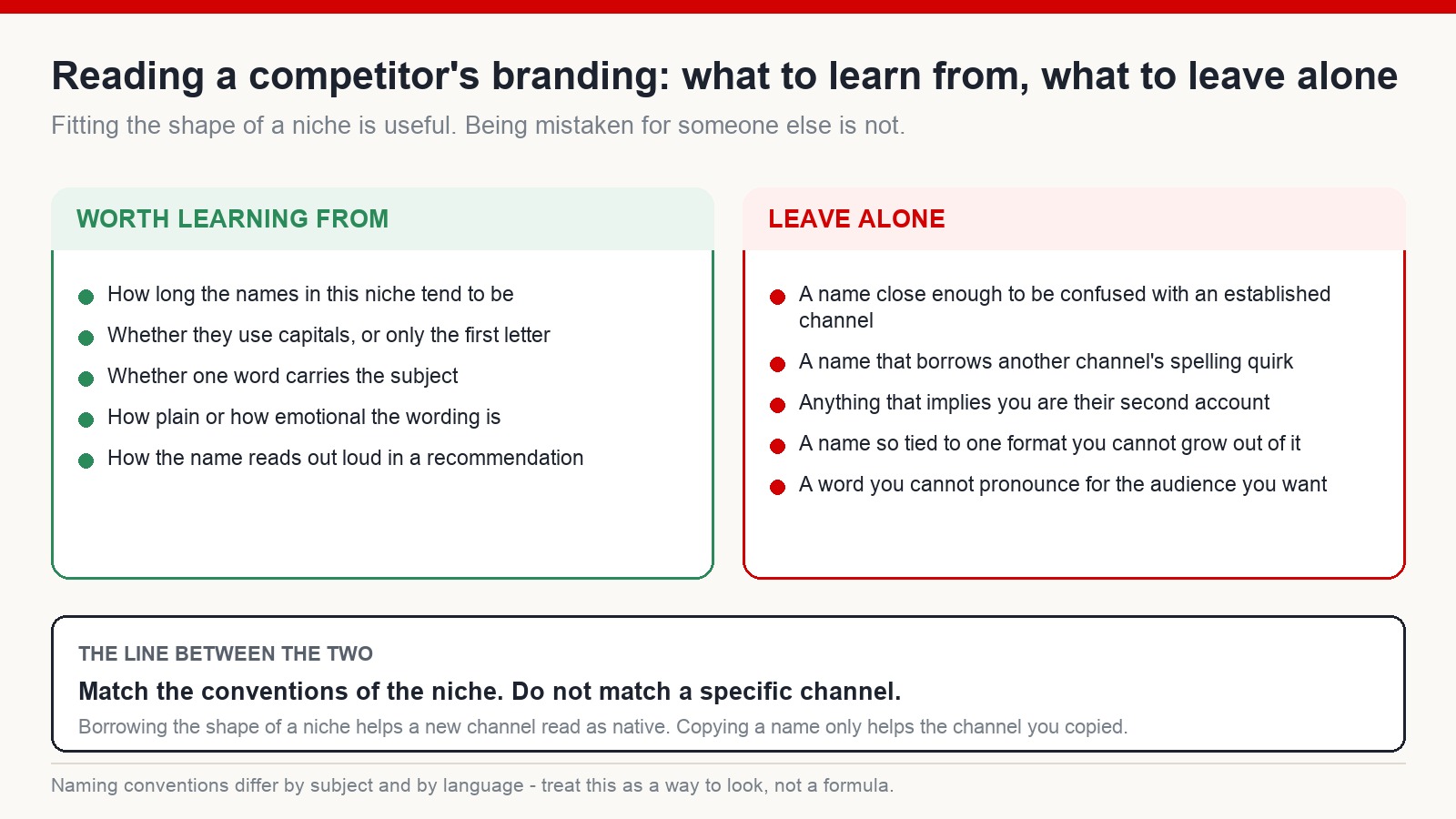
Line up eight or ten channels in the space and look at the shape of the names. How many words? Are they descriptive or abstract? All capitals, or sentence case? Does one word carry the subject, so a viewer knows what the channel is about before watching anything?
Fit those conventions roughly – somewhere around half – and then be different. If the niche runs on short, plain two-word names, a long emotional name will feel out of place. If the niche is playful, a corporate name will feel out of place too.
The line to not cross is the specific channel. A name close enough to be confused with an established one costs you more than it borrows: viewers get mixed up, your search results are polluted by theirs, and you spend years building recognition that keeps landing on somebody else. Match the niche. Never match a channel.
The core move: split their titles
This is the part that does the real work, and it takes about a minute per title.
A competitor’s title is a finished product. What you want is the raw material inside it. So take a title that is clearly performing and break it into every phrase a person might have typed on their own.
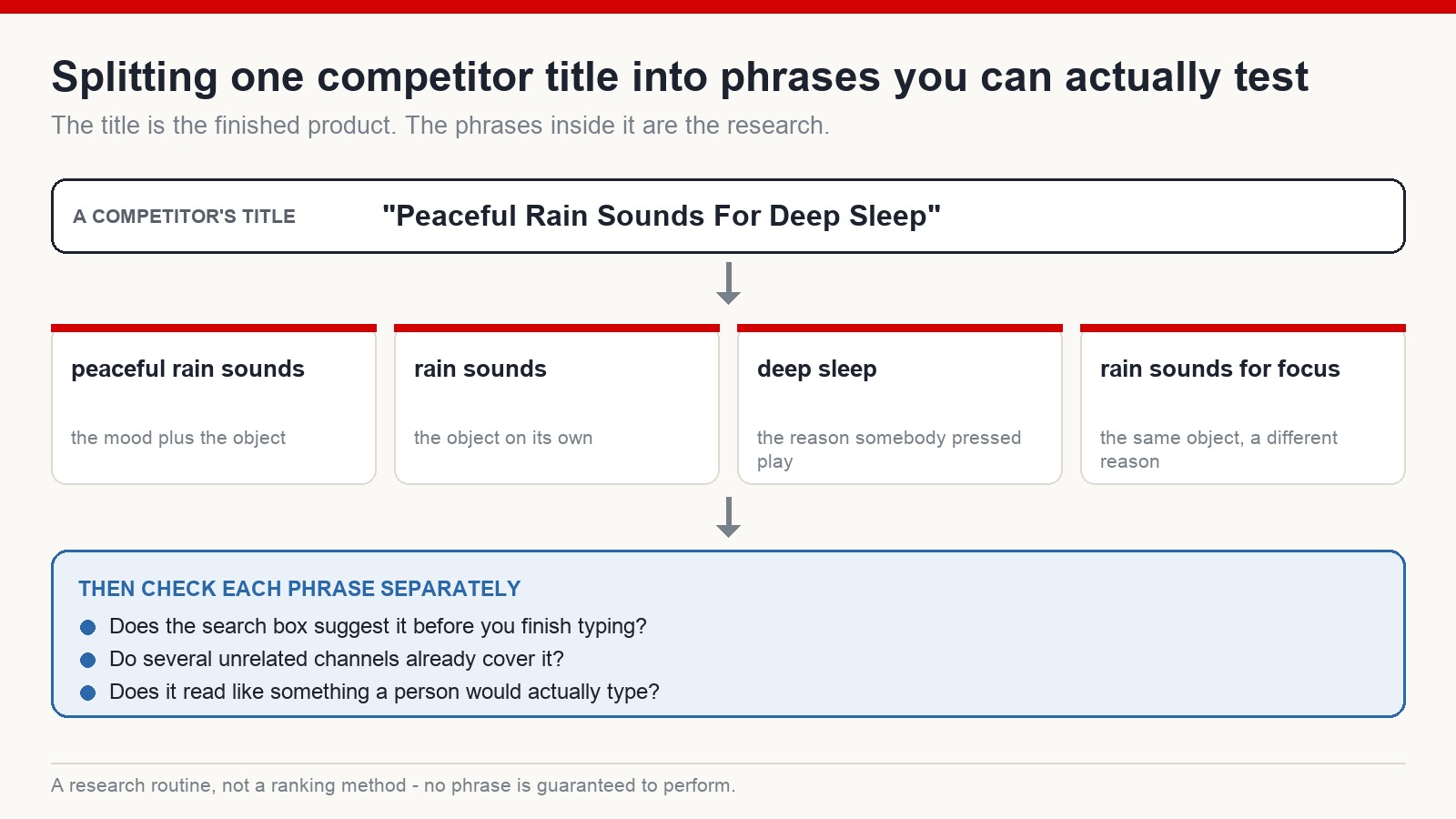
Take something like Peaceful Rain Sounds For Deep Sleep. Inside one title there are at least four different things:
- peaceful rain sounds – the mood attached to the object
- rain sounds – the object on its own, far broader and far more contested
- deep sleep – the reason somebody pressed play, which is not about rain at all
- rain sounds for focus – the same object, a different reason, and possibly a different audience
Now check each one separately, because they do not behave the same way. Some have real search behind them and some are just words that happened to be in a sentence.
Three checks, in order of how much they are worth:
- Does the search box complete it? Type the phrase into YouTube and watch the suggestions. Those suggestions are built from what people actually type, which makes them the cheapest honest signal available, and they cost nothing.
- Do unrelated channels already cover it? If several channels with no connection to each other have each made a video on the same phrase, the demand is real. One channel covering it proves nothing.
- What does a research extension say? Any of the standard tools will estimate search volume and competition. Use the numbers to compare phrases against each other, not as a target to hit – they are estimates, and they move.
Two things I would push back on here. First, ignore the broadest phrase in the list. It has the most volume and the least chance of you getting anywhere near it. Second, do not go hunting for a magic volume threshold. The right level depends on the subject, the language and the year, and a specific phrase with obvious intent regularly beats a broad one with ten times the search behind it, because search is only the door – the recommendation system does the rest.
Then ask who was actually watching
Here is the part almost nobody does, and it is where the interesting openings are.
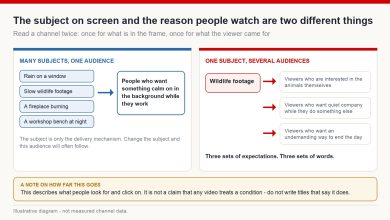
The subject of a video and the audience of a video are frequently two different things. A channel posts videos of animals in forests, and you assume the audience is people who like animals. Read the titles again and you see words like calm, peaceful, sleep. That is not an animal audience. That is people who want to feel a certain way, and animals are the material that happens to deliver it.
Same footage. Completely different reason for watching. And the phrases you would target for each are almost entirely different sets.
So for every competitor video worth studying, write one sentence: this video is for someone who wants ___. If the answer is not obvious from the title and thumbnail together, that is a finding in itself – it usually means the packaging is vague, and vague packaging is the easiest thing in the world to beat.
Widen the set before you trust anything
One video is an anecdote. It could be a returning audience, an old video with a long tail, an accident.
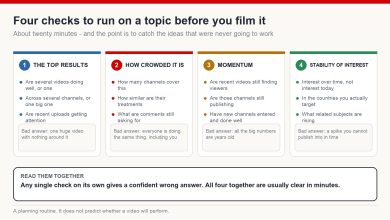
Once a phrase looks interesting, search it and work backwards. Find every channel ranking for it, then look at the top dozen videos across several of them. What you are hunting for is repetition: the same phrase structure appearing again and again, the same emotional angle, the same thumbnail composition. Repetition across unrelated channels is the closest thing to proof that a market exists.
While you are there, read the thumbnails as a set rather than one at a time. In several niches the thumbnail carries more weight than the title, and patterns jump out when you view a dozen together: which object is always in frame, which emotion recurs, which two or three colours dominate, whether text is used at all. Note what everyone does – then note the one obvious thing nobody is doing.
Three ways this goes wrong
Watching the content instead of reading the packaging. The video itself is the least informative part. The title structure, the thumbnail logic, the first fifteen seconds and the top comments tell you far more about why it worked.
Copying exactly. A channel that is a slightly worse version of an existing channel has no reason to be chosen. Take the phrase and the audience; bring your own angle, your own format, your own opinions.
Stopping at the subject. If you decide a niche is “animal videos” when its audience is really people trying to get to sleep, every decision after that will be slightly wrong – the wrong phrases, the wrong thumbnails, the wrong pacing.
One sitting, start to finish
If you want a concrete version of the whole thing: pick five channels in your space. Note the shape of their names. Take the three best-performing videos from each and split every title into phrases. Run those phrases through the search box and note which ones complete themselves. Cross out the broadest ones. For every remaining phrase, write the sentence about who wants it. Then search each survivor and check whether unrelated channels cover it too.
What you end up with is not a guarantee – nothing about this promises views, and plenty of well-researched channels never take off. What it gives you is a list of things people have demonstrably gone looking for, which is a considerably better starting point than a list of things you thought of on a Tuesday.
The creators who move fastest are usually not the most original ones. They are the ones who read the market fastest.
Is competitor analysis the same as copying?
No. Copying takes the content. Reading takes the reasoning – which phrase brought people in, what the viewer actually wanted, why one framing beat another. The output of good research is your own video on a subject you now know somebody wants.
How many competitors should I look at?
Enough that repetition becomes visible, which in practice means several channels rather than one, and a dozen or so of their top videos rather than a handful. A pattern that shows up across unrelated channels is worth far more than any single video.
What search volume should I be looking for?
There is no universal number, and anyone quoting one is describing their own niche in their own year. Compare phrases against each other instead: skip the broadest terms, favour phrases that read like something a person would type, and weigh intent more heavily than size.
Can I use a competitor’s title as it is?
You can use it as a starting point, but publishing the same title is a bad trade – you end up competing directly with an established video on its own terms. Take the phrase, change the angle, and make the promise specific to what your video actually delivers.
If you want to see how this research approach fits into building a channel for an English-speaking audience end to end, that is what I teach at mmoyoutube.com.