Replicate the Formula, Not the File: What Scaling a Faceless Channel Really Means
There is a misunderstanding that costs people a year. They hear that large faceless operations grow by replicating videos, and they picture downloading somebody’s upload, swapping the music, writing a new title and posting it. It sounds efficient. It is also not what any durable operation is doing, and it is not something I would tell anyone to try.
Replication does not mean copying a file. It means copying whatever produced the result – the subject, the packaging, the structure, the production process – and then building your own version of it from your own materials. That distinction is the whole thing. One of those is a content business. The other is a copyright complaint with a delay on it.
The loop, stated plainly
Every scaled catalogue I have looked at closely runs some version of the same loop. Find a subject that demonstrably works. Build several genuinely different videos around it. Turn the repeated parts into a process someone else can run. Then, if the subject travels, take the whole thing into another language market.
What is absent from that loop is the daily hunt for a new idea. Most people burn their capacity on invention when the bottleneck is exploitation – they find something that works and immediately walk away from it.
Audit the twelve, not the whole channel
The most useful research habit I have is also the least clever. Do not study a competitor’s channel. Study the handful of uploads carrying most of its views.
Pick a channel large enough that its results are not noise – an established name in the space rather than something with nine uploads. Sort its catalogue by views, take the top ten or twelve, and label each one by theme. Not by title, by theme. Then count.
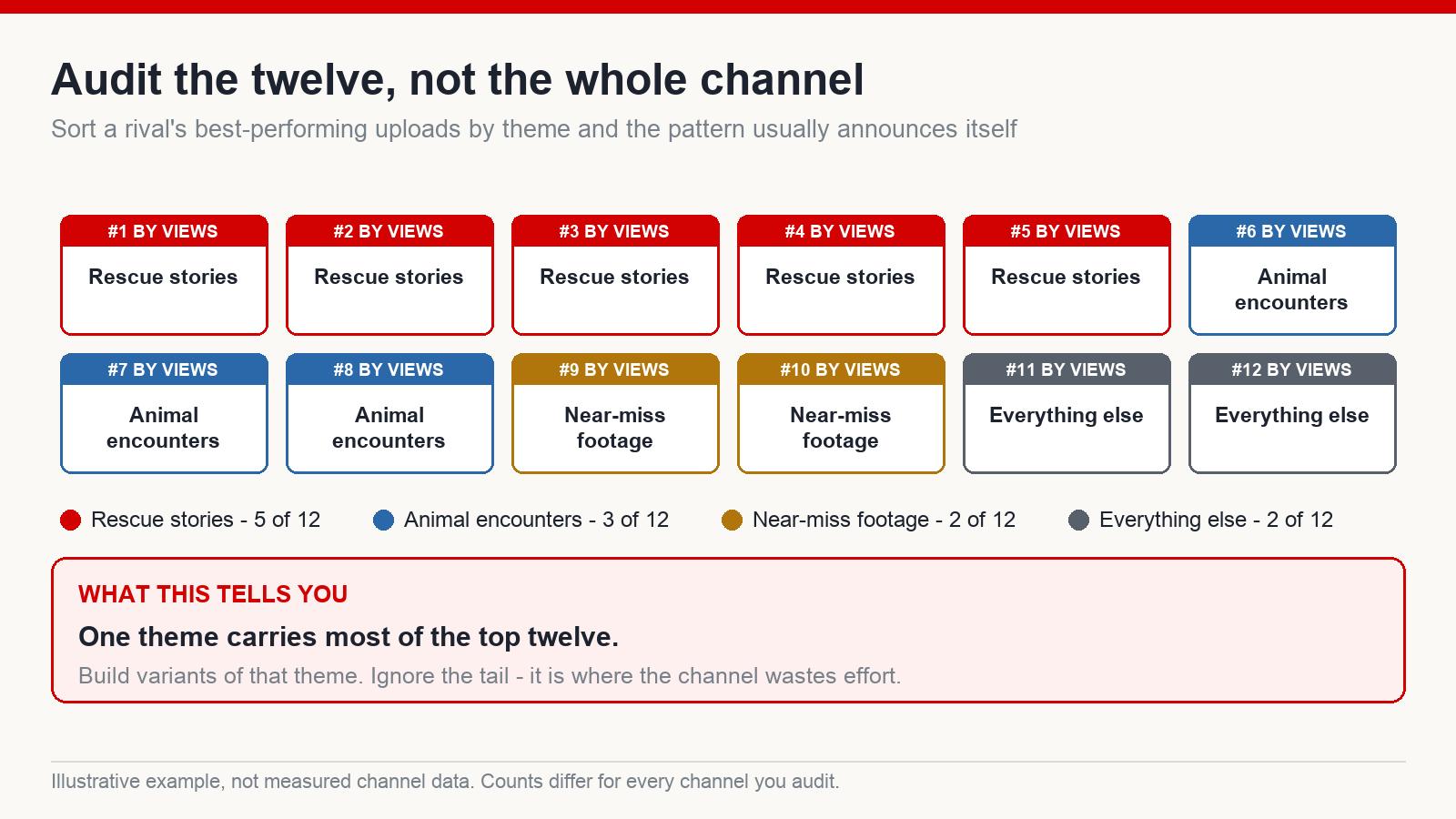
The pattern is usually obvious within twenty minutes, and it is usually narrower than the channel’s own description of itself. A channel that presents as being about wildlife might have most of its top results in one specific situation type. That situation is the thing worth building variants of. Everything outside the dominant group is where that channel is spending effort for very little return – and if you copy the channel broadly, you inherit that waste along with the wins.
Two signals before you commit
Here is where people get hurt. A large channel is winning with a subject, so they conclude the subject is in demand. Often it is not. The audience is following the name.
Reputation does not transfer. You can copy the format precisely and get nothing, because the thing generating the views was an existing relationship you do not have. So I look for a second signal before spending real time on a theme.
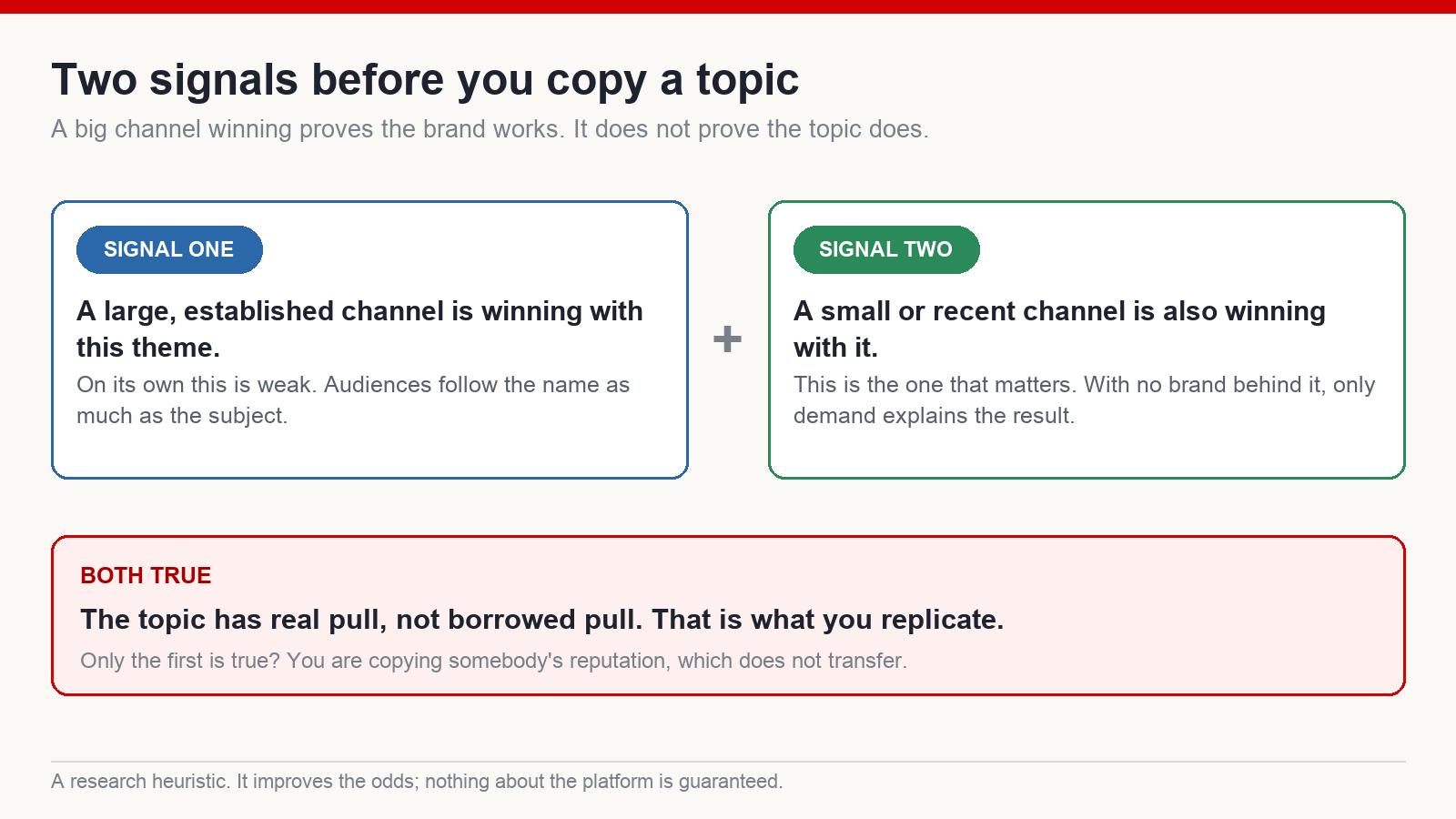
Signal one: a large, established channel is doing well with the theme. Weak on its own. Signal two: a small or recent channel, with no audience to speak of, is also doing well with it. That one is much stronger, because with no reputation behind it, the only remaining explanation is that people want the subject.
Both true, and you are replicating demand. Only the first, and you are replicating somebody’s reputation, which is not a thing that can be copied.
Two ratios that keep a catalogue readable
Once you have the theme, the question becomes what to publish and in what proportion. Two rough ratios do most of the work.
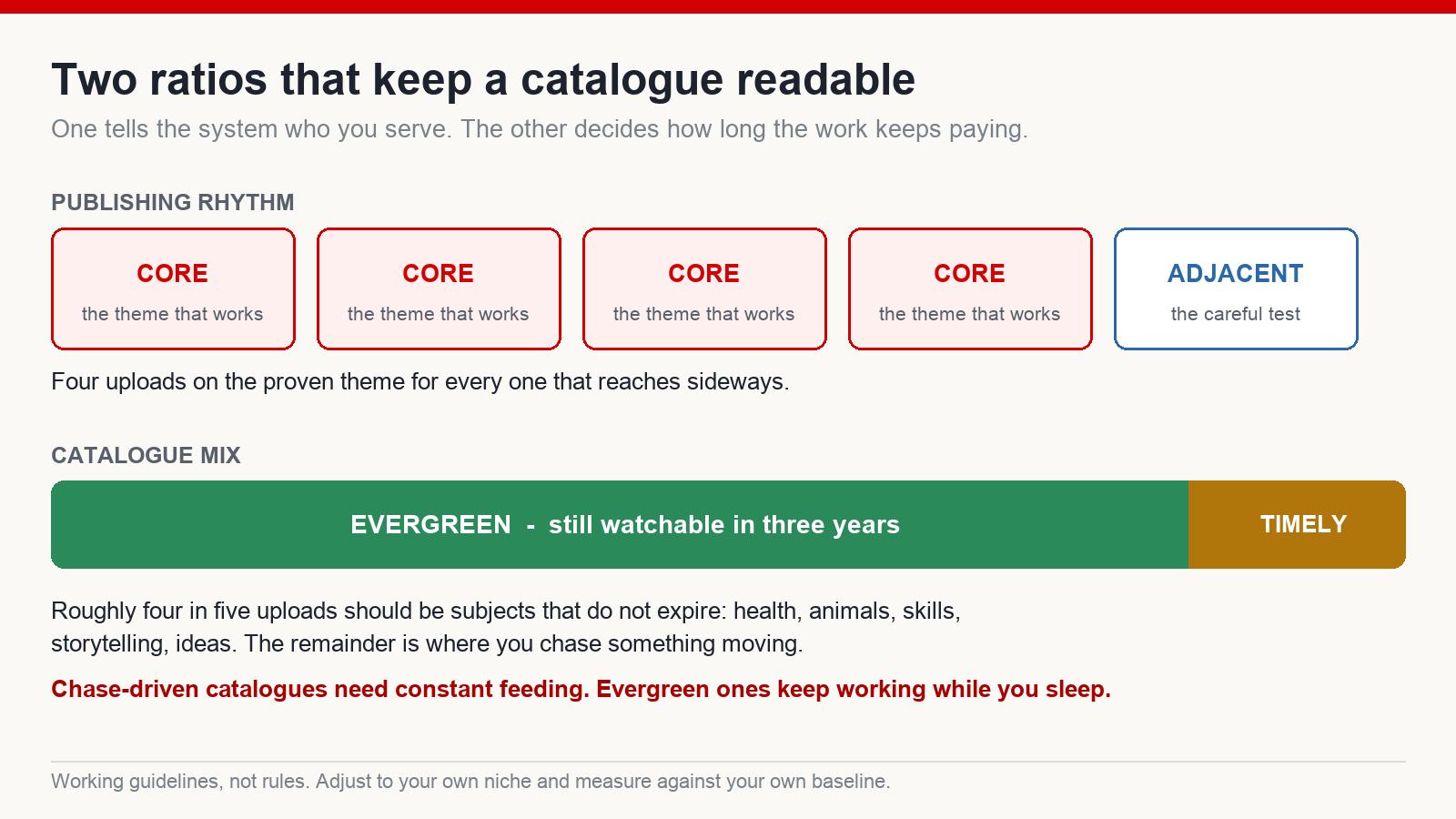
The first is the publishing rhythm: roughly four uploads on the proven theme for every one that reaches sideways. That ratio does two things at once. It keeps the recommendation system’s read of the channel stable, and it still gives you a steady supply of tests. Three to one works too. What does not work is alternating, which reads as two channels sharing an upload schedule.
The second is the catalogue mix: weight heavily towards subjects that will still be watchable in a few years. Health, animals, practical skills, ideas, storytelling, the kind of thing people search for continuously. Keep a minority for subjects that are moving right now. A catalogue built mostly on the moment needs constant feeding to stand still; an evergreen one keeps returning results from work you finished months ago.
These are working guidelines, not laws. Adjust them to your subject and judge them against your own baseline rather than against a number in an article.
Where AI earns its place
The honest answer is: in the parts that were previously slow and are not where the value sits.
Illustration is the clearest case. Some moments cannot be filmed – a rescue that happened before anyone had a camera out, a scene at a scale nobody can stage, an event described in a historical account. Generated imagery or animation can carry those, and it turns a week of hunting for approximate footage into an afternoon.
Thumbnails are the other. Being able to produce a dozen genuinely different concepts and test emotion, colour and framing against each other, without commissioning each one, changes what testing is possible.
One rule sits over both. Say what the thing is. If an image is generated or illustrative rather than a record of something that happened, make that visible. Platform disclosure requirements for synthetic media exist and they do change, so read the current ones rather than trusting an article. Beyond the rules, this is the part that decides whether people trust the channel in three years, which matters more than any individual video.
Why this model scales at all
Three reasons, and none of them is about the videos being easier to make.
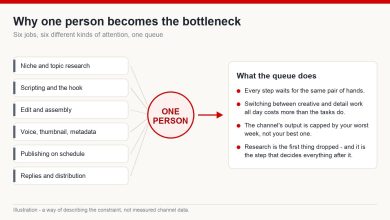
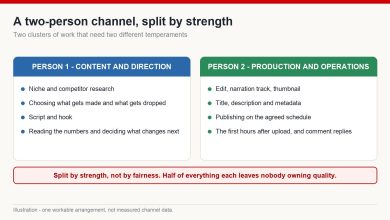
Work can be handed over. Research, scripting, narration and editing are separable jobs with describable standards. That is not true of a channel built around a person on camera.
Nothing stops when one person does. If the face of a channel takes three months off, the channel takes three months off. A production process does not have that dependency.
Volume changes nothing structurally. Once the process is written down, moving from one video a week to five is a resourcing question, not a redesign. That is the property that makes the word “scale” mean anything here.
What not to replicate
The temptation, once volume is possible, is to chase whatever produces the sharpest reaction. Extreme violence, crime as entertainment, material you do not hold the rights to, subjects sitting close to a policy line.
The short-term numbers on that content can be genuinely good, which is exactly what makes it dangerous. The penalty does not arrive per video. It arrives at the level of the account, and it arrives late – normally once you have built something worth losing. If you are treating this as an asset, that is not a trade worth making for a spike.
From one winner outward
The last step in the loop is the one most people never reach, because they abandon the winner too early. A subject that works in one language, with an audience whose interest is not tied to local culture, is a candidate for other markets. The research is already paid for. The script exists. The edit exists. What changes is narration and packaging.
That is not a guarantee – every market is its own test, with its own competition and its own habits. But it is a far better use of a proven asset than restarting the search from nothing.
Frequently asked questions
Is replicating videos the same as re-uploading?
No, and the difference is not cosmetic. Re-uploading means publishing content you did not make. Replicating means studying what made a result happen and producing your own work from that understanding. One is a rights problem; the other is ordinary research.
How do I decide which subject to build on?
Sort a large competitor’s catalogue by views, take the top ten or twelve, group them by theme, and see which theme carries most of the group. Then confirm that a smaller channel is also succeeding with it before committing.
Can AI produce the whole video?
It can, and it usually should not. The value is in the idea, the angle and whether people stay – none of which a tool decides for you. Fully automated output is also the exact shape of content that reviewers treat as low effort.
How many variants can one theme carry?
More than most people try, as long as each one is genuinely rewritten for a different question or a different audience. What stops working quickly is the same script with a different opening line.
Does this work for a brand-new channel?
The research does. The publishing ratios matter less at the start, when you have no established read to protect. Early on, the priority is finding one thing that works at all – only then is there a formula to replicate.
I have been building faceless channels for English-speaking audiences since 2017, and almost everything I know about scaling came from exploiting winners longer rather than finding more of them. The longer version is at mmoyoutube.com.