Ten AI Tools for Business Owners: Six Make Things, Four Run the Business
Ten AI tools for business owners, one job each, and a line at the bottom of the card worth more than the list: start with two, not ten.
The useful way to read it is not as ten products but as two halves. Six of the tools help you make things. Four help you run the business – and that second half is the one creators skip, because nobody ever felt behind for lacking a customer record.
Two halves, and only one of them gets bought
| The making half → | The running half |
|---|---|
| Producing the work Research, documents, competitor checks, campaigns, design, decks |
Keeping the business upright What is in progress, what repeats, who asked what, what was agreed |
| Six of the ten tools | Four of the ten tools |
| If you skip it: Skip it and you have nothing to publish |
If you skip it: Skip it and you lose follow-ups, deadlines and money you had already earned |
If you sell anything at all – a sponsor slot, a course, a service, a product – you are running a small business whether or not it feels like one. The failures on the right-hand side are quiet: a sponsor enquiry that never got a follow-up, a deadline agreed in a call and never written down, a discount promised to someone whose name you no longer remember.
The ten, and whether you need them
| # | Tool | Job | Half | Worth it for a creator? |
|---|---|---|---|---|
| 01 | ChatGPT | Research & strategy | Making | Yes – or whichever assistant you already use |
| 02 | Claude | Documents & analysis | Making | Yes, for long material |
| 03 | Perplexity | Competitor research | Making | Yes, when you need sources you can open |
| 04 | Jasper | Marketing & campaigns | Making | Only if you run campaigns at volume |
| 05 | Canva | Social media & ads | Making | Yes – thumbnails and short-form graphics |
| 06 | Gamma | Presentations & proposals | Making | If you pitch sponsors or teach |
| 07 | Notion | Project management | Running | Yes – this is the first one to add |
| 08 | Zapier | Workflow automation | Running | Later, once a chore repeats weekly |
| 09 | HubSpot | CRM, sales & marketing | Running | Only with real customers; a sheet works first |
| 10 | Fireflies | Meetings & action items | Running | Yes, the moment you take calls |
Rows one to three overlap heavily – three assistants doing research and writing. Pick one, not three, and check you are not already paying for a fourth inside your office suite. That duplication is the most common money leak in this whole category, and the audit for it is in stop paying twice.
The row most creators should add first is project management, because it is the one that keeps the other nine from producing work that gets lost. The one to postpone longest is the CRM: with a handful of sponsors a year, a spreadsheet is faster, cheaper and easier to read.
The post this came from
Watch the reel
Ten tools, ten jobs, one stack that runs the week. Posted on the BANI Academy page.
The running half, at the size of one person
You do not need enterprise software to run the right-hand column. You need four things written down somewhere you look weekly.
| The job | What it looks like | What it prevents | The free version |
|---|---|---|---|
| What is in progress | A board with four columns: idea, filming, editing, published | Work stops disappearing between stages | A page in the tool you already write in |
| Who asked what | One row per sponsor or client: name, date, what was discussed, what you promised | You stop re-reading email threads to remember terms | A spreadsheet with six columns |
| What repeats every week | A short list of chores you do by hand | You can see what is worth automating | A note, updated as you notice them |
| What was agreed on a call | Summary and action items written the same day | Nothing depends on your memory of a conversation | The recording tool you already use, plus five minutes |
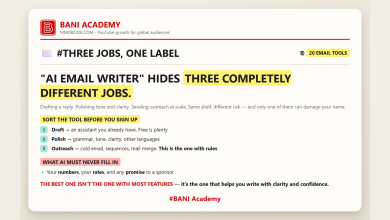
The second row is the one that pays for itself fastest. A sponsor conversation spread across email, a call and a chat window is a conversation you will misremember – and misremembering a promise is expensive in a way no tool subscription is. The same discipline applied to email is in one label, three very different jobs.
The third row is the input to automation. Automate the chore you have already written down three weeks running, not the one that sounds impressive – the approach in two of these are the automation.
A week where both halves are working
It helps to see what this looks like when it is running properly, because the running half is invisible by design.
On Monday you open one board and see three videos: one waiting on a thumbnail, one filmed and unedited, one published last week. Nothing has to be remembered, so nothing is forgotten. You spend the morning on the thumbnail, because the board told you it was the blocker.
On Wednesday a sponsor replies. You open one sheet, see what was discussed in August, what rate was quoted, and what you promised about placement. The reply takes four minutes instead of twenty, and it is accurate.
On Friday you glance at the list of chores you have been noting. Renaming clips appears for the third week running, so that becomes the thing you automate next – not because it is impressive, but because you have written evidence that it repeats.
None of that is exciting and all of it compounds. The making half produces the videos; the running half is what stops the week producing chaos alongside them.
Why the running half feels optional and is not
Making things gives immediate feedback: a video exists, a thumbnail looks better, a draft is finished. Running the business gives nothing back on the day you do it. You write down what a sponsor asked for and feel like you wasted four minutes – right up until the month you need it.
That asymmetry is why the left column fills up with three overlapping subscriptions while the right column stays empty. It is also why the losses there stay invisible: nobody counts the sponsor who never got a reply, because there is no record that they wrote.
The cure is cheap and boring. One place where work in progress lives, one row per person who pays you, one note of the chores that repeat, and action items written the same day. Half an hour to set up, five minutes a week to maintain, and it quietly protects the income the making half produces – the same reasoning as the six departments in your channel has six departments and the observability layer in the enterprise AI stack, shrunk to one person.
Frequently asked questions
I am not a business owner. Does this apply?
If anyone pays you – a sponsor, a member, a client – the running half already applies. It just has not caused a problem yet.
Do I need a CRM?
Not until you cannot hold your customers in your head. A spreadsheet handles the first dozen relationships perfectly well.
Which tool should I add first?
Whichever covers project management. It is the one that stops work vanishing between stages, and it makes the making half more productive immediately.
When is automation worth it?
When the same chore appears in your notes three weeks running. Before that you are automating a guess.
Add one from the right-hand column this week
Count how many tools you have in the making half. If it is more than two, you already know where your next saving is. Then add exactly one thing from the running half – a board for what is in progress, or a sheet for who asked what – and keep it for a month.
Start with two, not ten: one that makes things and one that keeps the business upright. The second one will not feel productive on the day. It is the one that keeps the first one from being wasted.
Learning a lot does not make anyone good. Doing a lot does.
If you want the structure that turns that into a habit, that is what our free challenge is built for: no barrier to entry, a genuine commitment to action, and a refundable commitment fee you get back when you finish. You are not paying for the knowledge. You are betting on yourself finishing, and we hold the stake.
Which AI tool do you use the most? Tell us in the comments on the original reel.
For more on building channels for English-speaking audiences, that is what we work on at mmoyoutube.com.
One Comment