How to Choose a YouTube Niche: A Five-Point Scorecard and Thirty Candidates
Most people who quit YouTube did not lose at editing. They lost at a decision they made before the first video, usually in an afternoon, usually on instinct.
This is the whole method I use for that decision: thirty niches worth considering, five criteria for scoring any of them, and the funnel that takes you from thirty candidates down to the one you actually build. Nothing to download — it is all here.
Why the niche decision carries so much weight
Beginners assume they are failing because the video is not polished enough, or because they have not learned the metadata game. The blunter truth is that a great deal of the outcome was fixed before recording started.
With the wrong niche, effort works against you. You sharpen thumbnails, rewrite titles, tighten the edit — and the thing that actually needs fixing sits at the root, untouched. That is how people burn three to six months, publish a few dozen videos, watch nothing move, and conclude they are not cut out for this. Very often the only problem was the pitch they chose to play on.
A niche is a lever that works in both directions. Choose well and every video adds to an audience the system understands better each week. Choose badly and identical effort scatters, and no signal ever gets strong enough to lift anything. That is why two people working equally hard end up in completely different places.
Five mistakes that produce a bad choice
Choosing by personal interest. “I like cooking, so I will make a cooking channel.” Your enthusiasm says nothing about search demand, advertiser interest or how crowded the market already is.
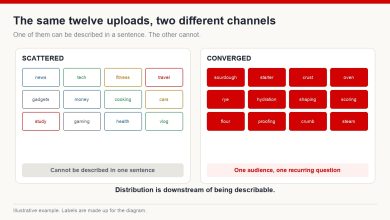
Choosing something far too broad. A channel about “health” or “animals” gives the recommendation system no one in particular to show it to, so it never settles on an audience.
Switching after ten videos. A new channel needs somewhere in the region of fifteen to thirty videos before the system has any real sense of who it serves. Changing course halfway discards everything accumulated so far.
Chasing advertiser rates you cannot produce for. People jump into finance or medicine because they hear the rates are good, then run out of material after four videos because they lack both the knowledge and the sources.
Picking a category with high policy exposure. Invented life stories, spiritual content that promises outcomes, deliberately sensational material. These can climb quickly and then take the whole channel with them when enforcement catches up.
The three-tier drill
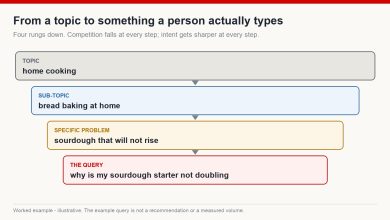
The principle running through all of this: the narrower the niche, the better your odds — you are not fighting channels with millions of subscribers, and the system understands precisely who to serve you to.
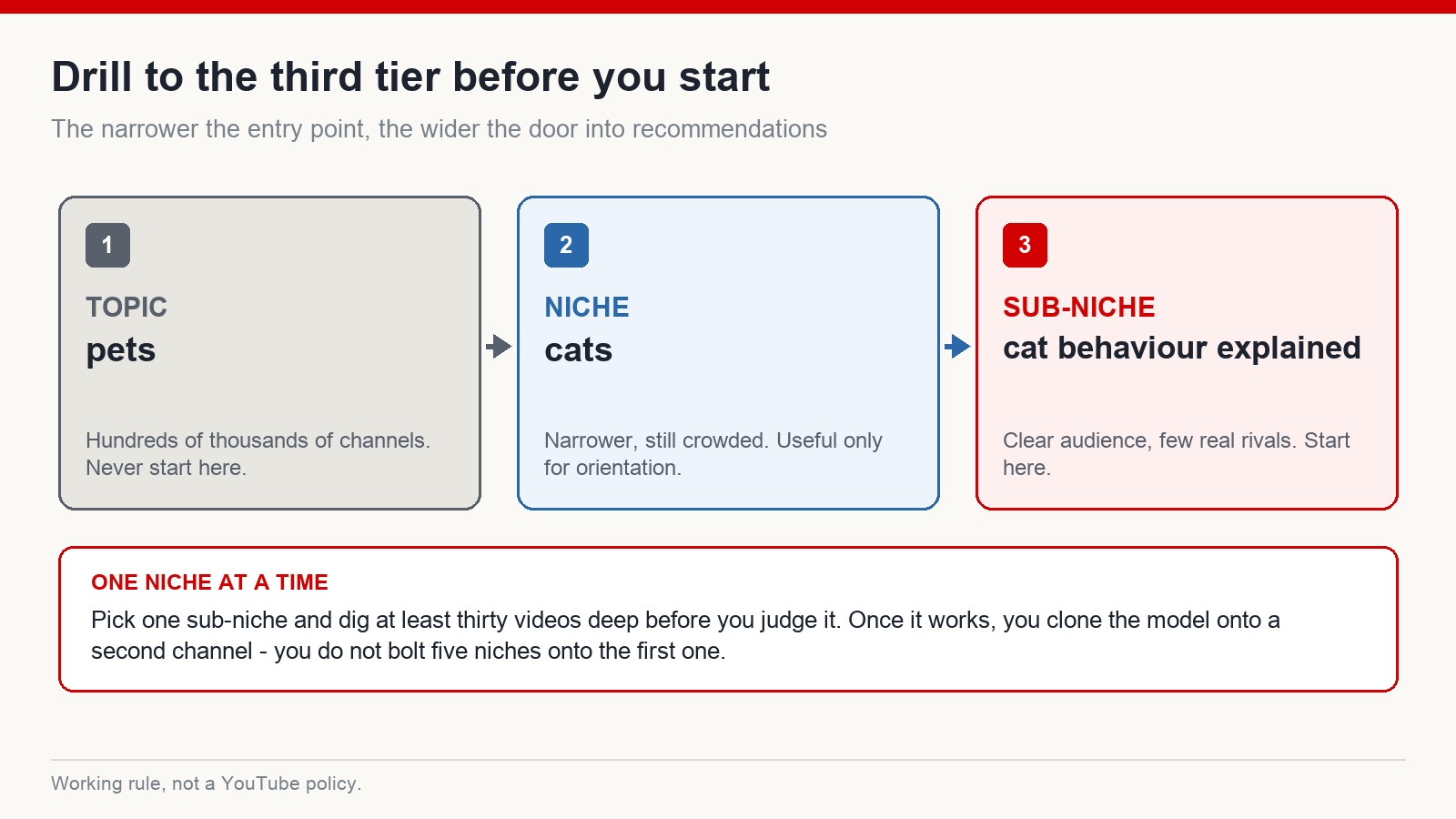
Tier one is the topic — “pets”, for instance. Hundreds of thousands of channels. Never start here.
Tier two is the niche — “cats”. Narrower, still crowded, useful only as orientation.
Tier three is the sub-niche — “cat behaviour explained: why cats do the strange things they do”. This is where you start. The audience is clear, the rivals are few, and recommendations are reachable.
One niche at a time. Pick a single sub-niche and dig at least thirty videos deep before you draw any conclusion about it. Once it works, you clone the model onto a second channel — you do not bolt five niches onto the first one.
The comfortable paradox of this platform is that the more you narrow, the wider the door into recommendations gets.
Five criteria for scoring a niche
Instead of arguing with yourself, score. Each criterion from one to five. Eighteen and above: build it. Under fifteen: let it go, however attached you feel.
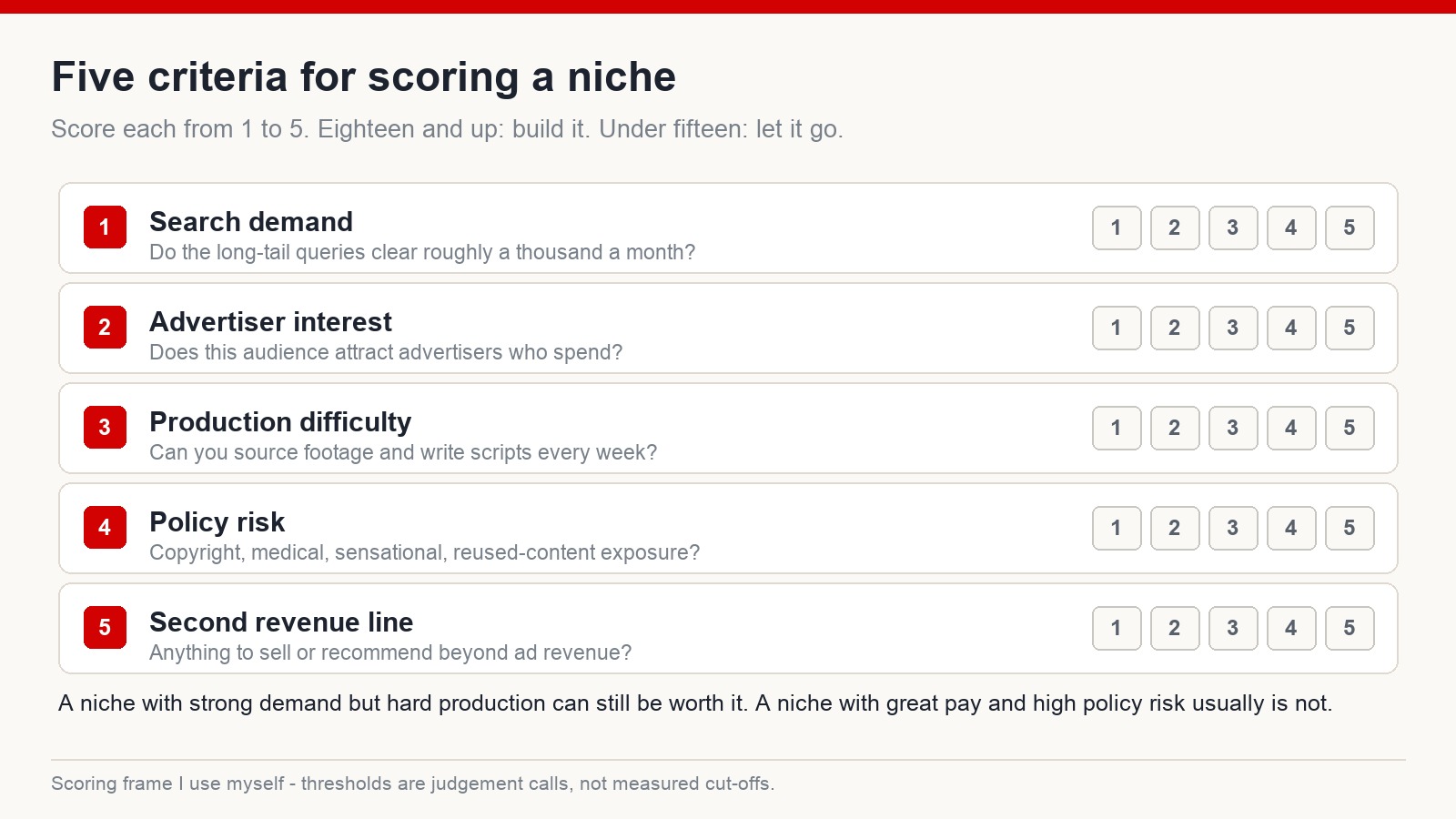
1. Search demand
Do the long-tail queries around this sub-niche clear roughly a thousand searches a month? Below about seven hundred and fifty, I drop it. Volume also moves constantly, so check close to when you will actually publish rather than months in advance.
2. Advertiser interest
Does this audience have money and do advertisers want to reach it? This is a directional judgement, not a number you can look up.
3. Production difficulty
Can you actually find the footage and write the scripts, every week, for months? This is the criterion people flatter themselves about most.
4. Policy risk
How exposed is this niche to copyright claims, medical guidelines, sensational-content rules, or enforcement against reused material?
5. A second revenue line
Beyond advertising, is there anything to recommend or sell? This is what lets a channel produce something before it qualifies for ad revenue at all.
A niche with strong demand and a weak production score can still be worth doing if it suits your skills. A niche with excellent advertiser interest and serious policy exposure usually is not — the risk score drags the total down for good reason. Reducing everything to one number is what stops the argument being emotional.
Thirty niches, seven groups
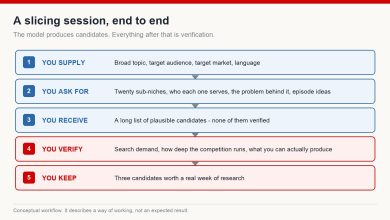
These are the candidates. Every one is a starting point that still needs your own verification — no revenue figures, because those vary far too much between channels to publish as guidance.
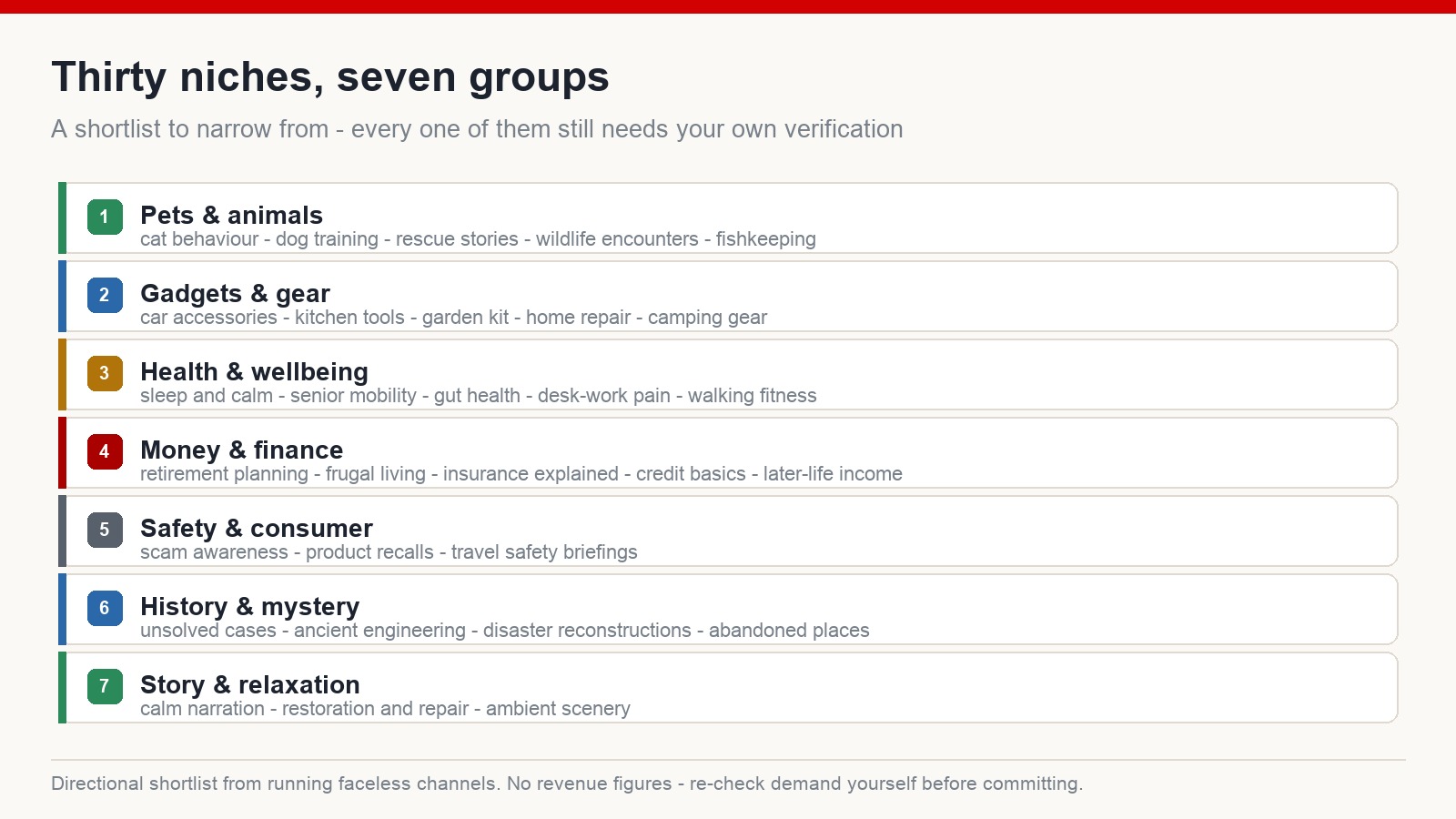
Pets and animals
- Cat behaviour explained
- Dog training fundamentals
- Animal rescue stories
- Wildlife encounters caught on camera
- Aquariums and fishkeeping setups
Easy to produce, broad audience, modest advertiser interest, strong affiliate potential in pet supplies.
Gadgets and practical gear
- Car accessories and in-car gadgets
- Kitchen tools tested
- Gardening tools and shortcuts
- Home repair and DIY fixes
- Camping and outdoor gear
Easy to produce, solid advertiser interest, and the strongest affiliate category on this list.
Health and wellbeing
- Sleep and relaxation
- Senior health and mobility
- Gut health basics
- Posture and desk-worker pain
- Walking and low-impact fitness
Advertiser interest is good and rises sharply with an older audience — but this is the group with the highest duty of care. Source everything, promise nothing.
Money and finance
- Retirement planning explained
- Frugal living and budgeting
- Insurance explained simply
- Credit and debt basics
- Income options in later life
The highest advertiser interest on the list and the hardest to produce credibly. Do not enter without real knowledge and citable sources.
Consumer safety and awareness
- Scam awareness and fraud patterns
- Product recalls and consumer warnings
- Travel safety briefings
Genuinely useful, moderate production load, and it demands accuracy — you are telling people what to avoid.
History and mystery
- Unsolved historical mysteries
- Ancient engineering
- Disaster reconstructions
- Abandoned places and urban decay
Excellent watch time, medium production difficulty, and a real footage-licensing question to solve before you start.
Story and relaxation
- Calm narration and bedtime stories
- Restoration and repair, filmed for the satisfaction of it
- Ambient scenery and nature soundscapes
The easiest group to produce, the lowest advertiser interest, and the most durable — these videos age very slowly.
How to read any one of these properly
Before committing to a candidate, write out its card:
- Audience: who watches. This decides your narration style, pacing and thumbnail language.
- Target market: which countries. A new channel often starts where views come more easily and steers gradually towards higher-rate markets later.
- Advertiser interest: directional only. Never treat it as a forecast.
- Production difficulty and second revenue line: can you make it weekly, and is there anything to recommend alongside it?
- Three sub-niches inside it, and five sample long-tail keyword shapes you can go and check volume on yourself.
- The risk to avoid: the specific thing that ends channels in this niche. Read this part more carefully than the keywords.
Being straight about the numbers
Everything qualitative above comes from running channels, not from YouTube’s own data, and none of it is a commitment about income. Keyword shapes are structures for you to check, not a volume table — volume moves constantly, and the rule is to choose keywords close to publication rather than months ahead.
The point of a list like this is not to promise what a niche pays. It is to help you eliminate the unsuitable ones quickly and concentrate limited time on the two or three worth testing. The numbers only orient you. The result comes from the quality of the work and how long you keep at it.
The funnel: thirty to three to one
Do not attempt thirty. Filter.
- Read the full list and circle three that fit your skills, your access to material and your time.
- Write the card for each of the three and score them against the five criteria.
- Verify each with the seven checks below.
- Commit to the one highest scorer and give it a minimum of thirty videos before deciding whether it worked.
The seven verification checks
- Check the long-tail volume yourself, close to when you would publish.
- Find at least one small, recently started channel already outperforming its size in that sub-niche. If none exists anywhere, be cautious.
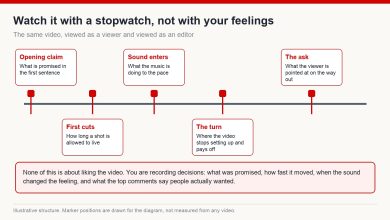
- Open the strongest competitor, sort by Popular, and confirm there is a repeating content line rather than one lucky video.
- Check the recent window, not the all-time window — what has climbed in the last thirty days.
- Establish where the visuals come from and whether you can use them legitimately.
- Write three full scripts before publishing anything. If the third one is agony, the production score was wrong.
- Name the specific policy risk in this niche and write down how you will avoid it.
That funnel turns a vague decision into a sequence of concrete steps, and it avoids the exact trap — choosing on instinct — that costs so many people their first months.
Where to start tomorrow
Circle three. Score them. Run the seven checks on the winner. Then make thirty videos in one narrow sub-niche and judge it on the evidence rather than on how you feel in week two.
Results depend on the niche, the execution and how consistently you show up, and platform policies change over time — treat this as a way to make a better decision, not as a guarantee about what follows it.
If you would rather do this as a guided programme with the work checked as you go, that is what I run at mmoyoutube.com.
Frequently asked questions
How narrow should a starting niche be?
Narrow enough to name the viewer and the recurring question in one sentence. “Cats” is not narrow. “Why cats do strange things, explained for new owners” is.
How many videos before I judge a niche?
At least thirty in a single sub-niche. Below that you are usually reading noise rather than a result.
What score means go ahead?
Eighteen or more out of twenty-five in my own framework, and I abandon anything under fifteen. Those thresholds are judgement calls from experience, not measured cut-offs.
Should I pick the niche with the strongest advertiser interest?
Only if you can genuinely produce it. Finance and medical topics attract the most advertiser money and are also the hardest to make credibly and the riskiest to get wrong.
What search volume is high enough?
I look for long-tail queries clearing roughly a thousand a month and drop anything under about seven hundred and fifty. Check it close to publication, because volume moves.
Can I run several niches on one channel?
Not at the start. Prove one sub-niche, then clone the model onto a second channel rather than diluting the first.
Which niches carry the most risk?
Anything where being wrong hurts the viewer — health and money above all — plus invented personal stories, deliberately sensational material, and any niche where you cannot establish clear rights to the footage.