The Tools Did Not Disappear. You Just Stopped Looking at Them.
Ten years ago, shipping one feature meant holding an entire ecosystem in your head at once: languages, cloud platforms, databases, deployment, version control, boards, monitoring. Thirty tabs open to change one thing.
Today a lot of that starts inside a single editor. One window, one conversation, and the feature appears.
So here is the question nobody enjoys answering: are people actually more productive, or has the work simply moved down a layer where you cannot see it? Because the old layer did not go anywhere. The databases still run. The servers still fall over. Somebody still gets woken up at three in the morning. We just stopped looking at them directly.
This is not only a developer story. It is precisely what has happened to making videos, and the consequences are the same.
What sits underneath each stage now
Every stage of making a video has acquired a tool that hides the work rather than removing it. The top row is what you touch. The bottom row is what is still there.
| Research | Script | Voice | Visuals | Publish |
|---|---|---|---|---|
| You see A tidy summary with citations |
You see A finished draft in seconds |
You see Clean narration, first take |
You see A thumbnail that looks professional |
You see A title and description, written for you |
| Still running underneath Whether the sources are real, current, and say what the summary claims. |
Still running underneath Whether the structure holds attention, and whether the promise is one you can keep. |
Still running underneath Pacing, emphasis, and whether a human would actually say it that way. |
Still running underneath Licensing, disclosure, and whether the image matches what the video delivers. |
Still running underneath Whether it targets a search anyone performs, and whether it oversells. |
Abstraction is a trade, not a gift
Every layer that hides complexity makes the common case faster and the rare case harder. That is the deal, and it is a good deal most of the time. The problem is that people accept the first half without noticing they signed up for the second.
| What the layer hides | What you gain | The day it bites you |
|---|---|---|
| Where a fact came from | Research in minutes instead of an afternoon | A confident claim in your video turns out to be from nowhere, and it is your name on it. |
| Why a structure works | A draft that reads fine on the first pass | Retention sags in the same place every video and you have no theory about why. |
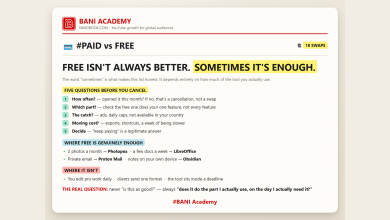
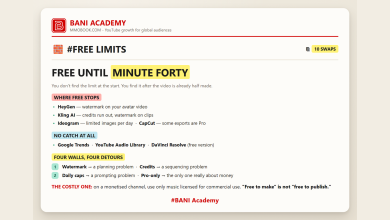
| What a free tier actually allows | No decisions to make at the start | A watermark or an export limit appears after the work is done. |
| Which asset is licensed for what | Assets that appear instantly | A claim or a strike on a monetised video, weeks later. |
| How your own process runs | Nothing to document | You cannot hand any of it to anyone, including future you. |
Two of those rows we have already mapped in detail, because they cost real money rather than time: the free-tier walls are listed tool by tool in free until minute forty, and the disclosure side is in disclosing generated visuals without losing trust.
Watch the reel
Then and now, side by side – and the question underneath it. Posted on the BANI Academy page.
Faster is not the same as more productive
Here is the honest answer to the question in the reel, as far as anyone can give one.
Production got faster. Verification did not. You can generate a draft in seconds, and checking whether it is true takes exactly as long as it always did – arguably longer, because a fluent wrong answer is harder to spot than an obviously incomplete one. The bottleneck moved; it did not vanish.
The easy part got automated, so the ratio changed. When typing was half the work, removing it felt enormous. Now that it is gone, what remains is deciding, judging, checking and taking responsibility – the parts that were always hard, now occupying the whole day instead of half of it. People describe this as feeling busier despite having better tools, and they are not imagining it.
And the hidden layer still pages you. A developer who never thinks about the database until it falls over is not free of the database. A creator whose thumbnails are generated and whose script is drafted still owns the video when it underperforms, and still has to explain why.
Which parts survive the abstraction
If the tools keep swallowing layers, the sensible question is what to get good at. The answer is the set of things that get more valuable as production gets cheaper, not less.
| Skill | Why it survives | How to practise it |
|---|---|---|
| Deciding what to make | No tool knows who your viewer is or what they already tried. Cheap production makes choosing matter more, not less. | Write one page about a single real viewer before you pick the next subject. |
| Verification | The faster claims arrive, the more the checking is the job. | For every factual line, open the source. If there is no source, cut the line. |
| Taste | Anyone can generate twelve titles. Rejecting the ten that oversell is the whole skill. | Keep a list of promises you refuse to make, and enforce it. |
| Reading your own numbers | The hidden layer announces itself through metrics before it announces itself any other way. | A monthly record you write yourself, not a dashboard you refresh. |
| Knowing one layer down | You do not need to build the tool. You need to know what it is doing on your behalf. | Once per tool, read the terms page and the limits. Once is enough. |
The fourth row is the one that catches people out. When production was slow, you noticed problems because you were elbow-deep in the material. When it is fast, the only early warning you get is the numbers – which is why we keep arguing for your own monthly record in a bad month is data, not a verdict rather than a dashboard you check when you feel anxious.
The fifth row is cheap and almost nobody does it. Reading a terms page once, per tool, is maybe twenty minutes across your whole stack, and it converts most of the surprises in the previous table into things you already knew.
The useful version of “one window”
None of this is an argument for thirty tabs. Consolidation is genuinely better – fewer contexts to hold, less switching, more of the day spent on the work itself. The time audit we ran in where do the hours actually go found that moving information between apps by hand was one of the largest invisible line items, and collapsing that is a real gain.
The difference between a useful abstraction and a dangerous one is whether you can still see through it when you need to. A good setup makes the common case one step and leaves the underlying thing reachable. A bad one makes the common case one step and makes the underlying thing invisible, so that the first time you meet it is during an emergency.
Practically, that means two habits: give the tools your real context so their output is yours rather than generic – the argument in stop re-explaining yourself – and keep access narrow and readable rather than broad and automatic, which we set out in stop pasting.
Frequently asked questions
So are the new tools worth using?
Yes. The argument here is not against them. It is against assuming that hidden work is finished work.
Do I need to understand what the tool does internally?
No. You need to know what it is doing on your behalf, which is a much smaller thing and usually written on one page.
Why does everything feel busier if the tools are better?
Because the easy half was removed and the hard half stayed. That is a real change in the mix, not a failure of discipline.
What is the single cheapest protection?
Read the limits and terms once per tool, and verify every factual claim before it reaches a published video.
Look underneath one thing this week
Pick the tool you rely on most and spend twenty minutes finding out what it actually does: where its information comes from, what its free tier permits, what happens to your files. Write down two sentences about what you learned.
Do that once per tool and the hidden layer stops being hidden. It is still there, still running, still capable of waking you at three in the morning – but you will know its name.
Learning a lot does not make anyone good. Doing a lot does.
If you want the structure that makes that stick, that is what our free challenge is built for: no barrier to entry, a genuine commitment to action, and a refundable commitment fee you get back when you finish. You are not paying for the knowledge. You are betting on yourself finishing, and we hold the stake.
What is your take? More productive, or a new layer of complexity with the old one hidden underneath? Tell us in the comments on the original reel – we read every one.
For more on building channels for English-speaking audiences, that is what we work on at mmoyoutube.com.

One Comment