Watch It Like an Editor: How to Take a Competitor Video Apart
Every guide to starting a channel tells you to study your competitors. Almost nobody says what studying means, so most people do the obvious thing: they watch a lot of videos in their niche, feel vaguely informed, and go on making exactly what they were going to make anyway.
Watching is not studying. Watching is what the video was built to make you do. It is designed to switch off the part of your brain that would notice how it is doing it. If you want to learn anything from a video that works, you have to fight that on purpose.
The difference between watching and taking apart
A viewer experiences a video. An editor sees a sequence of decisions – someone chose to open on that shot, chose to cut there, chose to let the music arrive at that moment, chose to hold the payoff back for four minutes. Every one of those choices is recoverable if you are looking for it, and none of them are visible if you are enjoying yourself.
The switch is mechanical: stop asking whether you like it, start asking what was decided and when.
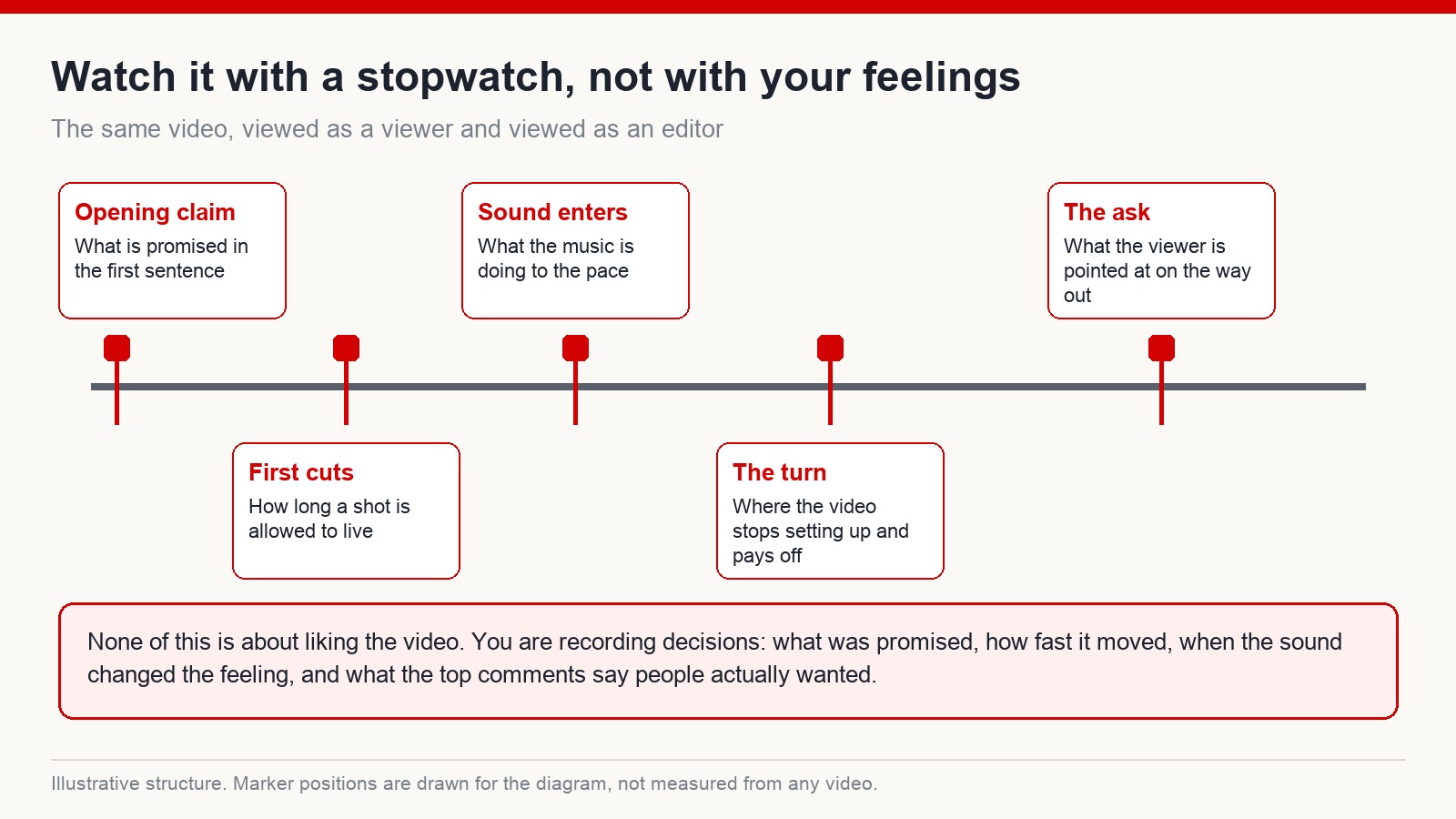
What to record, and in what order
The opening claim
Write out the first sentence word for word. Not a summary – the actual words. Then ask what has been promised, and how fast. Strong openings usually make a specific commitment in the first breath and spend nothing on introducing themselves. Weak ones warm up.
Compare that promise against the title and the thumbnail. Often the thumbnail is carrying a promise the title does not make, and the first sentence is quietly narrowing both. That three-way relationship is where most click behaviour actually lives.
The cut rhythm
Time how long the first shot lasts. Then notice roughly how often the picture changes through the first minute, and whether that rate stays constant or accelerates.
You are not looking for a magic number, and anyone who gives you one is selling something. You are calibrating: what does this audience, in this niche, currently tolerate? A pace that feels frantic in one subject reads as normal in another, and getting that wrong is one of the more common reasons a technically fine video underperforms.
The sound
Sound is the layer creators notice last and audiences respond to first. Note when music enters, whether it changes at the turn, whether it drops out entirely for the important line. Note whether there is anything underneath the voice at all – some formats deliberately run dry, and it reads as seriousness.
Watch a minute of the video with the sound off, then a minute with sound and your eyes closed. The difference between those two experiences tells you which layer is doing the work.
The turn
Every video that holds attention has a point where it stops setting up and starts paying off. Find it and note the timestamp as a fraction of the whole. Too early and there is nothing left; too late and people have gone.
This is the single most transferable thing you can take from a teardown, because the placement of the turn is a structural decision that has nothing to do with the subject matter.
What the comments wanted
Read the top comments, but read them for a specific thing: what did people ask for that they did not get? Requests, corrections, “but what about” – these are a free brief for your own video. The audience is telling you, in public, where the gap in the existing coverage is.
The sheet
Do this on paper, one page per video, filled in while the video runs. Doing it from memory afterwards produces a summary of your impressions, which is exactly the thing you were trying to escape.
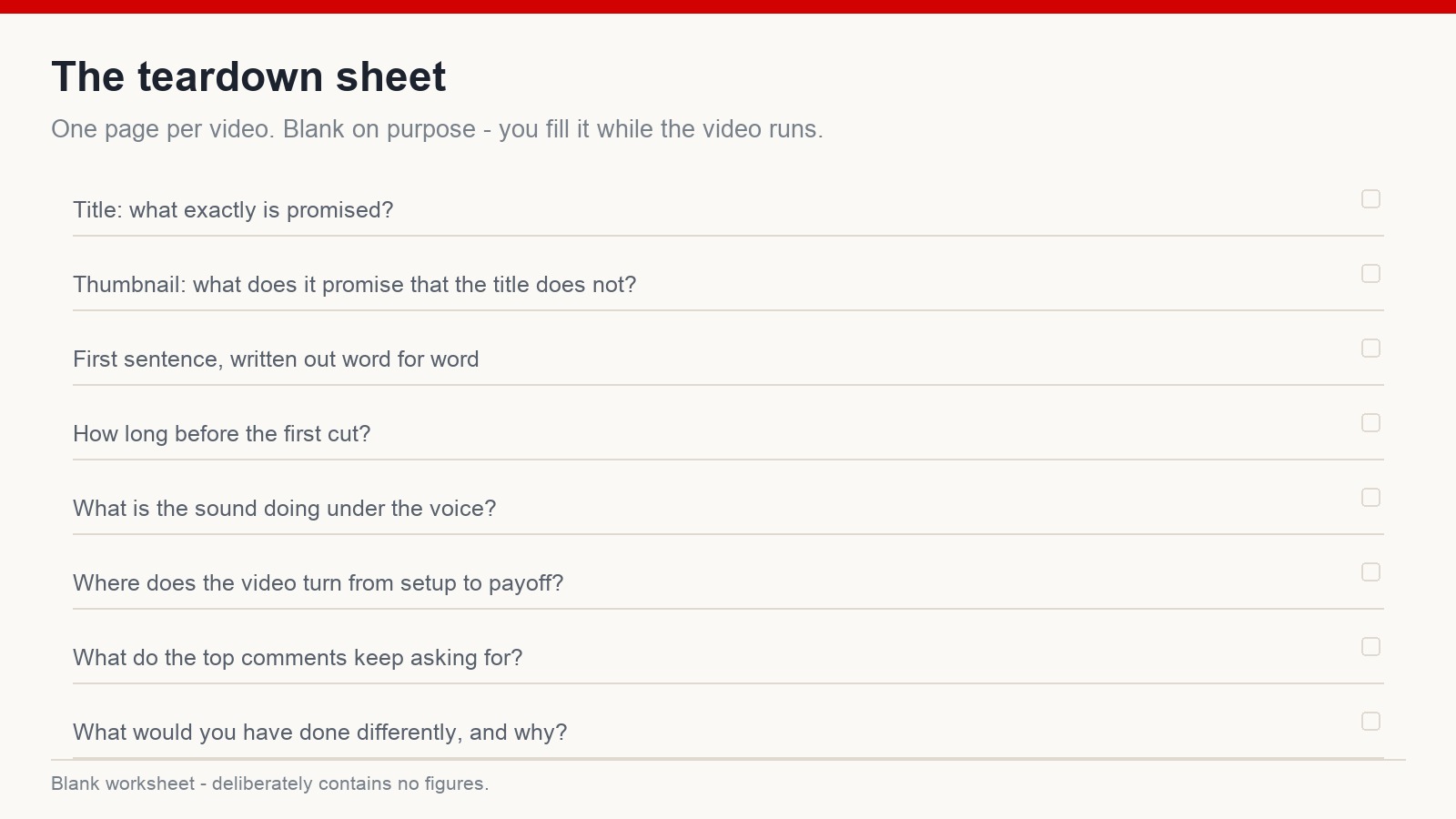
Two or three of these on the strongest videos in a niche will teach you more about that niche than fifty hours of casual viewing. It is slow, it is a bit joyless, and it works.
Borrowing the structure without taking the substance
This is where the practice gets misunderstood, so it is worth being precise about the line.
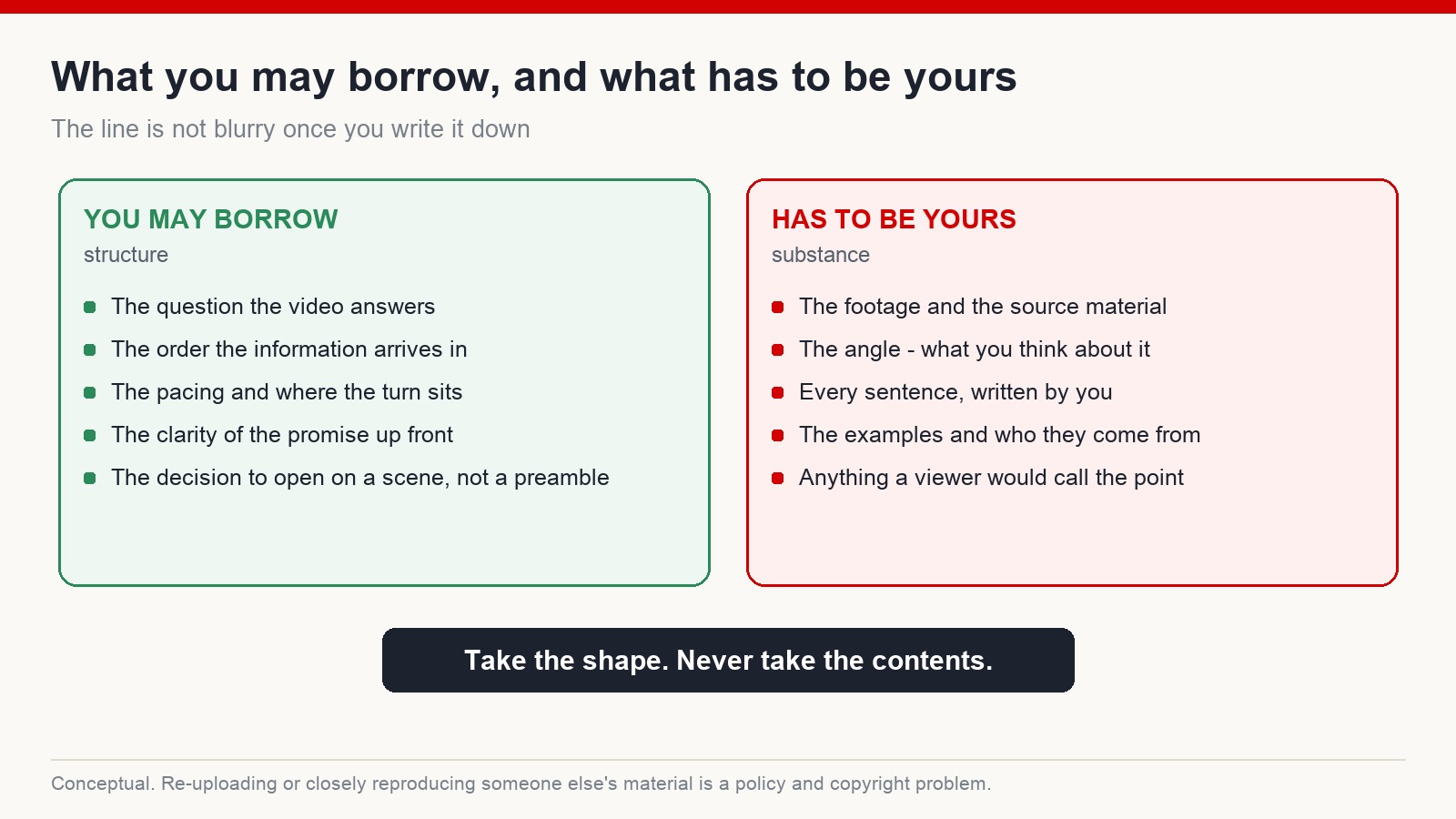
Structure is not owned by anyone. Opening on a scene rather than an introduction, putting the turn at a certain point, keeping the promise explicit – these are craft decisions, and learning them from people who do them well is how every trade has ever worked.
Substance is different. The footage, the script, the specific examples, the wording, the point of view – those have to be yours. Reproducing someone’s material closely is a copyright problem and a platform policy problem, and the fact that you re-recorded the narration does not change either.
The honest test: if the original creator watched your video, would they recognise a shared approach, or would they recognise their own work? The first is normal. The second is not.
A note on doing this with AI
Feeding a transcript to a language model and asking it to describe the structure is a reasonable use – it is fast, and it will often name a pattern you had half-noticed. Ask it what the video promises, where the argument turns, and what it leaves unanswered.
What it cannot do is watch. Pace, sound design, and the relationship between picture and voice are invisible in a transcript, and those are the layers that most often separate a video that holds people from one that does not. Use the model on the text; do the rest yourself.
How many, and how often
Three teardowns before you start a channel, and one every few weeks after that. Not more – this is calibration, not a full-time occupation, and there is a real failure mode where research becomes a way of not publishing.
Do it on the videos that are working now rather than the classics of the niche. Audience tolerance for pace, length and directness moves, and last year’s benchmark quietly stops being one.
Where this leaves you
The point of a teardown is not to find a formula. It is to stop guessing about the things that are knowable, so that the guessing you do is reserved for the part that is genuinely yours – what you have to say and how you say it.
If you want the wider process for building faceless channels aimed at English-speaking audiences, it is laid out at mmoyoutube.com.
Frequently asked questions
How is this different from just watching competitors?
Watching leaves you with impressions. A teardown leaves you with a record: the exact first sentence, where the turn sits, how fast the cuts run, what the comments asked for. Impressions cannot be applied; records can.
Which videos should I take apart?
The ones currently performing in your sub-niche, and ideally a mix – one from a large channel and one from a small channel doing unexpectedly well. The small one usually teaches you more, because whatever is working there is not being carried by an existing audience.
Is copying a competitor’s structure against the rules?
Structural conventions are not owned. Reproducing someone’s footage, script or edit is a different matter and can be both a copyright and a policy problem. Take the shape, never the contents.
Can I do the whole analysis with AI?
Only part of it. A model can analyse a transcript usefully and spot structural patterns in the text. It cannot assess pacing, sound or picture, which are frequently the difference between a video that holds attention and one that does not.