Five Shapes a YouTube Title Can Take, and Where the Keyword Goes
Most advice about titles hands you a formula and leaves you there. Keyword plus curiosity plus payoff. It is true, and it is almost useless at the moment you actually need it — sitting in front of an empty title field with a finished video and no idea how to start the line.
What helps at that moment is not a formula. It is a shape: a specific angle to draft against, so the first attempt exists and can be improved. I have been building YouTube channels since 2017, mostly faceless channels aimed at English-speaking audiences, and after enough of them you stop asking “what is the best title” and start asking “which five drafts am I choosing between.” This is how I get to those five.
The First Title You Write Is Rarely the One to Ship
There is a reason for that, and it is not laziness. The first title you write is a description of the video as you experienced making it. You know what is in it, so you summarise. Summaries do not create a reason to click, because they close the loop before the viewer has opened it.
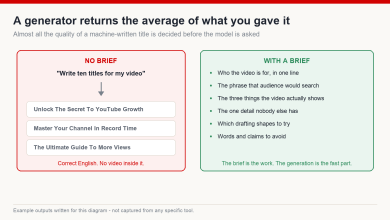
The fix is mechanical. Write more than one. Not twenty — you will just get twenty variations of the same instinct. Three to five, each built on a different shape, then read them cold an hour later. The one that survives that reading is almost never the first.
Five Shapes Worth Drafting Against
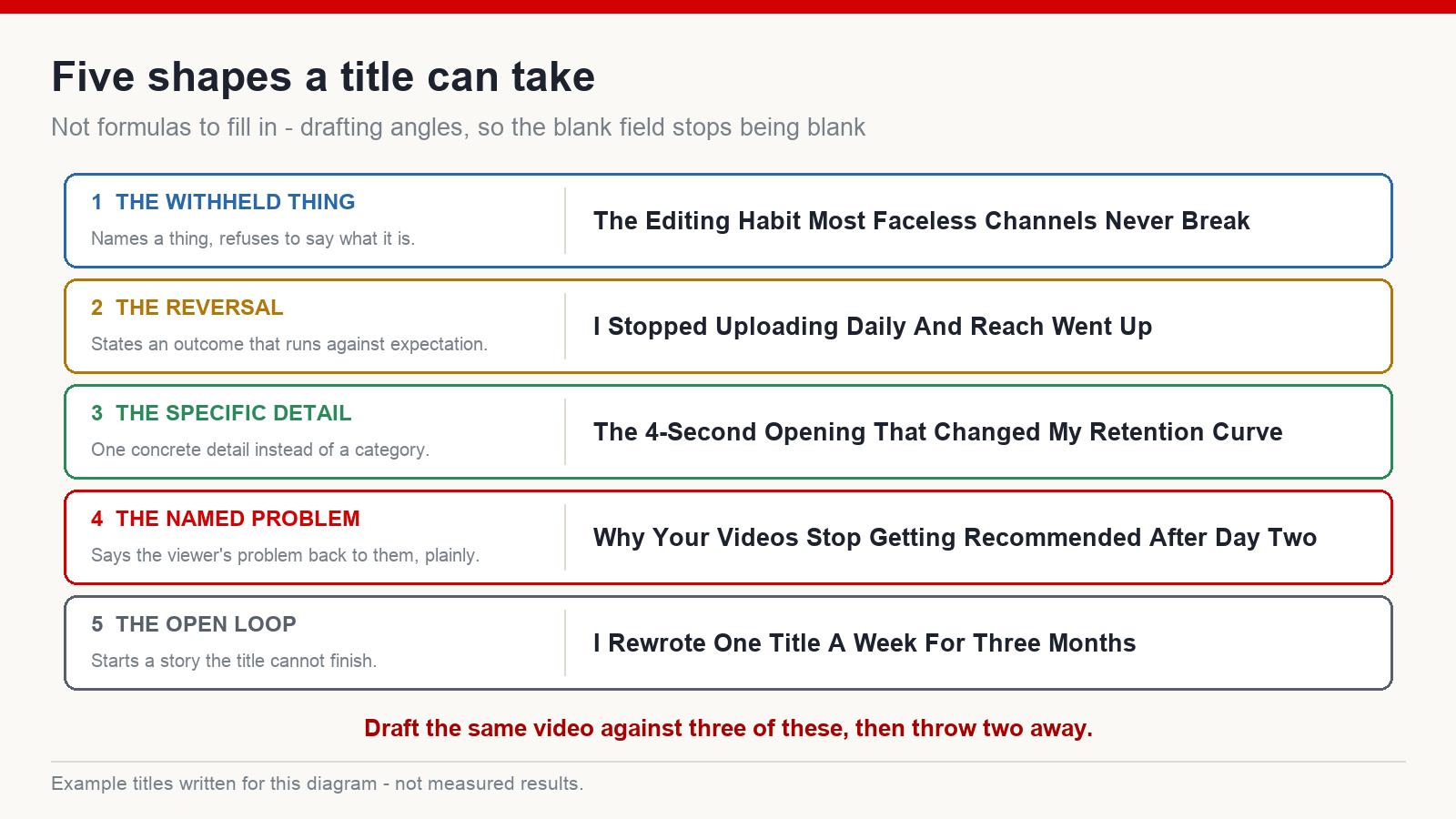
1. The withheld thing
Name that something exists without saying what it is. “The Editing Habit Most Faceless Channels Never Break.” The viewer knows the category of the answer but not the answer, which is a very different feeling from being told nothing at all. This shape fails when the withholding is total — “The Thing Nobody Tells You” gives the viewer nothing to be curious about.
2. The reversal
State an outcome that runs against what the viewer expects. “I Stopped Uploading Daily And Reach Went Up.” The tension does the work: the line contains a small contradiction that only the video can resolve. The obvious warning is that the reversal has to be true. If you did not stop uploading daily, do not write it.
3. The specific detail
Trade a category for a concrete detail. “How To Grow On YouTube” is a category. “The 4-Second Opening That Changed My Retention Curve” is a detail. Specificity signals that a real thing happened here rather than a general lecture, and it is the cheapest upgrade available to most titles — you usually already have the detail, you just left it out.
4. The named problem
Say the viewer’s problem back to them in their words. “Why Your Videos Stop Getting Recommended After Day Two.” This one performs unusually well in instructional niches for a simple reason: it is a title that only speaks to people who have that problem, and those are exactly the people who will watch to the end.
5. The open loop
Start a story the title cannot finish. “I Rewrote One Title A Week For Three Months.” The viewer wants the ending. The risk here is that an open loop with nothing behind it is the purest form of a broken promise, so this shape belongs on videos that genuinely have a result to report.
Draft one video against three of these. Not because all three will be good, but because writing the third one forces you past the instinct that produced the first.
Where the Phrase Sits in the Line
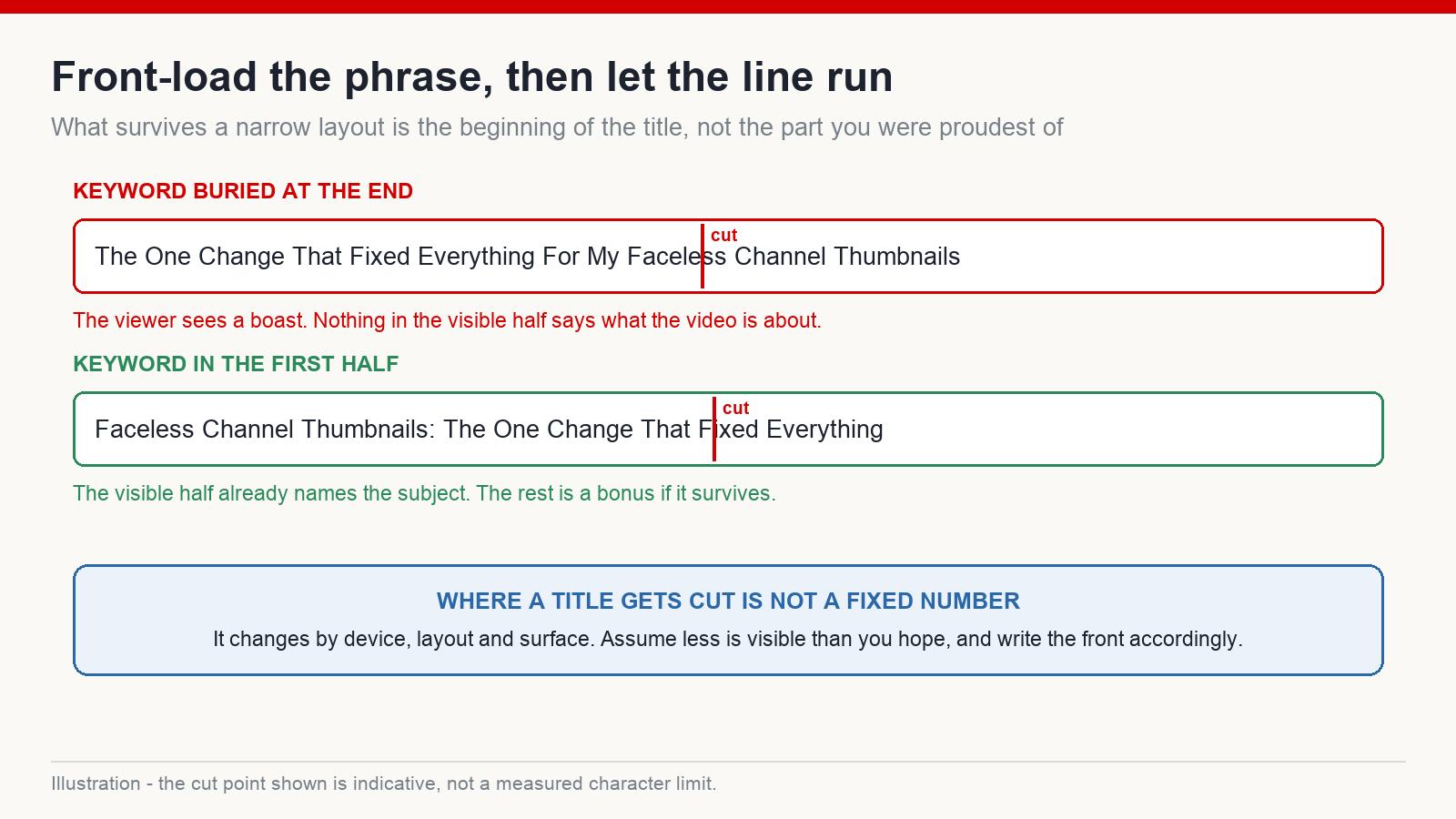
The shape decides the feeling. Placement decides whether anyone can tell what the video is about before the line runs out of room.
The phrase your audience would actually type — the demand keyword — belongs in the first half of the title, ideally in the first few words. Not because early words carry more weight in some ranking sense, but because titles get truncated in narrow layouts and the beginning is the part that always survives.
Compare these:
- The One Change That Fixed Everything For My Faceless Channel Thumbnails
- Faceless Channel Thumbnails: The One Change That Fixed Everything
Same words. In the first, everything visible in a cramped layout is a boast with no subject attached. In the second, the subject is stated before anything can be cut, and the hook rides along behind it.
One caution: this is placement, not repetition. Saying the phrase twice does not strengthen it. It reads as automated and it costs you the room you needed for the hook.
The Length Question
You will see a precise character count quoted as the correct title length. Treat that as a working habit rather than a rule, because where a title gets cut depends on the device, the surface and the layout, and those change without announcement.
The habit I use is simpler and does not expire: write the title, then look at it on a phone before publishing. If the front half alone does not tell someone what they are about to watch, rewrite the front half. That test survives every layout change.
Four Failures That Flatten a Title
- Generic. “New Video.” “How To Make Money Online.” Nothing in the line belongs to this video specifically, so nothing separates it from the four titles around it.
- Overlong and cluttered. Two ideas competing in one line means neither lands, and half of it disappears on a phone anyway.
- Phrase-stuffed. The same subject words repeated in different arrangements. It reads as machine-written to a human, which is the audience that decides.
- Promising past the content. This one is different from the others because it does not lower the click rate — it raises it, then collapses retention, and the second number is the one that decides whether the video keeps being shown.
The Check Before You Publish
- Does the front half name the subject?
- Is there one thing in the line the viewer cannot resolve without watching?
- Can the video actually deliver what the line implies — not approximately, but specifically?
- Does it read like a sentence a person would say, or like a field that was filled in?
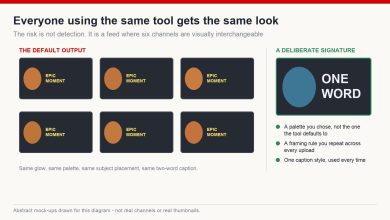
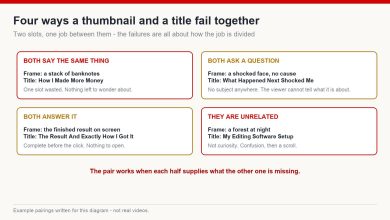
- Does it repeat the thumbnail word for word? If so, change one of them, because two copies of the same message leave nothing to be curious about.
Then publish, and read the outcome against the median of your own last ten videos rather than a benchmark from somewhere else. Compare how many clicked and how many were still there a minute in. Change one element at a time so you can tell what moved.
The Short Version
Titles are not written, they are drafted and discarded. Pick a shape so the first line exists, put the subject phrase where truncation cannot reach it, and make sure the video can keep whatever the line promised. Results vary, platforms change their layouts, and a title cannot rescue a video nobody wants — but a good title is the difference between a video that is available and a video that is chosen.
If you want the full workflow around packaging — research, thumbnails, titles and the production system behind them — that is what we work through at mmoyoutube.com.
FAQ
How many titles should I write per video?
Three to five, each from a different shape. More than that and you are usually rewriting the same instinct rather than producing genuine alternatives.
Where should the subject phrase go?
In the first half, and preferably in the first few words, so it stays visible when the line is truncated. Once is enough — repeating it does not help.
Should the title be written in capitals?
A capitalised word for emphasis is fine. A title entirely in capitals reads as shouting and, in most niches, as lower quality.
Is a curiosity title the same as clickbait?
No. The difference is whether the video pays off what the line implied. Curiosity opens a question you then answer. Clickbait opens one you do not.